

FSC chain of custody is a documented control system connecting eligible forest-based material with FSC-certified products through relevant sourcing, processing and sales activities.
For a carton buyer, the practical question is whether the supplied packaging follows that controlled route. A paper mill’s certificate is useful background, but the carton converter, legal seller, transaction claim and label permission still need to fit the order. Start with the finished carton and work back through those connections.
Verify the carton, not just the paper mill
A defensible FSC carton purchase connects the actual packaging to an eligible certified supply route and the right evidence for the buyer’s intended use. The certificate, the sales claim and the printed label perform different functions. Check them together, while distinguishing organizations that sell with FSC claims from service providers or businesses simply using finished labelled packaging.
- Risk: A valid upstream certificate does not identify every downstream carton as certified.
- Decision: Check the legal seller, covered product and site, transaction claim, and artwork permission.
- Common mistake: Treating physical handling as the only test of certification responsibility.
- Boundary: FSC sourcing claims do not replace carton strength or transport-protection requirements.
Follow the claim from paper mill to finished carton
FSC packaging chain of custody follows the controlled material and claim route through the organizations responsible for the finished carton. A simple purchase may involve a paper mill, a converter that cuts and forms board, a printer or finisher, and a seller supplying the cartons. The physical shipment can travel directly between factories while the relevant legal sales and certification responsibilities follow a different path.
Map each stage to its purchasing role: the mill supplies board, the converter turns it into cartons, and the seller supplies the finished packaging to the buyer. Keep processing stages separate from legal sales so a factory transfer is not automatically drawn as a change of owner. Use the role checks below to identify the certification and documentation needed for the intended claim.
Ask the supplier to identify who buys the board, who owns it during conversion, who applies the label, and which organization sells the finished cartons. A mill certificate and a converter certificate are not interchangeable. Nor does a certified converter’s involvement establish the status of an unrelated trading seller’s invoice.
For the purchase file, draw the actual sale route and place any transport or outsourced service alongside it. Attach the finished-carton specification and intended FSC claim to that route. This reveals whether the buyer is receiving a certified packaging transaction, using finished labelled packaging, or asking an intermediary to pass a claim it has not demonstrated authority to make.
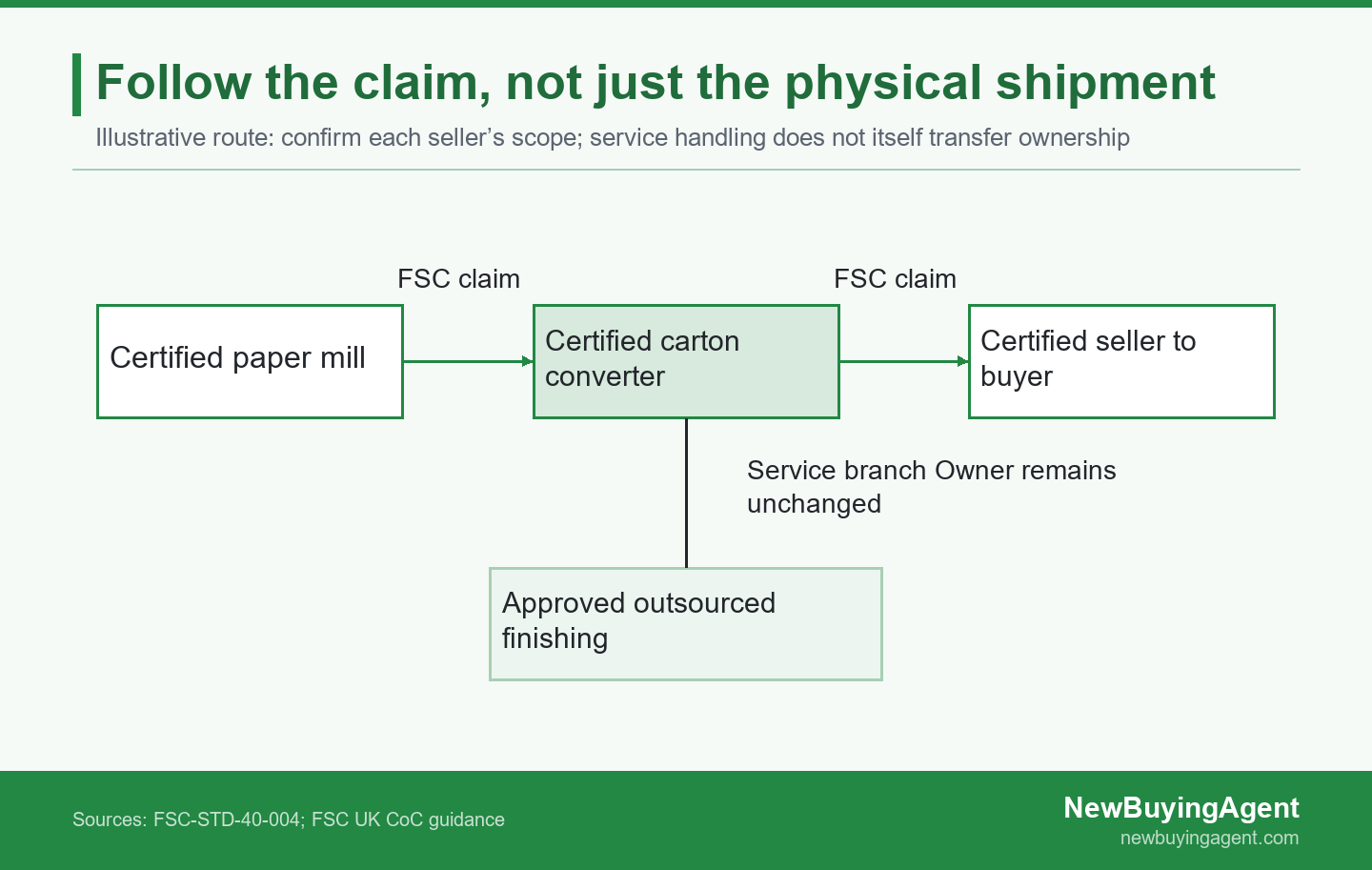
FSC claims follow the documented sales route; outsourced finishing keeps the certified owner responsible.
Identify who owns, processes and labels the packaging
Certification responsibility depends on ownership, the activity performed, and the claim being made, rather than the factory’s position on a shipment itinerary. Identify those facts before rejecting an uncertified service provider or accepting an intermediary’s assurance. The distinctions below apply to different roles; they are not alternative names that a supplier can choose simply to avoid a certification requirement.
Separate a trading seller from a transport provider
FSC UK’s packaging guidance distinguishes organizations taking legal ownership from transport providers or sales agents that normally do not take title. A trading company that buys the cartons and wants to pass an FSC claim is therefore a different case from a carrier moving the same cartons. The guide also distinguishes packers using finished labelled packaging without transforming or labelling it or adding forest-based materials: they normally do not need their own certification for that use. An onward sales claim is a separate question.
Review the proposed contract and invoice issuer, not just the contact person or delivery address. If a supplier calls itself an agent, ask whether it actually purchases and resells the packaging. An unchanged physical carton does not resolve a missing certified sales link when the customer needs an onward FSC claim.
Check outsourced finishing under the responsible certificate
A non-certified print finisher can operate within a certified organization’s outsourcing scope when that organization retains ownership throughout, as explained in FSC UK’s chain of custody FAQs. The responsible certificate holder needs the arrangement included appropriately through its certification body; the goods do not necessarily have to return to its premises.
Ask which certificate holder controls the work, what finishing activity is covered, and whether ownership stays with that organization. Keep confirmation of the arrangement with the carton reference. A supplier’s purchase of board followed by an independent resale is not converted into outsourcing merely by calling the second factory a contractor. Where the arrangement is unclear, obtain the responsible certification body’s clarification before accepting the route.
Distinguish using a finished carton from making an FSC claim
Write the buyer’s actual purpose into the order: using a finished labelled carton unchanged, promoting that use, or requiring an FSC sales claim for further manufacturing or resale. In the packaging specification, identify any additional cutting, relabelling or added paper components, rather than describing every activity simply as packing. Those inputs help the responsible reviewer distinguish ordinary finished-pack use from a changed product or an onward-claim requirement.
Avoid requiring every finished-pack user to become certified, while also avoiding an unsupported promise that buying a labelled carton authorizes every later claim.
Verify the actual seller, product and production site
Verify the organization supplying the claimed carton against a current public record and the scope relevant to that packaging. A certificate screenshot establishes little if its name, status, products or participating sites do not match the proposed route. Compare the record with the actual seller and manufacturing arrangements, then resolve mismatches before treating the FSC purchase requirement as satisfied.
Check validity and scope in the public database
FSC’s certificate-search guidance directs users to check validity and scope, including the types of certified products an organization can supply. Search using the organization’s name or code, and compare the result with the entity identified in the purchasing documents.
Retain the record checked, date, certificate code and relevant product scope. A seller of certified timber is not automatically demonstrated to cover printed cartons. Ask the certificate holder or certification body to clarify product or activity descriptions that do not clearly fit. Recheck relevant status changes before a later order instead of relying indefinitely on an old PDF.
Do not extend a group certificate to every factory
The FSC standard for multiple sites permits certification covering fewer than all associated sites. Only participating sites within the relevant certificate scope can claim their products as FSC certified, so a group name does not resolve the status of a newly proposed production location.
For a home-and-kitchen brand developing a product and its carton together, NewBuyingAgent’s local China factory resources and product development and quality-control capability help align the product brief with factory execution. Identify the carton production site in that brief and request the relevant certification evidence for the intended supply route, keeping a factory substitution visible before the packaging specification is carried into production.
Match the sales claim to the carton line item
A certificate describes an organization’s scope, while transaction evidence connects the claimed packaging to the purchase being made. Request a sample of the proposed sales documentation early enough to resolve missing fields before release. For a purchase requiring a certified FSC transaction, match the carton description, quantity, seller code and claim instead of accepting a generic statement elsewhere in the supplier’s paperwork.
Section 5 of FSC-STD-40-004 specifies sales-document information for products sold with FSC claims: seller and customer identification where applicable, issue date, product description, quantity, the relevant certificate code, and a clear product claim. Its provisions also address linked delivery documents and authorized supplementary documentation.
| Record | What it establishes | Buyer comparison |
|---|---|---|
| Certificate/database record | Organization, status and certified scope | Actual legal seller, product and relevant site |
| Sales and linked delivery records | Transaction-specific product and FSC claim | Carton reference, quantity, code and delivered goods |
| Approved artwork reference | The intended label use for the packaging | Printed file, label object and responsible approval route |
A logo printed in a document header does not identify which line items carry the claim. If certified and non-certified cartons appear together, ask the issuer to make their status unambiguous. Where the normal invoicing system cannot carry the required information, request confirmation of an authorized supplementary-document route rather than assuming any supplier letter will suffice.
Before closing the purchase file, connect the sales and delivery references to the cartons received. A generic certificate attachment cannot repair a transaction mismatch by itself. Record the unanswered item and seek the appropriate correction or clarification from the responsible certificate holder.
Keep label meaning and permission separate
The FSC claim category, the object carrying the label, and permission to use the artwork are separate approval questions. A correct label category does not authorize an unrelated organization to print it, and an approved carton label does not automatically describe the product inside. Match the artwork to the certified packaging and the responsible approval route before releasing the print file.
Match the label to the declared product
FSC’s explanation of its labels distinguishes FSC 100%, FSC Recycled and FSC Mix. FSC Mix can include material from FSC-certified forests, recycled material and/or controlled wood; it does not mean every fiber comes from an FSC-certified forest.
Keep the supplier’s supported claim category intact rather than upgrading it for marketing effect. Identify whether the label refers to the carton, another forest-based component, or the product itself. A plastic kitchen tool inside a labelled paperboard box should not acquire an apparent product certification merely because the artwork fails to identify the packaging clearly.
Confirm the applicable trademark version and approval route
FSC-STD-50-001 V3-0 became effective on July 1, 2026, with a transition end date of January 1, 2029. It provides for an approved trademark use management system or certification-body approval of intended uses; the transition also means an older artwork reference should not be rejected solely because a newer standard exists.
Ask the responsible certificate holder which applicable version and approval route cover the proposed carton file. Retain the approved artwork reference and compare the production file against it. Do not recreate a label from an image search or reuse another organization’s licence code. Any question about the certified component, permitted label elements or a changed print file should be resolved through the applicable approval route.
Keep promotional licensing distinct from product labelling
An FSC promotional licence permits eligible promotional use of the trademarks, rather than authorizing its holder to apply FSC trademarks to products or make FSC claims on sales documents. Buying finished labelled packaging and describing its use is therefore different from controlling product labelling or passing a certified transaction claim.
When marketing wants to feature the packaging online, identify the intended use and the organization making it. Confirm the relevant licence and approval requirements instead of treating an approved supplier print file as unrestricted permission for every website, brochure or sales document.
Turn the checks into an order handoff
A useful carton handoff connects the specification, legal sales route, current certification evidence, transaction claim and approved artwork in one purchase record. Mark missing information against the particular decision it prevents, rather than recording a general certificate pass. The following order example and fields are recommended purchasing controls that help the buyer state what is accepted and what still needs confirmation.
For a beauty brand buying a recurring product line with printed retail cartons, NewBuyingAgent’s China product supply service brings local factory access and product/QC capability to the combined product and packaging brief. Include the intended FSC packaging use and documentary route with the product requirements, so carton construction, production location and purchasing arrangements can be considered together. Identify the organization responsible for any FSC sales claim and label approval in the agreed route.
Consider an illustrative China order for 8,000 printed cartons. The buyer requires an onward FSC transaction claim, but the trading seller supplies only the paper mill’s certificate and a photograph of labelled cartons. This is a hypothetical procurement example, not a customer case. The received evidence leaves the trading seller’s claim authority and the transaction-specific carton claim unresolved.
Enter the actual seller in the handoff, compare its current certificate and product scope, and request a sample transaction document. If that seller cannot demonstrate an eligible claim route, hold acceptance of the FSC transaction requirement and resolve the commercial route with the responsible certified supplier and reviewer. The result is a targeted evidence request or an agreed eligible route, not permission to copy the mill’s code onto the trader’s invoice. If the buyer instead needs only to use finished labelled packaging, reassess the finished-user and promotional requirements explicitly; do not silently treat that different purpose as meeting the original onward-claim request.
- Packaging: Carton reference, revision, construction and production location.
- Route: Legal seller, ownership changes and any controlled outsourced work.
- Certification: Current record, product/site scope and date checked.
- Transaction: Required claim, document issuer, carton line item and linked delivery reference.
- Artwork: Labelled object, approved file and responsible approval route.
- Decision: Accepted requirement, missing evidence, request owner and follow-up action.
For a repeat product purchase with carton requirements, prepare the product specifications, quantity, destination, timing, current sourcing situation and replenishment plan, then send the purchasing brief to NewBuyingAgent. Include the intended FSC packaging use and required documents so the product-supply discussion starts with a clear physical specification and a defined claim route.
Frequently asked questions
What if a supplier certificate is suspended after the order?
A suspended certificate requires prompt review of the affected transaction and timing with the certificate holder and its certification body, rather than an assumed approval or automatic retrospective conclusion. Retain the status information and relevant order, production and sales-document dates when requesting clarification. Record the resulting instruction against the affected packaging requirement, and do not extend it to unrelated orders or invent a universal grace period.
Are the certificate code and trademark licence code interchangeable?
The certificate code and trademark licence code serve different purposes, so buyers should identify both in the relevant records rather than substitute the label’s code for transaction evidence. Compare the organization’s public record with the sales documentation and approved artwork to understand where each identifier belongs. A licence code on a carton can help locate its responsible organization, but it does not by itself identify the required claim for a particular purchase.
Must buyers obtain every upstream paper mill invoice themselves?
Buyers do not automatically need every upstream mill invoice to purchase finished certified cartons; the necessary evidence depends on their role and the certified seller’s documented claim route. Start with the immediate seller, relevant certification scope and transaction evidence, then escalate specific inconsistencies through the responsible certificate holder or certification body. Avoid replacing a focused verification request with a demand for unrelated upstream commercial records.
Does FSC certification establish carton strength or shipping protection?
FSC certification does not replace a carton’s protection specification or transport-performance assessment, so buyers should keep material-sourcing claims separate from product protection and delivery requirements. Define the relevant construction, dimensions, packing configuration and performance checks for the product being shipped. A supported sourcing claim and a satisfactory packaging-performance decision can coexist, but neither should be used as evidence that the other has automatically been fulfilled.
NewBuyingAgent
Related Resources

Get Started Today
Let's Turn Your Sourcing Goals into RealityWeChat:+86 15157124615
WhatsApp:+86 15157124615
Address:Building 10 #39 Xiangyuan Road, Hangzhou, China
