Introduction
The container is at the terminal in Ningbo and the vessel sails on Thursday. On Tuesday the terminal reports water damage to eight cartons. Your supplier says the goods left its factory in perfect condition, which is true. Your forwarder says the cargo was not yet on board, which is also true. Somebody owns that loss and the purchase order does not say who.
FOB is the most used trade term in China sourcing and one of the most loosely understood. Buyers treat it as a general arrangement where the supplier handles things until the goods are shipped. It is considerably more precise than that, and the precision is exactly what decides who pays when something happens in the last two hundred metres.
Key Takeaways
• Under FOB the seller's responsibility ends when the goods are on board the vessel at the named port.
• Cost, risk and obligation are three separate allocations, and FOB does not place them all identically.
• The seller clears the goods for export, which is the practical advantage FOB has over EXW.
• FOB says nothing about quality, acceptance, payment or insurance, which are separate agreements.
• American domestic FOB usage means something different from the Incoterms rule of the same name.
What FOB Actually Says
FOB is one of the Incoterms, the standardised trade terms published by the International Chamber of Commerce and referenced in most international sales contracts.
The rule in one sentence
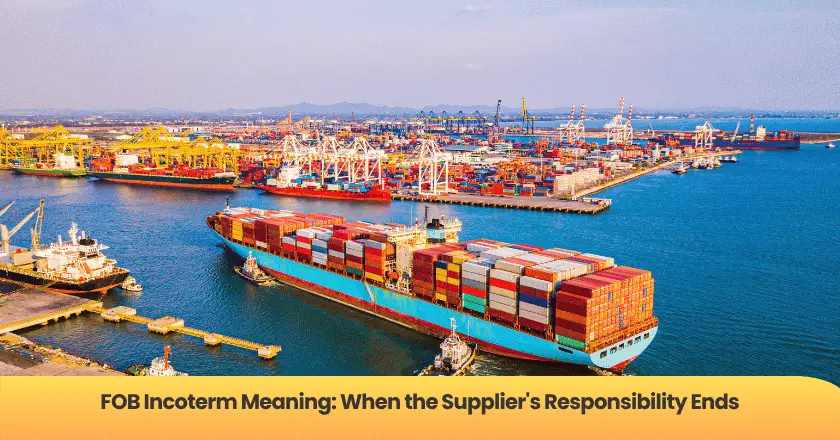
The seller delivers the goods on board a vessel nominated by the buyer at a named port of shipment, having cleared them for export. Everything in that sentence carries weight: on board rather than at the port, a vessel the buyer nominated rather than one the seller chose, and a named port rather than a country.
Sea freight only
FOB applies to sea and inland waterway transport, because it is defined around goods crossing onto a ship. Suppliers quote FOB on air shipments out of habit, and accepting it leaves the handover point genuinely undefined, since there is no vessel for goods to be placed on board.
FCA is the equivalent for air, road and multimodal shipments, and it works the same way conceptually. Accepting FOB on a non-sea shipment is rarely disastrous in practice, since both parties usually behave as though FCA applied, but it removes the certainty the term exists to provide.
Expert Tip: Write the term as three elements every time: FOB, the named port, and the Incoterms edition. FOB Ningbo, Incoterms 2020 is complete. FOB China is not a trade term at all, because it names no port, and the difference between two Chinese ports can be several days of inland transport and a meaningful sum in handling charges that somebody has to absorb.
Three Lines, Not One
Buyers picture a single point where the goods stop being the supplier's problem. There are actually three allocations running in parallel, and conflating them causes most FOB disputes.
Cost, risk and obligation
Cost decides who pays for each activity. Risk decides who bears a loss if goods are damaged or destroyed. Obligation decides who must perform a task, such as filing an export declaration. Under FOB all three sit with the seller up to the vessel, which is convenient, but they are still separate ideas that can be varied by agreement.
What none of them cover
Ownership is a fourth question entirely and is not addressed by Incoterms at all. When title passes is governed by your sales contract or by the applicable law. Buyers routinely assume that taking risk means taking ownership, and the two frequently transfer at different moments.
The practical consequence appears in insurance claims and in insolvency. If a supplier fails while goods are in transit, whether those goods are yours depends on the sales contract rather than on the trade term printed beside the price. State the ownership transfer point explicitly where the order value justifies the attention.
Common Mistake to Avoid: Treating the trade term as a complete agreement. Incoterms allocate cost, risk and certain obligations between seller and buyer. They do not cover price, payment timing, quality standards, inspection rights, remedies, ownership or dispute resolution. A purchase order carrying a term and a price has settled perhaps a third of what matters, and the unsettled portion is where arguments actually occur.
What the Supplier Covers Under FOB
The list is longer than most buyers realise, which is why an FOB price is meaningfully higher than a factory-gate price and usually better value.
Everything up to the ship's rail
Five things sit on the seller's side and are priced into the unit you agreed.
• Packing the goods appropriately for the transport it knows is intended.
• Inland transport from the factory to the named port of shipment.
• Export customs clearance, including the declaration and any licences required in China.
• Terminal handling at origin and delivery of the goods into the terminal.
• Loading on board the vessel and providing proof that this happened.
The documents that come with it
The seller must provide the usual proof of delivery, which in practice means an on-board transport document. It must also give you whatever assistance you need to obtain documents for import at your end, though the cost of obtaining those sits with you. Ask for that assistance clause to be explicit if your market requires unusual paperwork.
Note the difference between providing a document and paying for it. The seller assists, and the cost of certificates your market demands generally falls to you. Establish which certificates apply and who pays for each before the first shipment rather than discovering the split on an invoice.
Expert Tip: Ask what packing standard the supplier is working to, since the obligation is to pack appropriately for the transport it was told about. A factory that believes the goods are moving by air may pack lighter than a container journey requires. Stating sea freight, transhipment and the destination climate in the purchase order turns a vague obligation into a specific one.
What the Supplier Does Not Cover
This is where expectation and rule separate most sharply, usually at an inconvenient moment.
Everything after loading
The main voyage, its cost and its delays are yours. Insurance is yours and is not required of either party. Destination terminal charges, import clearance, duties and delivery are yours. If the vessel is delayed, transhipped or the container rolls to a later sailing, the supplier has performed its obligation and the consequences sit with you.
The quieter one: nomination
Under FOB you are responsible for nominating the vessel and giving the supplier adequate notice. Where a buyer nominates late and the cargo misses a cut-off, that is the buyer's failure rather than the factory's, however it feels at the time. Agree the notice period you will give and put it in writing.
In practice most China buyers let the supplier or a forwarder handle booking even under FOB, which is workable and slightly blurs the rule. Keep the nomination right explicit in the purchase order so that the arrangement remains a convenience you granted rather than a habit that became the default.
Common Mistake to Avoid: Assuming FOB includes any form of insurance. Neither FOB nor EXW obliges anybody to insure cargo, and carrier liability is capped by weight rather than by value, which bears no relation to what a container of finished goods is worth. Arrange your own marine cargo cover from the moment risk passes to you, and check that the policy names your company.
The Container Gap
FOB was written for an era of goods lifted individually onto ships. Containerised cargo creates a window the rule does not describe well, and it is where the opening example lives.
Between the gate and the crane
A container is delivered into a terminal days before it is loaded. During that period the supplier has physically parted with the goods while risk has not yet transferred, because the cargo is not on board. Neither party is controlling anything, and damage or loss in that window is genuinely awkward to place.
Why FCA exists
FCA moves the handover to the point where the goods are handed to the carrier, which matches how container shipping actually works. Through 2026 the International Chamber of Commerce has continued to recommend it for containerised cargo, and market habit has continued to prefer FOB anyway. Ask your forwarder whether FCA suits your lane.
Expert Tip: If you stay on FOB for containers, extend your cargo insurance to begin when the container leaves the factory rather than when it is loaded. The premium difference is minor and it closes the gap described above entirely, regardless of who would have been responsible in principle. Most disputes about that window end with an insurer rather than with a supplier.
American FOB Is a Different Animal
The same three letters carry a second meaning in domestic United States trade, and the confusion appears regularly in international purchase orders.
Domestic usage
In American commercial usage FOB is commonly followed by a place that indicates where title and risk pass, as in FOB origin or FOB destination, and it is applied to road and rail as well as sea. FOB destination means the seller carries risk all the way to the buyer, which is close to the opposite of what Incoterms FOB provides.
Avoiding the collision
Naming the Incoterms edition removes the ambiguity, since it states which rulebook applies. Where a counterparty uses the domestic convention, the mismatch is worth raising explicitly rather than assuming shared understanding. Here's the thing: both parties can read the same three letters and describe opposite arrangements in complete good faith.
Expert Tip: When a quotation says FOB with no port and no edition, ask one clarifying question rather than guessing: does that mean loaded on board at a Chinese port under Incoterms, or delivered to my address. The answer takes a sentence, and the two readings differ by the entire cost of international freight and every risk attached to it.
What FOB Never Settles
A trade term is a delivery rule. Several things buyers expect it to govern are governed elsewhere, or nowhere at all if nobody wrote them down.
Quality, acceptance and payment
FOB does not mean you have accepted the goods when they are loaded. Your inspection rights, your remedies when a batch fails and your payment milestones are contract terms sitting alongside the trade term. A supplier arguing that risk transfer equals acceptance is conflating two different things, and the purchase order should make that impossible.
Keeping the two separate
State the trade term for delivery and, separately, that payment of the balance depends on a passed pre-shipment inspection and on documents being released. Those conditions are entirely compatible with FOB. Buyers who fold everything into the trade term end up with a delivery rule doing work it was never designed to do.
Expert Tip: Write the delivery term and the payment trigger as two separate lines on the purchase order, and make one reference the other only where you intend it to. Something like FOB Ningbo, Incoterms 2020, with sixty percent of the balance due on a passed inspection and the remainder against document release. Two lines, no ambiguity, and nothing in either contradicts the other.
Settling Terms From Inside the Market: NewBuyingAgent
Trade terms are agreed alongside price and lead time, so getting the three aligned with the factory is an important part of the sourcing process.
NewBuyingAgent has built a network of 50,000 well-cooperating factories across China, giving buyers a broader range of suppliers to consider when discussing product requirements, pricing and commercial terms. Its China-based sourcing team also helps communicate requirements with factories and coordinate the details behind the order.
Under FOB, what happens before the goods are loaded matters. Product specifications, quantities, packaging and other agreed requirements need to be checked before the shipment leaves the factory, when there is still an opportunity to address discrepancies.
NewBuyingAgent's 20,000+ product development & QC experts provide product and quality support throughout the sourcing process, helping connect the buyer's approved requirements with what is produced and prepared for shipment.
For buyers using FOB, the practical value is having commercial terms, factory coordination and pre-shipment product requirements connected before the goods leave the supplier.
Frequently Asked Questions
What does the fob incoterm meaning cover exactly?
The seller packs the goods, moves them to the named port, clears them for export, pays origin terminal handling and loads them on board, then provides proof of loading. Risk passes to you at that point. Everything afterwards, including the voyage, insurance, destination charges and import clearance, is yours.
Who pays if goods are damaged at the Chinese port before loading?
Strictly the seller still carries risk until the goods are on board, though in container shipping the practical position is murkier because the supplier has already parted with the cargo. This is the gap FCA was designed to close. Cargo insurance starting from the factory removes the argument regardless of where responsibility formally sits.
Is an FOB price always better than an EXW price?
For a buyer without a presence in China, usually yes, because FOB puts export clearance with the party able to perform it and folds origin charges into a price you negotiated. EXW can work well where you have an agent consolidating locally. Compare landed totals rather than the two headline numbers.
How does NewBuyingAgent affect the terms I can obtain?
Terms follow the commercial position rather than the request, and that position depends on the field you select from. Its wide factory network lets it pick low-cost, high-cooperation suppliers. Coverage across product types matters where several suppliers are involved, since it can supply products from China across all categories to you at better price, quality and service.
Conclusion
Write FOB with a named port and an edition, understand that the supplier's obligation ends at loading and not before, insure from the factory rather than from the vessel, and keep quality, acceptance and payment as separate terms alongside the delivery rule. Ask one clarifying question whenever FOB appears without a port. If negotiating those terms from a stronger position is the missing piece, NewBuyingAgent is worth a conversation.
Partial Sources
1. Incoterms 2020 – International Chamber of Commerce — https://iccwbo.org/business-solutions/incoterms-rules/incoterms-2020/
2. Nomenclature and Classification of Goods – World Customs Organization — https://www.wcoomd.org/en/topics/nomenclature/overview.aspx
NewBuyingAgent
Related Resources
Get Started Today
Let's Turn Your Sourcing Goals into RealityWeChat:+86 15157124615
WhatsApp:+86 15157124615
Address:Building 10 #39 Xiangyuan Road, Hangzhou, China