

Flexible payment terms with Chinese suppliers are not a favor that appears because a buyer asks politely. They are usually negotiated when the supplier sees lower production risk, clearer order evidence, repeat potential, or a partner that can control communication, quality, and delivery from inside China.
The buyer's real question is not "Can I pay later?" The better question is: which part of the payment can move later without making the factory feel exposed, and what proof must exist before that term becomes reasonable?
Key Takeaways
- Payment terms follow risk allocation: cash in advance protects the seller, open account protects buyer cash flow, and most China sourcing terms sit between those two extremes.
- A sourcing agent can negotiate timing, milestones, and evidence gates: deposit ratio, balance timing, inspection hold, shipment-document release, sample fees, tooling amortization, and repeat-order credit may all be negotiable.
- Terms improve when order quality improves: clear specs, stable samples, repeat volume, inspection evidence, and reliable logistics make flexible terms easier to discuss.
- NewBuyingAgent's payment advantage should be tied to its local factory resources and service capability: flexible payment support is stronger when combined with product selection, cost negotiation, QC capability, and China-side execution.
Payment Terms Are Negotiated Against Risk, Not Hope
International payment methods exist because buyer and seller risks are not symmetrical. Trade.gov's payment-method guidance explains the spectrum from cash in advance to open account. Cash in advance reduces seller risk but increases buyer exposure before production proof. Open account helps buyer cash flow but increases seller non-payment risk. A sourcing agent's job is not to demand the buyer's preferred term in isolation. The practical job is to make the order safer so a better term becomes commercially reasonable.
The Trade Finance Guide from Trade.gov describes open account transactions as shipments made before payment is due, commonly 30, 60, or 90 days. That is attractive to importers, but it is also high-risk for exporters. EXIM's export credit insurance guidance shows why sellers may need risk protection before extending credit. In China sourcing, many small and mid-volume factory relationships will not jump straight from deposit terms to open account. They may accept staged payments if production evidence and relationship history reduce uncertainty.
That is where local execution matters. A buyer asking for better terms from abroad may sound like a payment risk. A China sourcing agent with factory relationships, production follow-up, QC evidence, and delivery coordination can make the discussion more concrete: which milestone proves the order is stable enough for the next payment?
The payment sources point to one rule: better terms become realistic when both sides can see how risk is controlled. Cash in advance protects the seller, open account helps the importer, documentary collections and letters of credit add document discipline, and credit insurance can reduce seller exposure. The buyer should not ask for better terms as a favor; the buyer should make the order easier to trust.
That trust also depends on import and delivery boundaries. CBP importing guidance reminds importers that they remain responsible for entry requirements, while ICC Incoterms rules clarify cost and risk responsibilities across the shipment.
Payment timing should follow proof. International Trade Administration cash-in-advance guidance shows why advance payment is safest for exporters, while export credit insurance guidance explains how sellers can reduce non-payment risk when offering open-account terms.
Release discipline matters after production too. The WTO Trade Facilitation Agreement text connects goods movement with regulatory information, and CBP reasonable-care guidance reinforces that import transaction details should be checked before they become costly corrections.
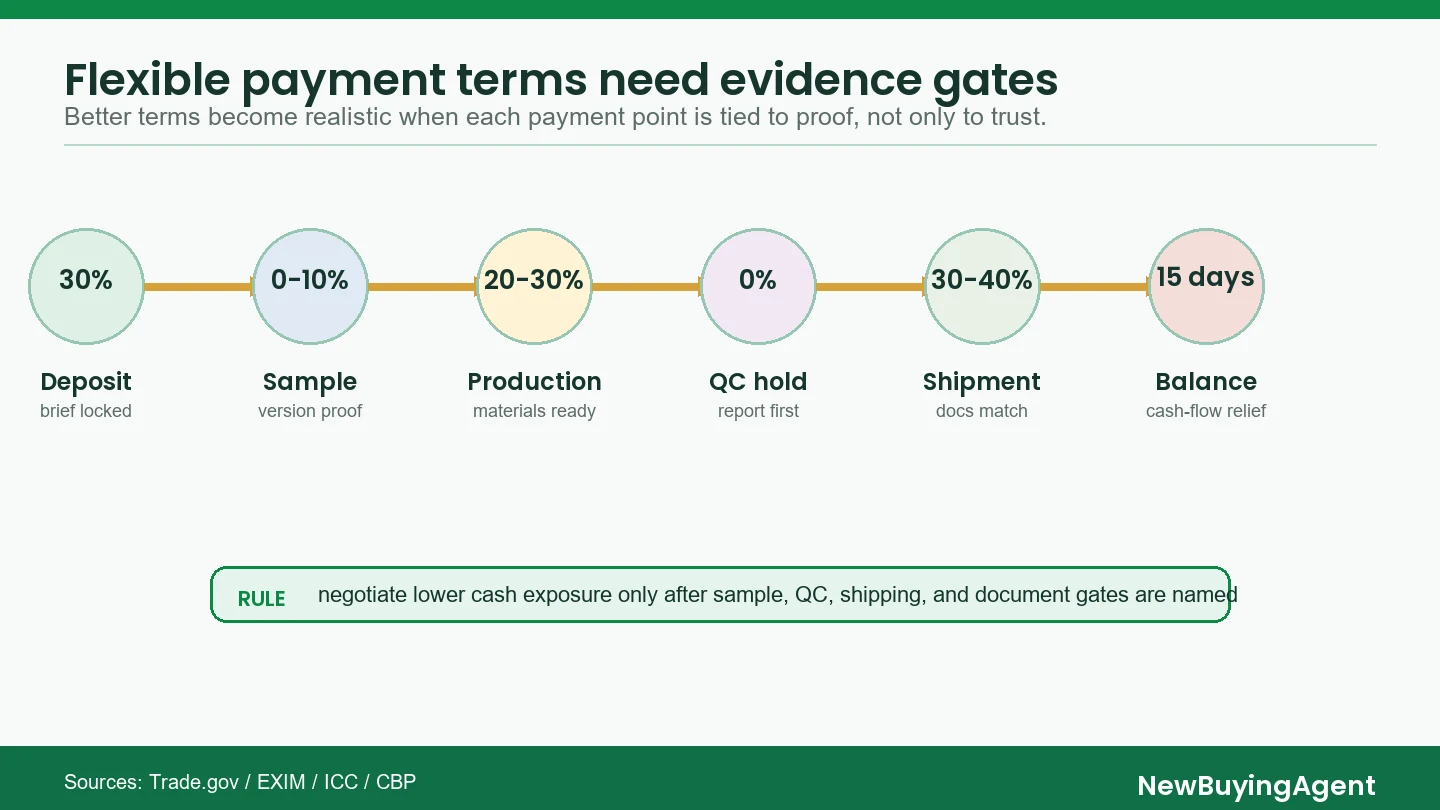
Flexible payment terms become more realistic when each payment point is tied to sample, production, QC, shipping, or document evidence.
What a Sourcing Agent Can Negotiate
Lower Deposit Ratio After the Order Is Clear
The deposit is usually the first place buyers ask for flexibility. A factory may ask for 30 percent, 40 percent, or more depending on material cost, tooling, customization, and relationship risk. A sourcing agent can sometimes negotiate a lower deposit when the product is standard, the quantity is credible, the specification is locked, and the buyer has repeat potential. The important point is that a lower deposit is not free credit. It is a signal that the supplier believes the order is unlikely to change, cancel, or become a dispute. Buyers improve their position by giving product details, packaging requirements, destination, timing, and target price before negotiation starts.
Balance After Final Inspection Instead of Before Inspection
Many buyers want to delay the final balance until quality is proven. That is reasonable, but the term must be written carefully. "After inspection" should mean after an agreed inspection scope, defect rule, reporting format, and release decision. Otherwise, the factory may worry that the buyer will use small findings to delay payment indefinitely. A sourcing agent can help define the inspection gate: what defects block release, what defects require rework, what defects allow a discount or sorting, and what evidence the buyer will accept. This makes the balance discussion less emotional and more operational.
Balance After Shipment or After Document Release
Some experienced buyers negotiate balance after shipment, after bill of lading copy, or after document release. These terms help cash flow because the buyer is not paying the entire balance before seeing shipping evidence. However, they also increase the seller's risk. Documentary structures can help, but they must be understood. Trade.gov explains documentary collections as bank-facilitated document exchange without the same payment guarantee as a letter of credit. A sourcing agent can help frame a practical middle ground, but the buyer should not treat document timing as a substitute for quality control.
Letters of Credit for Larger or Higher-Risk Orders
A letter of credit can protect both sides when the order size justifies bank cost and document discipline. Trade.gov describes a letter of credit as a bank commitment to pay after the exporter ships and presents required documents. ICC's eUCP materials show how documentary credit practice also has digital-rule development. For many consumer product orders, a traditional letter of credit may be too heavy. But for high-value, repeat, or custom production, it can create a clearer payment boundary than informal promises. In practice, buyers should compare bank fees with the value of delayed cash, reduced dispute risk, and cleaner document discipline. A letter of credit is not a cure for weak product control, but it can be useful when the product version, inspection rule, shipping document list, and payment trigger are all stable enough for banks to process.
Tooling, Mold, and Sample Fee Amortization
Tooling and sample costs often create friction because the buyer wants to avoid sunk cost while the factory wants commitment. A sourcing agent may negotiate partial tooling payment, refund after order volume, amortization across repeat batches, or clearer ownership language. The key is to separate three issues: who pays for development, who owns usable tooling or design files, and what happens if the first sample fails. Buyers should avoid treating sample cost as a small side topic. In custom hardware, plastic goods, packaging, or furniture, unclear sample and tooling terms can become the first sign of a weak production relationship.
Staged Payments for Multi-SKU or Multi-Category Orders
Multi-category buyers should not always put one payment rule on every item. A stable reorder item may deserve better terms than a new customized product. A low-risk packaging accessory may need less deposit than a high-material-cost metal item. A sourcing agent can divide the payment structure by product risk or milestone, so cash is not trapped equally across all SKUs. This is especially useful when one product line is ready and another is waiting for sample correction. The buyer should negotiate by release evidence, not by calendar date alone. A practical rule is to separate stable reorder SKUs from experimental SKUs, because the factory's risk is different. If the buyer treats every item as the same risk, the supplier will usually price the payment term around the weakest or most uncertain product in the order.
Repeat-Order Credit After Performance History Exists
The strongest payment flexibility usually appears after repeat orders. A supplier that has seen stable requirements, timely decisions, clean documents, and predictable payment behavior may accept a lower deposit, later balance, or limited credit. That does not mean the buyer should expect open-account terms immediately. It means the buyer should build a payment record. NewBuyingAgent can be relevant here because its local factory resources and China-side execution can reduce the uncertainty that makes factories resist flexibility. Better terms are easier to discuss when the sourcing path shows repeat order discipline.
A Practical Cash-Flow Scenario
Consider a buyer placing a USD 100,000 mixed consumer-goods order. Under a simple 30/70 term, the buyer pays USD 30,000 before production and USD 70,000 before shipment release. If the balance can be split into 50 percent after final inspection and 20 percent 15 days after shipment documents, the buyer may keep USD 20,000 in working capital longer. This is only an illustrative scenario, not a universal promise. The supplier may accept it only if product version, QC release, shipping documents, and buyer payment history are strong enough.
| Payment structure | Cash paid before shipment | Buyer benefit | Supplier concern |
|---|---|---|---|
| 30/70 before shipment | USD 100,000 | Simple and common | Low concern if buyer pays on time |
| 30/50/20 after shipment | USD 80,000 | USD 20,000 kept longer | Needs trust, documents, and release evidence |
| Deposit plus inspection hold | Varies by order | Quality evidence before full balance | Defect rules must be clear |
| Letter of credit | Bank-backed document route | Structured risk sharing | Higher cost and stricter documents |
The decision is not only financial. If the buyer saves cash but weakens factory cooperation, the term may become expensive through delay or lower attention. If the buyer pays early without QC evidence, the term may feel smooth until a defect appears. The useful payment term is the one that balances cash flow with proof.
Where NewBuyingAgent Fits in Payment Negotiation
NewBuyingAgent helps make payment negotiation more practical by making the order easier to trust. Buyers provide purchasing needs, product specs, quantity, target price, destination, and timing. NewBuyingAgent uses local China factory resources, product development and QC capability, cost negotiation, production follow-up, and logistics coordination to supply products from China with better price, quality, and service.
If the buyer is starting a new product order and cash flow is tight, the next step is to prepare product specs, target price, desired deposit, acceptable inspection gate, and delivery deadline before using NewBuyingAgent's product supply service. If the buyer already has Chinese suppliers but needs better payment discipline, production follow-up, and inspection evidence, NewBuyingAgent's China-side supplier management is the more relevant path.
For product categories where market fit matters as much as price, flexible payment should also be connected to demand confidence. Buyers can review NewBuyingAgent's hot-product analysis support before tying too much cash to products that may not sell. Payment flexibility protects cash flow, but product selection protects why the cash is being used in the first place.
Frequently Asked Questions
What payment terms are common with Chinese suppliers?
Many China sourcing orders use a deposit before production and a balance before shipment, often around 30/70, but actual terms vary by product, order size, customization, relationship history, and supplier risk. Buyers should treat any quoted term as negotiable only after product requirements, inspection gates, and delivery assumptions are clear.
Can a sourcing agent guarantee better payment terms?
No sourcing agent should guarantee better payment terms for every order. A good agent can improve the discussion by clarifying specs, using local factory relationships, defining QC evidence, and showing repeat-order potential. The final term depends on supplier risk, product type, order value, and the buyer's payment history.
Is it safe to pay the balance after shipment?
Balance after shipment can help buyer cash flow, but it must be tied to documents, inspection release, and a clear contract. It may not be realistic for new, small, highly customized, or material-heavy orders. Buyers should avoid using later payment as a substitute for sample approval and final QC evidence.
How should buyers request flexible terms?
Buyers should request flexible terms with a specific structure, not a vague discount-style demand. The request should name deposit percentage, inspection gate, shipment-document trigger, any delayed balance, and the evidence the supplier will receive. This makes the request easier for a supplier or sourcing agent to evaluate.
NewBuyingAgent
Related Resources


Get Started Today
Let's Turn Your Sourcing Goals into RealityWeChat:+86 15157124615
WhatsApp:+86 15157124615
Address:Building 10 #39 Xiangyuan Road, Hangzhou, China
