

Introduction
A resistance band that snaps mid-rep, a dumbbell whose coating chips on day one, a treadmill that fails its electrical safety test at customs — fitness equipment is a category where a quality miss isn't just a return, it's a liability. The products carry load, get used under stress, and sometimes plug into the wall, which means sourcing them well demands attention to safety and certification that a softer product category never requires.
Sourcing fitness equipment from China rewards knowing how commercial and home products differ, and matching your product to a factory built for its specific construction. The pattern holds across the category: the equipment that performs and passes certification comes from factories that specialize in that exact product type and take safety testing as seriously as the buyer must.
Key Takeaways
• Fitness equipment carries load and safety risk, so quality and certification matter more than in soft goods.
• Commercial and home equipment differ sharply in durability, build, and standards — match the factory to each.
• Factories specialize by product type; a strength-equipment maker is wrong for cardio machines and vice versa.
• Safety certification varies by product and market and is mandatory for anything electrical or load-bearing.
• Verify materials and load ratings with testing, since failures here cause injury and liability.
Commercial vs. Home: Two Different Products
What commercial equipment demands
Commercial fitness equipment — for gyms, hotels, and studios — is built for constant, heavy, multi-user duty. It demands heavier-gauge steel, higher-rated components, durability through years of daily abuse, and often compliance with commercial safety standards. The factories that excel run robust fabrication, welding, and finishing for heavy products and understand commercial certification. A home-grade factory building to commercial spec is a mismatch that surfaces as equipment failing under real gym use.
What home equipment optimizes
Home workout equipment — adjustable dumbbells, resistance bands, benches, compact cardio, yoga and recovery gear — optimizes for cost, compactness, ease of assembly, and consumer-grade durability. The volumes are higher and the price sensitivity sharper. These factories are built for efficient consumer production, not commercial-grade overbuilding. The right factory is one whose normal business is your tier; a commercial factory will overprice your home product, and a consumer factory will underbuild a commercial one.
Home equipment also carries a usability dimension that commercial gear largely escapes: it's assembled and used by ordinary consumers without a trainer or technician present. That makes clear assembly instructions, intuitive design, and safe operation by an untrained user real product requirements, not afterthoughts. A home rack that's confusing to assemble, or a folding treadmill with a pinch hazard, generates returns and complaints even if the core build is sound. The home-fitness boom that accelerated from 2020 onward has only raised consumer expectations here — buyers now expect home equipment to feel considered, not like a stripped-down commercial product. Factoring usability and clear instructions into your spec, and checking them on the sample, addresses a failure mode unique to the home tier that a purely structural inspection would miss.
Expert Tip: Ask a factory whether it builds for commercial or home use and what share of its output is each, then ask to see recent production of your specific product type — not the catalog. A factory whose floor runs commercial strength racks has the heavy fabrication and welding your gym equipment needs; one making consumer dumbbells daily has the cost-efficient lines for a home line. The two rarely overlap well, and the production mix, not a broad capability claim, tells you whether the factory fits your tier.
Sourcing by Product Type
Strength and load-bearing equipment
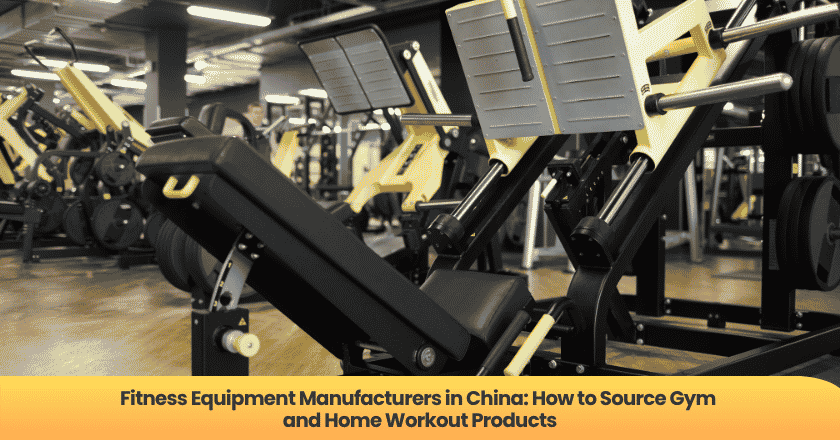
Strength equipment — racks, benches, weights, cable machines — lives or dies on structural integrity. The failure points are welds, frame steel gauge, weight-rating accuracy, and finish durability (a coating that chips invites rust and looks cheap). Verify the load rating with testing, not the spec sheet, since a frame rated for a weight it can't actually hold is a serious liability. Welding quality is critical and often where corners get cut invisibly.
Steel gauge is the spec most quietly downgraded. A rack built from thinner-gauge steel looks identical to a properly built one but flexes under load and fails sooner, and the difference rarely shows in a photo or even a showroom sample. Specify the steel gauge and tube dimensions precisely, and confirm them on the production unit, because a factory protecting its margin can switch to lighter steel without changing the appearance at all. The same applies to weight plates and dumbbells, where the actual weight should match the labeled weight within a tight tolerance — cheap weights are notoriously inaccurate, and a customer who checks will leave a damning review. For load-bearing gear, the gap between the spec sheet and the delivered product is exactly where safety and reputation are won or lost.
Cardio and electrical equipment
Treadmills, bikes, ellipticals, and rowers add a mechanical and electrical dimension. Motor quality, electronic controls, moving-part durability, and electrical safety all matter, and these products require electrical safety certification for sale. A factory experienced in cardio machines understands motor sourcing, control electronics, and the certification path; a general fitness factory may not.
Accessories and soft fitness goods
Resistance bands, mats, straps, and recovery tools seem simple but fail in ways that matter — a band that snaps can injure, a mat with toxic off-gassing fails chemical limits. Material quality and safety (latex content, restricted substances) are the variables. The category's apparent simplicity tempts buyers to under-vet, which is exactly where problems hide.
Common Mistake to Avoid: Treating fitness equipment like an ordinary consumer product and skipping load and safety testing. Buyers approve a good-looking sample, order, and discover frames that bend, bands that snap, or electrical units that fail certification — problems that cause injury and liability, not just returns. Fitness equipment carries load and risk, so verify load ratings, weld integrity, and safety certification on the production order. The visible quality of a sample tells you nothing about whether the bulk will hold a user's weight safely.
Certification, Quality, and Placing the Order
Safety certification is mandatory
Fitness equipment certification varies by product and market, and it's not optional for anything electrical or load-bearing. Electrical equipment for the US and EU needs electrical safety certification (such as UL or ETL marks for the US, CE for the EU) and electromagnetic compliance; products plugging into mains power can't legally or safely ship without it. Many markets apply safety standards to load-bearing equipment too. A factory experienced in your target market designs to these standards and provides test reports; confirm certification capability before producing, since an uncertified electrical product is stranded inventory at best.
Independent quality oversight matters because a factory's own testing comes from the party motivated to ship. An independent layer exists so fitness equipment meets its load ratings, passes safety testing, and holds finish quality across the run, not just in the approval sample.
Product liability is the reason all of this matters more than in most categories. Fitness equipment that fails can injure a user, and in a market like the US, an injury traced to a defective product can mean a lawsuit that dwarfs the value of the entire order. This raises the stakes on both certification and quality control: they're not just about passing customs, but about protecting your business from a liability event. Carrying appropriate product liability insurance is standard for fitness brands, and insurers and retailers often require documented safety testing and certification before they'll cover or stock a product. Treating safety documentation as a core business requirement, not paperwork to minimize, is what separates fitness brands that scale from those undone by a single failure. The certification and testing you invest in up front is cheap against the cost of a defective product reaching a user.
MOQ, freight, and the cost picture
Fitness equipment MOQs vary by complexity — simple accessories carry low minimums, while machines with custom tooling or electronics carry higher ones. Like furniture, much fitness equipment is bulky and heavy, so freight is a large share of landed cost; a heavy steel rack that ships inefficiently can cost more delivered than its unit price suggests. Calculate cost per delivered unit, factoring in packing and weight, before comparing quotes. Through 2026, freight and tariff shifts make this landed-cost math worth a fresh look. The best-fit factory often isn't the most visible online — the specialist genuinely built for your product tier and type may sit outside the listings you can easily find, which is what makes reaching it well worth the effort.
Expert Tip: For any load-bearing equipment, require a documented load or stress test on a production-run unit, not just a stated rating, and ask to see the data. A rack or bench rated for a given weight should be tested to a safety margin beyond it, and a factory that performs and documents this takes the liability seriously. One that treats the load rating as a printed number rather than a tested result is exposing you to the worst kind of product failure — the kind that injures a user and lands on your brand. Tested ratings, not claimed ones, are what protect you.
How NewBuyingAgent Helps You Source Fitness Equipment
Fitness equipment is a safety-and-certification job, not a simple price hunt: commercial and home gear are two different products, each with its own load, welding, and material demands, so the factory has to fit the exact construction. Lining up tier, build, and safety testing from a distance is hard to get right alone, which is why many brands bring in a sourcing partner. NewBuyingAgent is your perfect partner for global sourcing from China, backed by 30 years of expertise in trade, manufacturing and quality control.
Connecting your product tier and type to a specialist that genuinely fits it, rather than grabbing the most prominent quote, is the first move: with 100% Access to China's Factories, you use their 50,000+ cooperated partner factories—no language/region/time zone barriers. Their local reputation gets you full factory cooperation. Equipment this heavy and bulky turns a wrong factory match into an expensive failed order, and a wider network leaves more room to choose well and to price keenly: with Lower Prices Than Direct Sourcing, their wide factory network lets them pick low-cost, high-cooperation suppliers. Even with their margin included, they cut your costs by 5%-10%. And since load capacity has to survive repeated use and welds have to hold up under inspection, those have to be settled by real load and safety testing: NewBuyingAgent's 20,000+ product development & QC experts ensure your products match market needs and stay high-quality. Contact now.
Frequently Asked Questions
Are commercial and home fitness equipment made by the same factories?
Usually not. Commercial equipment is built for constant heavy multi-user duty with heavier steel and higher-rated components; home equipment optimizes for cost, compactness, and consumer-grade durability at higher volumes. A factory specializes in one tier — a commercial maker overprices home products, a consumer maker underbuilds commercial ones. Match the factory to your tier.
What certifications does fitness equipment from China need?
It varies by product and market, but electrical equipment for the US and EU needs electrical safety certification (UL or ETL for the US, CE for the EU) and electromagnetic compliance, and many markets apply safety standards to load-bearing equipment. Confirm the factory designs to your market's standards and provides test reports before producing — uncertified electrical product can't legally ship.
How do I verify a load rating is real?
Require a documented load or stress test on a production-run unit, not just the stated rating, and ask to see the data. Load-bearing equipment should be tested to a safety margin beyond its rating. A factory that performs and documents this takes liability seriously; a stated rating with no test behind it is a risk, since failure here causes injury.
Why does freight matter so much for fitness equipment?
Much fitness equipment is bulky and heavy, so freight is a large share of landed cost — a heavy steel rack that packs inefficiently can cost more delivered than its unit price implies. Calculate cost per delivered unit, factoring in packing and weight, before comparing quotes, rather than comparing ex-works prices alone.
What's the riskiest fitness category to under-vet?
Anything load-bearing or electrical, plus deceptively simple accessories like resistance bands and mats. A snapping band or a frame that bends causes injury, and an electrical unit that fails certification is stranded inventory. The apparent simplicity of accessories tempts buyers to skip testing, which is exactly where avoidable failures and liability hide.
Conclusion
Sourcing fitness equipment from China is a safety-and-certification discipline, not just a price hunt. Match your product to a factory built for its tier and type, verify load ratings and weld integrity with testing, confirm the safety certification your market demands before producing, and calculate landed cost on bulky, heavy goods. Get those right and you ship equipment that performs under stress and clears customs; skip them and a quality miss becomes a liability. When matching the right factory and verifying safety and load testing from a distance is more than you want to manage, it's worth having a partner match your product to the right specialist and put safety and quality testing behind your order.
NewBuyingAgent
Related Resources

Get Started Today
Let's Turn Your Sourcing Goals into RealityWeChat:+86 15157124615
WhatsApp:+86 15157124615
Address:Building 10 #39 Xiangyuan Road, Hangzhou, China
