

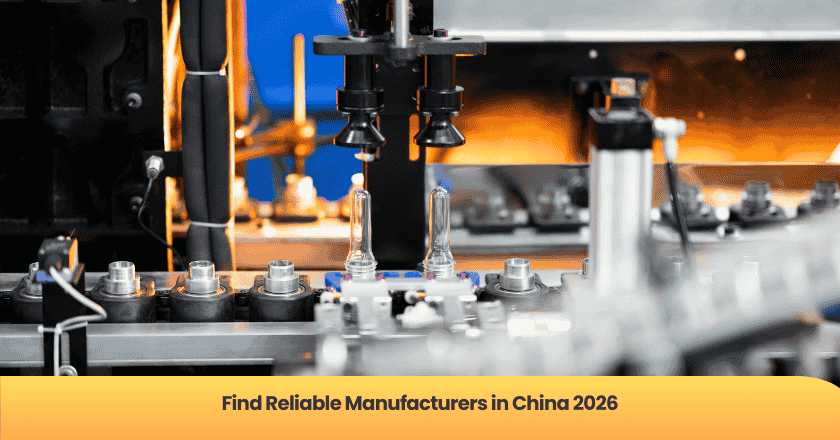
China remains the global manufacturing hub. From consumer electronics and home appliances to textiles and industrial parts, the country produces billions of products yearly. For importers and brands looking to scale, sourcing directly from Chinese manufacturers is often the most practical solution.
However, sourcing successfully requires more than a supplier search. Thousands of companies appear online. Many are trading companies rather than factories. Communication gaps, inconsistent quality, and compliance issues are common.
The real key is identifying manufacturers that consistently deliver quality, meet deadlines, and operate transparently. This guide provides a step-by-step framework for sourcing in 2026, combining proven methods with modern digital tools.
Key Takeaways
Verification beats discovery: Finding suppliers is easy; confirming their authenticity is the main challenge.
- Industrial clusters matter: Factories located in specialized regions have better supply chains, faster delivery, and stronger technical expertise.
- Detailed specifications save time: Clear technical documents prevent miscommunication and inaccurate quotes.
- Sampling is non-negotiable: Physical samples remain the most reliable method to evaluate quality.
- Digital sourcing is evolving: Live factory tours, short-form videos, and social media give buyers a real-time view of operations.
Why Brands Still Choose Chinese Manufacturers in 2026
Integrated Industrial Ecosystems
China's factories are concentrated in industrial clusters, regions where multiple related factories, suppliers, and logistics services operate together. This proximity reduces lead times and cost.
Examples:
- Shenzhen: Electronics & smart devices
- Dongguan: Hardware & accessories
- Yiwu: Consumer goods & small commodities
- Ningbo: Electrical components & machinery
Factories in these clusters can quickly source components and scale production efficiently.
Production Scalability and Technology
Chinese factories often operate MES (Manufacturing Execution Systems) to monitor and manage production in real time. This ensures consistency across large orders and enables traceability for every batch. Automation, robotics, and advanced machinery reduce human error and improve speed.
Export Expertise
Most Chinese manufacturers have decades of experience exporting. They understand international compliance, customs procedures, packaging requirements, and logistics. This reduces risks for first-time importers.
Expert Tip: Focus on factories inside industrial clusters with visible digital or physical production capacity. They are more likely to scale efficiently and meet deadlines.
Step 1: Define Detailed Product Specifications
Without precise specifications, even the best factory cannot produce the desired product correctly.
Key Components of a Product Specification Sheet:
Materials: Specify exact type, grade, or source. Example: ABS plastic vs polycarbonate vs food-grade silicone.
- Dimensions and Tolerances: Define acceptable variation in measurements. Precision components require tighter tolerances.
- Surface Finish & Appearance: Include coating, texture, or color references. Photos alone are insufficient.
- Packaging Requirements: Define box size, material, labeling, and retail vs bulk packaging.
- Compliance Standards: Include certifications needed, e.g., CE, RoHS, FCC, or UL standards.
Common Mistake to Avoid: Relying on photos or sketches alone leads to inaccurate quotes and delays.
Step 2: Discover Potential Manufacturers
Online Marketplaces
Alibaba, Made-in-China, Global Sources, and similar platforms remain primary sourcing channels. They allow filtering by production capabilities, certifications, and verified supplier status.
Trade Shows
Events like Canton Fair or Global Sources Expo enable direct evaluation of products and face-to-face discussions with suppliers. They reveal operational realities that online listings cannot.
Direct Manufacturer Websites
Some specialized factories prefer independent websites. Long-tail search queries (e.g., “OEM stainless steel cookware manufacturer Shenzhen”) often uncover reliable suppliers not listed on B2B platforms.
Professional Networks
Procurement teams often leverage logistics partners, product engineers, or referrals from other importers to identify reliable suppliers.
Emerging Channels in 2026
Short-form video platforms and social media allow manufacturers to showcase their production lines. Buyers can visually assess the factory size, assembly lines, and quality control processes.
Expert Tip: Collect 8–10 potential suppliers. Comparing multiple options establishes realistic pricing and production benchmarks.
Step 3: Verify Suppliers as Real Manufacturers
Distinguishing factories from trading companies is essential.
Verification Methods:
- Business License Check: Confirms legal existence, business scope, and registration details.
- Factory Certifications: ISO 9001 for quality management, ISO 14001 for environmental management, BSCI for social compliance.
- Equipment and Facility Lists: Request photos or videos of machinery and production lines.
- Live Video Tours: Allows real-time observation of workflow, assembly, and warehousing.
Common Mistake to Avoid: Suppliers with hundreds of unrelated products are often trading companies. Factories specialize in fewer categories.
Step 4: Sample and Evaluate Products
Sampling Process:
Prototype Sample: Tests design feasibility. Minor defects are expected.
Revised Sample: Factory adjusts based on feedback.
Golden Sample: Final approved unit used as reference for mass production.
Expert Tip: Keep written records of changes to avoid misalignment during large production runs.
Step 5: Negotiate Pricing, MOQ, and Lead Times
Minimum Order Quantity (MOQ)
Factories set MOQ based on production efficiency and material costs. Negotiate carefully; a lower MOQ is possible for long-term partnerships.
Payment Terms
Standard terms: 30% deposit before production, 70% before shipment. This balances risk between buyer and manufacturer.
Production Lead Time
Include material procurement, manufacturing, assembly, and packaging. Delays often occur if lead times are unrealistic.
Shipping Terms
Understand Incoterms (FOB, EXW, CIF) to clarify responsibilities for logistics, customs, and insurance.
Common Mistake to Avoid: Selecting the lowest quote without evaluating production capacity often leads to delays or inconsistent quality.
Step 6: Conduct Quality Inspections
Three main inspection stages:
- Pre-production Inspection: Confirms raw materials and components.
- During-production Inspection: Verifies process compliance with approved samples.
- Pre-shipment Inspection: Checks finished products, packaging, and quantity before shipping.
Expert Tip: Conduct inspections when ~80% of the order is complete. This provides time to correct defects.
Step 7: Build Long-term Supplier Relationships
Long-term partnerships offer stability, priority scheduling, better pricing, and innovation collaboration.
Communication is critical: Document every agreement in writing.
Consistency matters: Reliable suppliers value buyers with predictable orders.
Common Mistake to Avoid: Constantly switching suppliers to chase lower prices can disrupt production and reduce quality.
Step 8: 2026 Sourcing Trends
- AI-driven Supplier Matching: Tools analyze trade records, certifications, and supplier databases for precise recommendations.
- Digital Factory Transparency: Live video tours, short-form video channels, and virtual audits provide early operational insight.
- Sustainability Compliance: Buyers increasingly demand carbon reporting, renewable energy usage, and eco-friendly materials.
- Multi-region Supply Chains: Some companies combine Chinese production with secondary suppliers in Southeast Asia to mitigate risk.
Expert Tip: Evaluate suppliers' adaptability to digital tools and sustainability. These capabilities become standard requirements.
FAQ – China Manufacturing Sourcing
Is it safe to source from China?
Yes, when proper verification and quality inspections are applied. Most problems occur from skipping these steps.
How do I confirm a supplier's legitimacy?
Check business licenses, certifications, factory photos, and consider third-party audits or live video tours.
What is a typical MOQ in China?
Depends on product type. Consumer goods may require 500–1000 units; electronics often higher.
Should I visit the factory in person?
On-site visits provide the clearest understanding. When travel is impossible, third-party audits or video inspections are effective alternatives.
How long does production usually take?
Lead times typically range from 20 to 45 days depending on complexity and factory capacity.
Conclusion
Sourcing from China requires careful planning, verification, and ongoing communication. Success does not come from finding suppliers alone but from building trustworthy, transparent, and capable manufacturing partnerships.
With a structured process that includes detailed specifications, supplier verification, sampling, inspections, and strategic long-term relationships, Chinese manufacturers remain among the most reliable and scalable partners for global brands in 2026.
NewBuyingAgent
Related Resources
Get Started Today
Let's Turn Your Sourcing Goals into RealityWeChat:+86 15157124615
WhatsApp:+86 15157124615
Address:Building 10 #39 Xiangyuan Road, Hangzhou, China
