


A purchase order can say “payment in USD” and still leave the buyer paying more dollars at shipment. The missing detail is whether the supplier promised a fixed dollar amount or a renminbi-linked price converted into dollars later. Before approving a China order, settle that distinction, the rate used and the amount that may change. Otherwise, a currency disagreement can arrive with the balance invoice, when replacing the goods is already difficult.
Put the Currency Risk in the PO, Not in an Email
A currency clause allocates exposure through the amount promised, the adjustment formula and the fixing event, not the payment currency alone. The fixing event is when the reference rate is captured for the calculation. A fixed USD price and a CNY-linked price payable in USD can therefore produce different bills for the same goods. Identify the exposed balance before agreeing who absorbs a currency movement, including whether an already-paid deposit is excluded.
- Pricing: State the currency in which the amount is fixed, not just the currency printed beside the receiving bank account.
- How it works: Specify the reference series, rate direction, fixing date and eligible adjustment base.
- Risk: Test increases and decreases. A one-way surcharge is not balanced risk sharing.
- Decision: Keep rate fixing separate from payment approval, product acceptance and any change to the approved specification.
Who Carries the Risk Under a USD or CNY Price?
A genuinely fixed USD amount leaves the supplier with its exposure when converting those receipts into CNY, unless another agreed term changes that allocation. A CNY-linked amount paid in USD can instead pass a formula-driven price change to the buyer. Neither arrangement removes a non-USD buyer’s separate exposure when obtaining the dollars needed to pay the invoice from its own budget currency.
The interval matters: the International Trade Administration’s FX guidance explains that currency movements between agreement and payment can change the value received. Its discussion is written for U.S. exporters, but the timing mechanism helps both sides of a China purchase identify which conversion remains exposed. It does not establish either party’s contractual right to change a price.
For example, a fixed CNY amount payable in CNY leaves the buyer responsible for obtaining that amount. Paying its equivalent in USD does not make it a fixed USD price. Conversely, a fixed USD quote may include a supplier’s allowance for conversion uncertainty; moving the obligation into CNY is not automatically a saving. Compare complete, executable offers, including conversion costs and payment dates.
The distinction also appears in UNIDROIT Article 6.1.9, which separates the currency of the obligation from the currency used for payment. These are model contract principles, not automatically binding rules for every China PO. Use the distinction to ask counsel whether the accepted documents clearly specify both, rather than assuming that a bank instruction settles the question.
For a retailer sourcing a new countertop-organizer range, a stable currency price is useful only if material, dimensions and packing remain stable too. NewBuyingAgent's product-supply service uses its local China factory network to quote and supply products against the purchasing need. As a one-stop China sourcing agent for global buyers, it connects the commercial offer to the goods being bought; the buyer’s finance team still decides the acceptable currency exposure.
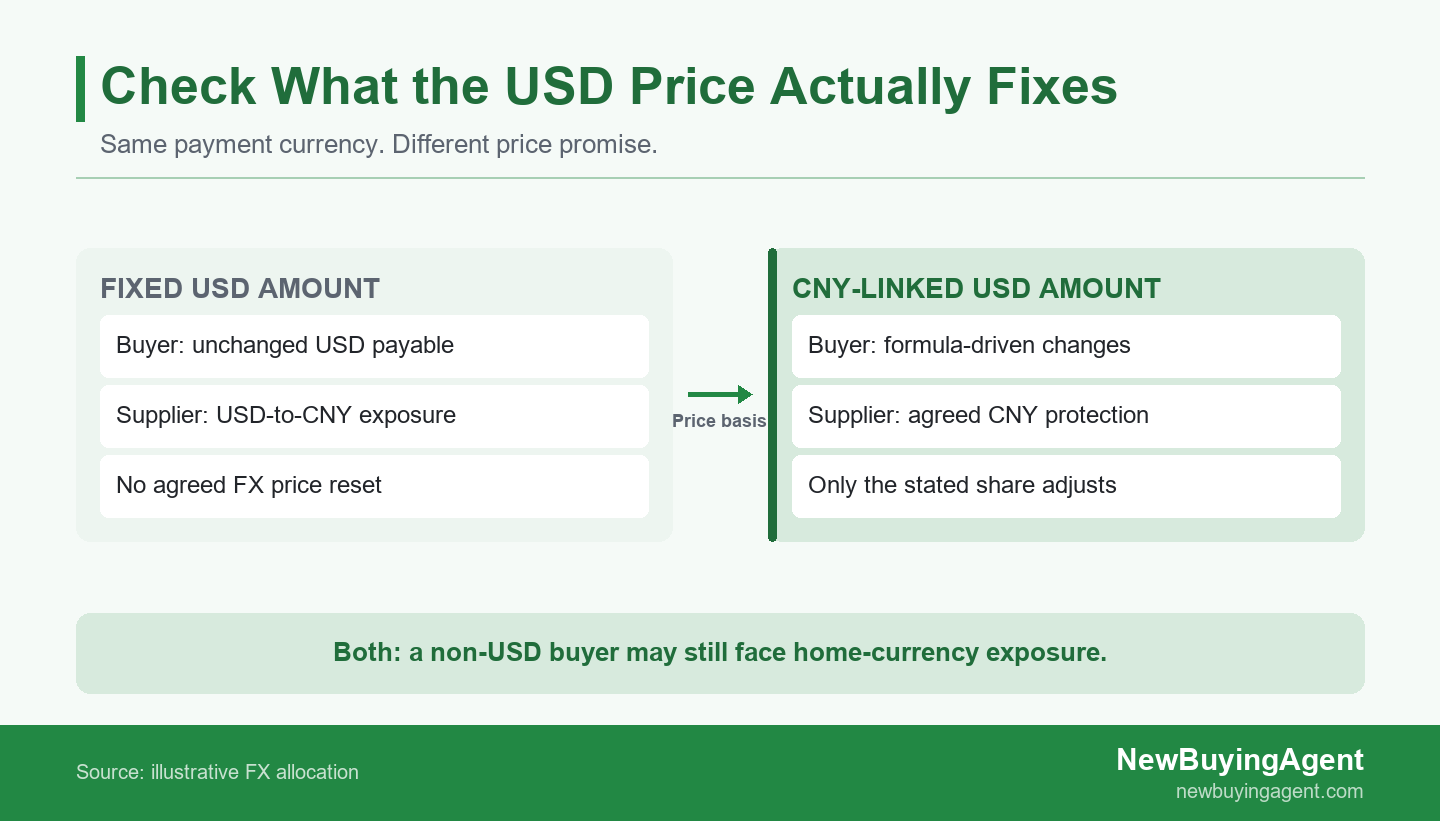
Fixed USD and CNY-linked USD prices assign different currency exposures to buyer and supplier
Specify a Rate That Both Parties Can Reproduce
A reproducible reference rate needs a named series, a quotation direction, a fixing time and a rule for days when no rate is published. “Use the bank rate” leaves too many choices open because banks can publish or offer several different rates. Both parties should be able to retrieve the same observation and calculate the same product-price adjustment without asking the other side to choose a number.
Name the Rate Source and Conversion Direction
A reference rate is a pricing input, not a promise that a bank will execute the payment at that rate. Specify the publisher, exact currency pair and series, and whether the quotation means CNY per USD or USD per CNY. In the examples below, a lower number of CNY per USD means more dollars are needed to preserve a fixed CNY value; reversing the quotation reverses the arithmetic.
Even a central-bank label does not establish an executable dealing price. The European Central Bank publishes its reference rates for information and discourages their use for transaction purposes. The numerical examples below use assumed rates, not ECB observations. Before choosing any series, confirm that its stated purpose and availability suit the proposed contract.
Bank execution brings another distinction: HMRC’s explanation of the spot market separates a dealer’s bid and offer prices from a midpoint quotation. Although this is general market terminology, not a China procurement rule, it explains why a public midpoint and a bank payment quote can differ. Allocate that spread and transfer fees separately; do not let an unspecified bank charge become a second product-price surcharge.
Fix the Date Before Either Party Can Choose It
Choose the fixing event before rates move: accepted order date, a named production milestone or a scheduled payment date can allocate different periods of exposure. Avoid “the rate near shipment,” which lets the person preparing the invoice choose among several observations. An objective date makes that selection reproducible rather than discretionary.
Include the time zone and the publication timestamp if the source offers more than one observation. For a weekend or holiday, specify whether the previous available business-day rate applies. A monthly average needs a precise observation window and averaging method. Keep a downloadable record or dated capture so accounts payable can reproduce the calculation after the original webpage updates.
Then test delay. If a shipment slips, does the original fixing date stand, or move with actual shipment? If payment is late, is there a separate adjustment or remedy? Those are negotiated allocations, not details to leave to whichever outcome favors one side. Finance and counsel should agree how the delay rule interacts with the payment obligation.
Adjust Only the Price Share and Balance You Agreed
A partial FX adjustment must identify both the exchange-sensitive price share and the unpaid amount eligible for recalculation. Applying a sharing percentage to the whole order can still overcharge a buyer when the contract excludes a paid deposit. State these two boundaries separately, then test the formula with movements in both directions before accepting it as the basis for later invoices.
For an illustrative USD balance, let B be the eligible unpaid amount before adjustment, s the agreed exchange-sensitive share, r0 the base rate and r1 the fixing rate, both expressed as CNY per USD. One possible arrangement is:
Adjusted balance = B × [(1 − s) + s × (r0 ÷ r1)].
This preserves the base CNY equivalent of the exposed share while leaving the rest unchanged in USD. It is a negotiable commercial formula, not a mandatory industry standard. A share of 60% does not prove that exactly 60% of factory costs are in CNY; request a commercial rationale for the chosen share, and check that another material-price clause does not charge for the same movement again.
A tolerance band also needs arithmetic. A deadband can mean no adjustment while a defined change remains inside the band, followed by the full change outside it. A deductible approach adjusts only the excess. For a hypothetical 5% change and 2% deductible, the excess is 3 percentage points before the agreed share is applied. Define which change is measured, then specify any upward cap and downward floor; the labels alone cannot determine the invoice.
Illustrative Scenario: Correcting an FX Surcharge on a Paid Deposit
Consider a hypothetical importer buying 10,000 countertop organizers from China at USD 10 each, a USD 100,000 order. A USD 30,000 deposit has been paid and expressly fixed. The signed PO allows adjustment of 60% of the remaining balance, using a base rate of 7.20 CNY per USD. The supplier’s later worksheet applies the percentage to the full order instead of excluding the deposit.
Applying a 60% exchange-sensitive share only to a 70,000 USD unpaid balance gives a 2,470.59 USD increase when the reference moves from 7.20 to 6.80 CNY per USD.
The calculation is 70,000 × 60% × (7.20 ÷ 6.80 − 1). The supplier’s full-order calculation instead produces a USD 3,529.41 surcharge. That overstates the amount by USD 1,058.82 because the USD 30,000 deposit is outside the agreed adjustment base. The correct goods balance is USD 72,470.59, before any separately agreed charges.
The procurement manager asks for a corrected balance worksheet, not a new concession. The correction keeps the agreed rate and share but replaces the full-order base with the unpaid eligible amount. Accounts payable then matches the deposit receipt to this PO and confirms it was not allocated to another order. Payment approval uses the corrected USD 72,470.59 balance, subject to the contract’s ordinary acceptance and payment conditions.
Before approval, a second reviewer checks the signed clause, archived rate observation, deposit allocation and calculation independently. A reverse-direction test should reduce the eligible balance when the same formula produces a decrease; it should not silently stop at the original price unless a floor was agreed. This is illustrative arithmetic, not a customer case or a rate forecast. It assumes no threshold or cap, excludes fees and taxes, and depends on an explicit paid-deposit exclusion—not merely on the fact that money was sent earlier.
Keep the Fixing Event Separate from Payment and Acceptance
Fixing the price does not require paying earlier or accepting goods before inspection. The PO can determine an amount at one event and make it payable at another, provided both parties agree to that structure. Keep the currency calculation, bank execution, product acceptance and authority to release payment distinct, so resolving an FX question does not quietly change the buyer’s other protections.
The International Trade Administration’s cash-in-advance guidance describes the arrangement as secure for exporters because importers pay before goods are shipped. That is a different risk allocation from choosing a currency rate. A supplier’s offer to stop price adjustments in exchange for earlier payment therefore needs a separate cash-flow and non-delivery assessment; currency certainty alone does not show that the exchange is worthwhile.
For split shipments, assign each payment tranche its own eligible base and fixing event. Do not recalculate previously fixed tranches whenever another container leaves. Finance should also check that any independently arranged currency transaction matches the expected amount and date. A PO amendment can change those needs; discussing the consequences with the bank is different from assuming the sourcing contract itself provides a hedge.
For an existing organizer supplier, a currency dispute may coincide with pressure to reduce material thickness or substitute packaging. NewBuyingAgent's factory-management service can support local production follow-up and quality control against the approved product. Its product development and quality-control capability is relevant to preserving the supplied goods and delivery plan while the buyer’s authorized finance and legal reviewers resolve the commercial calculation. A rate movement should not be treated as approval for a product change.
What to Put in the Currency Clause Before Approving the PO
The signed PO should make the payable amount reproducible without reopening price negotiations at shipment. Combine the agreed price basis, reference definition, eligible balance and adjustment rule with named approval authority and a document-precedence rule. Use the checklist below as a commercial drafting brief, then have qualified counsel and finance review the actual agreement under its governing law before anyone signs.
An agreed shipping term does not fill this gap. ICC explains that Incoterms rules do not determine the time, place, method or currency of payment. Keep the chosen delivery term, but write the currency obligation and adjustment machinery separately. An FOB or DDP label cannot decide which exchange rate belongs on the balance invoice.
| Clause item | What to settle | Approval test |
|---|---|---|
| Amount and currency | Fixed USD, fixed CNY or indexed amount; payment currency | No conflicting quote or invoice currency |
| Reference rate | Publisher, series, direction, date, time zone and fallback | Both teams retrieve the same observation |
| Eligible exposure | Price share, unpaid tranches and deposit exclusions | Paid or fixed amounts cannot re-enter the base |
| Adjustment limits | Two-way formula, threshold method, cap and floor | Upward and downward tests reproduce the result |
| Execution and changes | Fees, rounding, evidence, authority and document precedence | The invoice follows the accepted terms |
A plain-language starting instruction is: “The product price is fixed in USD for the accepted order. Payment is in USD. No exchange-rate adjustment applies to that order unless both parties approve a written amendment.” For an indexed deal, replace that fixed-price instruction with the fully specified formula and reference schedule; do not leave both versions in the contract. This wording illustrates the commercial choice and is not a jurisdiction-ready legal template.
Specify whether calculations retain full precision until the final payable amount is rounded to cents. Require any adjustment request to identify the PO, affected tranche, recorded rate and calculation. Establish a deadline for raising a discrepancy and an escalation route if the parties disagree, while counsel determines how disputed and undisputed payments should be handled. Avoid granting either side unlimited discretion to select a replacement rate or amend a signed price.
If the purchase is still being quoted, prepare product specifications, quantity, target price, budget currency, destination and delivery timing, including any deposit or price-validity constraints. The objective is a China-sourced product offer that fits the required goods and commercial limits, rather than a low opening price whose payable amount remains undefined. With those requirements ready, buyers can request a product quotation from NewBuyingAgent.
Frequently Asked Questions
Can a supplier raise an accepted USD price without an FX clause?
A supplier request is not, by itself, an agreed price amendment. Review the accepted PO, quotation, master agreement and document-precedence terms to establish what was actually agreed. Other contract provisions or applicable law may matter, so do not assume either an automatic right to a surcharge or an automatic right to cancel. Ask counsel to assess the position before withholding payment or asserting remedies.
Should a euro-based buyer ask for a USD or CNY quote?
Compare both offers in the buyer’s budget currency over the same payment dates. A fixed USD quote still leaves a euro-based buyer exposed when obtaining dollars, while a CNY obligation changes the currency that must be funded. Include executable bank conversion costs and the company’s ability to manage that exposure. Neither quotation currency is universally cheaper; finance should evaluate the actual offers rather than a public midpoint alone.
What if the named rate is unavailable on the fixing date?
Use the fallback agreed in the PO, rather than choosing a replacement after seeing the price effect. A routine publication holiday might use the previous available business-day observation, while a discontinued series needs a separately named successor or an agreed approval procedure. If the contract provides neither, document the gap and resolve it through authorized representatives. A convenient online converter should not silently become the contractual benchmark.
Do refunds use the original exchange rate?
The refund currency and conversion rule should be agreed separately. Returning the same USD deposit amount does not necessarily restore a buyer’s original euro cash cost, because the buyer may convert the refund at another rate. Define whether the supplier owes the original payment currency or a converted amount, and how permitted fees are handled. Do not assume the supplier must reimburse an unrelated home-currency loss without a contractual or legal basis.
NewBuyingAgent
Related Resources



Get Started Today
Let's Turn Your Sourcing Goals into RealityWeChat:+86 15157124615
WhatsApp:+86 15157124615
Address:Building 10 #39 Xiangyuan Road, Hangzhou, China
