


An engineering change order can be agreed by both the buyer and the factory and still leave the product unsafe to repeat. The risk is not the conversation; it is the frozen baseline, the cost and the validation evidence that an informal change never updates. A buyer sourcing a custom product from China should control every change through the same short workflow: freeze the baseline, classify the change, cost it, authorize it in writing, re-validate the affected characteristics, and version the records before the change reaches production.
An engineering change order (ECO) is a documented, buyer-authorized change to a product or process baseline that has already been frozen — the drawing revision, bill of materials, tooling, process and approved sample — together with the affected cost and the re-validation evidence for that change.
The practical question is not whether a change sounds small, but which baseline items, costs and characteristics it actually touches.
The Change-Control Gate an Engineering Change Order Must Close
An engineering change order earns its place when it keeps a frozen baseline, its cost and its validation evidence under buyer control. Treat it as the gate a product change passes before production, not as a formality for large orders. The gate has four links: the baseline item that changes, the class of change, the cost and authorization, and the re-validation of the affected characteristics. A change that closes all four is controlled; a change missing any one of them is not.
- Freeze the baseline: the drawing revision, bill of materials, tooling and approved sample define what a change is measured against.
- Classify before you cost: impact, not order size, decides whether a change needs full, partial or recorded control.
- Authorize in writing: an agreed change becomes a controlled change only when it is written, costed and approved.
- Re-validate the affected characteristics: evidence should cover what the change can affect, and say so explicitly.
- Version the records: the next order repeats the approved configuration only if the records were updated.
What an Engineering Change Order Actually Controls
An engineering change order controls the point at which a product stops being the approved version and becomes a new one. It is a documented, buyer-authorized change to a defined baseline that records the affected drawings, bill of materials, tooling, cost and validation evidence. It is not a note, a chat message or a revised sample; those may describe a change, but only the written order moves the baseline and makes the change safe to repeat.
The record-keeping side is well established outside China. ASME Y14.35 defines the practices for revising drawings and associated documents and establishes methods for identification and recording revisions. For a buyer, that is the mechanism an ECO borrows: a change is identified, recorded and versioned, so a later order can be matched to the approved state rather than to memory.
A change sits inside product development, so it helps to see how China manufacturing stages connect before a baseline is frozen; the China manufacturing and product guide explains how product requirements, tooling and production stages relate.
Two limits matter from the start: the order belongs to one configuration, and it records evidence rather than guaranteeing later units.
When a China Product Change Needs a Written ECO
Require a written ECO whenever a change can alter the product or process baseline and invalidate earlier cost, tooling or validation evidence. The trigger is the loss of that evidence, not the size of the change or the order value: a tweak that touches a validated characteristic still needs control, while a change that alters nothing the buyer relies on may need only a recorded notice. When in doubt, ask what the change could invalidate.
The invalidation mechanism is not unique to consumer goods. NASA's systems engineering guidance states that control of the configuration is critical to understanding how changes will impact the system, and that design and environment changes can invalidate previous analysis results. The transferable lesson for a buyer is narrow but useful: once the configuration changes, earlier evidence may no longer apply, so the change has to be tracked.
For a buyer sourcing a new product, NewBuyingAgent's local China factory resources and product-development/QC capability can write the change-control requirement into the supply brief. Its product-supply service sources the product against those requirements, with the baseline and the change procedure agreed before the first order runs.
| Change event | Baseline item it can alter | Typical control response |
|---|---|---|
| New or modified tool | Tooling and dimensions | Full ECO with dimensional re-validation |
| Material or source change | Bill of materials and process | ECO with material verification |
| Process or equipment change | Process window and tolerances | Partial ECO on affected characteristics |
| Drawing revision | Dimensions and tolerances | ECO with a revised drawing and bill of materials |
| Long production lapse | Continuity of the approved process | Re-validation before resuming |
| Packaging or carton change | Packing specification and freight | Recorded notice unless a validated characteristic changes |
Read the table as a decision rule: name the change, state the evidence it invalidates, and require the smallest response that re-establishes that evidence. When two events overlap, the wider re-verification governs.
The Change Events That Reopen a Frozen Baseline
New tooling, a material or source change, a process change, a drawing revision and a long production lapse each reopen the baseline, because each removes evidence the earlier approval relied on. A tool modification is the easiest to underestimate: the tool may be proven, but the process window around it may not be. A material change behaves the same way even when the specification looks identical, and a long gap between orders adds a different risk, since equipment, tooling and personnel may have drifted. Match the event to the evidence it invalidates before assuming the old baseline still holds.
Class 1, Class 2, Class 3: How Much Control a Change Needs
Class 1 changes need full re-validation, Class 2 need partial re-validation, and Class 3 need only a recorded notice, because impact decides the control level. A Class 1 change affects safety, function or a regulated requirement, so the whole baseline is re-checked. A Class 2 change is local and affects a defined set of characteristics, so the affected set is re-validated against the current drawing. A Class 3 change is cosmetic or documentary and touches nothing the buyer validates, so a dated notice is enough. Classify the change before deciding how much evidence it needs, and record the class in the order itself.
The buyer sets the class; a supplier's confidence that a change is minor is not a classification.
Scope the ECO to the Baseline, Not to a Chat Message
Scope the ECO to the frozen baseline — drawing revision, bill of materials, tooling and process — so every affected item has a defined before and after state. A photograph, a sample or a verbal description can explain a change but cannot define one, because no one can say which value matches which requirement. Write down the item that changes, the revision it changes from and to, and the characteristics affected.
The controlled object is a drawing and its associated lists. ASME Y14.100 establishes the requirements and reference documents applicable to the preparation and revision of engineering drawings and associated lists. If the ECO does not name the revision it supersedes, the factory and the buyer can work from two different documents without either noticing.
Tolerances need the same treatment, because a change to a dimension is only meaningful against a defined tolerance. ASME Y14.5 is the authoritative guideline for the design language of geometric dimensioning and tolerancing. When the buyer and the factory interpret a tolerance differently, a change can be implemented correctly and still answer the wrong question.
A practical scoping rule is to list every baseline item the change can touch, add any item whose earlier record was incomplete, and treat that union as the scope.
Price the Change Before You Approve It
A change carries tooling modification, work-in-process, material, lead-time and freight consequences that must be priced before approval. Approving a change before its cost is known transfers an open commercial risk to the buyer. The cost is rarely only the new part: a tool touch-up, scrap of work in process, a higher material price and a longer lead time can each change the economics of the order.
The party that benefits from the change or caused it should normally bear its cost, and that allocation belongs in the order. If the buyer asks for the change, the buyer expects to cover tooling and any scrapped work in process; if the factory proposes a cheaper material or a process improvement, the saving and the cost both belong in the same conversation. What matters is that the number is written before production continues, not reconstructed afterwards.
Re-Validate Only What the Change Can Affect
Re-validate only the characteristics the change can affect, and state whether the re-validation is full or partial. A broad change that touches a shared process step reopens the whole baseline; a local change to one feature reopens that feature and anything that depends on it. The scope follows the change, not the calendar, and it should be written in the order so the factory knows what evidence to prepare.
The full-versus-partial choice is a formal distinction in other industries. Boeing tells suppliers to decide between a full and a partial first article inspection when engineering, production process or tooling changes invalidate the original results. The aerospace obligation does not apply to a consumer product, but the decision logic does: name what changed, then re-verify the characteristics that change can affect.
Decide the evidence before the change is made, not after. A re-validation can be a measured dimensional check, a functional test, a finish standard or a documented visual standard, depending on the characteristic. What it cannot be is a photograph of a sample, because a photograph shows one result and not the relationship between a requirement and a measured value.
For buyers managing an existing Chinese factory, the harder part is often following the re-validation into production rather than agreeing to it. NewBuyingAgent's existing-factory management service connects local follow-up and quality-control capability with that ongoing supply work, so a partial re-validation and its release condition can be tracked instead of forgotten.
The change is ready to release only when the re-validation closes the characteristics the change can affect and leaves the rest explicitly recorded.
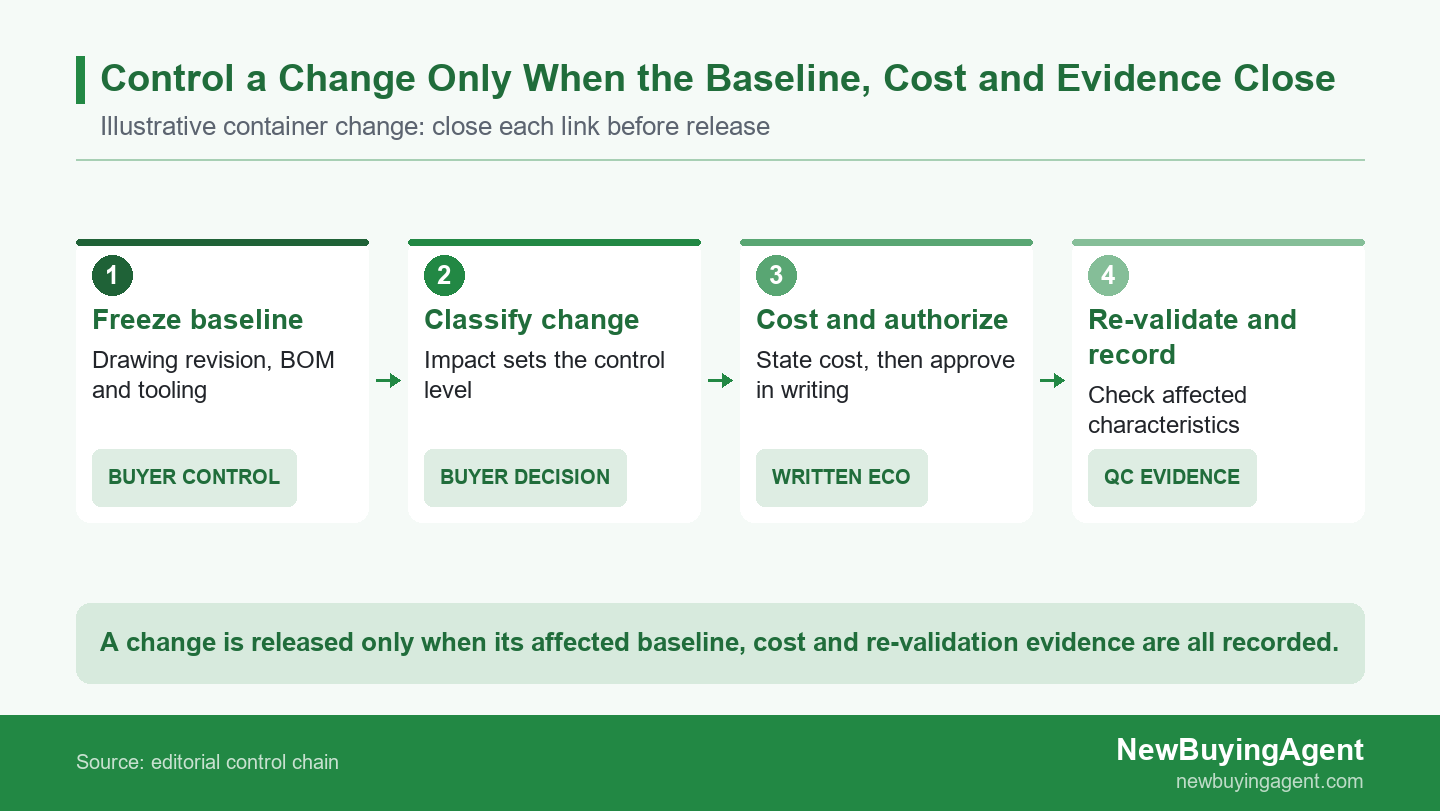
Four-stage change-control sequence linking a frozen baseline, a change class, a costed written authorization and re-validation records
Version the Records So the Next Order Matches
Version the drawing, bill of materials, approved sample and approval record so a repeat order matches the approved configuration. A change that lives only in a chat history or one person's memory will not survive a new buyer, a new factory contact or a new order. Keep one current revision, retire the superseded one, and record who approved the change and when.
Approving a production configuration against the engineering design record is standard practice. AIAG describes PPAP as the industry standard for defining the production part approval process so that engineering design record and specification requirements are consistently met. A consumer buyer does not need the automotive submission, but the underlying discipline is the same: the approved configuration is the design record, and a change updates it.
Record the change as a notice as well as an order. An engineering change notice tells the factory that the approved revision is now in effect, and it gives both sides a dated reference for the next order. Confirm that the supplier has acknowledged the new revision before production resumes.
When a Change Travels Through Samples Instead of an ECO
Separate reversible preparation from the change that depends on missing evidence, and state the condition for release. This keeps the project moving without treating a sample or a chat agreement as permission to start production. The buyer can keep packing, labelling and logistics planning moving while the baseline, cost and re-validation links are still open.
Illustrative Example: A Finish Change That Reopened Tooling
In this illustrative example, a consumer brand is sourcing a molded polypropylene kitchen storage container with a matte finish and a 2.5 mm wall thickness, with 30,000 units in production from a China factory using an existing injection mold. The first order is running against a frozen drawing revision and an approved sample, and the supplier proposes a finish and wall-thickness change by chat.
The change arrives by chat with a photograph of a revised sample, the current drawing revision and bill of materials have not been updated, and the tooling touch-up cost and any work-in-process impact are not stated. Because the tooling, the bill of materials and the affected characteristics are not recorded, the change cannot be authorized or re-validated as it stands.
The decision is to hold the change from entering production while allowing reversible preparation such as packing and logistics planning. The factory is asked to issue a written ECO that names the affected drawing revision, the tooling touch-up and its cost, after which the affected finish and wall-thickness characteristics are re-validated against the drawing.
Before the tooling change is implemented, the buyer reviews the costed ECO and the re-validation of the affected characteristics against the drawing, and after release confirms conformity with ongoing sampling. This illustrative example invents no measured value and no passed test, and an engineering change order is not a guarantee against later drift; the product's own critical characteristics govern the real scope.
Approve the Change Only When the Affected Evidence Closes
Approve the change only when the affected baseline items, cost and re-validation evidence all close, and decide any remaining items explicitly. Approval is a decision about evidence, not about goodwill. If a characteristic is unmeasured or a cost is unknown, either close it before release or record it as an accepted open item with an owner.
Regulated industries make the sequence explicit. FDA design controls require manufacturers to establish procedures to control design changes so that changes are reviewed, validated and approved before implementation. That rule governs medical devices, not a consumer product, but its order is worth borrowing: review, validate and approve before implementation rather than after shipment.
Do not confuse a change order with a deviation. A deviation is a documented one-time acceptance of output that sits outside the baseline; it does not change the drawing or the bill of materials. If the same deviation recurs, the baseline is wrong and a change order is the correct instrument. Pair the release with ongoing control, because approving a change does not guarantee later units.
Write the ECO Into the China Supply Agreement
Write the change workflow into the supply agreement as a scoped deliverable: who authorizes, what the ECO contains, who bears the cost, and the release condition. A defined procedure lets competing suppliers quote the same work and removes the ambiguity behind the phrase “small change”. It also tells the factory what to do when it believes a change is an improvement.
State the notice period, the required records and the default cost allocation. A factory that must stop and ask before implementing a change will sometimes slow a good improvement; that cost is usually smaller than the cost of an unrecorded change that reaches a repeat order.
For a product already in production, prepare the current drawing revision and bill of materials, the proposed change and the characteristics it affects, the tooling and process details, the quantity and forecast, the target price, the destination and the delivery timing. NewBuyingAgent can use its local China factory resources and product-development/QC capability to coordinate the change, cost it and follow the affected re-validation through production. With that brief ready, send your product change brief to NewBuyingAgent.
Frequently Asked Questions
Is an engineering change order the same as a revised sample?
No; a revised sample shows one physical result, while an engineering change order records the authorized change to the baseline and its evidence. A sample can support a change, but it does not name the drawing revision, update the bill of materials, state the tooling cost or define which characteristics were re-validated. If the factory sends a sample without those records, treat the change as proposed rather than approved.
Does every change need full re-validation?
No; re-validation should cover only the characteristics the change can affect, unless the change is broad enough to reopen the whole baseline. A local change to one feature reopens that feature and anything that depends on it. A change to a shared process step, a material or a tool reopens more. The scope follows the change and belongs in the order, so both sides know what evidence to prepare.
Who should pay for a change after the order is placed?
The party that benefits from the change or caused it should normally bear its cost, and that allocation belongs in the change order. If the buyer requests the change, the buyer expects to cover tooling and scrapped work in process. If the factory proposes a cheaper material or a process improvement, the saving and the cost both belong in the same conversation. Write the number before production continues.
Can a factory make a small improvement without an ECO?
A change that cannot alter the drawing, the bill of materials, the tooling or any validated characteristic may be handled by a recorded notice rather than a full change order. The test is not how small the change feels but what it can touch. If it changes a validated characteristic, a tolerance, a material or a tool, it needs a change order. If it is documentary or purely cosmetic and alters nothing the buyer validates, a dated notice is enough.
NewBuyingAgent
Related Resources


Get Started Today
Let's Turn Your Sourcing Goals into RealityWeChat:+86 15157124615
WhatsApp:+86 15157124615
Address:Building 10 #39 Xiangyuan Road, Hangzhou, China
