


A cost target can be met and still cost the buyer more. A factory can reach a lower unit cost by changing a material, a tolerance, or a process step. The saving is real on the invoice and invisible in the sample. It shows up later in returns, reviews, and rework. Design to cost is the discipline that removes cost a customer does not notice while protecting the features the customer pays for. It only holds when those features are written down as measurable floors before the target is released.
Design to cost is the practice of setting a unit-cost target and meeting it by removing cost the customer does not value. The value-bearing features are protected by a recorded floor, and a supplier may not change that floor without a test and an approval. In China sourcing, design to cost connects the buyer's cost target to factory capability, a should-cost baseline, and the evidence that keeps the customer experience intact.
The decision is not how low the quote goes. It is which characteristics may change, and how each change is proved.
What a Design-to-Cost Program Must Protect
A cost target only holds when every accepted saving keeps a named, customer-visible characteristic verified. Without that check, the saving is a quality loan the buyer repays in returns, reviews, and rework. The goal is not the lowest possible unit cost. It is the lowest cost that still delivers the features the customer buys the product for. That requires three working parts: a map that separates value from removable cost, a baseline that shows where the cost sits, and a floor that keeps each protected characteristic measurable.
- Best for: product-development and sourcing teams setting a cost target for a China-made consumer product who cannot afford to trade quality for price.
- How it works: map value against cost, build an independent should-cost baseline, set a measured floor for each value-bearing characteristic, and release only cost changes that pass the floor test.
- Key advantage: the cost target and the customer experience are approved together, so a saving cannot quietly remove a feature the customer notices.
- Decision: accept a saving only when the characteristic it touches still meets its recorded floor; otherwise replace the saving or restore the approved specification.
- Risk: a cost change to a shared part or material reaches every variant that depends on it, even when only one SKU was tested.
What Design to Cost Means for a China-Sourced Product
Design to cost sets a unit-cost target and meets it by removing cost the customer does not value, while a recorded floor protects the features the customer does value. For a China-sourced product, the target has to survive tooling, sampling, production, and a reorder. It is not a number agreed at the quotation stage. It is a set of decisions about which cost elements may move and which may not. That makes design to cost wider than a price negotiation and narrower than a full redesign.
The idea rests on a customer's view of value, not a supplier's view of cost. The Lean Enterprise Institute defines value as the inherent worth of a product as judged by the customer and reflected in its selling price and market demand. The Institute treats value as judged by the customer rather than cost as judged by the supplier. It separates value-creating versus nonvalue-creating activity, which adds cost without adding worth the customer can see. The transferable lesson for a China order is simple. A cost element is only removable when the customer would not judge the product less valuable without it.
Because the cost sits inside a manufacturing route, it helps to see how design, tooling, and production stages connect before the target is set. The China manufacturing and product guide explains how those stages relate.
Two limits matter from the start. A cost target governs only the elements that were written down, so a buyer who has not defined the specification cannot protect it. Design to cost also manages the cost of the features the customer values. It does not decide what those features should be, which remains the buyer's market decision.
Separate Must-Keep Value From Removable Cost
A value-to-cost map sorts every feature and cost element into three groups. Must-keep value is what the customer pays for. Removable cost is what the customer never notices. The gray zone needs a test before it can be removed. The map is the part of the method that stops a cost target from landing on the wrong feature. For each element, the buyer asks two questions. Would a customer notice if this changed? Does the selling proposition depend on it?
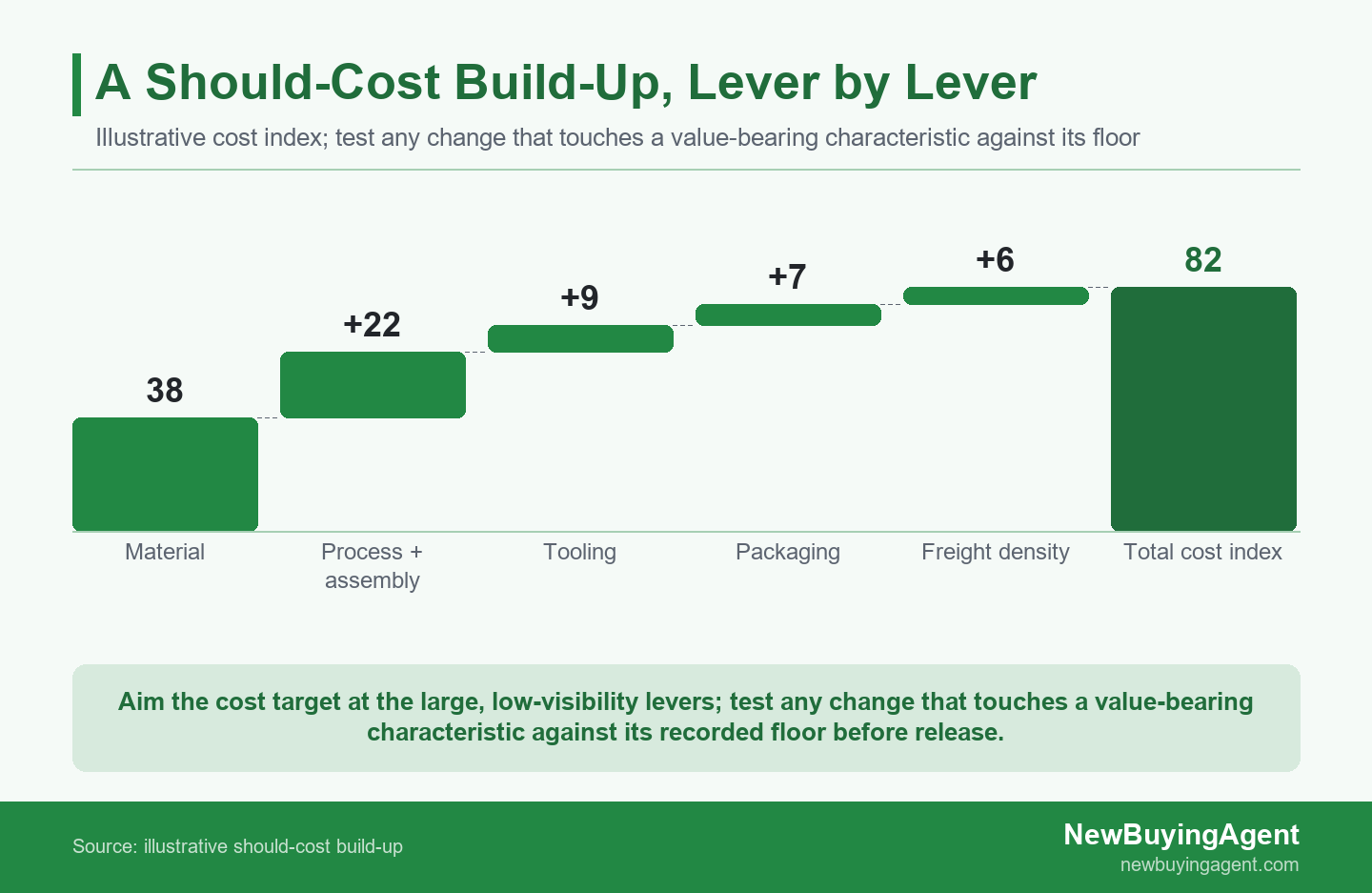
Illustrative should-cost build-up showing material, process and assembly, tooling, packaging, and freight as cost levers with a total index
Must-keep value covers the features the customer bought the product for, such as a light output level, a weather seal, a finish that survives handling, or a fit the product is known for. Removable cost covers the parts of the build the customer cannot perceive, such as an extra fastener, an over-specified tolerance on a hidden surface, an oversized carton, or a process step that repeats a check already covered elsewhere. The gray zone is where the cost decision becomes real. A cheaper material or a faster cycle may be invisible in a sample and visible after a season of use, so the element cannot be removed until it is measured against a floor.
For a product entering China sourcing, NewBuyingAgent's product-supply service sources the product against the value map and the floors written into the brief, using local China factory resources and product-development/QC capability to connect each cost decision to the factory that must satisfy it.
Build a Should-Cost Baseline From a Teardown
A should-cost baseline is an independent estimate of what a part or product should cost. It is built from the part list, the part count, the process steps, and the cycle assumptions rather than from a supplier quote. It shows where the cost sits before a quote anchors the negotiation. It also exposes which levers are large enough to matter. Without a baseline, every cost discussion is relative to the quote in front of the buyer, and a quote that is already low looks like a success even when most of its cost sits in one lever that could move safely.
That structure is the subject of established design and cost-engineering practice. Boothroyd Dewhurst describes DFMA as combining should-costing built from process-based cost models across 25 or more manufacturing processes with product simplification that reduces part count and assembly complexity. Those methods were built for product engineering rather than for a single China order. The transferable lesson is to estimate the cost from the parts and the process, and to treat part count and assembly as first-class levers.
A practical teardown for a consumer product lists the parts and their materials, the process step and cycle time for each, the tooling and its amortization across the order volume, the packaging, and the freight density. The output is a short build-up, not an accounting exercise. Its purpose is to answer one question: which levers can carry the target, and which of those levers touch a value-bearing characteristic?
Where the Cost Actually Sits
The largest cost levers in a consumer product are part count and assembly, material grade and yield, tolerance and finish, packaging, and freight density. Each lever has a different effect on what the customer experiences. Ranking the levers by size and by customer visibility is what turns a target into a plan. The largest levers are often the least visible, and the smallest levers are often the ones a buyer reaches for first.
| Cost lever | Typical share of a should-cost build-up | Customer visibility | Floor test needed? |
|---|---|---|---|
| Material grade and yield | Usually the largest single lever | High when the material is felt, seen or weather-exposed | Yes, when the material is value-bearing |
| Part count and assembly | Large and often reducible | Low if the customer cannot see the internal build | Usually no, unless it affects fit or durability |
| Tolerance and finish | Moderate, hidden in process cost | High on visible or moving surfaces | Yes, on any visible or functional surface |
| Packaging | Small to moderate | Medium, felt at unboxing and in transit damage | Yes, when protection or unboxing is a selling point |
| Freight density | Small but recurring | Low, felt only if the product arrives damaged | No, if protection is unchanged |
Read the table as a targeting rule. Work the large levers whose customer visibility is low first. Treat any lever that touches a value-bearing characteristic as a change that needs a floor test before it can be released.
A small worked check makes the targeting concrete. In an illustrative build-up, material is 38 index points, process and assembly 22, tooling 9, packaging 7, and freight 6. The total is 82 points, and an 8% target is about 6.6 points. Material could carry four of those points, but it is the lever most likely to touch a value-bearing characteristic. Part count and assembly could carry two points with low visibility. Packaging could carry the rest. The point of the sensitivity is not the exact split. It is that the buyer can see which points are cheap to take and which points require a floor.
Guardrails That Stop a Cost Cut From Reaching the Customer
Guardrails name the characteristics a cost change may not alter without a test, an approval, and a re-verification. They stop a cost target from quietly reaching the customer through an unrecorded material, tolerance, or process change. A guardrail is not a longer specification. It is a short list of the characteristics that matter most, each with the evidence required to change it. Written that way, the supplier knows what is fixed and what is open to cost work.
The discipline of controlling changes sits inside quality management rather than beside it. ISO 9001:2015 is the quality management system standard published by ISO/TC 176, Quality management and quality assurance. Its logic of planning, verifying, and approving before release is the same logic a buyer applies to a cost change. The standard does not set the buyer's guardrails. The buyer's own specification and market position do.
Readiness for volume is treated as a decision in its own right. The NIST Manufacturing Extension Partnership is a program administered by the U.S. Department of Commerce's National Institute of Standards and Technology to strengthen small and medium-sized U.S. manufacturers through MEP Centers. The program supports U.S. manufacturers, so the transferable lesson is narrower. Moving from an approved sample to a cost-reduced volume build is a readiness decision that benefits from documented evidence and named ownership, wherever the factory is.
For a buyer who already has a Chinese supplier, the guardrail list is mostly a follow-up problem rather than a sourcing problem. NewBuyingAgent's existing-factory management service connects local China follow-up and quality-control capability to the change record and the floor test, so a cost change and its re-verification can be tracked through production instead of being rediscovered at shipment.
Set the Tolerance and Finish Floor Before the Cut
A floor is set by measuring the value-bearing characteristic on the approved sample and recording the tolerance band and finish level that keep the product acceptable. Any later cost change is then tested against a number rather than an opinion. The floor is what makes a cost change decidable. Without it, a cheaper material either looks fine in a photograph or is rejected on feel, and neither answers whether the customer experience is preserved.
Change control is a defined activity rather than a promise to be careful. IEEE 828-2012 establishes configuration management as identifying configuration items, controlling changes, and reporting the status of configuration items. That standard governs systems and software engineering, so the transferable lesson is narrow. Identify each item that can change, control the change, and keep its status visible. A buyer can apply that lesson to a lens material or a sealing cycle without claiming that a software standard governs the order.
In practice the value floor is a short record per protected characteristic: the measured value on the approved sample, the acceptable range around it, the test method, and the person who accepted it. A cost idea that stays inside the range can proceed. A cost idea that moves outside it needs a new approval, not a supplier decision.
When to Stop Cutting
A design-to-cost program should stop when the next saving requires removing a value-bearing characteristic or a safety, compliance, or durability requirement. Any published saving or performance claim must still be supportable after the change. Without a stop rule, a cost target keeps reaching for the next point and eventually pays for it with the feature the customer bought the product for.
There is also a claims boundary to respect. The U.S. Federal Trade Commission's advertising guidance explains that advertising claims must be truthful and not misleading and that advertisers must be able to substantiate the claims they make. That requirement applies to advertising claims in its own jurisdiction. The transferable lesson is that a cost-driven change should not leave a published performance or savings claim without support.
A workable reject rule is to refuse a cost idea when it crosses a floor, removes a safety or compliance input, weakens a durability property the product is sold on, or invalidates a claim the buyer publishes. When a saving fails one of those tests, the answer is usually to replace the saving with a different lever, not to lower the floor.
Worked Example: A Cost Target That Nearly Removed the Wrong Feature
Test a cost target against the value map and the floors before it is released. Replace a saving that fails the test instead of absorbing it as a hidden downgrade. In a real program the release is rarely all-or-nothing. Some levers are safe to take while others wait on a measurement. The point of the floor is to make that split explicit before the factory commits to a cheaper build.
Illustrative Example: A Cost Target That Changed the Wrong Material
In this illustrative example, a consumer brand is re-costing an outdoor-lighting family of 6 SKUs, 2 finishes and 3 color temperatures, built on a shared housing and a shared lens. It plans 12,000 units for a first production run at a China factory with an 8% lower unit-cost target set after the design freeze. The design is frozen, the tool is cut, a golden sample is approved, and the factory has proposed a cheaper lens material and a shorter sealing cycle to reach the target.
On paper the target is reached. The cheaper lens and the shorter UV-sealing cycle remove the points the buyer asked for. The sample still passes a visual check, so the change is presented as cost-neutral to the customer. Two gaps sit underneath it. The value map marked lens clarity and weather sealing as value-bearing, because the product is sold on light quality and outdoor life. No floor was recorded for either characteristic on the approved sample, so there is no number to test the substitute against. Because the lens is shared, the change reaches all six SKUs, and the affected variants cannot be judged acceptable or unacceptable from the evidence that exists.
The buyer's decision is to hold release for the variants that share the lens while allowing reversible preparation such as carton and manual proofing. The factory is asked to measure lens clarity and weather sealing on the approved sample to set a floor, re-test the substitute lens against that floor, and record the change with a version and an effectivity. The saving is then kept only for the variants that pass. The approved material is restored for any variant that does not.
Before release, the buyer reviews the floor measurement and the substitute test against the approved sample. After release, in-process checks confirm that the protected characteristics stay inside the floor. This illustrative example invents no measured value and no passed test. A closed floor test is not a guarantee for every later unit; the product's own value map, floor, and test method govern the real scope.
Put the Cost Target and the Value Floors Into the China RFQ
Put the value map, the should-cost baseline, the value floors, and the change-approval path into the China RFQ and supply brief. The cost target and the customer experience are then approved together, and each variant carries its own identity. Written this way, competing suppliers quote the same controlled product. "The same as the sample" is replaced by a set of levers the factory may work and a set of floors it may not cross. The brief also tells the factory what it must deliver before a cost change may be released.
Import and standards documentation belongs in that brief rather than at the end of the process. The U.S. International Trade Administration's China Country Commercial Guide covers customs, regulations and standards, including tariff and non-tariff barriers, import requirements and documentation, and product standards. Naming the applicable documentation in the cost brief keeps compliance evidence attached to the release decision instead of surfacing at the port.
Variant identity is what makes a cost change traceable to the right item. GS1 states that a Global Trade Item Number (GTIN) supports the unique identification of trade items, defined as products or services priced, ordered or invoiced at any point in the supply chain. When a finish or a color can be ordered separately, it is a separate trade item. A cost change and its floor test should name the exact item they affect rather than the whole family.
For a product entering China sourcing, prepare the product concept, the specification and design files, the value map and the protected characteristics, the target cost and quantity, the destination and the delivery timing. NewBuyingAgent can use its local China factory resources and product-development/QC capability to develop a product quotation around those requirements, including the value map, the should-cost review and the floor conditions. With that brief ready, send your product requirements to NewBuyingAgent.
Frequently Asked Questions
Is design to cost the same as cost cutting?
No; cost cutting removes spending wherever it can, while design to cost removes only the cost the customer does not value and protects the features the customer does value with a recorded floor. A cost cut is judged by the saving. Design to cost is judged by whether the saving kept the product worth its price. That difference is why design to cost needs a value map and a floor, and a cost cut does not.
How do I know which features the customer actually values?
Ask which features a customer would notice if they changed. Check that against reviews, returns, and the selling points the market pays for. Record the answers as a floor rather than an opinion. The features named in the product's own marketing and in its negative reviews are usually the value-bearing ones. A feature that appears in neither is a candidate for removal, not a protected one.
Can a supplier hit a cost target without changing the specification?
Often yes; part count, assembly steps, yield, packaging and freight density can carry a large share of the target without touching a value-bearing characteristic. That is why the baseline comes before the negotiation. When those levers are exhausted, the remaining target usually lands on a material or a tolerance. That is the point where a floor test is required rather than optional.
When should a cost-reduction idea be rejected?
Reject an idea when it removes a value-bearing characteristic, a safety or compliance requirement, or a durability property, or when it would make a published claim no longer supportable. The test is not whether the sample still looks acceptable. A sample cannot show how a cheaper material behaves after a season outdoors. When an idea fails, the usual answer is to find a different lever, not to lower the floor.
Do I need a full should-cost model for a simple product?
A simple product needs a lighter version, not none. A part list, the main process steps, and one or two measured floors are usually enough to test a quote and protect the visible features. The full build-up matters most when the product has several materials, a shared tool across variants, or a target that can only be reached by changing a material. For a low-complexity product, the map and the floor matter more than the depth of the model.
NewBuyingAgent
Related Resources

Get Started Today
Let's Turn Your Sourcing Goals into RealityWeChat:+86 15157124615
WhatsApp:+86 15157124615
Address:Building 10 #39 Xiangyuan Road, Hangzhou, China
