

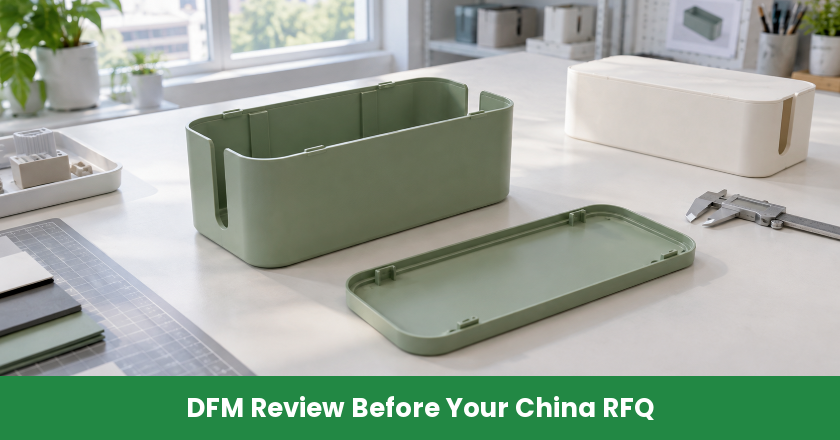
Design for manufacturability (DFM) is the review and adjustment of a product design so it can be made using the intended materials and manufacturing processes while meeting its requirements.
A finished-looking prototype can still leave a factory guessing about tooling, assembly or acceptable quality. Before sending a request for quotation (RFQ) to China, separate the decisions that must be resolved from the assumptions a factory can price explicitly. The aim is a meaningful production quotation, not a premature declaration that engineering is complete.
Send an RFQ That Prices a Defined Design
A useful production RFQ follows a review that resolves design blockers and makes remaining assumptions explicit. Without that distinction, apparently comparable prices may cover different materials, tool concepts or performance levels. Buyers should establish one base design, identify permitted alternatives and keep the later approval of tooling and production separate from the decision to request prices.
- Decision: Resolve unknowns that prevent the product or its required function from being defined.
- Common mistake: Treating a printed appearance sample as evidence that the production process will work.
- Pricing: Request alternatives separately so a cheaper proposal cannot silently replace the base specification.
- Risk: A DFM suggestion needs engineering approval; a quote does not authorize a design change.
Decide Whether the Design Is Ready to Quote
A pre-RFQ DFM review separates a priceable assumption from an unresolved design blocker; it does not approve production. An assumption is priceable when the factory can state what it includes and the buyer can compare the same basis elsewhere. If required function, material scope or geometry remains undefined, the next step is design clarification rather than comparison of production prices.
This does not mean avoiding factories until every detail is finished. Early feasibility discussions can reveal a process limitation or an expensive feature before the design is fixed. Label that request correctly: ask for preliminary feedback or a budget estimate, state what is undecided, and avoid using the response as if it were a confirmed offer for the final product.
The connection between product intent and costing matters here. NIST-hosted design-for-cost research treats target market, volume and price as inputs established before component cost estimation. That supports giving the reviewer commercial context alongside the geometry; it does not turn a research model into a universal factory procedure.
For example, a factory can quote a clearly specified smooth finish and price a defined textured alternative separately. It cannot produce a reliable like-for-like offer if “premium finish” is the only acceptance requirement. Similarly, a forecast should be distinguished from the first purchase quantity: a production route attractive at the forecast volume may not suit the initial order.
Use this test before sending the RFQ: can each remaining assumption be described, priced and accepted or rejected without changing an unstated product requirement? If not, close that issue first. If yes, include it visibly in the request and reserve the necessary sample or process validation for the appropriate approval stage.
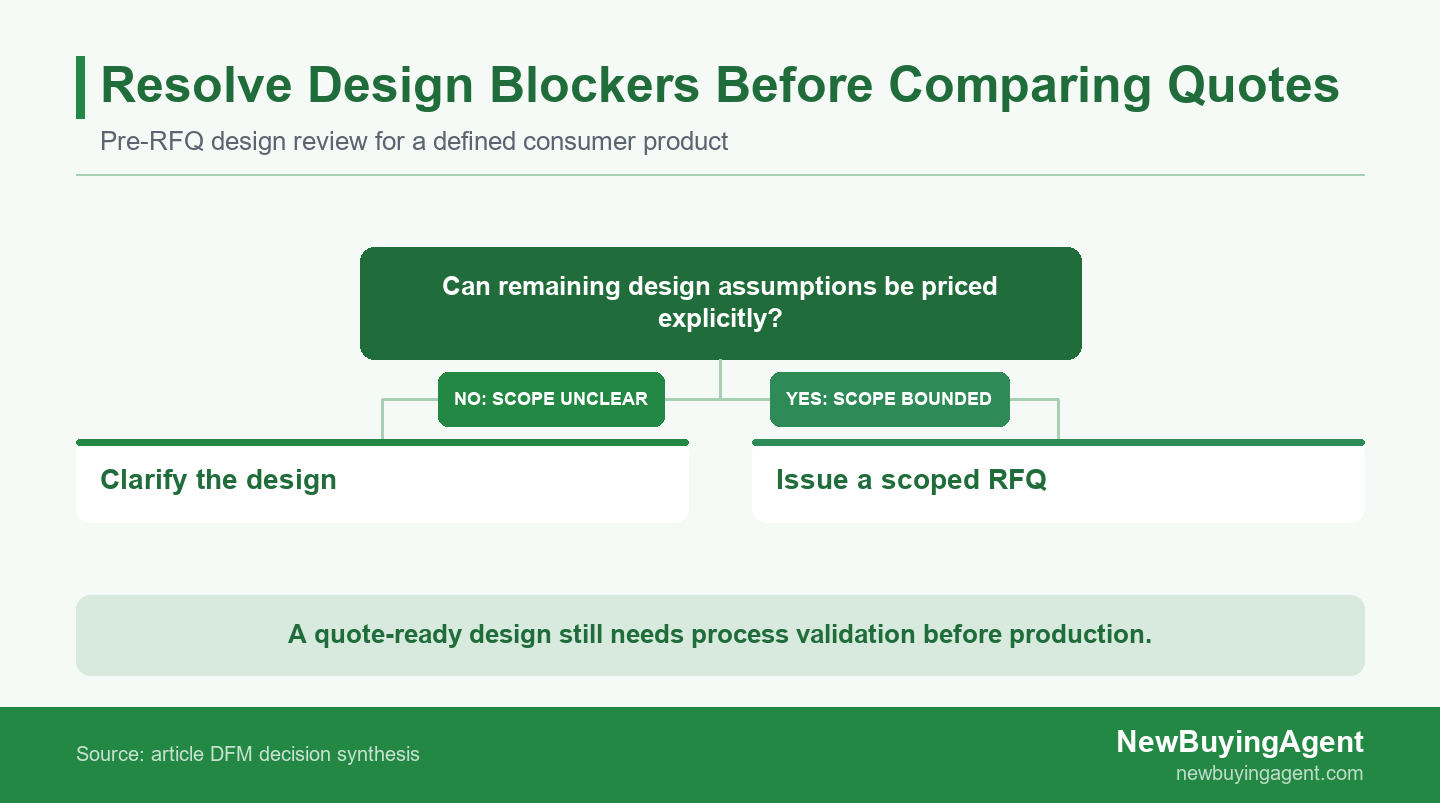
Decision tree separating unbounded design blockers from explicit assumptions that can enter a production RFQ
Give the Factory One Consistent Design Baseline
One aligned model, drawing and product brief gives the factory a consistent design to review and price. The documents should identify the same revision and distinguish required features from areas open to change. A detailed file package is not useful if its model, dimensions and material notes disagree, because the factory must either stop or choose an interpretation the buyer may not share.
Xometry's technical-drawing guidance recommends revision references and complete material and surface-finish specifications. Apply that communication discipline without copying its process tolerances into an unrelated product: the drawing must explain this part, its interfaces and its intended manufacture.
Include the native or agreed exchange-format CAD model, a readable drawing, an assembly view and a brief explaining use conditions. Identify critical mating features and the dimensions that protect them. State units, material grade where selected, finish zones and any prohibited substitutions. If a requirement is performance-based rather than material-specific, explain the required performance and how a proposed material would be evaluated.
Mark reference samples by what they prove. A color chip may define appearance but not resin properties; a hand-finished prototype may demonstrate ergonomics but not production assembly. Where documents disagree, correct them instead of relying on an informal instruction that one file “usually takes priority.” Name the person responsible for resolving technical questions and give every supplied file an identifiable revision.
For a new consumer-product range, these inputs help connect design intent with an achievable supplied product. NewBuyingAgent's product-supply service uses local China factory resources and product development capability to quote and supply products against purchasing needs. Include the must-have features and permitted changes so a sourcing proposal can address price and quality without losing the product's intended use.
Check the Design Against Its Intended Production Process
Process-dependent features and required performance must be reviewed together before a production RFQ. A working prototype may answer a shape or handling question while leaving mold release, assembly access or repeatability unresolved. Ask which production process the review assumes and whether its recommendations preserve the features that matter to the buyer, rather than accepting a generic statement that the design is manufacturable.
The checks below use molded consumer products as a concrete example. For another process, keep the same questions about access, variability and verification, but change the technical checks with the relevant engineer. Do not apply a molding rule to a machined part, a sewn product or a fabricated metal assembly merely because all are sourced from China.
For Molded Parts, Check Walls and Tool Release
Wall transitions, draft, undercuts and finish locations can change tooling assumptions even when the outside shape is unchanged. Ask the reviewer to mark the affected feature on the model or drawing, explain the likely production issue and identify the proposed change. “Optimize for molding” is not specific enough to assess its effect on appearance, function or price.
Protolabs' wall-thickness guidance explains that non-uniform walls can cause sink, warp and dimensional inaccuracy in injection-molded parts. Sink is a local surface depression; warp is a distortion of shape. Flag thick junctions and abrupt transitions for review, but have the appropriate engineer confirm changes for the selected resin and product loads rather than adopting one thickness rule for every part.
Draft is the taper that helps a molded part come off the tool. Protolabs describes draft as reducing surface drag during release and warns that limited draft can lead to damage during ejection. Its guidance is a reason to ask for a feature-specific recommendation, not a basis for imposing the same angle on every material, texture and tool.
Also identify features that obstruct the proposed direction of tool opening, known as undercuts. Ask whether they require an additional tool movement or a design change and whether that assumption is included in the quote. For visible surfaces, agree which areas may show parting lines, gate marks or ejector marks. Those locations can affect the buyer's cosmetic acceptance even if the part performs correctly.
Then Check Assembly and Inspection Access
A part can be manufacturable on its own yet difficult to assemble or inspect in the finished product. Review the assembly sequence, access for tools and the interfaces between parts before accepting a process proposal. The useful question is not merely whether components can be produced, but whether the intended product can be put together and checked without an unplanned operation.
Use an assembly view to follow each joining operation. Can the operator reach the fastener after the previous part is installed? Can similar-looking components be fitted in the wrong orientation? Does closing a housing hide a feature that must be inspected? Ask the factory to identify fixtures or intermediate checks that the proposed sequence needs, and make their quoted scope explicit.
ASQ's cost-of-quality guidance distinguishes prevention work, including specifications and quality planning, from appraisal work such as checking products against agreed specifications. In a DFM review, defining a check is prevention planning; it is not evidence that a future product will pass that check.
For a critical fit or fastening function, identify the acceptance criterion, measurement or test method, responsible party and required sample condition. A vague instruction such as “lid should fit well” leaves both engineering and inspection unresolved. If testing requires finished production material, say so: an appearance prototype cannot substitute for that evidence simply because it closes successfully once.
Classify Findings Before Comparing Prices
DFM findings need different purchasing actions: resolve blockers, request bounded alternatives and defer only details that cannot change the quoted scope. This prevents a long issue list from stopping useful factory dialogue while protecting the price comparison from undefined requirements. Classification should reflect each issue's effect on function, manufacturing feasibility and the offer, not how easy it appears to fix.
A blocker prevents a meaningful base quote. An alternative has a defined base and a separately stated variation. A deferral has a named owner and deadline, with confirmed limits on cost, tooling and delivery impact. If those limits cannot be stated, the item is not ready to defer.
Illustrative Scenario: Six Findings in a Cable-Box Design
In an illustrative project for 6,000 cable-management boxes, the design review covers all 6,000 boxes before a production RFQ is issued. A consumer brand has a printed appearance prototype of a passive desktop box with a removable lid. It looks finished, but the review below finds six unresolved items. This is a constructed purchasing example, not a NewBuyingAgent customer case.
The model and drawing show different latch geometry, and the brief does not define acceptable lid retention. Those two issues prevent a consistent base quotation. Texture and hidden rib design can instead be presented as bounded alternatives. Final artwork and carton-print copy can be deferred only after their production method, coverage, carton size and cost assumptions are fixed.
| Finding | RFQ treatment | Required action |
|---|---|---|
| Conflicting latch geometry | Blocker | Align model and drawing |
| Undefined lid retention | Blocker | Define acceptance and test |
| Surface texture choice | Alternative | Price named finishes separately |
| Hidden rib proposal | Alternative | Preserve function; price the change |
| Final artwork | Conditional deferral | Fix method, coverage and deadline |
| Carton-print copy | Conditional deferral | Fix carton scope and deadline |
The product manager holds the production RFQ while engineering aligns the latch revision and specifies how retention will be assessed. The revised package names a base texture and rib design; any proposed variation must be quoted separately and remains subject to performance review. The team records the artwork deadlines rather than asking the factory to assume unlimited later changes.
The result is a defined request: two blockers are closed, two alternatives are isolated and two deferrals have limits. Before treating responses as comparable, the buyer checks that each quotation acknowledges the same revision and assumptions. Tooling decisions and production-process samples still require their own review; the illustrative classification does not prove that the design will pass testing or deliver a saving.
Turn Factory Feedback into an Approved Revision
Factory feedback remains a proposal until the product owner approves the change and the design baseline is updated. A suggestion that makes a tool simpler may also alter appearance, assembly or durability, so purchasing should not accept it solely because the quoted price falls. Record the affected feature, reason, expected benefit and verification needed before deciding whether the base design should change.
Microsoft's engineering change management documentation separates a change request from its review and approval by designated approvers. That is a useful distinction even when the buyer uses a simple issue log rather than this software: receiving a suggestion is not the same as authorizing it.
Ask for an annotated image or drawing, not just a revised CAD file with no explanation. The designer evaluates function and interfaces; the quality lead checks how acceptance will be demonstrated; purchasing confirms price, tooling and schedule consequences. These may be the same person in a smaller project, but each decision still needs an explicit answer. Retain rejected proposals so they cannot reappear later as supposedly agreed changes.
When an existing Chinese factory will make the revised product, the implementation risk shifts to using the approved version consistently. NewBuyingAgent's existing-factory management service provides local communication, production follow-up and quality-control support. An approved revision and its acceptance checks give that support a concrete basis for following the order, rather than leaving the factory to interpret old sample comments.
Close each accepted issue with the new revision reference and factory acknowledgment. For a rejected proposal, state whether the original design remains feasible at the quoted scope or whether a different manufacturing approach is needed. Silence is not a useful disposition.
Package the Review with the China RFQ
A production RFQ should combine the controlled design package, the DFM issue log and the purchasing requirements. This lets the factory identify what it is pricing, which assumptions remain and what evidence will be needed later. Request a response against that package instead of a standalone unit price, especially when tooling, alternatives or acceptance methods could materially change the offer.
- Design identity: List the model, drawing, assembly and specification revisions, with units and an agreed file format.
- Product requirements: State intended use, required performance, finish zones, material constraints and the destination market.
- Review findings: Show closed blockers, the approved base, separately priced options and any permitted deferrals with deadlines.
- Commercial scope: Distinguish the first order from forecasts; request explicit tooling, sample, packing and delivery assumptions.
- Response format: Ask the factory to acknowledge the revision, list exceptions and identify what must be confirmed before tooling or production approval.
Review exceptions before ranking prices. If a quotation changes a material or excludes a required check, resolve that difference first. A lower number is informative only after the offered product and scope are understood. Keep a short clarification record tied to the quotation so the purchasing decision does not depend on reconstructing messages weeks later.
If the design is ready for a product offer, prepare the current files, must-have performance, open DFM findings, quantity, target price, destination and delivery timing before you request a product quote from NewBuyingAgent. As a one-stop China sourcing agent for global buyers, it uses local factory resources and product/QC capability to quote and supply products around those requirements. The useful outcome is a product quotation aligned with quality and delivery needs, not an assumption that every engineering issue has already been validated.
Frequently Asked Questions
Can a buyer start without 3D CAD?
A buyer can start a feasibility discussion without 3D CAD, but should not treat the resulting estimate as a fully defined production quote. Sketches, dimensions or reference samples can explain the intended product. Agree who will create the production design, what that work includes and how it will be approved. Design development may require a separate scope and fee before reliable tooling or unit pricing is possible.
Does a factory DFM report approve product safety?
A factory DFM report does not by itself approve product safety or market compliance. Its scope may cover only particular manufacturing features, not all intended uses or destination-market requirements. Ask exactly what the review evaluates and excludes. The responsible product team should determine applicable requirements and obtain appropriate specialist or laboratory input where needed; a manufacturability comment is not a substitute for that work.
Should every factory receive the same DFM package?
Every factory asked for a comparable quote should receive the same approved base package. Label alternatives separately and share material clarifications with the same quotation group, subject to legitimate confidentiality restrictions. Do not distribute one factory's proprietary tool design as a shortcut. Instead, communicate the buyer-owned product requirements consistently and assess each proposed manufacturing solution against the same functional and commercial scope.
What if there is no budget for a detailed DFM study?
A limited budget should narrow the first review to decisions that could invalidate the quote or force irreversible rework. Prioritize unclear function, conflicting files and uncertain manufacturing feasibility with the relevant engineer. Ask what review is included and what is chargeable rather than assuming comprehensive engineering is free. Keep unresolved risk visible and delay the affected commitment if there is not enough evidence to proceed.
NewBuyingAgent
Related Resources



Get Started Today
Let's Turn Your Sourcing Goals into RealityWeChat:+86 15157124615
WhatsApp:+86 15157124615
Address:Building 10 #39 Xiangyuan Road, Hangzhou, China
