

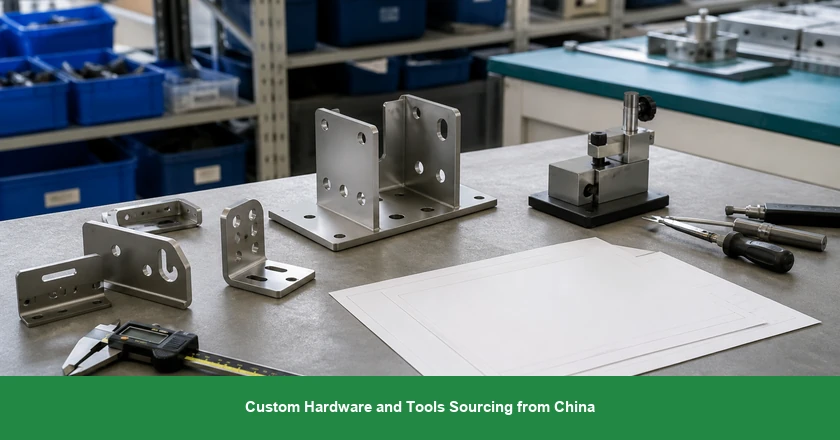
A custom hardware order becomes manageable when a buyer can verify the same thing at every handoff: the part that was quoted, sampled, approved, produced, inspected, and shipped. That sounds elementary, yet a drawing revision in chat, an unlabelled prototype, or a late finish change can break that chain long before a shipment is visible.
For custom hardware and tools sourcing from China, the practical question is not simply whether a factory can make a part. It is whether the buyer can connect the technical requirement to production evidence before committing to tooling, bulk material, or a release date. The framework below is procurement guidance, not engineering validation, legal advice, or product-specific certification.
What Makes a Custom Hardware Order Controllable
Custom hardware sourcing becomes controllable when one released part version stays connected to process, sample, change, and lot evidence.
Use four proof gates:
- Release the requirement: identify the part version and the features that govern fit, function, finish, or packing.
- Check route fit: make the proposed method answer those critical requirements before comparing prices.
- Approve the right sample: state what it proves and how the critical features are checked.
- Control the next change: preserve a written decision and a practical lot reference before bulk release.
This sequence does not make every project slow. It makes the irreversible decisions visible. A simple catalog modification may move through the gates quickly; a stamped, machined, forged, assembled, or safety-relevant part may need deeper product-specific input. In either case, a low quote is comparable only after the scope and evidence basis are clear.
Release a Technical Package Before Comparing Quotes
ISO 9001:2015 specifies requirements for a quality management system when an organization needs to consistently provide products and services meeting customer and applicable statutory and regulatory requirements. That does not make an ISO certificate proof that a particular bracket, wrench, fixture, or hand tool meets your drawing. It does explain why the buyer should give every quotation the same controlled starting point.
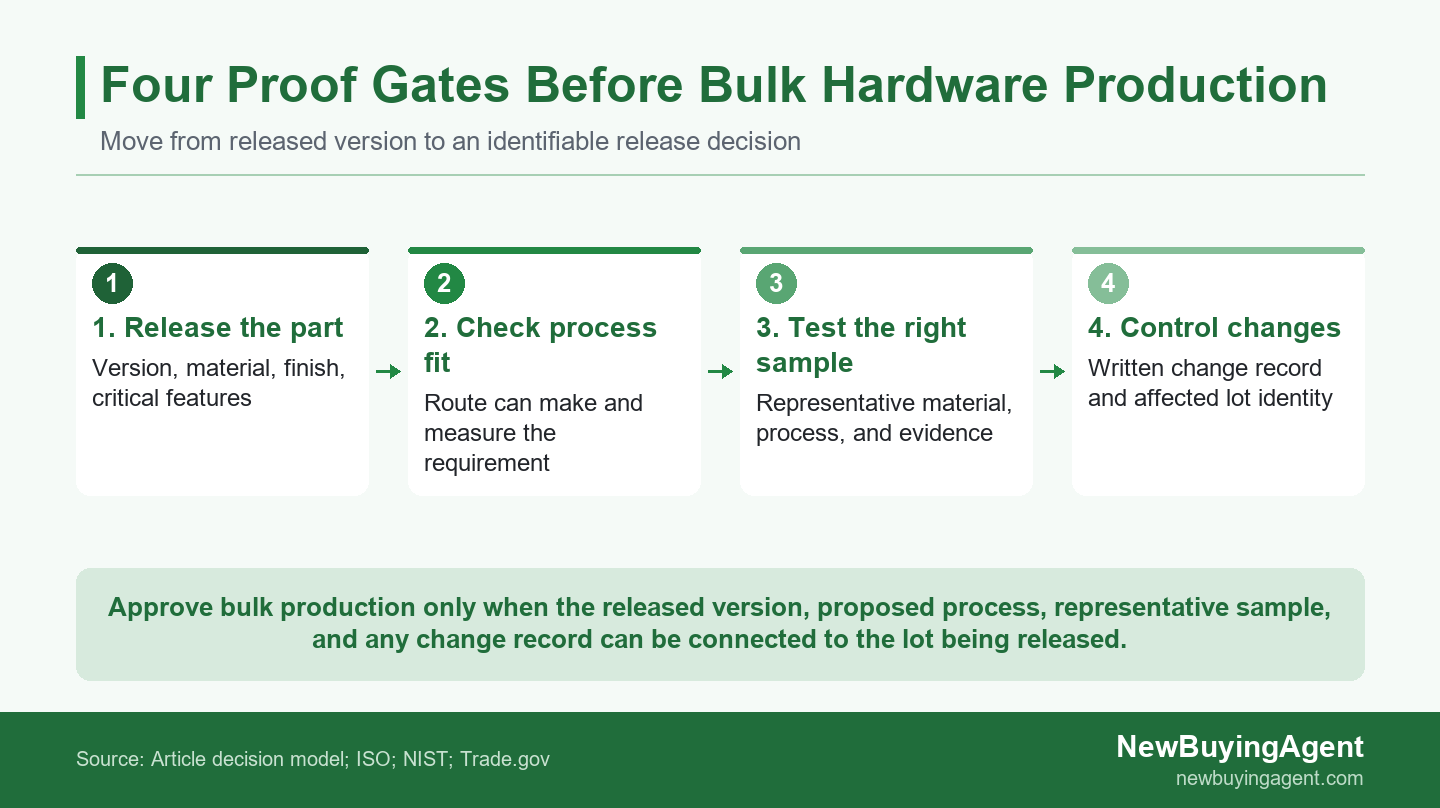
Four-step flow showing proof gates before custom hardware bulk release
A useful release package identifies the part number and revision, material or approved alternatives, finish, quantity, destination, and the features that decide fit or function. Add the acceptance evidence needed for those critical features: for example, a dimension and datum, a thread gauge result, a coating reference, an assembly check, or a functional load condition. Put open questions in the package too. Hidden uncertainty often returns later as an assumption embedded in the unit price.
| Release-file element | What it fixes before quotation | Evidence to request later |
|---|---|---|
| Part ID and revision | Which geometry and commercial scope are being priced | Sample label and order record use the same revision |
| Material, finish, and assembly basis | Whether an alternative changes function, durability, appearance, or cost | Material, finish, or assembly confirmation tied to the release |
| Critical feature and test condition | What cannot be judged by appearance alone | Named method, result, and responsible reviewer |
| Quantity, packing, destination, and delivery term | Whether a quote has the same production and delivery basis | Written commercial record before production or packing release |
NIST explains that measurement uncertainty sets reasonable bounds for a measurement result. For a buyer, the practical implication is modest but important: if a hole position, thickness, flatness, torque, or interface fit is critical, name how it will be checked. A photograph can show a sample exists; it normally cannot show whether the agreed measurement condition was met.
Match the Requirement to a Production Route
A proposed production route must be tested against the released requirements that affect fit, function, finish, quantity, and measurement.
Ask route-specific questions instead of accepting a process label as an answer. For a stamped part, ask how burr direction, hole location, formed features, and coating access will be held. For machining, identify datums, thread verification, surface condition, and the point at which a fixture is required. For forged or cast hardware, clarify machining allowance, critical interfaces, and which feature will be measured after the relevant operation. For an assembled tool, identify the component, fastener, torque, or functional step that must be demonstrated.
The aim is not to prescribe manufacturing from a purchase order. It is to make the proposed route answer the buyer's released requirements. When a proposal relies on a different material, process sequence, finish, packing basis, or measurement assumption, show it as a conditional path—not as an invisible substitution.
For a buyer preparing an early China-side discussion, NewBuyingAgent can work from this kind of concise technical package rather than from a loose photo brief. That keeps the later product-supply conversation focused on the part, its evidence needs, and the decision the buyer still owns.
Make the Sample Prove the Production Route
Trade.gov says good due diligence helps protect a company from problems, loss, and liability. A custom sample is one part of that diligence. It should answer whether the intended material, production route, finish, and inspection logic can reproduce the released part—not merely whether one hand-finished piece looks acceptable.
State what kind of sample is being approved. A visual prototype can be useful for form, packaging, or stakeholder review. A first article is an early production part made against the released requirements before bulk production; when it is made by the intended route, it carries stronger production evidence. If the sample uses a temporary method, different material, or special finishing step, record that difference and avoid treating it as final production proof. The buyer can then decide whether the next gate is a revised sample, a process review, or a controlled bulk release.
Define the Acceptance Rule Before Sampling
Trade.gov says a pro forma invoice should include a description of goods, quantity, price, weight, and specifications. Keep that documented goods description aligned with the acceptance rule. An inspection plan may organize how many pieces are reviewed, but it cannot decide which feature is critical, what counts as a defect, or which test method proves the requirement.
Before sampling, agree the inspection population, the critical and noncritical checks, the test or gauge method, how results are recorded, and what happens when a result fails. AQL, or acceptance quality limit, is a sampling approach for an inspected lot; if it is used, state it as one element of the agreement rather than a replacement for the technical specification. A statistically organized sample cannot validate a feature that was never defined.
Record What the Sample Actually Proved
A sample approval record should identify the version, intended process, evidence reviewed, unresolved boundary, and release decision.
A concise record can be more useful than a long email chain. It should say whether the review approved appearance only, production readiness, a limited correction, or no release. Attach or reference the drawing revision, sample label, measurement evidence, and any remaining exception. Name the next milestone too: tooling release, first bulk run, packing review, or a further sample. That gives the buyer and China-side team a shared decision record when production begins or a later question appears.
Control Changes and Keep the Affected Lot Identifiable
Trade.gov describes Incoterms as rules that clarify tasks, costs, and risks associated with international transportation and delivery. The same commercial discipline matters when a custom-hardware order changes. A material, finish, packing, destination, or delivery-term change can alter the buyer's decision even when the unit price seems unchanged.
Use a short change notice: a written record that names the released version, proposed difference, affected scope, evidence required, and approval decision. The notice separates three decisions that are too often mixed together: whether the part may change, whether the existing sample still applies, and whether the change affects the delivery or commercial record. No buyer needs a ceremonial form; they need a reviewable before-and-after basis.
Trade.gov says a pro forma invoice describes goods, quotes a price, states terms of sale, and provides an estimated shipping date. If an approved change affects the goods or delivery basis, update the commercial record as clearly as the technical record. Alongside that record, preserve a practical batch or lot reference so a hold, recheck, or exception can be confined to the affected scope rather than debated from memory.
Lot traceability means keeping a product group linked to its production record and inspection record, so an observation can be connected back to the relevant group of parts. For a one-lot launch, the identifier may be a simple production date, part revision, and batch reference. For recurring orders, it may also distinguish process changes, material receipts, or packing runs. The appropriate depth depends on the product and agreement. What matters is that the buyer can decide whether to release, rework, replace, or investigate the affected group.
Illustrative Scenario: A Bracket That Looked Right but Was Not Ready
This illustrative scenario is a decision aid, not a reported client outcome. It is an example, not a documented customer result.
For context on the kind of China-side work that can sit around a project like this, readers can review NewBuyingAgent success stories. They are not a substitute for the part-specific requirement package or acceptance evidence in this example.
Decision: Hold Bulk Release Until the Functional Feature Is Evidenced
This illustrative 5,000-piece bracket scenario shows why an attractive sample is not enough when a critical functional feature has no defined measurement or test.
A retailer is sourcing a custom powder-coated steel mounting bracket for a tool-storage line. 5,000 brackets across 1 initial production lot, with a production sample requested before bulk release. The buyer has an outline drawing and an appearance reference but has not defined the critical hole-position measurement or load check.
The first sample fits loosely in a display mock-up but shifts after repeated mounting. The sample record lists color and overall dimensions but not the hole-position datum or functional load condition.
The sample proves appearance only; without a defined measurement and function check, the buyer cannot tell whether bulk production will reproduce the intended installation behavior. Hold the bulk release, identify the critical hole-position feature and test condition, and request a revised sample from the intended stamping and finishing route.
Issue a revised drawing record, tag the sample with the new revision, and require the proposed process evidence before the lot moves forward. Release only after the revised sample meets the stated measurement and functional check and its record identifies the released version. This illustrative example has no universal tolerance, load, testing, or compliance outcome; requirements depend on the part, market, and use case.
Choose the China-Side Path That Matches the Project
NewBuyingAgent's We Supply service is designed for buyers who need products supplied from China after they share their purchasing requirements. For a new program, buyers can use NewBuyingAgent's product-supply service with a complete hardware brief.
That brief gives a China-side sourcing discussion a practical starting point. Include the product purpose, released or working requirements, quantity, target price, delivery destination, timing, critical evidence, and the decisions still open. A controlled request can contain open questions; it should not disguise them as fixed requirements. For example, a buyer may ask whether a proposed process can meet a hole-position condition, while making clear that the requirement has not yet been approved for bulk release.
NewBuyingAgent can coordinate the product-supply work around the buyer's stated need, while the buyer retains approval for product-specific technical, commercial, and release decisions. A productive first discussion separates information that is fixed from information that needs a response: a current drawing revision, material and finish preferences, sample purpose, expected order scale, market destination, packing constraints, and the evidence required before the next gate. This prevents a request for clarification from being mistaken for authority to alter the part.
The handoff also benefits from a named decision owner. If engineering owns functional approval, procurement owns delivery and commercial approval, and a brand team owns appearance, the brief should say so. China-side follow-up is more useful when the team knows whether it is gathering an answer, arranging an agreed check, or escalating a decision that remains with the buyer. That distinction reduces avoidable delay without converting an agent into the product approver.
When an Existing Hardware Factory Needs Local Follow-Up
NewBuyingAgent's We Manage service is for buyers using existing China suppliers who need local production, quality, and logistics follow-up. A buyer that retains a factory relationship can use NewBuyingAgent's factory-management service for an existing China hardware factory.
This is a different situation from starting a new product-supply program. The buyer keeps the factory relationship but needs clearer production progress, inspection evidence, packing confirmation, or issue follow-up close to the work. The local task can be tightly scoped: confirm that the batch being checked uses the stated revision; compare a packing reference to the approved basis; collect the named evidence before a release decision; or raise a change for buyer approval.
In both paths, the handoff is stronger when the buyer shares the current part revision, sample decision, known exceptions, required evidence, and the next irreversible milestone. That avoids an artificial supplier-selection exercise and puts attention on the actual product and production decisions. It also gives the buyer a clean way to assess a response: does it answer the released requirement, identify an assumption, or require a decision from the buyer?
Before the inquiry is sent, consolidate the latest files in one place. Note which revision is current, which sample was reviewed, which result remains open, and which shipment or production point is affected. This modest preparation makes a local follow-up request easier to act on. It also prevents a new stakeholder from relying on an old attachment, a superseded price basis, or an approval that applied only to an earlier sample.
When the project has reached that point, prepare the drawing revision, material and finish notes, quantity, target price, destination, delivery timing, and acceptance evidence. State whether the need is a new China-supplied custom program or local follow-up for an established factory. Then share the custom hardware project brief with NewBuyingAgent for a practical discussion around price, quality, market fit, and delivery.
Frequently Asked Questions
What should a custom hardware RFQ include?
A custom hardware RFQ should identify the released part version, material, finish, critical features, quantity, delivery destination, and approval evidence. Add drawings or requirement sheets, acceptable alternatives, packaging basis, delivery term if known, and the open questions that require an answer. The goal is not a longer RFQ; it is a request whose scope can be compared without hidden assumptions.
Is a prototype enough to approve production?
A prototype is not enough for production approval when its material, process, finish, or measurement evidence differs from the proposed production route. It can still be a valuable visual or ergonomic checkpoint. Label what it proves, then decide whether a production-representative sample, a functional check, or a revised record is required before bulk release.
Which custom hardware changes require written approval?
Any change that can affect fit, function, safety, material, finish, packaging, compliance evidence, or the agreed test method should be approved in writing before affected production continues. Also record changes to quantity, destination, packing, or delivery terms when they alter the commercial decision. A concise before-and-after notice is usually more useful than a vague approval in a chat thread.
When is China-side factory management the better fit?
China-side factory management is the better fit when the buyer already has a chosen hardware factory but lacks reliable local production, quality, and logistics follow-up. For a new project that needs China-supplied hardware, start from a complete brief. The appropriate path depends on whether the buyer needs a new product-supply program or scoped support around a retained factory relationship.
NewBuyingAgent
Related Resources
Get Started Today
Let's Turn Your Sourcing Goals into RealityWeChat:+86 15157124615
WhatsApp:+86 15157124615
Address:Building 10 #39 Xiangyuan Road, Hangzhou, China
