

A commercial invoice audit is a check of the seller’s invoice against the agreed transaction, actual shipment and applicable document requirements.
Start with the approved order, actual packing list and destination requirements; a neat invoice with a correct total can still carry the wrong unit, party or product description. Use the following twelve checks to find those mismatches before the document is released.
Release the facts, not just a tidy invoice
Treat the invoice as a commercial record tied to a particular transaction. Release it only when the goods, quantities, prices and party details reconcile with current supporting records, and the responsible people have resolved the destination-specific questions. The checklist below is a practical audit tool; it does not establish a universal legal invoice format.
- How it works: check what will actually leave the factory, including partial deliveries and changed packing.
- Common mistake: pieces, sets and cartons cannot be substituted without a documented conversion.
- Decision: a commercial price correction and a customs-value adjustment may require different records and owners.
- Timeline: confirm which corrected file the seller, forwarder and responsible declarant will use.
Set the shipment and destination scope before checking fields
A commercial invoice audit reconciles the seller’s transaction record with the goods actually being shipped and the information needed for the applicable declaration. Begin by identifying the shipment, parties and destination, then check the field evidence rather than the appearance of the form. Resolve mismatches with the party that owns the underlying fact before releasing the current document.
Collect the current purchase order or contract, agreed price changes, approved product specifications, packing list and invoice draft. Identify whether this is a complete order, a partial shipment, a replacement or a no-charge movement. Record the destination and importer so the reviewer can ask for the right local requirements. A previous shipment’s accepted invoice is useful background, but it is not proof that the new goods or route need identical information.
The International Trade Administration’s commercial-invoice guidance advises checking country-specific requirements: some countries prescribe a form, while many accept a seller or exporter’s form containing the pertinent information. For a China shipment, use that principle to establish the actual destination requirements rather than copying another market’s document wording.
On the export side, China’s customs declaration rules, reproduced by MOFCOM require truthful, accurate and complete declarations and address supporting commercial documents. An invoice review therefore needs to support the responsible exporter or declarant’s work, rather than replacing their declaration responsibilities. Ask them what information and supporting records the particular shipment requires.
Accurate descriptions begin with reliable product information from the factory. For recurring China procurement, NewBuyingAgent’s local China factory resources and product-development and quality-control capability are relevant to confirming specifications and packing facts behind the invoice. The buyer should still identify who approves commercial terms and who confirms declaration requirements for the route.
Keep the evidence roles distinct: the order establishes agreed commercial terms, the packing record describes the physical shipment, and the declaration review addresses the applicable origin, classification and value questions. The invoice must reconcile with these records without disguising a difference between them.
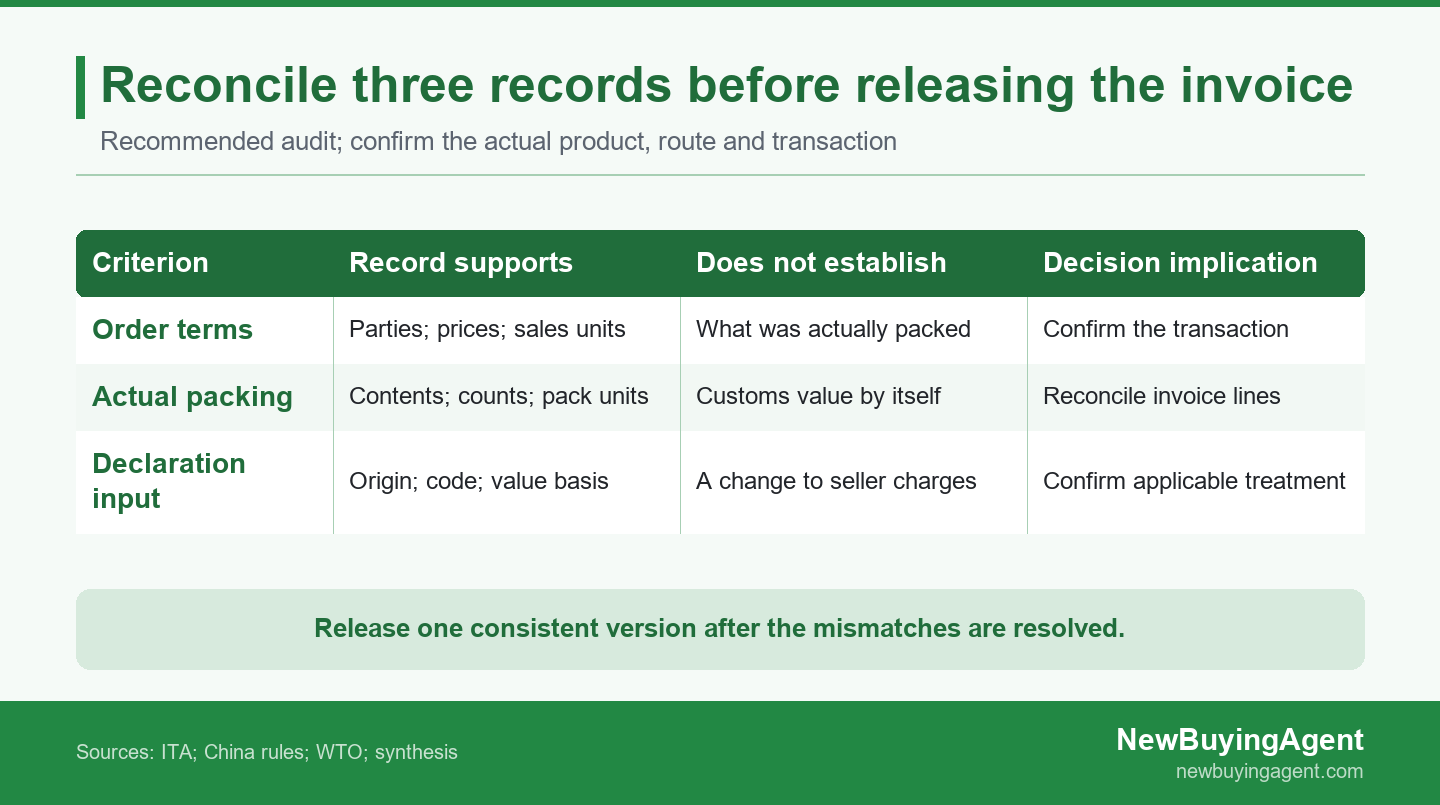
Reconcile order terms, actual packing and declaration inputs; the commercial invoice should not hide differences between them.
Use twelve checks to reconcile the commercial invoice
Use the matrix as a working review record: compare every applicable field with its source document, assign a correction owner and retain the resolution. These are recommended audit areas, rather than twelve fields mandated in the same form by every country. If a requirement belongs in a supporting document instead of on the invoice, record where it is supplied and have the responsible party confirm that treatment.
Copy the matrix into the shipment review and add the actual value, supporting file or reference, reviewer, status and resolution date for each row. Mark a row complete only after checking the current evidence. Where information is missing, enter the question and named owner; a blank cell must not silently become approval. Add product-specific certificates or destination fields when the responsible declarant identifies them.
| Field | Compare with | If wrong | Owner |
|---|---|---|---|
| 1. Invoice ID, date, version | Issuer record | Replace old copy | Issuer |
| 2. Seller / exporter | Contract; actual roles | Confirm party | Seller |
| 3. Buyer / consignee / importer | Order; entry needs | Clarify roles | Buyer |
| 4. Order reference | Current agreed order | Resolve linkage | Buyer |
| 5. Goods / specification | Approved item details | Correct description | Product lead |
| 6. Quantity / sales unit | Order; packing list | Reconcile units | Seller |
| 7. Unit price / currency | Agreed price | Verify price basis | Buyer |
| 8. Amounts / charges | Lines; charge record | Recompute; flag extras | Finance |
| 9. Trade term / place / version | Sale contract | Specify exact place | Seller |
| 10. Origin | Origin evidence | Confirm per item | Importer |
| 11. HS classification | Item; relevant tariff | Confirm code | Broker |
| 12. Packing / shipment references | Actual packing | Match shipment | Logistics |
Confirm the parties and the transaction being invoiced
Check legal names and addresses against the actual contract and shipment instructions. Seller, exporter, buyer, consignee and importer describe roles; they are not interchangeable labels simply because a template offers only a few boxes. Where roles differ, record the relationship and confirm how it must be shown for this shipment. Link the invoice to the current order and identify the portion being shipped, so an old order balance is not mistaken for the shipment quantity.
Destination rules can be more specific than a familiar supplier template. For example, U.S. invoice-content requirements address descriptions, quantities, purchase-price and currency information, relevant charges and origin. That is a U.S. import example, not a requirement list to transfer unchanged to every destination. Ask the importer or broker to identify the applicable omissions before the seller finalizes the document.
Also verify that the invoice identifier and date distinguish this document from earlier drafts or other shipments. Do not invent a new seller or alter an address merely to make documents look alike; resolve the underlying party detail with the issuer.
Match product descriptions, quantities and classification evidence
A product description should let the reviewer connect each line to the approved item and actual goods. Check the relevant material, function, model and specification rather than relying on a vague label such as “accessories.” An internal SKU can help connect records, but it should not be the only explanation of an unfamiliar product. Ask the product owner for missing technical facts before a broker is expected to classify it.
Trace the quantity by item and sales unit. A set may contain several components; a carton may contain several sets. Retain the pack conversion used to reconcile the packing list, and distinguish sale quantity from package count. Check mixed cartons, partial deliveries and replacement goods explicitly, because copying the original order quantity can overstate what is leaving the factory.
Classification needs the actual product facts and the applicable tariff. The ITA explanation of the Harmonized System describes a six-digit international foundation, with countries able to add longer codes. Do not assume a full national code supplied for one country is valid in another. Have the responsible broker or declarant confirm the relevant extension and product description; this checklist cannot assign a code from a generic item name.
Origin also needs its own evidence. A China shipping address or a supplier’s location alone does not establish the origin of every item. Refer uncertain origin questions to the responsible party with the product and production facts, rather than selecting a country because it matches the dispatch port.
Reconcile amounts, currency and the agreed trade term
Recalculate each line from its stated quantity, sales unit and agreed unit price, then reconcile the merchandise total and any separately stated charges. Confirm the currency rather than relying on an ambiguous currency symbol. Compare discounts, credits and price changes with their commercial basis, and distinguish a deposit already paid from a change in the price of the goods. A remaining payment balance is not automatically the full value of the transaction.
Where the parties use Incoterms rules, the ICC guidance on incorporating the rules calls for the chosen rule, named port, place or point, and version. The rules allocate obligations, risk and costs; they do not replace the complete sale contract or determine every customs-value issue. Check the exact named location against the agreement so freight and other cost discussions start from the same commercial basis.
If a charge appears in the freight quotation but not in the seller’s invoice, identify who charges it and where it is recorded. The resolution may be a separate supporting record or valuation adjustment, not a newly invented invoice line. Likewise, do not delete a genuine seller charge merely because another document shows a different total. First explain the difference.
Keep the invoice amount and customs-value work distinct
The seller’s invoice amount records commercial charges, while customs value follows the applicable valuation rules. The figures may differ for a valid reason, including an adjustment supported outside the invoice. Identify that reason and its evidence before deciding whether the seller must correct the invoice or the responsible importer needs a separate valuation record. Changing a number merely to make two totals match conceals the issue.
Build the value review from the actual transaction and relevant adjustments. Keep a clear link between the commercial invoice and the declared value calculation, including what is already included, what may need to be added and who confirmed the treatment. The reviewer should be able to explain a difference without rewriting the commercial history.
Escalate buyer-supplied tooling and other potential adjustments
Under the WTO Customs Valuation Agreement’s transaction-value framework, specified goods or services supplied by the buyer free or at reduced cost for production and sale for export can require additions, apportioned as appropriate, when their value is not already included. The conditions matter: the agreement addresses specified categories and objective, quantifiable data, rather than an unrestricted addition of every buyer expense.
An assist is a specified buyer-provided input, such as production tooling, that may require a customs-value addition under applicable rules. If the buyer paid separately for a production mold, collect the agreement, payment and use records, the proposed allocation and evidence of any value already included in the price. Ask the destination valuation owner to confirm whether an adjustment applies and how it should be supported.
Do not add the mold’s entire cost to every shipment invoice, or omit the question because the supplier did not bill for the mold on that invoice. Both shortcuts bypass the relevant conditions. Freight and insurance treatment also needs the applicable destination basis; the commercial trade term alone is not a complete valuation calculation.
Assign product, finance and declaration questions to the right owner
Route the correction to the person who can establish the fact. Product staff confirm material, function and set contents; the seller and buyer resolve agreed prices and party details; logistics confirms actual packing and shipment references. The responsible importer, broker or declarant confirms classification, origin and valuation treatment within the applicable procedure. An invoice reviewer can collect these decisions without claiming authority over all of them.
When an existing factory changes the product or packing, the documents need accurate China-side information. NewBuyingAgent’s existing-factory management connects supplier communication, production progress, quality management and logistics coordination within the agreed scope. That support is relevant to obtaining current order and packing facts; the buyer’s designated commercial and declaration owners still confirm their respective decisions.
Work an invoice draft back to the actual packed order
Test the review by tracing each invoice line through the order and the actual packing record, then checking any value question separately. Correct multiplication proves only the arithmetic of the entered figures. It cannot establish that a sales unit describes the physical goods, that the item description supports classification, or that a separately supplied input has received the appropriate valuation treatment.
Consider a hypothetical two-item shipment with an agreed merchandise price, confirmed packing and a buyer-paid production mold. The invoice draft uses a vague description and the wrong unit for one line, while the mold’s treatment remains unresolved. This is an illustrative audit exercise, not a customer shipment or a reported customs-clearance result.
Trace each line through quantity, unit and amount
In this hypothetical order, item A is 200 PCS at USD 12.50, giving USD 2,500; it occupies 20 cartons containing 10 PCS each. Item B is 150 SETS at USD 8, giving USD 1,200; it occupies 15 cartons containing 10 SETS each. The merchandise total is USD 3,700 across 35 cartons. These are agreed commercial assumptions, not a customs-value calculation.
| Item | Actual packing | Sale quantity | Line amount |
|---|---|---|---|
| A | 20 × 10 PCS | 200 PCS | USD 2,500 |
| B | 15 × 10 SETS | 150 SETS | USD 1,200 |
| Shipment | 35 cartons | Keep units separate | USD 3,700 |
Suppose the draft labels B’s quantity as CTN rather than SETS. Its numerical multiplication may still produce the expected line amount, but the document now describes cartons instead of sets. The seller must correct the sales unit and the reviewer must recheck the invoice against the packing conversion. Adding A’s pieces to B’s sets and calling the result a total number of pieces would introduce another error.
Next, replace “accessories” with the product details confirmed by the approved specification and actual goods. Send those details for classification confirmation rather than guessing a tariff code. Finally, retain the true commercial charges while opening the separate mold valuation question with the relevant records. Until that material question is resolved by the responsible party, the audit is incomplete even though the merchandise arithmetic works.
Release one current version and retain the correction trail
Have the issuer produce a corrected invoice that clearly supersedes the draft, then check the corrected fields and the totals again. Retain the superseded version, correction basis and confirmation from each affected owner. Share the current file with the people preparing shipment and declaration documents, and obtain confirmation that they are using it. A saved file in the buyer’s folder does not ensure the forwarder has replaced an earlier attachment.
Where a declaration has already been submitted, tell the responsible declarant about the change and follow the applicable amendment procedure. Replacing the invoice attachment does not itself amend a filed declaration. Record which downstream documents or instructions were affected and whether their owners have completed the required corrections.
For recurring orders, carry resolved product and packing facts into the next approved order brief, while checking actual shipment changes each time. If you need China-side support managing an existing supplier, send the product requirements to NewBuyingAgent, including specifications, quantities and units, target price, destination, delivery timing and the current supplier situation. The team can assess an agreed factory-management scope for production, quality and logistics coordination, so the next shipment’s records start from reliable factory information.
Frequently Asked Questions
Can a pro forma invoice replace the final commercial invoice?
A pro forma invoice usually records proposed terms or supports advance arrangements; do not assume it can replace the final commercial invoice for the actual shipment. Check what the destination and responsible declarant require. If price, quantity or parties changed after the proposal, obtain the appropriate current commercial document and reconcile it with the shipped goods rather than renaming an outdated quotation.
Can the seller and exporter be different companies on the documents?
They can represent different roles, but the documents must accurately describe the actual arrangement and meet the relevant requirements. Ask the seller to explain the relationship and confirm the party details with the responsible declarant. Do not change company names solely to make every document identical. If the relationship cannot be substantiated, resolve it before the document is accepted for the shipment.
Should free samples always show zero value on the invoice?
No. A no-charge sample does not automatically have zero customs value. Identify the nature of the movement and ask the responsible importer or broker which valuation basis and document wording apply. Keep the absence of a sale charge clear without assuming it removes import valuation requirements. Retain the supporting basis instead of choosing a token amount simply to populate the invoice.
What if the invoice changes after a customs declaration is submitted?
Notify the responsible declarant promptly and ask which formal correction or amendment process applies. Keep both invoice versions and the reason for the change, and identify the declaration and shipment affected. A revised invoice does not automatically update a submitted declaration. Confirm completion of any required amendment with its owner before treating the document discrepancy as resolved.
NewBuyingAgent
Related Resources

Get Started Today
Let's Turn Your Sourcing Goals into RealityWeChat:+86 15157124615
WhatsApp:+86 15157124615
Address:Building 10 #39 Xiangyuan Road, Hangzhou, China
