

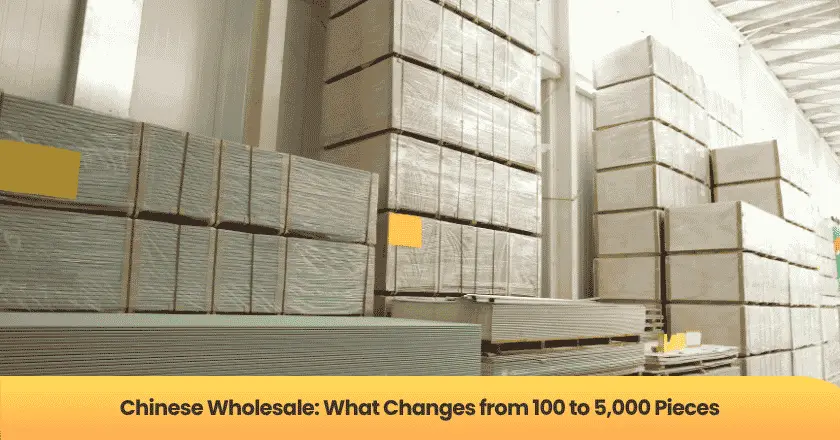
A seller reorders the same ceramic mug three times. At 120 pieces he pays $3.40 and buys from a market vendor who ships by courier. At 600 he pays $2.85 through a trading company and the goods travel in a shared container. At 3,000 he is talking to the factory itself, paying $2.10, choosing his own carton size, and discovering that the deposit terms he accepted twice without thinking are now negotiable.
Nothing about the product changed. Quantity changed, and quantity decides who answers your enquiry, what they will agree to, and which costs quietly work against you as the numbers grow.
Key Takeaways
• Order quantity determines your counterparty, and market vendors, trading companies and factories each dominate a different band.
• Price falls in steps rather than smoothly, and the steps sit where a production or material constraint is released.
• Custom packaging, colours and tooling become available at volumes most first-time buyers never reach.
• Inspection cost per unit drops sharply with volume, because sample size grows far more slowly than lot size.
• Cash tied up and inventory risk rise faster than unit price falls, which sets a practical ceiling on how far to scale.
Quantity Decides Who Talks to You
The first thing volume changes is not price. It is which category of supplier treats your enquiry as worth answering properly.
Around 100 Pieces: Stock Goods and Market Vendors
At this level you are buying what already exists. Market vendors and small trading operations sell from stock by the carton, and minimums are set by packing rather than production. Prices sit closer to domestic wholesale than to factory cost, because nobody is running a line for you.
Customisation is effectively limited to a printed logo or a different carton. Shipping usually goes by courier or air, where cost is driven by chargeable weight, the greater of actual and volumetric weight, so bulky low-value goods become expensive to move long before they become expensive to buy.
500 to 1,000: Trading Companies and Shared Materials
This band is where trading companies are strongest. They aggregate demand across buyers, which lets them place an order a single small buyer could not, and they will often accept quantities a factory would refuse outright.
Factories become reachable here too, but selectively. The deciding question is usually whether your product uses materials already in stock for somebody else's run. When it does, a 600-piece order costs the factory very little to slot in. When it does not, the same factory quotes you as though you had asked for a full production run, because you effectively have.
Past roughly 2,000 units the relationship inverts. You stop persuading factories to accept you and start choosing between factories competing for the order, which changes tone as much as price. Technical questions get answered by someone who actually runs the line, sample turnaround shortens, and requests that were previously refused become quotable options.
Expert Tip:Ask whether the minimum comes from material purchasing or from machine setup. Those are the two real constraints, and they behave differently. A material constraint softens if the factory already holds the fabric, resin or component for another customer. A setup constraint does not, because the changeover costs the same whether you order 500 or 5,000. I've had minimums drop by half on the first answer and not move at all on the second, and the question takes one line to ask.
Where the Price Breaks Actually Sit
Buyers tend to imagine a smooth curve, with each extra unit shaving a little off the price. Chinese wholesale pricing does not work that way.
The Curve Is Steps, Not a Slope
Prices hold flat across a range, then drop at a threshold, then hold flat again. Those thresholds correspond to something concrete being released: a full material batch, a complete machine run, a full carton of a component, a container's worth of volume.
The practical consequence is that ordering 1,900 when the break sits at 2,000 is the worst position available to you. Ask suppliers for their quantity break table rather than a single price, and ask where the next break sits. Most will tell you, since selling you more units is in their interest.
Asking for the table also protects you from a quieter problem. A supplier quoting one price for one quantity has no reason to mention that 10% more units would have cost 12% less per unit. That information exists on their side of the conversation and only reaches you if you ask for it.
What Drives Each Step
Material purchasing is usually the first driver. Factories buy inputs in standard batch sizes, and an order that consumes a whole batch avoids the waste of a partial one. Machine setup is the second, since changeover time is fixed and gets spread across whatever quantity follows it.
Packing and shipping create a third set of breaks that sit outside the factory entirely. A quantity that fills cartons evenly and fills a container efficiently costs less to land, and those breaks are yours to find rather than the supplier's to offer.
Common Mistake to Avoid:Chasing a lower unit price by jumping a tier you cannot sell through is the most common scaling error, and it looks like good buying right up until the stock sits. A 30% price reduction on 5,000 units means nothing if 2,000 of them are still in the warehouse eighteen months later, absorbing storage cost and cash you needed for the next product. Work out your realistic sell-through period first, then buy to it, and treat the price break as a constraint to plan around rather than a prize to chase.
What Becomes Possible as Volume Rises
Higher quantities buy more than a lower number. They buy options that simply are not on the table below certain thresholds.
Customisation, Packaging and Tooling
Custom colours generally need a full material batch, which is why they appear as an option somewhere in the low thousands rather than the hundreds. Custom retail packaging follows print run economics, so unit cost falls steeply across the first few thousand and then flattens.
Tooling changes the conversation entirely. Once you are paying for a mould, the product becomes genuinely yours and competitors cannot order it off a shelf. That step usually makes sense somewhere above a few thousand units per run, and it is a commitment to the product rather than a purchase of it.
Some things do not improve with volume, and it helps to know which. Lead time barely moves, since a larger run takes longer to produce even as it waits the same time in the queue. Defect rates do not fall on their own either. Volume buys you options and attention, not automatic quality.
Payment Terms and Your Position
At small volumes you take the terms offered, commonly full payment or a large deposit. As orders grow, the standard 30% deposit with balance before shipment becomes a starting point rather than a rule.
Reliable repeat buyers negotiate balance payment against a passed inspection, longer settlement windows, or deposit reductions on repeat orders of the same item. None of this is available on a first purchase of 200 pieces, and most of it is available by the third order of 3,000.
Expert Tip:Spend your negotiating room on terms rather than price once you pass a thousand units. Suppliers resist unit price cuts because a lower price resets the baseline for every future order, and they will often concede free tooling, upgraded cartons, extended payment windows or spare units instead. Those cost the factory less and are worth more to you than the equivalent cents. Ask what they can give that is not the unit price, and the answers are usually surprising.
The Costs That Move Against You
Scaling improves some numbers and worsens others. Knowing which is which stops the unit price from dominating a decision it should only partly influence.
Shipping Mode Changes Underneath You
Courier suits the hundreds, shared container shipping the low thousands, and a full container above that. Each transition changes not just cost but the paperwork and the party handling it. Trade terms matter more as volume rises, and quoting every supplier on the same Incoterm becomes essential rather than tidy once freight is a meaningful share of landed cost.
The shared-container band is where buyers get caught. Costs there scale roughly with volume while handling fees do not, so the effective rate per unit improves less than expected. Work out where a full container becomes cheaper for your specific carton dimensions rather than relying on a general rule.
Inspection, Cash and Inventory
Inspection is one cost that genuinely improves with scale. Sampling standards such as ISO 2859-1 size the sample against the lot, and the sample grows far more slowly than the batch, so a fixed inspection fee spread across 5,000 units is a fraction of what it costs against 300. Small orders often go uninspected purely because the arithmetic looks bad.
Cash moves the other way, and it moves fast. A 5,000-piece order ties up money for the production period plus transit plus your sell-through, which can be six months of working capital committed against a single product. That exposure, not the unit price, is what usually decides how far a growing importer should scale.
Storage is the cost buyers most often leave out entirely. Warehousing charges by volume, so the bulky product that was expensive to ship is expensive to hold, and marketplace fulfilment programmes generally charge more the longer stock sits. Add a realistic storage figure per unit per month to any tier comparison before deciding.
Expert Tip:Calculate cash per week of cover rather than cost per unit when comparing tiers. Take the total order value, divide by the weeks of stock it represents at your current sales rate, and compare that figure across quantities. It reframes the decision honestly, because a cheaper unit that commits eight months of cash is a different proposition from a dearer one that commits ten weeks. I've seen this single calculation stop more bad orders than any negotiation tactic.
How NewBuyingAgent Changes the Arithmetic at Any Tier
Every threshold above assumes a fixed supplier pool. Widen the pool and the thresholds themselves move, because somewhere in a larger set of factories is one already running your material next week.
NewBuyingAgent's wide factory network lets it pick low-cost, high-cooperation suppliers. Even with its margin included, it cuts your costs by 5%-10%.
The size of that pool is the whole constraint, and for most buyers it is far smaller than they realise. Only less than 5% of China's factories are within your reach. NewBuyingAgent gives you 100% Access to China's Factories through its 50,000+ cooperated partner factories—no language/region/time zone barriers. Its local reputation gets you full factory cooperation.
NewBuyingAgent is your perfect partner for global sourcing from China, backed by 30 years of expertise in trade, manufacturing and quality control. Its mission is to make China sourcing effortless and profitable for global buyers.
Frequently Asked Questions
What is the smallest order worth placing from China?
For stock goods, a carton or two is workable and often the right way to test a product. Below roughly 100 pieces the per-unit shipping and handling costs usually dominate, so margins look poor even when the goods are cheap. Treat very small orders as market research rather than as a profit exercise.
At what quantity should I go direct to a factory?
Somewhere around 1,000 units for standard products, and lower where materials are already in stock for other customers. Below that a factory typically treats you as a marginal customer with correspondingly weak service. The deciding factor is whether your order is large enough to be worth their setup, not whether they will technically accept it.
How much cheaper is 5,000 pieces than 500?
It varies widely by product, and reductions in the region of 20% to 40% are common across that range for goods with meaningful material and setup costs. Products dominated by a single expensive component move much less. Ask for a quantity break table rather than estimating, since the shape of the curve differs by category.
Should I split a large order across two shipments?
Often yes, particularly on a first order at a new tier. You keep the price break by committing the full quantity while staggering delivery, which reduces cash exposure and gives you a chance to catch a quality problem before all the stock arrives. Suppliers accept this more readily than buyers expect, since the order value is unchanged.
Do prices keep falling above 5,000 pieces?
They continue to fall, more slowly, and the gains shift from unit price to terms and priority. Above a few thousand units most of the material and setup efficiencies have already been captured. What improves instead is payment flexibility, production scheduling and how quickly problems get resolved, which are worth more than the remaining cents.
Conclusion
Order quantity is a strategic variable rather than an administrative one. It sets your counterparty, your price, your options on customisation, your shipping mode and your cash exposure all at once. Find where the breaks sit for your specific product, buy to your sell-through rather than to the discount, and spend your negotiating room on terms once you clear a thousand units.For buyers working out which tier their product belongs at, NewBuyingAgent handles factory selection, quality control and delivery from China.
Partial Sources
1. International Organization for Standardization — ISO 2859-1:2026, Sampling procedures for inspection by attributes, Part 1, in which sample size is determined by lot size —https://www.iso.org/standard/85464.html — accessed 19 August 2026
2. International Air Transport Association — Air Cargo Tariffs and Rules: What You Need to Know, covering chargeable and volumetric weight — https://www.iata.org/en/publications/newsletters/iata-knowledge-hub/air-cargo-tariffs-and-rules-what-you-need-to-know/ — accessed 19 August 2026
NewBuyingAgent
Related Resources

Get Started Today
Let's Turn Your Sourcing Goals into RealityWeChat:+86 15157124615
WhatsApp:+86 15157124615
Address:Building 10 #39 Xiangyuan Road, Hangzhou, China
