

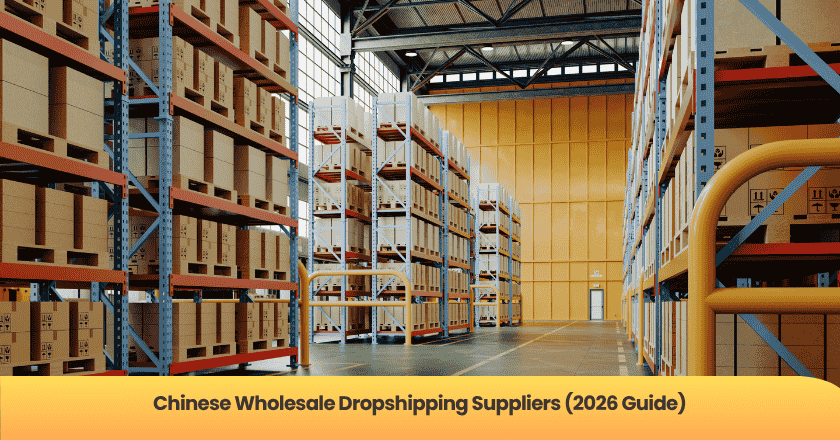
China has dominated global manufacturing for decades — and in 2026, it still accounts for the lion's share of dropshipping inventory sold by e-commerce stores worldwide. Low production costs, a mature logistics infrastructure, and an increasingly sophisticated supplier ecosystem make it the default starting point for most online sellers. Yet the gap between those who build profitable stores and those who struggle with delayed shipments, poor product quality, and unreliable partners often comes down to one thing: knowing how to navigate the sourcing process correctly from day one.
This guide covers everything from identifying your niche to vetting suppliers, selecting the right fulfillment partners, and staying ahead of the trends reshaping Chinese dropshipping in 2026.
Key Takeaways
- Define your niche before you search — supplier quality and shipping times vary significantly by product category.
- AliExpress suits beginners; Alibaba and 1688.com offer better pricing at volume but require more supplier management.
- Always order samples and check MOQ, lead time, return policy, and communication speed before committing.
- Third-party fulfillment services reduce friction but add cost — evaluate the trade-off.
- 2026 trends include AI-assisted sourcing, TikTok Shop integration, rising tariff pressure, and growing demand for branded packaging.
- Building a real relationship with your supplier — not just transactional emails — is one of the most underrated advantages in this space.
How the Chinese Dropshipping Ecosystem Actually Works
Dropshipping, at its core, is a retail fulfillment model where you sell products without holding any inventory. When a customer places an order, you forward it to a supplier — who ships directly to the customer on your behalf. You keep the margin between your selling price and the supplier's price. No warehouse, no bulk purchasing, minimal upfront risk.
China's role in this model goes well beyond being a cheap manufacturing hub. Chinese suppliers — particularly those clustered in Guangdong, Zhejiang, and Fujian — have built entire fulfillment ecosystems specifically designed for cross-border e-commerce. Many factories operate their own dropshipping arms, offering per-unit shipping, branded packaging, and direct integration with platforms like Shopify and WooCommerce.
What makes this complex is the sheer number of intermediaries. A product sold on AliExpress might pass through a trading company (a middleman that sources from factories), a consolidation warehouse, a freight forwarder, and a last-mile carrier before reaching your customer. Understanding where friction occurs at each step is what separates experienced sellers from frustrated beginners.
Expert Tip: Before contacting a single supplier, map out your ideal supply chain: Where does the product originate? Which fulfillment model fits your order volume — dropshipping directly from a supplier, or through a third-party fulfillment service? Clarity here saves weeks of wasted negotiation.
Define Your Niche Before You Search
This sounds obvious, but plenty of sellers make the mistake of browsing supplier directories first and reverse-engineering a niche around whatever looks profitable. The smarter approach is the opposite.
Your niche dictates supplier type, shipping sensitivity, average order value, and acceptable lead times. Selling phone accessories? AliExpress will do fine. Building a brand around custom pet products? You'll need a supplier who can handle private labeling and consistent quality control. The two involve completely different sourcing strategies.
How to validate your niche before sourcing:
Google Trends + keyword research: Confirm that search demand is stable or growing — not a flash-in-the-pan trend that peaked 18 months ago.
Competitor audit: Look at who's already selling in this space. High competition isn't necessarily bad; it confirms demand. No competition often signals a dead market.
Profit margin check: Factor in product cost, shipping, platform fees, and ad spend. A product that sells for $29 with $18 landed cost leaves very little room for a sustainable business.
Shipping sensitivity: Some products (fragile, oversized, temperature-sensitive) make Chinese dropshipping impractical. Know the constraints early.
Common Mistake to Avoid: Choosing a niche based solely on profit margin calculators without factoring in return rates, shipping complaints, and supplier reliability. A 40% margin means nothing if 15% of orders result in disputes.
3. Where to Find Chinese Wholesale Dropshipping Suppliers in 2026
The sourcing landscape has matured significantly over the past few years. Here are the primary platforms worth knowing, with an honest assessment of each.
AliExpress
The default starting point for new dropshippers — and for good reason. AliExpress offers a massive product catalog, buyer protection, and native integrations with tools like DSers and AutoDS. Pricing is higher than factory-direct, but the friction to get started is minimal. Suitable for testing product ideas before committing to larger MOQs elsewhere.
Alibaba
Alibaba is a B2B marketplace (business-to-business — meaning it's designed for bulk buyers, not individual consumers) connecting buyers with verified manufacturers and trading companies. MOQs (Minimum Order Quantities — the smallest number of units a supplier will sell at once) are often higher here, but many suppliers will negotiate smaller trial orders. Best used once you've validated a product and are ready to scale.
1688.com
The domestic Chinese counterpart to Alibaba — entirely in Mandarin and priced for local buyers, which means significantly lower unit costs. Navigating the platform without Chinese language skills requires a sourcing agent or browser-based translation tools. For sellers comfortable with that friction, 1688 offers some of the most competitive pricing available anywhere.
CJDropshipping
A purpose-built dropshipping platform with its own warehouses, product sourcing service, and direct integrations with major e-commerce platforms. CJDropshipping sits between AliExpress (too retail-oriented) and Alibaba (too wholesale-oriented) — practical for sellers who want supplier management handled without going fully custom.
DHgate
Positioned between AliExpress and Alibaba in terms of MOQs and pricing. Good for mid-volume orders and particularly strong in categories like electronics accessories, apparel, and jewelry. Buyer protection is reliable, though product quality can vary sharply between sellers.
Banggood
A solid alternative for sellers transitioning away from AliExpress. Banggood runs its own dropshipping program with dedicated support, faster shipping on select categories, and a product quality tier that tends to be more consistent than open marketplaces.
Common Mistake to Avoid: Treating all suppliers on these platforms as equal. Seller ratings are a starting point, not a guarantee. Always verify Trade Assurance status on Alibaba, check shipment feedback scores on AliExpress, and run independent searches for the supplier's company name before placing any order.
How to Vet a Chinese Supplier: What to Check Before You Commit
Most sourcing mistakes are not caused by bad luck — they're caused by skipping due diligence. Here's a practical vetting checklist developed from the realities of cross-border sourcing.
Verify business registration: On Alibaba, check for a verified supplier badge and confirmed business license. For 1688, use the platform's enterprise verification system. A legitimate manufacturer should have traceable legal status.
Assess communication response time and quality: How quickly does the supplier respond? Do they answer your specific questions or send generic copy-paste replies? A supplier who takes three days to reply before you've even placed an order will not improve once they have your money.
Request product samples: Non-negotiable. Ordering samples before committing to a supplier is standard practice. Evaluate packaging, build quality, accuracy to the product listing, and shipping time from China to your target market.
Clarify shipping methods and lead times: Ask specifically: How long from payment confirmation to dispatch? Which carrier? What is the estimated transit time to the US / UK / Australia? A supplier who hedges on these answers is one to approach cautiously.
Confirm return and refund policies: Who bears the cost of a defective product? What is the dispute resolution process? This matters more as your order volume grows.
Test order processing under volume: A supplier who handles 10 orders a day may not handle 200. Ask directly about their current capacity and peak-season performance.
Expert Tip: Don't rely on platform messaging alone. Move supplier communication to WeChat or WhatsApp at some point — it gives you a more accurate read of their responsiveness and lets you build the kind of relationship that results in priority handling when supply chain disruptions occur.
Chinese Dropshipping Fulfillment Services: A 2026 Overview
Beyond direct supplier relationships, a growing number of third-party fulfillment providers (3PLs — companies that handle warehousing, packing, and shipping on your behalf) have emerged specifically for cross-border dropshippers. These are worth evaluating if you want to reduce the operational load of managing multiple suppliers independently.
A few points worth noting about this table: several of these services overlap significantly in what they offer. CJDropshipping and Eprolo, for instance, are both viable for beginners, but CJ's platform tends to offer more direct control, while Eprolo's branding tools are marginally more developed. The right choice depends on your product category and target market.
Common Mistake to Avoid: Assuming that using a fulfillment service eliminates the need to vet the underlying suppliers. These platforms source from the same Chinese manufacturer pool as everyone else. Quality control remains your responsibility — the fulfillment layer manages logistics, not product standards.
Two Types of Sourcing Agents — and Why the Model Matters
Not all sourcing agents operate the same way. Once you move beyond self-service platforms like AliExpress and start working with an intermediary, you'll encounter two fundamentally different engagement models. Understanding the distinction upfront prevents a lot of surprises on the invoice.
The Traditional Commission-Based Model
In the conventional agent setup, buyers negotiate product prices directly with factories, then pay the agent an additional service commission — typically 5% to 20% on top of the factory cost — for tasks like supplier outreach, quality checks, and logistics coordination. The agent's incentive is tied to the transaction size, not the outcome quality. You're paying twice: once for the product, once for the middleman.
This model works for buyers who want limited involvement from their agent and already have strong factory relationships. The problem is that it structurally misaligns incentives: agents earn more when orders are larger, not necessarily when sourcing decisions are better.
The Order-Driven, End-to-End Responsibility Model
A newer approach — increasingly adopted by full-service sourcing companies — flips this structure. Buyers submit their purchasing requirements and place orders directly with the sourcing partner, who then takes full ownership of every step in China: factory selection, price negotiation, production oversight, quality control, and door-to-door logistics. No commission is charged separately; the sourcing partner works on a transparent, order-driven basis.
The practical effect for buyers is significant. You deal with one accountable point of contact instead of coordinating across multiple factories and service providers. Communication overhead drops, quality accountability becomes clearer, and the sourcing partner's incentive is aligned with delivery performance rather than transaction volume.
NewBuyingAgent operates on this end-to-end model. Backed by 30 years of trade and manufacturing expertise through ShiningHub Group — established in 1995 — the company has built a network of 50,000 partner factories and over 20,000 product development and quality control specialists stationed across China. Buyers submit their requirements, and NewBuyingAgent handles the full procurement cycle, from sourcing and negotiation through production monitoring and final shipment. The stated cost outcome is a 5%–10% reduction in sourcing costs compared to direct factory purchasing, with quality losses covered by the company if standards aren't met.
| Factor | Commission-Based Agent | Order-Driven Model(e.g. NewBuyingAgent) |
|---|---|---|
| Pricing structure | Factory price + agent commission (5–20%) | Transparent order price, no separate commission |
| Factory access | Buyer negotiates directly | Agent leverages full factory network on buyer's behalf |
| Quality accountability | Agent advises; buyer bears risk | Agent takes end-to-end ownership; covers losses |
| Multi-category capability | Varies — often category-specific | Full-category sourcing under one account |
| Payment terms | Typically rigid upfront requirements | Flexible credit terms tailored to buyer needs |
| Best suited for | Buyers with existing supplier base | Buyers wanting one accountable sourcing partner |
Building Supplier Relationships That Actually Last
Dropshipping is often discussed as a purely transactional business — find a supplier, list the product, collect the margin. In practice, the sellers who consistently outperform the rest share one thing: they treat their suppliers as partners, not vending machines.
What does this look like operationally?
- Consistent communication cadence: Check in regularly, even when there are no active issues. Knowing what's happening at the factory — production delays, material shortages, holiday closures — gives you advance warning rather than a nasty surprise.
- Pay on time and clearly: This sounds basic, but payment reliability is one of the fastest ways to build trust. Suppliers prioritize buyers who are easy to work with financially.
- Give structured feedback: If there's a quality issue, report it specifically: photos, batch numbers, which SKUs, how many units affected. Vague complaints get vague responses.
- Plan for Chinese public holidays: Chinese New Year (typically January–February) shuts down most manufacturing for 2–4 weeks. Golden Week in October is another pause point. Build these into your inventory planning calendar every year without exception.
- Reward performance: When a supplier consistently delivers on quality and timing, tell them. Increased order volume, positive platform reviews, and referrals are genuine incentives that get you treated as a preferred buyer.
Expert Tip: If you're sourcing at meaningful volume, consider visiting your top one or two suppliers in person — or hiring a local inspection agent to do so. Nothing builds trust faster than showing up. It also lets you see factory conditions firsthand, which matters both for quality control and for any sustainability commitments you may need to make to your customers.
2026 Trends Reshaping Chinese Dropshipping
The landscape is genuinely different in 2026 compared to even two years ago. Here are the shifts that matter most.
AI-assisted sourcing and quality prediction: Several sourcing platforms now deploy AI tools that analyze supplier ratings, shipment data, and customer dispute histories to flag high-risk suppliers before you engage. Use them — they compress the vetting timeline significantly.
TikTok Shop as a sourcing-to-sale channel: TikTok Shop's integration with Chinese suppliers has created a more direct pipeline from factory to consumer. Understanding this channel is increasingly relevant for dropshippers targeting Gen Z demographics.
Tariff and trade policy pressure: Ongoing US-China trade tensions and evolving tariff structures continue to affect landed costs for certain categories. Electronics, textiles, and solar products are particularly exposed. Build tariff risk into your margin calculations and maintain a secondary supplier in Vietnam or Mexico for key SKUs if diversification is possible.
Demand for branded and sustainable packaging: Consumers are paying more attention to packaging — both aesthetics and environmental impact. Suppliers who offer custom packaging (your logo, color scheme, insert cards) at low MOQs give you a meaningful brand-building advantage. Several fulfillment services now include this as a standard offering.
Faster last-mile logistics: Shipping times from China to Western markets have improved considerably. A growing number of suppliers and 3PLs now offer 7–12 day delivery windows to the US and EU via direct air freight channels — a far cry from the 20–30 day waits that were standard just a few years ago.
Expert Tip: Track the USPS, UPS, and FedEx announcements around de minimis threshold changes (the value below which goods can enter a country duty-free). Policy shifts here directly affect Chinese dropshipping economics and have been under active regulatory review in both the US and EU as of 2026.
Frequently Asked Questions
Is dropshipping from China still profitable in 2026?
Yes — but margins have compressed compared to the early 2020s. Increased competition, rising shipping costs, and platform fee changes mean that surface-level margin calculations no longer translate to bottom-line profit. Sellers who focus on brand differentiation, custom packaging, and niche specificity consistently outperform those chasing generic trends.
What is the typical shipping time from China to the US for dropshipping?
It depends on the carrier and shipping method selected. Standard ePacket or China Post routes typically take 15–25 business days. Faster options via YunExpress Direct, 4PX Priority, or air freight can reduce this to 7–14 days at a higher per-unit cost. Express services (DHL, FedEx, UPS) from China routinely deliver in 5–8 business days but are rarely cost-effective for low-margin dropshipping products.
Do I need a sourcing agent to buy from 1688.com?
Not strictly — but it helps significantly. 1688 is a domestic Chinese platform with no English interface, no buyer protection designed for international customers, and payment systems not accessible to foreign buyers. A sourcing agent handles translation, payment, quality checks, and consolidated shipping. For occasional purchases, browser translation tools can get you started; for regular sourcing at volume, an agent earns their fee quickly.
What is an MOQ and why does it matter for dropshippers?
MOQ stands for Minimum Order Quantity — the smallest number of units a supplier will sell in a single order. For dropshippers, this is a critical number because the business model depends on fulfilling one order at a time. Many factory-direct suppliers on Alibaba have MOQs of 100–500 units, which means they're not practical for pure dropshipping. AliExpress, CJDropshipping, and dedicated dropshipping agents typically have MOQs of 1, making them compatible with the model.
How do I handle returns in a Chinese dropshipping model?
This is one of the more complex operational areas. Most Chinese suppliers do not accept direct returns from international customers — the logistics cost makes it uneconomic. The typical approach is to offer the customer a refund or replacement without requiring a physical return, absorbing the cost as a cost of doing business. For high-value products, negotiating a defect allowance with your supplier upfront — where they cover a percentage of replacement costs per batch — is a more scalable solution.
Which product categories are best suited for Chinese dropshipping?
High-performers tend to be lightweight (reducing shipping costs), non-perishable, and not heavily regulated in target markets. Categories that consistently work well include: home décor and organization, phone and tech accessories, pet products, fitness and wellness gear, and beauty tools. Categories to approach carefully include electronics with safety certifications, children's toys, food supplements, and anything subject to import quotas or duties.
Final Thoughts
Chinese wholesale dropshipping in 2026 is neither a get-rich-quick shortcut nor a dead model. It's a mature, competitive supply chain strategy that rewards sellers who invest in proper vetting, build genuine supplier relationships, and stay current with trade and logistics developments. The platforms and fulfillment services have never been more accessible — but accessibility alone doesn't create a sustainable business.
Start with your niche. Vet before you commit. Order samples without exception. And treat your suppliers as the business partners they are, because in this model, their performance is your reputation.
NewBuyingAgent
Related Resources
Get Started Today
Let's Turn Your Sourcing Goals into RealityWeChat:+86 15157124615
WhatsApp:+86 15157124615
Address:Building 10 #39 Xiangyuan Road, Hangzhou, China
