


A China-side sourcing agent is useful for wooden furniture and home decor only when the agent turns a visually credible collection into evidence that can be compared, assigned, and released. A factory may quote a console, mirror, and tabletop object as one collection, yet the buyer still needs separate answers about wood condition, panel construction, finish reference, fragile-item protection, and the destination path. If no party owns those answers, the price comparison is premature.
The practical test is not whether an agent can find furniture factories. It is whether the agent can keep one current request version across the buyer, factory, packing team, and destination decision-maker—and make any unanswered question visible before production or shipment. That matters for an established retailer, a hospitality project, a design-led brand, or any buyer combining large furniture with small decor in one release.
Choose the Agent by the Proof Each Party Can Own
Evidence ownership means the named party responsible for providing and checking a required record. For a mixed wooden-furniture and home-decor order, the buyer owns the commercial intent and approval threshold; the China-side agent owns version control and factory follow-up; the factory owns build and packing records; and the importer or a qualified destination specialist owns the final destination interpretation. A proposal is decision-ready only when those four lanes are explicit.
That division is deliberately narrow. The agent does not become the legal importer, and the buyer does not need to translate every factory note alone. The agent's value is in forcing a question into the correct lane: “What wood or panel is in this SKU?” belongs with the factory record; “Which destination obligation applies?” must be escalated to the party qualified to answer it. A quote that says “compliant,” “export packing included,” or “same as sample” without the record owner does not solve either question.
For a buyer who has already defined the collection, NewBuyingAgent's relevant contribution is China-side request control and factory follow-up: making the evidence gap visible, recording the factory's answer against the right version, and escalating what the service should not decide. That is a service-fit boundary, not a claim that an agent can certify every product or market outcome.
- Buyer lane: SKU scope, intended market, finish reference, tolerance, and the approval that can release a commercial choice.
- China-side agent lane: one RFQ version, factory response tracking, sample-to-build reconciliation, and escalation when a proof is missing.
- Factory lane: construction, material, component, finish, carton, and pack-out evidence for the current SKU version.
- Importer or specialist lane: destination scope, classification, and the decision to accept the applicable market path.
No named owner, no comparable quote.
Separate Wood Condition From Panel and Finish Evidence
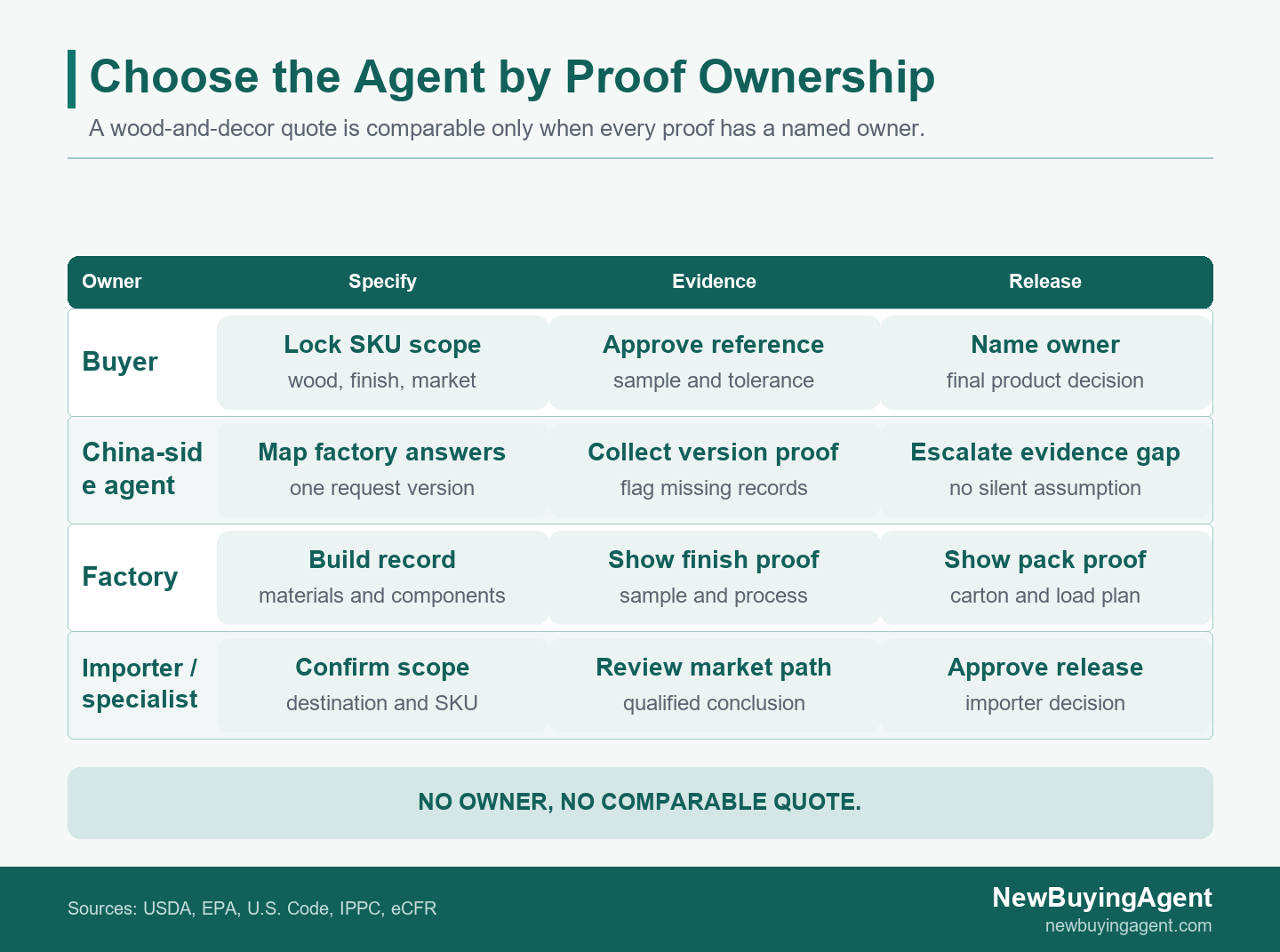
A quote becomes comparable only when the product specification, factory build proof, destination check, and packing evidence have named owners.
A wooden-furniture brief should not use “solid wood” or “kiln dried” as a substitute for a usable condition record. The USDA Forest Service's technical chapter on moisture and dimensional change explains why drying, handling, and storage affect moisture condition and movement. In a sourcing request, ask where the reading was taken, what material it refers to, when it was recorded, and how the component was stored between machining, finishing, and packing. That is more informative than an unqualified moisture number.
Construction still needs a separate line. A console can contain a solid-wood frame, veneer surfaces, engineered panels, metal brackets, and a coating system. The finish sample can show color and sheen while saying little about the panel beneath it; a component list can identify the panel while saying little about the finished surface. Ask the agent to collect a SKU-level construction sheet that separates visible wood, substrate or panel, edge treatment, hardware, and finish reference. Keep the approved sample identifier beside that sheet, rather than allowing a collection photo to stand in for all of it.
For a U.S.-bound item containing regulated composite wood, the material boundary can also change the evidence request. EPA's TSCA Title VI overview describes a U.S. formaldehyde-emissions framework for hardwood plywood, MDF, particleboard, and certain finished goods containing those materials, including imported goods. This is not a blanket verdict on every furniture SKU or destination. It is a reason to keep composite-panel evidence separate from a veneer approval and to have the importer or qualified adviser confirm the applicable route.
A useful agent does not merely forward a factory declaration. The agent checks whether the declaration, the bill of materials, the sample revision, and the factory's answer refer to the same SKU version. If the factory changes a core panel, veneer source, finish system, or hardware construction after a sample is approved, the buyer needs a new comparison point—not a verbal assurance that the look is unchanged.
Test the Destination Boundary Before the Packing Decision
Wood packaging material means the wood used to support, protect, or carry goods, including pallets, crates, and dunnage. It needs its own packing record because its controls do not automatically follow from a furniture material description.
Material proof does not settle the destination question. Start by naming the intended country, importer, product family, and any uncertainty that needs qualified review. For covered plant imports, 16 U.S.C. 3372(f) identifies declaration data such as scientific name and the country from which a plant was taken, subject to statutory exclusions. The sourcing lesson is not that every wooden item needs the same declaration. It is that the buyer should identify who can supply, verify, and route the relevant wood-origin data before setting a release date.
Product scope is equally specific. In the United States, 16 CFR Part 1261 applies to defined clothing storage units manufactured in or imported for U.S. use after September 1, 2023. A tabletop vase, a framed mirror, and a storage cabinet should therefore not inherit one untested conclusion merely because they share a shipment or a supplier. Put the intended use and product family into the brief; then ask the destination owner to confirm which, if any, product-specific path applies.
Wood packaging is another record, not an afterthought to the furniture description. The International Plant Protection Convention's wood-packaging guide covers pallets, crates, drums, dunnage, ISPM 15 marks, and inspection context. Ask for the pack-out drawing, carton dimensions, corner and surface protection, pallet or crate plan, marks where applicable, and loading sequence. This separates the product-material decision from the shipment-control decision—especially important when mirrors, ceramics, and timber components share a load.
The handoff must remain explicit. U.S. Customs and Border Protection explains that importers must ensure goods meet other-agency requirements and obtain required permissions. A China-side agent can coordinate documents, ask factories for clarification, and flag a missing record; it should not be described as replacing the importer's or qualified specialist's decision. This boundary protects both the buyer and the agent from turning a coordination service into an unsupported compliance promise.
Use Four Questions to Select the China-Side Sourcing Agent
First ask whether the agent can distinguish a factory-side record from a destination-market conclusion. Trade.gov's China standards guide describes mandatory national standards and recommended standards in China's standards system. That context may help the agent ask a better factory question, but it does not by itself answer a buyer's destination requirement. The agent should label the evidence boundary and show who must close it.
Then evaluate the agent against four operational questions: Can the team freeze a request version before quotes are compared? Can it obtain SKU-level build and packing proof from the factory? Can it show the buyer exactly what remains unverified? Can it escalate a destination question to the responsible party rather than hide it in a general assurance? The strongest answer is a visible workflow, named owners, and dated records—not a longer list of product categories.
| Selection question | Useful agent evidence | Warning sign |
|---|---|---|
| Can the request be version-controlled? | One RFQ, dated changes, SKU references, and approved sample links. | Each factory is quoting from a different image set or verbal revision. |
| Can build proof be separated by SKU? | Construction, finish, hardware, and carton records mapped to each product family. | A collection-level statement substitutes for materials and packaging detail. |
| Can the agent manage an existing factory? | Clear version follow-up, inspection coordination, and escalation notes. | The service starts again with a broad factory search despite a viable supplier. |
| Can the destination boundary be escalated? | Open questions are recorded with an importer or specialist owner. | A general claim of compliance appears without a defined product and market scope. |
Before asking factories to quote a collection, buyers can review product-selection context before locking a furniture-and-decor brief; this helps keep the product direction separate from the factory proof that will follow. When the requirement is already defined and the gap is China-side coordination, buyers can also compare a defined wooden-furniture sourcing request with NewBuyingAgent's product-supply service. The meaningful test is whether the service scope matches the evidence gap, not whether the buyer needs a generic intermediary.
When a Mixed Collection Needs a Subset Hold, Not a Blanket Delay
Consider an illustrative 2,700-unit entryway collection: 600 oak-veneer consoles, 900 framed mirrors, and 1,200 ceramic-and-wood tabletop pieces. The buyer has approved the console visually, but the current quote uses a broad engineered-wood description; the mirror and tabletop items share a pallet plan without a final pack-out record. The right response is not “inspect everything later.” It is to isolate the affected evidence streams before the commercial terms harden.
The console family needs its current construction sheet, panel statement, finish reference, and hardware version tied together. The fragile-decor family needs its carton, corner protection, pallet or crate plan, and breakage-control evidence tied together. If other SKU families have complete, aligned records, there is no operational reason to hold them merely because one family is unresolved. The agent's job is to make that release boundary visible and to prevent a shared shipment plan from masking a product-specific gap.
That approach also gives the buyer a better negotiation position. A factory may still quote lead time and price while a record is open, but the buyer should treat those terms as conditional. The agent can mark the unresolved fields, identify the owner, set the next evidence date, and show which release decision depends on the answer. It is a more disciplined alternative to accepting a broad promise now and discovering a construction or packing mismatch after units are already consolidated.
For an existing supplier relationship, the issue may be management rather than supplier discovery. In that case, buyers can review China-side factory management for an existing furniture supplier to assess whether local follow-up, version control, and packing evidence are the missing capabilities.
Split Material and Packing Records Before Terms Are Consolidated
This illustrative buyer is preparing a mixed entryway collection for a named destination market, not documenting a NewBuyingAgent client case.
The launch contains 600 oak-veneer consoles, 900 framed mirrors, and 1,200 ceramic-and-wood tabletop pieces: 2,700 units in total.
The console sample looks approved, but the panel statement, finish reference, mirror protection, and wood-pallet responsibility are still open.
The console quote names engineered wood broadly even though the approved sample has veneer and panel components.
The mirror and tabletop cartons share a pallet plan, yet the mark and SKU-level breakage evidence remain unassigned.
A single collection quote hides two mismatches: construction evidence for furniture and shipment evidence for fragile decor.
Hold only the console and fragile-decor release until their records are owned; do not delay an unrelated, fully documented SKU family by default.
Issue a console material-and-finish sheet and an illustrated mirror-and-tabletop pack-out record, then reconcile them against the shared pallet plan before terms are consolidated.
Release each family only when the approved reference, current build record, carton proof, and destination-owner check identify the same version.
The scenario is an editorial example, not a certification conclusion, legal advice, or a claim about an actual customer order.
Send a Request Packet That Lets Factories Answer the Same Question
Send one packet that asks every factory and agent to answer the same versioned questions. For each SKU family, include: product use and destination; wood species or veneer direction; panel or substrate description; finish reference and allowed variation; hardware and fragile-component details; sample and drawing version; carton and inner-protection requirements; pallet or crate plan; required records; and the named party for any destination decision. Ask the agent to return missing evidence as a list, not to silently fill gaps with assumptions.
For a U.S.-bound storage SKU, record whether it fits the defined product family before reusing a collection-level conclusion. The Federal Register's final rule for clothing storage units records a distinct product-safety path. That is why a console, mirror, and tabletop decor item should retain separate product and market records even when they share a release plan.
The packet does not replace testing, classification, or specialist advice. It creates a clean handoff between commercial sourcing and the people who must decide those issues. Once the fields are complete, a buyer can compare more than unit price: they can compare which factory has answered the request, which agent has controlled the version, and which questions remain outside the service scope. For buyer-context examples after that packet is ready, review NewBuyingAgent sourcing stories for buyer-context examples.
If the remaining gap is China-side coordination rather than a broad supplier search, prepare a first handoff that names the SKU list, wood or panel construction, finish reference, hardware, destination market, and carton plan. That lets the service discussion start from the open evidence rather than a generic category label when the buyer chooses to share a defined request packet with NewBuyingAgent.
Frequently Asked Questions
Should a furniture agent choose the wood species for me?
No. The buyer should approve the commercial material direction, while the agent makes the requested species, grade, construction, and supporting record testable. If the material choice affects a destination decision, the agent should surface that dependency and assign it to the responsible importer or specialist rather than make the choice by implication.
Are moisture readings enough to approve solid wood furniture?
No. A reading becomes useful only when it is tied to the specified wood, measurement method, sample point, storage condition, component thickness, and finished construction. Use it as one record in a material-control packet, not as proof that the finish, joint design, or shipment condition has been approved. Ask the agent to preserve the reading with its SKU and sample reference so a later build change does not detach the number from the component it described.
When does a decor item need a separate supplier path?
A decor item needs a separate path when its material, electrical function, fragility, labeling, safety requirement, or destination boundary cannot be evidenced through the furniture factory's normal controls. A shared visual style or shared container does not by itself create a shared evidence path. The buyer can still consolidate commercial planning, but should request a distinct build, packing, and release record for the item family that uses different controls.
Can an agent take responsibility for destination-market compliance?
No. An agent can coordinate documents, maintain the question log, and follow up with the factory, while the responsible importer and qualified advisers confirm applicable destination-market requirements. The most useful service outcome is a clear handoff with evidence, scope, and unanswered questions visible to the party that must decide. If the answer changes by SKU or market, keep that uncertainty open in the release plan rather than turning an early estimate into a final claim.
NewBuyingAgent
Related Resources

Get Started Today
Let's Turn Your Sourcing Goals into RealityWeChat:+86 15157124615
WhatsApp:+86 15157124615
Address:Building 10 #39 Xiangyuan Road, Hangzhou, China
