

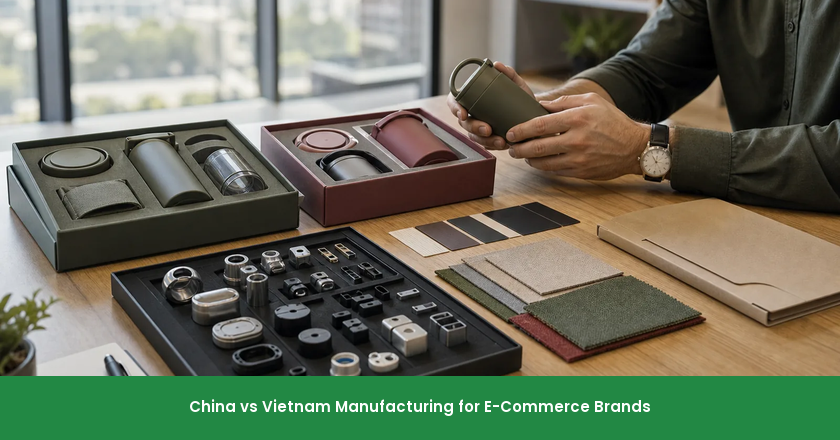
A country choice should follow the SKU's bill of materials and destination rule, not a country-level cost reputation. For an e-commerce launch, start with the finished product: its materials, component count, revision rate, packaging, target market, and delivery window. China may be the better route for one SKU and Vietnam for another. The useful question is not “which country is cheaper?” but “which route can prove the same product, origin position, landed cost, and launch control?”
This comparison gives product teams a practical way to decide whether to choose China, choose Vietnam, or keep both options open until a comparable quote and evidence pack are complete. It is not a tariff calculation or a substitute for product- and market-specific customs advice.
The Decision Is Product-First, Not Country-First
China and Vietnam are manufacturing locations, not product specifications. A simple, stable product with a documented material path can be evaluated differently from a component-dense item that needs rapid revisions, custom tooling, or several packaging variants. A lower initial factory quote does not answer whether the two routes are actually quoting the same work.
- Decision 1: define the finished SKU and its non-negotiable quality requirements.
- Decision 2: map critical inputs and the destination-market origin question.
- Decision 3: compare the full launch path, including samples, checks, packaging, freight handoff, and timing.
That sequence keeps a country comparison from becoming a wage comparison. It also makes a Vietnam option testable without assuming it will replace a proven China route, and it makes a China option defensible without claiming that China is automatically right for every category.
Start With the Product Architecture
A bill of materials (BOM) is the list of every material, component, and packaging item that makes up the finished product, including all components that affect function. It should identify the parts that affect quality, labeling, origin, tooling, or continuity of supply. Before comparing countries, mark which inputs are custom, which are commonly available, which need repeatable tolerances, and which are likely to change after customer feedback.
The Country Choice Matrix checks product architecture, input path, origin rule, and repeatable landed cost before a full manufacturing move. It is a four-layer check of the product, its inputs, its origin rule, and repeatable landed cost. Product architecture asks whether the route can support the required parts, processes, variations, and revision rhythm. Input path asks where the critical materials and components will come from. Origin rule asks what the destination market requires for the finished article. Repeatable landed cost asks whether the quoted unit price still holds after quality controls, packaging, freight preparation, and the work required to launch reliably.
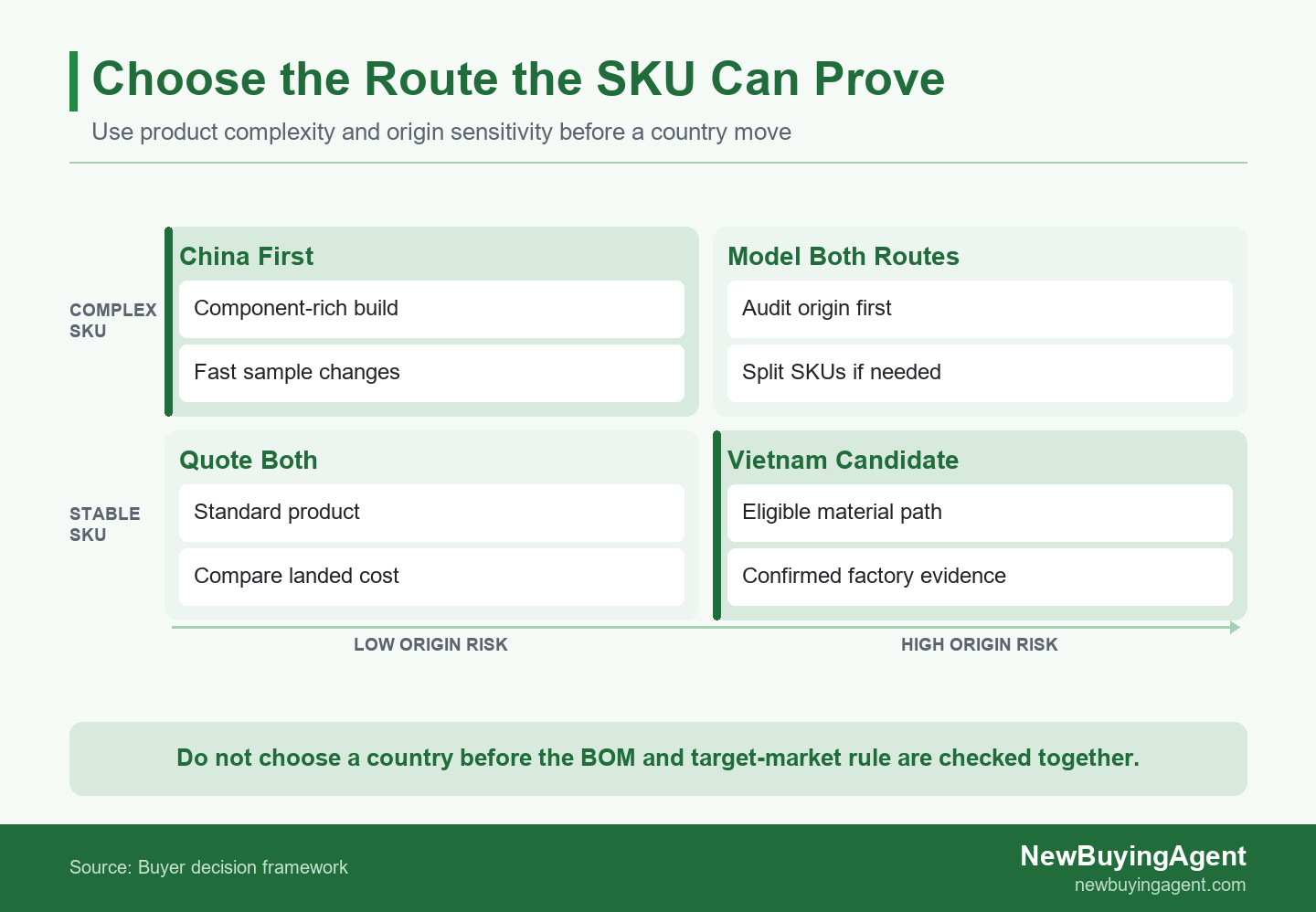
Use product complexity and origin sensitivity together: a country choice is stronger when the BOM, market rule, and launch controls support the same route.
For a brand still deciding what to sell, it can be sensible to use product-market research before locking the sourcing route. Once the product is defined, give both country options the same technical pack. A route that needs assumptions about materials, inspection criteria, or retail packaging is not yet comparable to a route that has those inputs confirmed. NewBuyingAgent can be a relevant China-side baseline when the brief is ready for a comparable product-supply route.
China and Vietnam Compared on the Decisions That Change a Launch
The WTO reports China total exports of USD 3,576,543.3 million in 2024. See the WTO China trade profile for the underlying trade data.
That is useful context for the breadth of China's export economy, not proof that a particular China factory will meet a specific price, quality, or lead-time requirement.
The WTO reports China supplied 34.0% of Vietnam's imports in 2023. The figure is reported in the WTO Viet Nam trade profile.
This does not mean every Vietnamese finished product uses the same inputs. It is a reminder to inspect the actual BOM instead of treating a country switch as a complete upstream switch.
| Decision dimension | China may fit when | Vietnam may fit when | Evidence to request |
|---|---|---|---|
| Product architecture | The SKU needs many coordinated parts, frequent changes, or multiple variants. | The specification is stable and the factory can show the required process and capacity. | Approved drawing, BOM, process steps, sample plan. |
| Critical inputs | A known component path already supports the required quality and timing. | The material path is documented and compatible with the production plan. | Supplier list, material specifications, alternates, and lead times. |
| Origin and market access | The importing-market treatment is understood for the finished SKU. | The applicable product rule and supporting documents can be verified. | Classification, material origin, processing description, and importer review. |
| Quote comparability | The quote includes the same quality, packaging, and launch controls. | The quote covers the same scope rather than a reduced material or service assumption. | Line-item quote, tooling, sampling, packaging, QC, and delivery assumptions. |
| Repeatability | The route can absorb revisions and replenishment without re-opening key unknowns. | The sample, process controls, and input continuity have been checked for repeat orders. | Sample record, inspection points, production schedule, and handoff owner. |
Based on this comparison, choose China first when the product needs a proven, tightly coordinated component and launch path; choose Vietnam when the specification, material path, process capability, and destination-market origin position are all evidenced for that SKU; quote both only when the same brief can be priced and verified on both routes. Neither country wins on a headline factory price alone.
Origin and Market Access Can Reverse a Cheap-Route Assumption
Country of origin is the country determined under the importing market's applicable market rules for the finished article. It is not simply the place named on a booking, warehouse, or final assembly line. For any SKU where labeling, preference, duties, or customer claims matter, put an origin review into the quote process before a production decision.
OECD reports that imports account for about four-fifths of the inputs into Vietnam's final exports.
The country-level finding is a reason to map critical materials, not a conclusion about every factory or product. The relevant question is which inputs are used in the finished SKU, where they are obtained, and what processing occurs. The source is the OECD Economic Survey of Viet Nam 2025.
For US marking purposes, CBP states that work in another country must effect a substantial transformation to change country of origin.
That is a US marking boundary, not a universal answer for every market or product. It illustrates why a buyer should not turn an assembly location into a blanket origin claim. Review the underlying CBP ruling N300209 alongside the rule that applies to the intended market.
The EU-Vietnam agreement includes a protocol governing originating products, so tariff preference should be checked against the SKU's rule of origin. The European Commission page for Protocol 1 on originating products provides the governing framework.
For EU-bound goods, eligibility depends on the tariff classification, materials, processing, documentation, and current agreement requirements. This is a starting point for the governing framework, not a duty calculation for a product.
Launch Control Is More Than Freight Time
The World Bank's 2023 LPI frames reliable logistics around services, infrastructure, and border controls as well as speed.
That distinction matters because a buyer cannot evaluate launch risk with a transit-time estimate alone. The World Bank's explanation of the 2023 LPI describes a system-level measure; a specific launch still needs its own sample, inspection, documentation, consolidation, and handoff plan.
A launch route is comparable only when sample approval, QC evidence, packaging, and delivery handoff are included in the cost and timing baseline. Add named owners, acceptance criteria, and a response path for defects or late components. Otherwise, an apparently lower quote may be omitting work that the buyer must absorb later.
When China remains the selected route, buyers can review China-side factory management for an existing supplier as part of defining the production and QC controls. The comparison stays fair only when a Vietnam alternative is given an equivalent control plan.
A 5,000-Unit Example: Keep the Decision Conditional
The following example is an illustrative composite, not a documented client case or a tariff determination. Its purpose is to show how a buyer can compare routes without treating an unverified alternative as a final manufacturing decision.
Illustrative Composite: A Modular Storage Organizer for an EU Launch
The 5,000-unit example keeps China as the base quote until the Vietnam material path, sample, and origin evidence can be verified.
An EU-facing home-organization brand is deciding where to make a new modular storage organizer. It wants a consumer-ready product rather than a generic bin: the design includes a metal frame, molded parts, textile inserts, retail packaging, and several color variants. The illustrative first production run is 5,000 units, with a USD 14 target ex-factory price and a six-month launch window. Both routes are asked to quote the same unit quantity, approved drawings, packaging, quality checks, and delivery point so that a lower price does not hide a reduced scope. The design is approved, but the buyer has not confirmed the origin treatment of the organizer's metal frame, molded parts, and textile inserts. That missing evidence is commercially relevant for the EU route and prevents the team from presenting the Vietnam option as a completed landed-cost answer.
The China quote includes the frame, molded parts, inserts, and retail packaging from one established product path. It is therefore the working baseline for sample timing, quality checks, and the first launch schedule. The Vietnam quote is attractive only after the factory confirms the material path and whether the proposed inputs meet the destination-market origin requirement. Until then, it is an option to validate, not a like-for-like replacement price. The apparent country comparison is incomplete because the product contains several inputs and the buyer's EU route makes origin evidence commercially relevant. A change in the factory country could leave some upstream inputs unchanged, alter sample timing, or require separate proof for the finished SKU.
Keep China as the base quote, request a documented Vietnam BOM and origin review, then compare both on identical quality, packaging, freight, and launch controls. This preserves a launch path while the alternative route is tested on the evidence that could actually change the decision. Freeze the technical pack, identify critical inputs, and separate transferable tooling from country-specific material sourcing before a Vietnam sample order. Ask both routes to flag assumptions and substitutions in writing rather than allowing them to appear after a price is accepted. Approve the Vietnam route only after the sample matches the specification, the input path is documented, and the applicable origin rule is confirmed for the finished SKU. If any of those checks remains open, keep the China baseline and treat the alternative as a controlled pilot. This is an illustrative decision path; it is not a documented client case or a tariff determination. Actual results depend on the product, factory, inputs, destination, commercial terms, and the verification completed by the buyer and relevant advisers.
When a China Route Is the Better Control Route
NewBuyingAgent can turn a defined purchasing brief into a China product-supply route with product selection, production follow-up, quality control, and logistics coordination. This is most relevant when the SKU depends on a coordinated China-side component path, needs frequent revisions, or needs a launch-control plan that is already more developed in China. Buyers can compare a China product-supply route with a complete brief.
The practical next step is not to declare China the permanent winner. It is to turn the China option into a controlled, comparable route with an approved specification, sample gate, quality standard, packaging requirement, and delivery handoff while continuing to validate another country where the SKU and market case warrant it.
Build a Comparable Request Pack Before You Quote
A comparable country request needs the same approved specification, BOM, destination, quality checks, packaging, and delivery date. Add quantity, target market, required tests or labels, tooling status, target commercial terms, and the decision deadline. State which materials or processes are non-negotiable and which may be proposed as alternatives.
Ask each route to identify what is included, what is assumed, what needs a sample, and what must be verified before production. That makes price differences explainable: they may reflect input choices, process capability, packaging, control scope, or market treatment rather than a simple country advantage.
Before choosing either route, reconcile the two quotation packs line by line. Confirm whether each price includes the same components, finishing, cartons, labels, test evidence, inspections, and delivery preparation. Ask for an exception list rather than assuming blanks mean inclusion. If one route has an unresolved origin or input question, show it as an open decision gate with an owner and date. This approach lets a buyer compare an established base route with an alternative without forcing a premature transfer of production.
Keep the supplier conversation specific. A factory can respond clearly to a fixed drawing, material standard, approved color reference, sample deadline, and quality acceptance point. It cannot give a meaningful comparison to “make this in China or Vietnam” when the critical parts, packaging, destination, or production controls have not been fixed. A written brief also helps the buyer identify whether a cost difference comes from a real process advantage, a changed material, or a missing service item.
When the China brief is complete and the decision gate is defined, send the product requirements to NewBuyingAgent for a comparable China quote.
Frequently Asked Questions
Country-selection FAQ answers remain conditional because origin, cost, and factory fit are product and market specific.
Is Vietnam always cheaper than China for manufacturing?
No. A Vietnam factory quote can be lower for a suitable product, but the buyer must compare the same BOM, quality scope, freight assumption, origin outcome, and launch work before calling it cheaper. A stable product with a documented input path may produce a useful Vietnam option; a component-heavy or fast-changing SKU may carry different coordination, sampling, and continuity costs. Tooling, defect handling, carton changes, and replenishment should also sit in the comparison. Compare a complete route over the planned order cycle, not only an ex-factory number.
Can goods assembled in Vietnam automatically be marked Made in Vietnam?
No. Assembly location alone does not settle country of origin; the product's materials, processing, and the importing market's applicable origin rules must be reviewed for that SKU. The answer may differ by product classification and destination. Treat origin as a documented product question and obtain the appropriate market-specific assessment before making labels, preference, or duty claims. Keep the factory's material record, processing description, and supporting documents aligned with the finished item so the importer can assess the actual route instead of a generic country statement.
When should a brand keep manufacturing in China?
Keep China as the first route when the SKU depends on dense component sourcing, frequent revisions, multiple variations, or a production-control system that the buyer cannot reproduce quickly elsewhere. That is a product and launch-control conclusion, not a universal country ranking. Keep the China route as the baseline while another option is assessed if the specification, supply path, and market case make that comparison worthwhile. The buyer should be able to name what would change the decision: a verified alternate input path, a successful sample, a market-rule outcome, or a lower complete landed-cost case.
What should be in a China-versus-Vietnam factory brief?
Include the approved specification, BOM or material list, quantity, target price, destination, required tests or labeling, packaging, quality checkpoint, and delivery date so both routes are quoting the same job. Also identify tooling status, critical components, permitted substitutions, and who will approve samples. Ask each factory to state material sources, process assumptions, exclusions, sample timing, and the commercial term used in its quote. The more complete the request, the easier it is to distinguish a real route advantage from an omitted requirement.
NewBuyingAgent
Related Resources
Get Started Today
Let's Turn Your Sourcing Goals into RealityWeChat:+86 15157124615
WhatsApp:+86 15157124615
Address:Building 10 #39 Xiangyuan Road, Hangzhou, China
