


CBP states that an importer remains ultimately responsible for knowing requirements and ensuring its import complies, even when it uses a customs broker.
That distinction matters because a local contact can improve communication and execution without becoming the owner of every product, payment, or import decision.
A China purchasing agent is a China-side commercial support arrangement that helps a buyer carry out defined product, production, quality, and logistics tasks while the buyer retains the authority and responsibilities stated in the purchase brief and contract.
CBP also says that, where a broker assists a foreign exporter, final compliance responsibility remains with the importer.
The definition is deliberately practical. The useful question is not whether an agent can “handle everything.” It is which China-side coordination gap the buyer needs to close, which decisions remain with the buyer, and which records must be ready before money moves or goods ship. A purchasing agent is a different commercial role from a customs broker, but the operating lesson is similar: assistance should make ownership clearer, not invisible.
The Buyer’s Four Decisions Before Delegating China-Side Work
- Definition: Lock the current product version and the buyer-approved change path.
- Authority: Name who can approve price, samples, substitutions, payment, and delivery changes.
- Evidence: Require records that identify the current version and the relevant production or shipment population.
- Route: Keep the destination market, Incoterms rule, and importing responsibility visible.
What a China purchasing agent is — and is not
A China purchasing agent is most useful when the buyer needs dependable China-side coordination around a defined purchase, rather than a vague promise to find “the best” factory. Depending on the engagement, that can include product selection, cost negotiation, sample follow-up, production updates, quality-control coordination, packing checks, and logistics handoff. It does not mean the buyer should abandon product approval, commercial authority, or destination-market decisions.
Think of the relationship as an operating design. The buyer owns the commercial intent: what product should be sold, which version is approved, what price and timing are acceptable, and which market will receive the goods. The China-side agent translates those decisions into local action and brings back evidence that lets the buyer approve the next step. If the buyer cannot point to a named decision-maker and a current version record, the relationship is too vague before it is even busy.
A good guide therefore starts with boundaries, not with a catalog of agent services. The same local capability can be valuable in a first product launch, a multi-category replenishment program, or an established factory relationship. What changes is the buyer’s control gap.
For global buyers who need a fuller product route, NewBuyingAgent applies the same discipline: the buyer provides the purchasing requirements and retains the approvals that matter, while the China-side team coordinates product selection, cost negotiation, production follow-up, quality control, and logistics. That early business anchor shows where local capability begins without implying that the buyer has handed away commercial ownership.
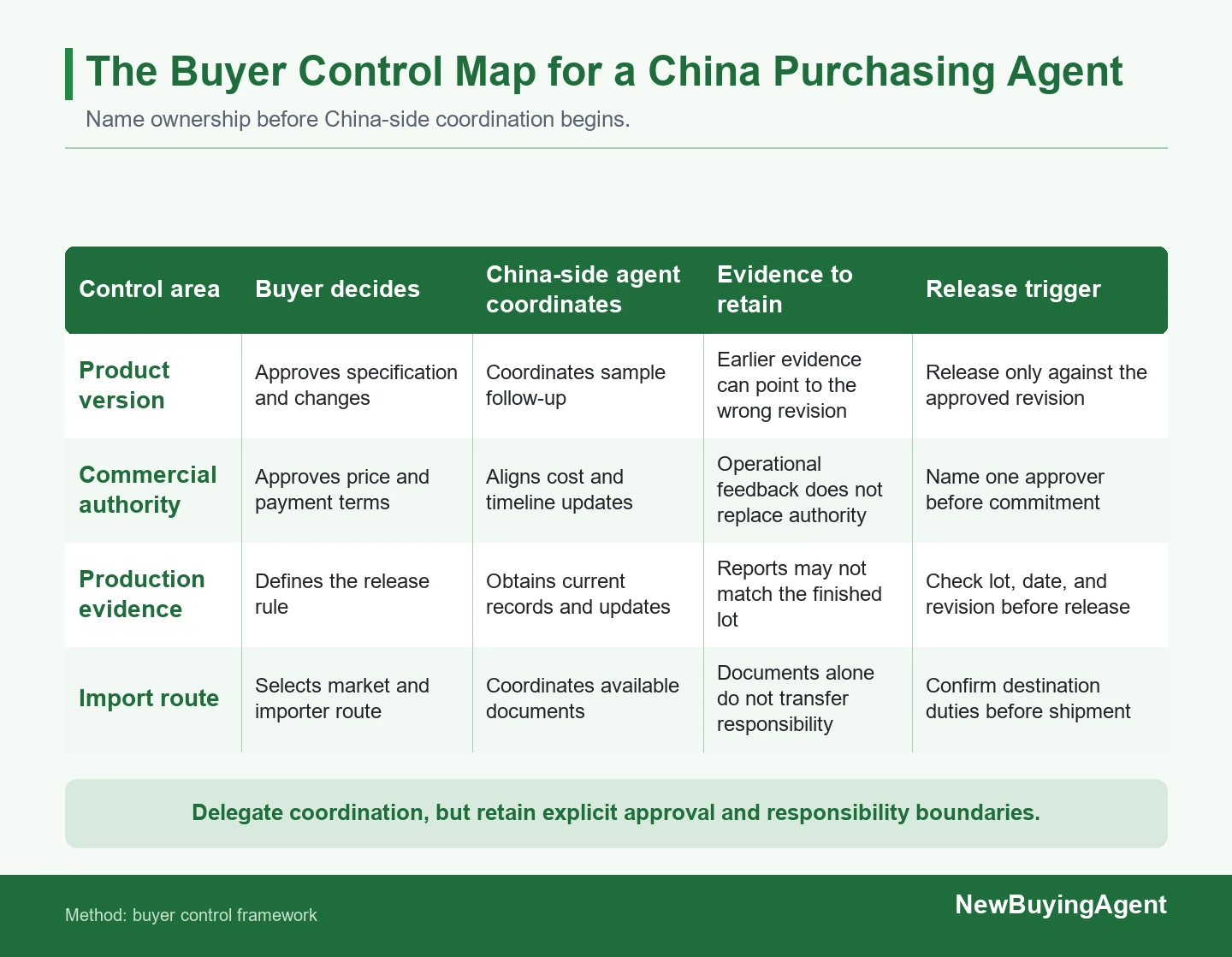
Use the map to set ownership before samples, deposits, substitutions, or shipment release.
Use the Buyer Control Map Before You Choose a Working Model
The Buyer Control Map uses four boundaries—product definition, commercial authority, production evidence, and import responsibility—to make delegation reviewable.
The Buyer Control Map is a four-part ownership check: product definition identifies the approved version; commercial authority names the buyer who can approve changes; production evidence links the version to a real production or shipment population; and import responsibility identifies the party accountable for entry and applicable destination-market obligations. A buyer can delegate China-side coordination within each boundary, but should not leave the boundary itself unnamed. This framework is buyer operating guidance, not a legal transfer-of-liability model.
The map works because it prevents one recurring mistake: treating a useful China-side contact as the substitute for a decision system. Before asking an agent to start, place each question in one of the four rows below. If an answer is missing, resolve it in the brief or control sheet before it becomes a production dispute.
1. Keep product definition under buyer control
A product brief should identify the version, materials, packaging, destination, and approved change path before price discussions become meaningful. “Same as the photo” is not a version. For a drinkware program, the buyer may need to identify vessel capacity, lid material, color reference, print position, carton count, destination, and sample sign-off. For hardware, it may be finish, dimensions, load requirement, thread type, packaging, and required instructions.
The agent can coordinate local clarification, sample progress, and production follow-up. The buyer should still say what constitutes an acceptable substitute and who may approve one. This prevents a late material, color, component, or packing change from being treated as an ordinary production detail when it is actually a new product decision.
2. State commercial authority before quotes or payment
The buyer should state who can approve price, samples, substitutions, payment milestones, and delivery changes. A China purchasing agent can coordinate a cost discussion and explain a factory-side constraint, but should not have to infer whether a buyer will accept a changed specification, a revised target price, or a delayed launch date.
A short authority matrix is enough for many orders. Name the buyer contact who can approve the final product version, the person who can release a deposit, the person who can approve a packing or timeline change, and the response window for each. When a decision is commercial rather than operational, the agent should surface the trade-off with evidence and wait for the stated approval.
3. Require evidence that matches the production decision
Evidence is decision-useful only when it matches the current product version and the production or shipment population it is meant to support. A sample photograph, material declaration, measurement sheet, production update, inspection record, and carton mark can all help. None should be treated as a stand-alone promise that applies to every later version, lot, or shipment.
Set the evidence gate in buyer language. For example: “Do not release the changed color until the approved swatch, lid version code, and carton marking refer to the same version.” That is more actionable than asking for “quality proof.” It gives the China-side team a clear collection task and gives the buyer a clear release condition.
4. Keep destination-market and importer duties visible
U.S. and EU official guidance illustrates that importer responsibilities remain market-specific even when outside parties assist with the transaction. The European Commission says that importers bringing goods from outside the EU must check applicable safety, health, and environmental requirements before placing products on the market; its importer guidance also points to documentation and manufacturer-contact expectations.
At this stage, define the Importer of Record in plain operational terms: the party identified for import entry and applicable responsibilities in the destination market. That party may work with brokers, advisers, and China-side coordinators, but it needs the product, entry, and responsibility facts required for its own route.
That does not mean every product follows the same EU route, or that a China purchasing agent should give legal advice. It means the buyer should state the destination market early, identify the party responsible for import entry and applicable product obligations, and ask the appropriate qualified adviser, laboratory, broker, or authority when a product-specific determination is needed. The agent can coordinate documents and manufacturing evidence, but the buyer should preserve the final route decision.
Five China Purchasing-Agent Working Models, Ordered by China-Side Coordination
Working models should be ordered by coordination scope rather than treated as a universal provider-quality ranking.
The five models below are ordered by China-side coordination scope, not by universal quality or suitability. The best fit is the smallest model that closes the buyer’s actual gap while keeping product, commercial, evidence, and import ownership visible.
| Model | China-side scope | Buyer must retain | Best fit |
|---|---|---|---|
| #1 Direct factory buying | Minimal | All operating records | Proven factory relationship |
| #2 Communication support | Language and local follow-up | Product and release decisions | Narrow communication gap |
| #3 Release coordination | Production and evidence follow-up | Defined product and terms | Visibility gap |
| #4 Product-supply support | Product through delivery | Approval authority and market route | New defined requirement |
| #5 Existing-factory management | Ongoing local coordination | Commercial ownership and release rules | Current manufacturer, weak visibility |
Based on this comparison, start with the control gap rather than the label. A buyer with a stable factory and clear process may need only evidence-focused support. A buyer with a defined new product may need a fuller China product-supply route. A buyer whose manufacturer is already chosen but whose production visibility is weak may need ongoing local factory management.
#1 Direct factory buying — least China-side coordination
Direct factory buying leaves the buyer responsible for the China-side operating record.
It can fit when the buyer already has a proven manufacturing relationship, reliable communication, current product documentation, and a practical way to collect production and shipment evidence. The risk is not that direct buying is automatically wrong; the risk is assuming a familiar contact removes the need for version control and clear release authority. Before choosing this model, test whether the buyer can identify the latest approved version, obtain a response to a production issue in the needed time window, and make a shipment decision from records rather than memory. If not, there is a coordination gap even with a long-standing factory contact.
#2 Communication support — narrow local assistance
Communication support is narrow local assistance, not a complete product-supply route.
It can help a buyer clarify a sample question, localize a packaging instruction, follow up on a stated date, or reduce a time-zone delay. It is insufficient when the buyer has not defined the product version, commercial approvals, or production evidence. In that case, better communication may simply make an unclear process move faster. Use this model when the commercial structure is already stable and the buyer needs an extra local communication layer, not when the buyer needs someone to invent missing product or approval rules.
#3 Production and release coordination — evidence-focused support
Release coordination is useful when product and commercial decisions are already defined.
The buyer might need production follow-up, a check that the approved version is being made, quality-control coordination, packed-carton evidence, and logistics handoff updates. The model works best when the buyer gives the agent a concrete release rule rather than asking for a general assurance that the goods are “okay.” A useful release question is: which photos, measurements, records, or carton marks must be reviewed before the buyer gives the next instruction? The answer differs by product, but the decision structure remains the same.
#4 Product-supply support — a route from requirements to delivery
Product-supply support fits a defined requirement that needs China-side product and delivery coordination.
The buyer supplies the commercial brief; the China-side team turns it into a quoted product path and keeps the next decisions visible. This is appropriate when the buyer has a category, specification, quantity, target price, destination, and timing, but needs local product selection, cost negotiation, quality management, production follow-up, and logistics coordination to make the route workable. The buyer should still approve the version and commercial changes in writing. For buyers starting with a product requirement rather than an existing manufacturer, NewBuyingAgent's product-supply service is the relevant route.
Before China-side coordination begins, turn the approved requirement into a short handoff record. State the product version and change rule, the cost and payment approver, the sample that controls the current decision, the evidence needed before release, and the destination-market route that still needs the buyer’s confirmation. Give the team one current file location for each item and name who can replace it. When a date, price, material, carton mark, or shipping instruction changes, record whether it is a request, an approved change, or an open question. This prevents routine follow-up from being treated as authority to alter the deal. It also makes a pause understandable: the team can point to the missing decision rather than sending a vague warning that something needs attention.
#5 Existing-factory management — the deepest ongoing coordination
Existing-factory management fits a current manufacturer relationship with a China-side visibility gap.
The buyer keeps the commercial relationship and release rules, while local support can coordinate production follow-up, QC evidence, issue clarification, and logistics continuity. This model is helpful when the buyer knows the current product and factory history but cannot obtain timely, comparable updates from outside China. It is not a reason to reopen every original commercial decision. First document the current PO, approved sample, latest production status, known issues, and shipment schedule. Then the local team can identify the immediate release gap. If that is the buyer’s situation, a factory-management service is more precise than restarting the entire product-supply path.
Build a Buyer Brief Before a China Purchasing Agent Starts Work
For applicable U.S. consumer-product rules, certificate responsibility belongs with the manufacturer or importer, not with an undefined sourcing role. The U.S. certificate regulation is one reason to make roles explicit rather than relying on an informal statement that a third party will “take care of compliance.” The exact obligations depend on the product and market.
A practical buyer brief does more than request a price. It gives the China-side team enough information to decide whether it can build a product-supply route, manage an existing factory path, or ask the buyer to resolve a missing control first. The brief should use the same facts the buyer will later use to approve a sample, payment, or shipment.
- Product: product name, current version, key specifications, materials, colors, dimensions, packaging, and any approved sample reference.
- Commercial: quantity, target price, target delivery timing, payment constraints, and the named buyer approver.
- Quality and evidence: critical functions, finish expectations, required photos or records, lot or carton identifiers, and the release condition.
- Market route: destination, sales channel if relevant to requirements, shipping preference, and the party handling import entry and product obligations.
- Change path: which substitutions require written buyer approval and how quickly the buyer will respond.
Do not confuse a long brief with a useful brief. A one-page record with a version date is often stronger than a large email thread with conflicting attachments. Where an item is unknown, mark it as an open decision. That gives the agent a reason to surface the gap instead of silently filling it with an assumption.
Put the Decision Boundaries in Writing Before Payment
Incoterms allocate defined shipment tasks, costs, and risks, but they do not settle whether goods conform to the sales contract or resolve disputes. Trade.gov’s Incoterms overview describes their role in assigning buyer and seller tasks, costs, and risks.
The ICC’s Incoterms 2020 checklist shows why the selected rule and named place matter to delivery and risk transfer.
For the buyer-agent relationship, a compact written control sheet should sit beside the purchase documents. It is not a replacement for a sales contract, shipping document, or market-specific advice. It is the operating record that answers practical questions before they become expensive:
- Which product version and sample are approved?
- Who can approve a material, packaging, price, or timing change?
- What must the agent report before the buyer authorizes the next payment?
- What evidence must match before the buyer releases the shipment?
- Which Incoterms rule and named place apply, and who owns the destination-market import decision?
- Who is copied if a decision has not arrived by the stated response time?
These questions are deliberately ordinary. A good operating model turns ordinary questions into a record before an urgent booking, a changed component, or a delayed carton mark turns them into a dispute. The agent then has authority to coordinate facts, but not to guess the buyer’s risk appetite.
Worked Scenario: A Drinkware Launch With an Unclear Change Authority
An illustrative product change should be held until product authority, version evidence, and carton identity match.
Situation, problem, action, and result
A homewares buyer is preparing a 1,200-unit insulated drinkware launch for two destination markets. The order uses a stainless-steel vessel, a colored lid insert, printed cartons, and a named FCA handoff. The buyer approved a sample appearance but had not stated who could approve a lid-material change after the deposit.
The factory proposed a different lid insert after the approved sample because the original color additive was delayed. The revised insert had no buyer-approved version code on the production photos or carton reference. The forwarder booking date created pressure to treat the change as a routine substitution.
The illustrative hold makes a late product change reviewable before release.
Problem analysis: the issue is not simply a color delay; the buyer’s product approval, commercial authority, and evidence record are disconnected. Decision: hold the 1 drinkware family using the changed lid insert until the revised material, version code, sample, and packed-carton reference are reviewed together.
Action: issue a change sheet naming the replacement material, product version, buyer sign-off, updated sample, and release evidence required. Result and verification gate: release only after the buyer-approved change sheet, current version, and carton identifier resolve to the same record. Illustrative procurement scenario; it does not certify product safety, customs clearance, or delivery performance.
Where NewBuyingAgent Fits in the Buyer Control Map
NewBuyingAgent can fit a buyer who needs a China-side product-supply route or existing-factory management after the buyer defines the control boundaries.
NewBuyingAgent is a one-stop China sourcing agent service provider for global buyers, helping them simplify China procurement through local factory resources, product selection, cost negotiation, production follow-up, quality control, logistics coordination, and China-side factory management.
For a buyer whose order is still a product requirement, the useful fit is a defined brief with product specs, quantity, target price, destination, and timing. NewBuyingAgent can use local China factory resources and product/QC capability to turn that brief into a China-supplied product route with clearer product, quality, and delivery decisions. For a buyer that already has a manufacturer, the more relevant fit may be China-side follow-up and evidence coordination around the existing factory.
NewBuyingAgent draws on 30+ years of trade, manufacturing, and QC experience, along with 50,000+ cooperated factory resources and 20,000+ product development & QC experts. Those capabilities are most valuable when the buyer has made the approval boundaries explicit. If the product is ready for a real quote or the current factory has a visibility gap, prepare the current version, quantity, target price, destination, timing, and the decision that needs China-side support, then contact NewBuyingAgent to share the project brief.
Frequently Asked Questions
The right engagement model is the one that closes the buyer’s real China-side coordination gap without obscuring ownership. The same buyer may use a different model for a new product launch, a repeat order, and an established factory relationship.
What does a China purchasing agent do?
A China purchasing agent coordinates the China-side commercial and operating tasks that the buyer defines in the brief. The scope can include product selection, cost negotiation, sample follow-up, production updates, quality-control coordination, packing evidence, and logistics handoff. The buyer should still retain named authority over product versions, commercial approvals, payment, and the destination-market route.
Does a purchasing agent become the importer of record?
A purchasing agent does not automatically become the Importer of Record; the buyer must identify the responsible importing party for the destination market. An agent or broker may coordinate information and documents, but the importing structure and applicable obligations need to be checked against the specific product, destination, and transaction. Treat this as a trade-compliance question, not a service label.
What should I send a China purchasing agent before asking for a quote?
Send a product brief with specifications, quantity, target price, destination, timing, packaging needs, and the approvals you want to retain. Include the current product version, sample reference if available, quality-critical details, and any planned Incoterms rule or shipping preference. A brief that names open decisions is better than one that hides them in a long email chain.
When is existing-factory management a better fit than product-supply support?
Existing-factory management is the better fit when the manufacturer is already chosen and the gap is local production, QC, or logistics visibility. Product-supply support is more useful when the buyer starts with a defined purchasing requirement and needs a China-side route through product selection, cost negotiation, quality management, and delivery coordination. The control sheet makes the distinction visible before the engagement begins.
NewBuyingAgent
Related Resources

Get Started Today
Let's Turn Your Sourcing Goals into RealityWeChat:+86 15157124615
WhatsApp:+86 15157124615
Address:Building 10 #39 Xiangyuan Road, Hangzhou, China
