

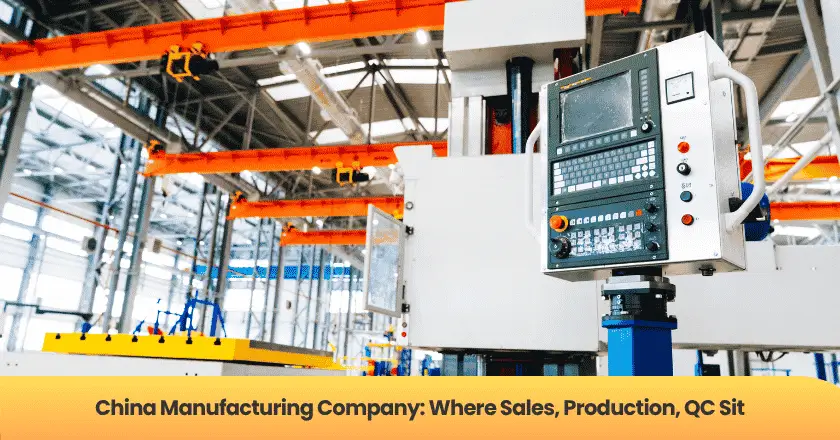
A buyer asks a simple technical question on Tuesday: can the wall thickness go to 1.8mm without affecting cycle time. The answer arrives Friday, and it is correct. Between Tuesday and Friday his message travelled from an export sales office to a merchandiser, from the merchandiser to an engineer, from the engineer back through both, and was translated twice. Nobody was slow. The question simply crossed three departments in a building the salesperson may never have visited.
Chinese factories are organised in a recognisable way, and knowing where each function sits explains most of what buyers experience as inconsistent responsiveness. It also tells you who to ask when an answer actually matters.
Key Takeaways
• Export sales usually sits in its own department, sometimes in a different city from the plant.
• A merchandiser translates your order into production instructions and is the operational centre of most factories.
• Production planning controls the queue, which is what determines your cargo ready date.
• Quality control appears at three stages, and whether it reports independently of production is the question that matters most.
• Technical answers come from engineering, so ask to reach that function directly on anything dimensional.
Who You Are Actually Talking To
The person in your inbox is rarely the person who decides anything, and that is a structural fact rather than a criticism.
The Foreign Trade Department
Export sales is generally a separate function with its own staff, chosen for language and commercial ability rather than technical background. In integrated industry and trade firms it may sit in a coastal city with better staff availability while the plant is inland or in a smaller town.
This is why a salesperson can be excellent commercially and unable to answer a tolerance question. The distance is organisational and sometimes physical. Judge the department on responsiveness and accuracy of relay rather than on technical depth, and get a second contact for the technical questions.
The Merchandiser Behind Them
Behind sales sits the merchandiser, who converts your order into instructions the plant can follow, chases material, tracks the schedule and handles the daily coordination. In most Chinese factories this role is the operational centre of everything that happens to your order.
Ask who the merchandiser is and speak to them directly where the factory allows it. Sales owns the relationship, and the merchandiser owns the order. Buyers who only ever reach sales are receiving a summary of a summary.
Above these sits a general manager or owner, and in smaller factories the owner is often directly reachable and directly decisive. That is an advantage on a difficult question and a risk on continuity, since a business where one person decides everything has a single point of failure. Larger plants distribute authority and move more slowly, which is the ordinary trade between the two.
Expert Tip: Ask for three named contacts at the start: commercial, order execution and technical. Most factories provide them without hesitation and the request signals that you have done this before. I route pricing to the first, schedule questions to the second and anything dimensional to the third, which removes days from the response cycle. Buyers who send everything to one address get everything at the speed of the slowest relay.
How Production Is Organised
Three functions sit between an order and a finished carton, and each affects a different part of your experience.
Planning, Purchasing and Engineering
Production planning, often called PMC, controls the schedule and decides when your order enters the line. This is the function that actually determines your cargo ready date, and it balances your order against everyone else's. Purchasing buys materials and components, and its lead times sit ahead of production in the sequence.
Engineering handles drawings, tooling, process settings and technical decisions. When you ask what a design change would do to cost or cycle time, this is where the answer comes from. Factories with a real engineering function can support product development, and those without one are effectively building to whatever you supply.
Warehousing and shipping sit at the end of the chain and are usually a small team. They handle finished goods storage, packing verification and the handover to your forwarder, and they are the people who discover late that a carton specification was never communicated. Where packing matters commercially, ask whether this function receives your packing standard directly or only through production.
Where Your Order Sits in the Queue
Ask when your order enters the schedule rather than how long production takes. A 25-day build starting three weeks after your deposit is a 46-day wait, and only planning knows which applies. During peak periods the queue is the constraint rather than capacity.
Material purchasing usually waits for the deposit, which is why a late payment moves the whole sequence rather than just its own step. Ask what has to be bought and how long it takes, since a component with a six-week lead time sets your schedule regardless of how fast the line runs.
Common Mistake to Avoid: Asking sales for a production commitment produces optimistic dates that nobody in planning has agreed to, and buyers then treat the slip as dishonesty. Sales is measured on winning and keeping orders, and it rarely holds the schedule. Ask instead for a confirmation from planning of the date your order enters the line, in writing. The answer is usually less flattering than the one sales gave you, and it is the one that turns out to be true.
Where Quality Control Sits
The quality function appears at several points, and its position on the org chart matters more than its size.
Incoming, In-Process and Final
Incoming inspection checks materials and components before they enter production. In-process checks sample output while the line is running, which is where a systemic error can still be corrected cheaply. Final inspection checks finished goods before packing, sometimes with a separate outgoing check before loading.
These map onto the stages your own inspection plan should use, and both work to sampling schemes of the kind set out inISO 2859-1.Ask which stages the factory actually operates and what records it keeps, since a factory with in-process checks and no records is describing an intention rather than a system.
The Reporting Line Question
The single most informative question about a factory's quality function is who it reports to. Where quality reports to production, the people judging output answer to the person responsible for meeting the schedule. Where it reports independently, a quality manager can hold a batch over a production manager's objection.
This is one reason quality system certification exists. ISO 9001 is the most widely used quality management standard in the world, with over a million certificates issued across 189 countries, and it sets requirements for a documented system rather than for your specific product.A new edition is expected to replace the 2015 version in September 2026, so certificates and audit reports will reference different editions for a period.
Expert Tip: Ask whether quality can stop a shipment over the objection of the sales or production manager, and listen to how the question lands. Factories with genuine independence answer immediately, often with an example. Factories without it explain why the situation would not arise, which is not an answer to the question asked. This tells you more about what will happen during a difficult production run than any certificate on the wall.
Using the Structure in Practice
Knowing the org chart changes who you contact, what you escalate and how quickly problems get resolved.
Matching the Question to the Function
Price and terms go to sales. Schedule and material status go to the merchandiser or planning. Tolerances, materials and process questions go to engineering. Defect classification and inspection results go to quality. Sending everything through one contact adds a relay step to each exchange and loses detail in translation.
Where a factory refuses direct access beyond sales, that is a legitimate policy and it is also information. It usually means either a small operation where one person genuinely covers several roles, or a trading operation presenting itself as a factory. Both are workable and both change what you can expect on technical questions.
Language capability is distributed unevenly and worth mapping too. Sales generally works in English, while merchandisers vary and engineering and quality staff frequently do not. Where a technical exchange has to pass through translation, precision is lost exactly on the details that matter, which is an argument for written specifications with drawings rather than for longer conversations.
Escalation Before You Need It
Ask early who your contact reports to and who owns the customer relationship above them. Escalation works when you know the name in advance and badly when you are searching for it during a crisis at eleven at night.
Staff turnover is the other reason to map this. Merchandisers move between factories, and a departure takes accumulated understanding of your tolerances with it. Keep your own record of what the factory has learned about your requirements, since that record is yours rather than theirs and it survives a resignation.
Expert Tip:Visit the plant rather than the sales office if you visit at all. Buyers are frequently hosted in a showroom near the sales function and shown a presentation, which is pleasant and tells you little. Ask specifically to walk the production floor, see the incoming inspection area and meet the merchandiser handling your orders. A factory that arranges this readily is showing you something it is comfortable with, and that comfort is itself useful information.
Reaching the Right People Without Doing It Yourself
Mapping three or four functions inside one factory is manageable. Doing it across a dozen suppliers, in a second language, across a time difference, is the work that quietly consumes a buying team.
NewBuyingAgent handles all factory communication—perfect for multi-category buyers. Free up your time to focus on expanding your local market sales.
NewBuyingAgent is your perfect partner for global sourcing from China, backed by 30 years of expertise in trade, manufacturing and quality control. Its mission is to make China sourcing effortless and profitable for global buyers.
Reaching the right people inside a factory also affects what the goods cost, since a buyer who can talk to engineering can change a product rather than only argue about its price.
NewBuyingAgent's wide factory network lets it pick low-cost, high-cooperation suppliers. Even with its margin included, it cuts your costs by 5%-10%.
Frequently Asked Questions
Why does my technical question take days to answer?
Because it is being relayed. Export sales staff are chosen for language and commercial ability rather than technical background, so a dimensional question travels to engineering and back, often with translation at both ends. Ask for a technical contact alongside your commercial one and the cycle shortens considerably.
Who decides my delivery date at a Chinese factory?
Production planning, not sales. Planning controls when your order enters the line and balances it against other customers. Ask for written confirmation from planning of the date your order enters the schedule rather than accepting a general lead time from a salesperson.
Does it matter who quality control reports to?
It matters a great deal. Where quality reports to production, the people judging output answer to the person responsible for the schedule. Where it reports independently, a batch can be held over a production manager's objection. Ask whether quality can stop a shipment and listen to how directly the question is answered.
Should I insist on talking to someone other than my salesperson?
Ask rather than insist, and expect most factories to agree. Three contacts covering commercial, order execution and technical questions is a normal arrangement. Where access beyond sales is refused, that usually indicates a small operation or a trading company, both of which are workable once you know which you are dealing with.
How large is a typical export-focused Chinese factory team?
It varies enormously, and the shape matters more than the size. What is worth establishing is whether separate people hold sales, order execution, technical and quality roles, or whether one or two people cover all four. The latter is common in smaller factories and workable, provided you understand that continuity depends heavily on those individuals staying.
Conclusion
Sales owns the relationship, the merchandiser owns your order, planning owns the date and engineering owns the answers that matter technically. Ask for three contacts at the start, take schedule commitments from planning rather than sales, and find out who quality reports to before you need to know. The structure is consistent enough that a few questions map it, and the mapping pays for itself on the first difficult order.For buyers who would rather not map a dozen factories themselves, NewBuyingAgent handles factory selection, quality control and delivery from China.
Partial Sources
1. International Organization for Standardization — ISO 9001:2015, Quality management systems: Requirements, the most widely used quality management standard —https://www.iso.org/standard/62085.html— Accessed 31 August 2026
2. International Organization for Standardization — ISO 9001 revision page, with the new edition expected to replace ISO 9001:2015 in September 2026 —https://www.iso.org/standard/88464.html— Accessed 31 August 2026
3. International Organization for Standardization — ISO 2859-1:2026, Sampling procedures for inspection by attributes, Part 1 —https://www.iso.org/standard/85464.html— Accessed 31 August 2026
NewBuyingAgent
Related Resources
Get Started Today
Let's Turn Your Sourcing Goals into RealityWeChat:+86 15157124615
WhatsApp:+86 15157124615
Address:Building 10 #39 Xiangyuan Road, Hangzhou, China
