

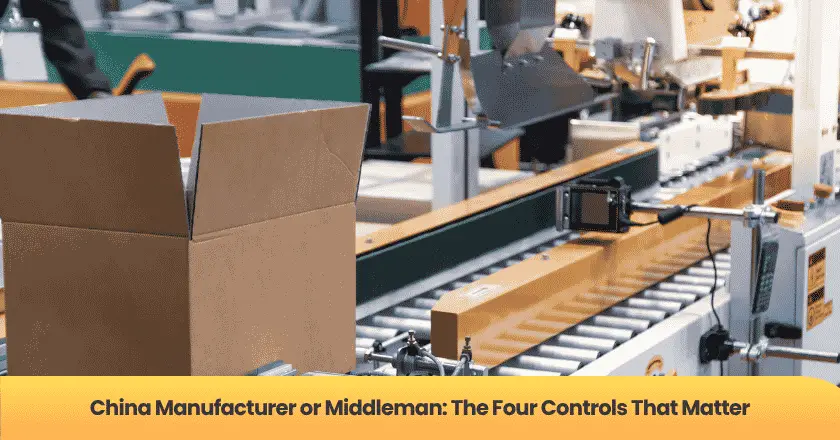
A buyer spends five weeks confirming that his supplier owns its factory. Video walkthrough, business licence, site address, all consistent. He places the order relieved. The batch arrives with the wrong surface finish, and it emerges that the plating was subcontracted to a workshop two streets away, as it always had been. The factory was real. The control he assumed came with it was not.
Buyers treat factory ownership as a single yes-or-no question that settles everything. It settles very little on its own. Four separate controls determine how an order actually goes, and a supplier can hold any combination of them regardless of what the licence says.
Key Takeaways
• Factory ownership is a proxy for capability rather than a measure of it, and the proxy fails often enough to be unreliable.
• Four controls decide outcomes: pricing headroom, technical authority, quality accountability and supply continuity.
• A factory that subcontracts part of your process has already given away technical authority over that step.
• A trading company with deep long-term factory ties can score higher on continuity than a small independent plant.
• Some situations genuinely require a factory, and knowing which ones stops you paying for control you do not need.
Why the Factory Question Is the Wrong First Question
The question is popular because it is answerable. You can check a licence and watch a video. The trouble is that the answer does not predict much.
What Buyers Are Actually Trying to Find Out
Behind the factory question sit four practical worries. Am I paying a hidden margin. Can this supplier change the product if I need it changed. Who fixes a bad batch. Will they still be supplying me in two years. Every one of those is a question about control, and ownership of machines is only loosely correlated with any of them.
That loose correlation is why buyers who verify factory status still get surprised. They confirmed the proxy and never checked the thing the proxy was standing in for.
Why Ownership Answers It Only Partly
Manufacturing is rarely done end to end under one roof. Plating, printing, injection moulding, heat treatment and assembly are routinely split across specialised workshops within a cluster, which is efficient and entirely normal. A factory that owns assembly but subcontracts finishing controls part of your process and not the rest.
Meanwhile a trading company that has placed volume with the same three factories for a decade may have more real influence over a production schedule than a small plant has over its own component suppliers. Influence follows commercial weight more reliably than it follows asset ownership.
Scale complicates it further. A factory that is genuinely yours at 2,000 units may push your order to a partner workshop at 20,000 because its own line is committed, and it will often do so without announcing the change. The arrangement is not deceptive by local convention, and it does alter who is standing over your production that month.
Expert Tip:Ask which steps happen in-house and which are subcontracted, then ask it again as a list of process names rather than as a general question. Plating, printing, moulding, assembly, packing. Suppliers answer specifics readily because subcontracting is unremarkable to them, while a broad question invites a broad reassurance. The list you get back is a map of where your technical authority actually stops, and it is worth more than any video walkthrough.
Controls One and Two: Price and Technical Authority
The first two controls decide what you can negotiate and what you can change. They are the ones buyers think about, and they still get misread.
Who Has Room on Price
Pricing headroom means the ability to move a number without losing money. A factory has headroom over its own conversion cost and none over the copper, resin or fabric it buys at market. A trading company has headroom over its margin and, if it buys in volume across clients, sometimes over the factory price too.
The mistake is assuming the factory always has more. On a component-heavy product where materials dominate the bill, a factory may have less room than an aggregator placing combined orders. Ask what proportion of the price is material rather than pushing on the total, since that ratio tells you where any movement can come from.
Watch how a supplier responds to a price challenge as well as what number comes back. A party with real headroom asks what quantity or specification change would justify a move. A party without it either refuses flatly or agrees immediately, and an instant agreement usually means the quote had padding rather than that you negotiated well.
Who Can Change How It Is Made
Technical authority is the power to alter the product itself: material grade, tolerance, process, tooling. It sits with whoever controls the step being changed, which is why the subcontracting map matters so much.
Test it with a specific request rather than a general enquiry. Ask what changing a wall thickness by half a millimetre would do to cycle time and cost. A party with authority over moulding answers with numbers and consequences. A party without it comes back a day later having asked, which is useful information rather than a failure.
Common Mistake to Avoid:Assuming that buying direct removes the middleman is the error underneath most of this. Every supply chain has intermediaries, and going direct to an assembly factory usually means the intermediaries have simply moved upstream where you cannot see them. Your factory buys components from traders too. The question worth answering is not how many parties exist but whether the one you contract with controls the steps that matter for your product, which is a different and much more useful investigation.
Controls Three and Four: Accountability and Continuity
The second pair decide what happens when something goes wrong, and whether the arrangement survives long enough to matter.
Who Is Answerable When a Batch Fails
Quality accountability has a legal dimension and a practical one. Practically, it means somebody with authority to stop a line and rework a batch at their own cost. Contractually, it means your quality terms bind the party that controls production rather than only the party that invoices you, which is why the model contracts published by the International Chamber of Commerce are worth borrowing from when drafting.
There is a regulatory dimension as well. The EU'sGeneral Product Safety Regulation, applicable since December 2024, requires consumer products to carry the manufacturer's name and contact details and to have an economic operator established in the EU responsible for them. Some markets therefore make the manufacturing identity a compliance matter rather than a preference.
Accountability also has a practical test that costs nothing. Raise a small, genuine complaint early in the relationship, such as a packing detail that was missed. Watch whether the response is a fix, an explanation, or a request that you overlook it. How a supplier handles a minor failure is the most reliable available predictor of how it will handle an expensive one.
Who Guarantees the Line Keeps Running
Continuity is the control buyers examine last and regret first. A single factory carries single-site risk, including local inspections, equipment failure and the owner deciding to change product lines. An aggregator holding relationships across several plants carries a different risk profile, and often a better one for a buyer who cannot afford a gap.
Ask what happens if the primary line is down for three weeks. A supplier with continuity control names an alternative arrangement. One without it explains why the situation is unlikely, which is not an answer to the question you asked.
Expert Tip:Write the four controls into your supplier review rather than assessing them ad hoc. I score each one out of three at onboarding and again after the first production run, because the second scoring is the honest one. Suppliers present well on price and technical authority during courtship and reveal their accountability and continuity only under pressure. Two rounds of scoring, twenty minutes each, and the picture is considerably more useful than a factory audit certificate.
Scoring Suppliers and Choosing Accordingly
Once the four controls are explicit, supplier selection becomes a matching exercise rather than a hunt for a single ideal type.
A Four-Column Assessment
Build a simple grid: supplier down the side, the four controls across the top, and a note in each cell describing evidence rather than impression. Pricing headroom evidenced by a material breakdown. Technical authority evidenced by an answer to a specific process question. Accountability evidenced by contract terms and who signs them. Continuity evidenced by a named alternative arrangement.
Supplier relationship management as a discipline has long treated suppliers as varying in strategic weight rather than as interchangeable, and professional bodies such asCIPSframe procurement around exactly this kind of ongoing supplier assessment. Applying that thinking at small scale costs nothing and prevents most of the surprises.
Weight the columns rather than totalling them. The four controls are not equally important on every purchase, and a supplier scoring two out of three across all four may suit you far better than one scoring full marks on the two that happen not to matter for this product. Deciding the weighting before you score keeps the exercise honest.
When You Genuinely Need the Factory
Four situations make direct factory engagement close to mandatory. Custom tooling, because you are commissioning an asset and its ownership needs to be settled with whoever holds it. Site-specific certification and social compliance audits, which attach to a named facility. Exclusivity arrangements, which are worthless if the party granting them does not control production. Designs where confidentiality genuinely matters, since every additional party widens the circle.
Outside those, the choice should follow the four controls rather than the label. Buyers running several categories at modest volume frequently do better with an aggregator that scores well across all four than with a factory that scores highly on two.
Expert Tip:Decide which of the four controls actually matter for the product in front of you before assessing anybody. A commodity item bought on price needs pricing headroom and continuity, and technical authority is close to irrelevant. A custom moulded part inverts that completely. Buyers who skip this step apply the same standard to every purchase and end up over-investigating simple items while under-investigating the ones that can genuinely hurt them.
Assessing Suppliers at Scale With NewBuyingAgent
Scoring four controls per supplier is straightforward once. Doing it across enough candidates to have a real choice is the part that defeats most buying teams, and the shortlist is only as good as the pool it was drawn from. NewBuyingAgent gives you 100% Access to China's Factories through its 50,000+ cooperated partner factories—no language/region/time zone barriers. Its local reputation gets you full factory cooperation.
NewBuyingAgent is your perfect partner for global sourcing from China, backed by 30 years of expertise in trade, manufacturing and quality control. Its mission is to make China sourcing effortless and profitable for global buyers.
Of the four controls, accountability is the one that reaches your customers, and it is the one that needs people watching production rather than paperwork. NewBuyingAgent's 20,000+ product development & QC experts ensure your products match market needs and stay high-quality.

Frequently Asked Questions
Is buying from a factory always better than buying from a trading company?
No. It is better when you need technical authority or site-specific certification, and often worse when you need breadth, small quantities or reliable export handling. Judge the supplier on pricing headroom, technical authority, quality accountability and continuity rather than on which category it falls into.
How do I find out whether a factory subcontracts my process?
Ask about named process steps rather than asking in general terms. Plating, printing, moulding, assembly, packing. Suppliers answer specific questions directly because subcontracting is ordinary practice locally. Where a step is subcontracted, ask who performs it and whether the same workshop is used every time.
Does subcontracting mean I should walk away?
Rarely. Specialisation across workshops is how clusters achieve their cost and speed, and refusing it would rule out most competent suppliers. What matters is that you know which steps are involved, that the arrangement is stable, and that your quality terms still reach the party performing the work.
Which control causes the most problems in practice?
Quality accountability, usually because it was never assigned. Buyers contract with an invoicing entity, defects originate at a production site, and no document connects the two. Naming the manufacturing entity in your order and attaching quality obligations to it removes most of that exposure for the cost of a clause.
How often should I reassess these four controls?
Once at onboarding and again after the first production run, then annually or whenever something changes visibly. Volume growth, a new account manager, a longer than usual lead time and a sudden price movement are all signals that the underlying arrangement may have shifted. Reassessment takes minutes when the original scoring is written down.
Conclusion
Stop treating factory ownership as the question and treat it as one piece of evidence. Work out who has room on price, who can change how the product is made, who is answerable for a bad batch and who keeps you supplied when a line goes down. Suppliers that score well across all four are worth keeping, whatever the licence happens to say.For buyers who want that assessment run across a much wider set of candidates, NewBuyingAgent handles factory selection, quality control and delivery from China.
Partial Sources
1. EUR-Lex, Publications Office of the European Union — summary of Regulation (EU) 2023/988 on general product safety, including manufacturer identification and responsible person requirements —https://eur-lex.europa.eu/EN/legal-content/summary/general-product-safety-regulation-2023.html— accessed 19 August 2026
3. Chartered Institute of Procurement & Supply — What is procurement, covering supplier relationship management and category management —https://www.cips.org/intelligence-hub/procurement/what-is-procurement— accessed 19 August 2026
NewBuyingAgent
Related Resources
Get Started Today
Let's Turn Your Sourcing Goals into RealityWeChat:+86 15157124615
WhatsApp:+86 15157124615
Address:Building 10 #39 Xiangyuan Road, Hangzhou, China
