

Introduction
Everyone sourcing electronics hears "go to Shenzhen," and they're not wrong — but Shenzhen and the wider Pearl River Delta around it form an ecosystem, not a single address, and knowing how its pieces fit determines whether you find the right manufacturer or just the loudest one. The same region that hosts world-class design houses also hosts board shops, trading companies, and component markets, and treating them as interchangeable is how buyers end up with the wrong partner at the right postcode.
Shenzhen and neighboring Dongguan together anchor the densest electronics supply chain on earth, and that density is the real advantage — components, assembly, tooling, and expertise within an hour of each other. The buyers who understand what each part of the hub does best consistently find better-fit manufacturers than those chasing the first impressive quote.
Key Takeaways
• Shenzhen and Dongguan form one electronics ecosystem, with a real advantage in supply-chain density.
• Shenzhen leans toward design, prototyping, and complex products; Dongguan toward scaled assembly and volume.
• The region's strength is the component and tooling supply chain within reach of every factory.
• The best-fit manufacturer often isn't the most visible online; reach into the ecosystem matters.
• Verify capability, testing, and that you're dealing with a factory, not a broker, regardless of location.
Understanding the Shenzhen–Dongguan Ecosystem
Why density is the advantage
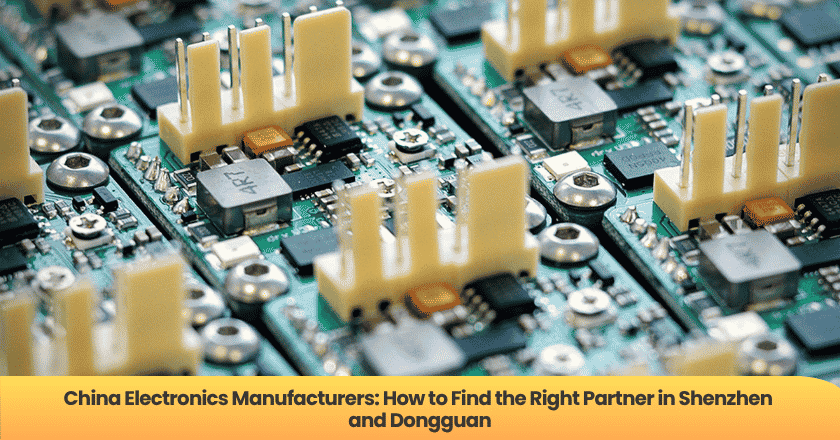
The reason this region dominates electronics isn't any single factory — it's that the entire supply chain co-locates. Components from the legendary Huaqiangbei markets, PCB fabrication, SMT (Surface-Mount Technology — automated placement of components onto boards) assembly, tooling, plastics, and engineering talent all sit within a short radius. A manufacturer here can source a hard-to-find component, get a tooling change, and run a pilot build in days, where a factory elsewhere might wait weeks. That speed and integration is what you're really buying when you source from the Pearl River Delta.
For a buyer, the practical implication is that proximity to the ecosystem matters as much as the individual factory. A capable manufacturer embedded in this supply chain can solve problems and iterate faster than an equally skilled one located away from it.
This speed compounds over a product's life. The first advantage shows up in development, when a fast iteration loop turns months of back-and-forth into weeks. It shows up again in production, when a component shortage that would strand a factory elsewhere is solved by a same-day trip to a local supplier. And it shows up in scaling, when ramping volume draws on a dense pool of labor and adjacent factories. Few regions anywhere can match this combination, which is why even with rising labor costs and China+1 diversification pushing some volume toward Southeast Asia through 2026, the Pearl River Delta remains the default for electronics that benefit from rapid iteration and deep component access. Much of the "Southeast Asian" electronics output still leans on components and tooling that originate in this very ecosystem.
Shenzhen and Dongguan: different strengths
The two cities lean different ways, though the line blurs. Shenzhen skews toward design, R&D, prototyping, and complex or higher-mix products, home to design houses, ODM specialists, and innovation-driven manufacturers. Dongguan, just north, skews toward large-scale assembly and manufacturing volume, with extensive factory capacity for producing at scale. Simplifying: Shenzhen is often where products get designed and refined, Dongguan often where they get built in quantity. Many projects touch both. Knowing this helps you target — a complex new product benefits from Shenzhen's design density, a high-volume mature product from Dongguan's manufacturing scale.
Expert Tip: When a manufacturer pitches you, ask where in the region its key suppliers and tooling partners sit. A manufacturer deeply embedded in the local ecosystem names component suppliers and tooling shops within the Pearl River Delta it works with regularly. One that's vaguer, or sources key inputs from far away, gives up the speed advantage that makes the region worth choosing in the first place. The supplier network behind a factory often matters more than the factory's own floor.
Where the rest of the region fits
Shenzhen and Dongguan anchor the hub, but the wider Pearl River Delta adds depth worth knowing. Huizhou and Zhuhai contribute electronics manufacturing capacity; Guangzhou adds scale and logistics; Hong Kong has historically served as a finance, trade, and export gateway for the region. For a buyer, this matters because a manufacturer's effective supply chain often spans several of these cities, not just its home base. A factory in Dongguan may pull components from Shenzhen's markets, tooling from a Dongguan shop, and ship through Hong Kong or a Shenzhen port. Understanding that the ecosystem is regional, not city-bound, helps you read a manufacturer's logistics and lead times realistically rather than assuming everything happens behind one gate. The integration across these cities is precisely what lets the region move faster than competitors elsewhere.
Finding the Right Manufacturer in the Hub
Beyond Huaqiangbei and the obvious listings
The visible face of Shenzhen electronics — the component markets, the platform listings, the trading companies fluent in English — is real but partial. Many of the strongest manufacturers fill their order books through relationships and don't market aggressively to foreign buyers. In a hub this dense, the gap between the visible suppliers and the best-fit ones is wide, and the manufacturer truly suited to your product may never surface in a search at all.
Telling a factory from a broker
The region's density also means a high concentration of trading companies and brokers presenting as manufacturers. A broker resells from factories with a markup and no production control, costing you price transparency and a direct line to solve technical problems. Verify with specific production questions — what SMT lines they run, what testing is in-house — and request the business license, confirming the registered name matches the bank account you'll pay. A mismatch between the invoicing entity and the bank-account holder is the clearest broker tell. None of this means avoiding intermediaries entirely; a transparent agent adds value, while a hidden middleman posing as a factory does not.
Common Mistake to Avoid: Assuming any company with a Shenzhen address is a capable electronics manufacturer. The region's prestige attracts countless trading companies and tiny workshops trading on the location's reputation, and a Shenzhen postcode guarantees nothing about production capability. Buyers see "Shenzhen" and lower their guard, then discover their "manufacturer" is a reseller or a board shop without the testing their product needs. Verify capability and production control the same way you would anywhere — the address is not a credential.
When an intermediary genuinely helps
The factory-versus-broker distinction isn't about avoiding all intermediaries — it's about transparency and value. A hidden middleman posing as a factory adds cost and removes your control, which hurts you. A transparent sourcing partner that openly represents itself, reaches factories you couldn't find alone, verifies capability, and manages quality adds real value, especially in a hub this dense and hard to navigate from abroad. The difference is disclosure and what you get for the margin. A buyer new to the region, without a local presence or the ability to vet factories on the ground, is often better served by an honest intermediary with deep ecosystem reach than by gambling on a direct relationship with a company they can't properly verify. The mistake is paying a middleman's margin while believing you're dealing direct; the smart move is choosing intermediation knowingly when it earns its keep.
Verifying Capability and Managing Quality
What to confirm regardless of location
The hub's reputation doesn't replace verification. Confirm in-house SMT and assembly lines rather than work subcontracted to an unseen workshop, testing systems matched to your product (automated optical inspection, functional testing, and in-circuit testing for higher-reliability products), and traceability linking component lots to finished units. A live video walkthrough confirms the lines and test stations exist and run. For connected or wireless products, confirm the manufacturer can navigate the certifications your market requires — FCC, CE, RoHS, and radio approvals for consumer goods, sector-specific standards for B2B.
Independent quality oversight matters because a factory's own testing is reported by the party motivated to ship. An inspection layer answering to the buyer exists so electronics match spec and pass real testing across the run, not just on a sample.
Protecting IP in a dense, fast-moving hub
The same density that makes the region powerful also makes design leakage a real concern — ideas and designs move fast here. Settle IP protection before sharing files: a confidentiality and IP agreement, clarity on tooling and test-fixture ownership, and terms against unauthorized overruns and building for others. Where you can, keep firmware control on your side so the factory can't easily produce sellable units without your final step. Through 2026, with hardware buyers more focused than ever on where designs are built, explicit IP terms are standard practice, not an over-precaution — and a structural protection like firmware control beats any clause alone.
Expert Tip: Use the region's density to your advantage by running a quick pilot build before committing to volume. Because components, assembly, and tooling are all local, a manufacturer here can turn a small pilot run faster and cheaper than almost anywhere, surfacing assembly, yield, and design issues while they're still cheap to fix. Buyers who skip straight to a volume order forfeit this, discovering problems at scale instead. A pilot run is the ecosystem's quiet superpower — it costs little and prevents the expensive surprises that appear only in production.
How NewBuyingAgent Helps You Source in the Shenzhen–Dongguan Hub
The Shenzhen–Dongguan belt is a whole ecosystem, not a pin on a map, and a Shenzhen address says nothing about a factory's real strength — the best-fit maker is rarely the most visible one. Reaching into this dense web to find the right manufacturer and verify it isn't easy to do solo, which is why many buyers bring in a sourcing partner to navigate it. NewBuyingAgent is your perfect partner for global sourcing from China, backed by 30 years of expertise in trade, manufacturing and quality control.
The strongest manufacturers here win their work through relationships and sit outside the English-marketing column, so connecting your product to the maker that genuinely fits within this ecosystem is the first move: with 100% Access to China's Factories, you use their 50,000+ cooperated partner factories—no language/region/time zone barriers. Their local reputation gets you full factory cooperation. In a hub where real makers, brokers, and workshops mix freely, capability and quality have to be proven by independent checking rather than taken from an address: NewBuyingAgent's 20,000+ product development & QC experts ensure your products match market needs and stay high-quality. Contact now.
Frequently Asked Questions
What's the difference between Shenzhen and Dongguan for electronics?
They lean different ways within one ecosystem. Shenzhen skews toward design, R&D, prototyping, and complex or higher-mix products, with many design houses and ODM specialists. Dongguan skews toward large-scale assembly and manufacturing volume. Complex new products benefit from Shenzhen's design density; high-volume mature products from Dongguan's scale. Many projects use both.
Why is the Shenzhen region so dominant in electronics?
Supply-chain density. Components, PCB fabrication, SMT assembly, tooling, plastics, and engineering talent all co-locate within a short radius, so a manufacturer can source parts, change tooling, and run pilots in days rather than weeks. That speed and integration — not any single factory — is the real advantage of sourcing from the Pearl River Delta.
Does a Shenzhen address mean a company is a capable manufacturer?
No. The region's reputation attracts many trading companies, brokers, and small workshops trading on the location, and an address guarantees nothing about capability. Verify production control with specific technical questions, a business-license check, and a factory walkthrough — treat the address as a starting point, not a credential.
How do I find a good manufacturer in the hub if I'm not local?
Define your product and volume, then look beyond the most visible English-marketing suppliers, since the best-fit manufacturer often fills its book through relationships. A live video audit, specific capability verification, and either a trusted local presence or a sourcing partner with deep ecosystem reach help you find the right factory among thousands.
How do I protect my product's IP when sourcing in Shenzhen?
Sign a confidentiality and IP agreement before sharing files, clarify tooling and fixture ownership, and include terms against unauthorized overruns and building for others. Where possible, keep firmware control on your side so the factory can't easily produce sellable units without your final step — a structural protection stronger than any contract clause alone.
Conclusion
Sourcing electronics in Shenzhen and Dongguan means working an ecosystem, not picking a pin on a map. Understand what each part does best — Shenzhen's design density, Dongguan's manufacturing scale, and the supply-chain proximity that powers both — target the right kind of manufacturer for your product, and verify capability and production control regardless of the prestigious address. Use the region's speed with a pilot build, and protect your IP before files move. When navigating this dense hub and finding the right-fit manufacturer from a distance is more than you want to take on, it's worth having a partner reach into the ecosystem to match your product and verify the maker before you commit.
NewBuyingAgent
Related Resources
Get Started Today
Let's Turn Your Sourcing Goals into RealityWeChat:+86 15157124615
WhatsApp:+86 15157124615
Address:Building 10 #39 Xiangyuan Road, Hangzhou, China
