


The costly error in a building-materials project is rarely failing to find a factory. It is allowing the approved product, its performance evidence, and its shipment records to drift apart before the material reaches site. A capable China building materials sourcing specialist prevents that drift by making the project’s control points visible: what each material must do, which version is approved, who owns the evidence, and which packages may move. That is the capability to test before an engagement is awarded.
The selection standard: judge the control package, not the pitch
Select a building-materials specialist on the control package they can demonstrate, not on the service list they can present.
- Ask for a scope map that turns each critical item into a use, acceptance condition, evidence need, and approval owner.
- Ask how an approved sample, a specification revision, and a production change remain tied to one current version.
- Ask how cartons, invoices, packing records, and delivery responsibilities are reconciled before release.
- Score the demonstrated method, then apply one no-go rule: no evidence map, no selection.
A useful specialist is not defined by the number of categories they mention. They can take a real project brief and show the records, decisions, and handoffs that will keep those categories usable together. The method below is an original procurement framework, not a certification or a substitute for design, legal, or destination-market advice.
1. Check scope translation before you discuss price
Before discussing price, ask the specialist to turn the BOQ into controlled product packages with an intended location, acceptance condition, and approval owner.
A bill of quantities (BOQ) is a project list of material items and quantities. It is a necessary starting point, but it is not yet a purchasing control. “Porcelain tile, 1,800 m²” does not say which spaces it serves, what finish or dimensional range has been approved, which document matters in the destination, or who can accept a change. A specialist should be able to make those missing decisions visible without turning the first review into an endless specification rewrite.
A material line is not an acceptance condition
For a construction product, a performance record is useful only when the buyer can connect it to the product's intended use and required performance. In EU CPR context, the European Commission’s CPR guidance describes a common technical language for assessing construction-product performance and identifies a Declaration of Performance as a source of performance information.
Put the intended location beside the item: wet room, exterior wall, guest-room door, public corridor, or concealed cabinet. Then ask for the condition that decides acceptance: the approved material and finish, a performance question, a relevant record, and the person who may approve a deviation. This is not paperwork for its own sake. It is how the buyer can tell whether a provider understands the use case behind a line item.
Then test whether intended use drives the evidence path
The evidence path is the specific set of records and approvals needed for one product, its intended use, and its destination.
In the EU EOTA route, the main content of an ETA is information on the product's intended use and performance. The European Commission’s EOTA-route explanation is a useful reminder that a generic request for “all certificates” is not a control method.
For covered composite-wood products and finished goods imported into the United States, EPA describes TSCA Title VI certification and labeling conditions. The EPA’s composite-wood guidance is a bounded example: cabinets or panels need to be checked against the rule’s actual scope, not assumed compliant because they look similar to an approved sample.
Ask the specialist to show three columns for each high-risk item: the intended use, the evidence or approval that applies, and the named owner of the next decision. A buyer beginning a new project can use this test while they review a new-product sourcing route with NewBuyingAgent. The deliverable should be a project control map, not a vague promise to “handle compliance.”
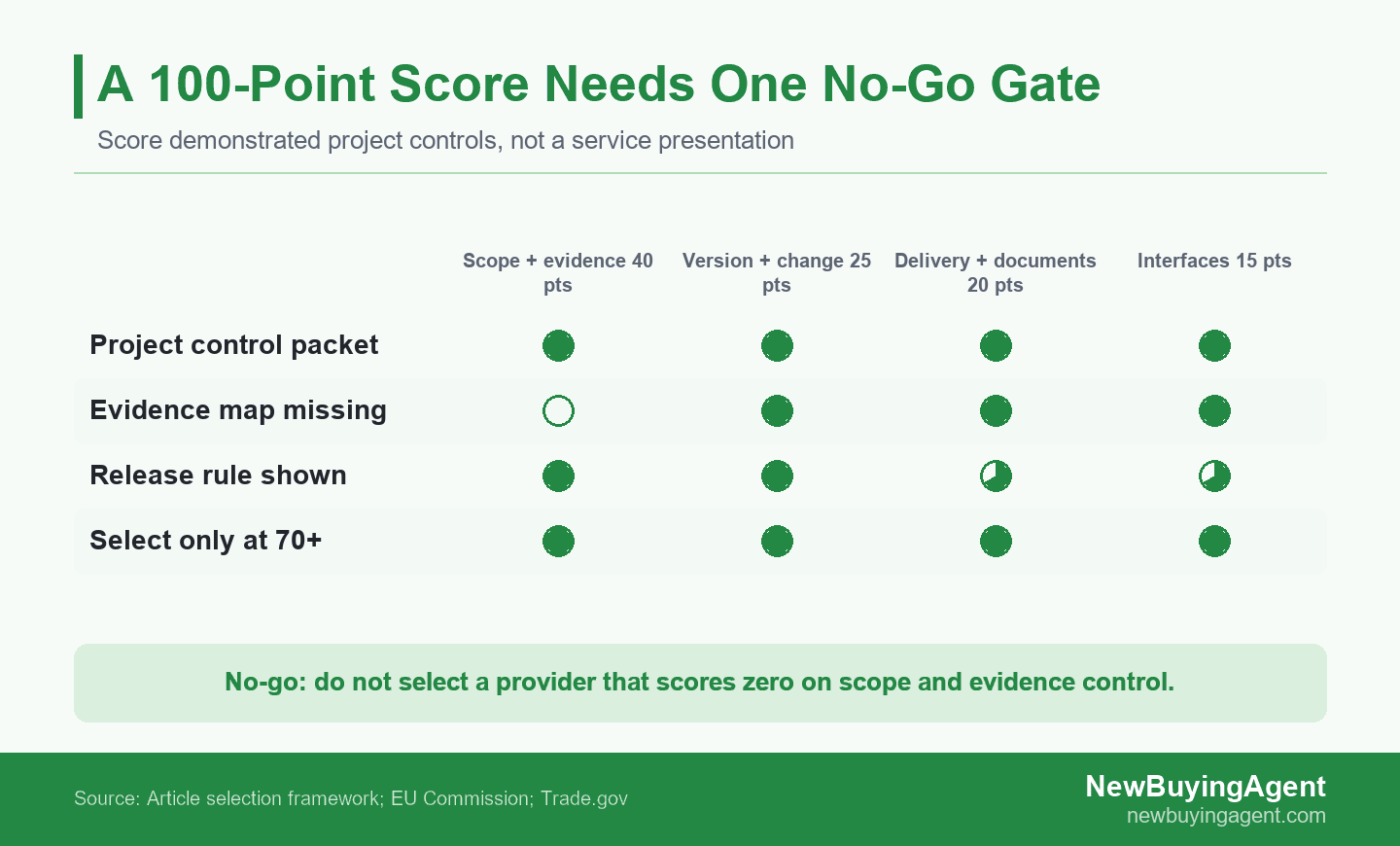
Score matrix showing four building-materials sourcing controls and a no-go gate for missing scope-and-evidence control
2. Test version control where project changes actually occur
A change to a product, process, raw material, or test can mean that the required product documents need revision. The European Commission’s CPR guidance makes that boundary explicit for its construction-product context.
For selection, do not ask whether the provider “manages changes.” Ask to see the revision fields they would maintain. A credible answer names the approved reference, what triggered the change, the material package affected, the evidence that may be stale, the approval owner, and the disposition: proceed, hold, correct, or seek a new decision. A PDF folder full of documents is not version control if nobody can tell which record still describes the goods being packed.
The strongest test is a small counterfactual: “If the panel core, hardware finish, or coating process changes after sample approval, what stops the previous approval from being reused by default?” Look for a specific chain of ownership and impact, not an assurance that the factory will be informed.
3. Test cross-category interfaces, not just individual product files
A specialist proves cross-category control by tracing one conflict from its physical product to its record, owner, corrective action, and release decision.
Building-materials projects become difficult at the joins: a door and its hardware, a vanity and its panel record, a tile and the room schedule, or a finished carton and the delivery allocation. An individual file can look complete while the project package is not. Ask prospective specialists to walk one such interface through their method before you appoint them.
A document is useful only when it has an owner and a scope
A document becomes a project control only when it names the current product version, affected scope, evidence owner, and approval owner.
Consider this illustrative capability test, not a client case. An international hospitality procurement team is choosing a China-side specialist for a 72-room refurbishment. The draft BOQ covers tile, vanity cabinets, door sets, hardware, lighting, and sanitaryware from six China factories. The buyer has intended locations and a staged shipment plan, so the candidate is asked to create a short control packet before any award.
The candidate is shown a production vanity sample whose panel-core description differs from the file packet prepared for destination review. The packing plan still groups all 72 vanity units as one ready-to-ship package. A capable response is not “the finish is the same.” It identifies the affected scope, the current product version, the record owner, the approval owner, and whether the other five material families are truly independent of the problem.
A change must carry a release decision
When the physical product and its record conflict, hold the affected package until the product, evidence, and release decision match.
In the illustrative scenario, the disciplined decision is a product-family hold: separate the 72 vanity units in the revision register, request the correct evidence or design approval, update the packing map, and name the person who may release the revised scope. Other traceable packages can move only if their own product version, records, approval owner, and packing map agree. This is a composite decision test, not evidence that any actual product is accepted in any market.
This is especially relevant when the buyer already has China factories. Rather than discarding those relationships, the buyer can ask how version, quality, and logistics control would be added around them. In that situation, see how existing China factories can be managed by NewBuyingAgent, then use the same conflict prompt to test whether the proposed controls fit the project.
4. Test delivery control at carton and document level
Before release, the specialist should reconcile each critical package's contents and marks with the packing list, commercial record, and project allocation.
A packing list itemizes each package's contents, weights, measurements, and detailed goods information. Trade.gov’s packing-list guidance also notes that forwarders and customs officials use this package-level information.
A packing list is not a substitute for a commercial invoice, and the commercial record should reflect the packing information. Trade.gov’s common-export-documents guidance makes the distinction clear and notes that additional documents can depend on the product and destination.
Incoterms clarify specified buyer and seller responsibilities, but they do not specify every document required for customs clearance in the buyer's country. Trade.gov’s Incoterms overview is clear that these terms do not settle every condition of a sale or destination-document requirement.
Use those distinctions to test the specialist’s delivery method. They should be able to say what package marks identify the project allocation, who checks count and condition before handoff, which commercial and packing records must agree, and who owns the remaining destination-document questions. Avoid an answer that treats a trade term, a freight booking, or a single invoice as the whole release process.
5. Use a weighted capability score with one no-go condition
Use 70/100 as the selection threshold, but do not select a provider that scores zero on scope-and-evidence control.
This is an illustrative decision rule for project procurement. Give 40 points to scope and evidence control, 25 to version and change control, 20 to delivery and document reconciliation, and 15 to cross-category interfaces. The weighting deliberately gives the evidence map the largest share: it is impossible to judge whether a product version is acceptable when nobody can say what must be proved for its intended use and destination.
| Control dimension | Weight | What the candidate should demonstrate | No-go question |
|---|---|---|---|
| Scope and evidence | 40 | Product package, intended use, evidence path, and approval owner | Can they show what proof matches the current product? |
| Version and change | 25 | Revision register, impact fields, and hold-or-proceed logic | What happens when an approved input changes? |
| Delivery and documents | 20 | Carton, packing, invoice, and responsibility reconciliation | Can physical packages be matched to the release record? |
| Cross-category interfaces | 15 | Named owner and containment path for linked materials | Can they contain one conflict without losing the project view? |
Based on this comparison, a polished proposal with strong logistics language should not outrank a less polished provider that can demonstrate the evidence map, revision logic, and package-level reconciliation. The score is only useful when it is applied to a real brief and a real response. It is not a universal rating, and the weights should be increased or adapted for regulated, structural, or unusually high-consequence materials.
Brief the specialist with six inputs before you select them
A meaningful capability review starts with six inputs: scope, destination, critical categories, approvals, delivery sequence, and existing-factory status.
- Share the draft BOQ, drawings, and a short note on intended locations.
- Name the destination market and the product categories carrying the highest acceptance risk.
- Mark the current approved sample, finish, or reference for each critical package.
- Identify the approval owner for design changes and destination evidence questions.
- Show the staged delivery sequence, site constraints, and any consolidation point.
- State which China factories are already engaged and which materials still need a route.
If those inputs are ready, ask the provider to return a first-pass map of product packages, evidence owners, version controls, and delivery handoffs. The useful outcome is clarity about the controls required for this project—not a generic promise that every material will fit every market. Buyers ready for that project-specific discussion with NewBuyingAgent can prepare the BOQ, destination, critical categories, approval path, and current factory status, then request a project capability review.
Frequently Asked Questions
Should I choose a specialist before or after the BOQ is final?
Choose the specialist once the project has a usable draft BOQ and approval path, not after every quantity is frozen. The draft needs enough detail to reveal critical categories, intended locations, delivery sequencing, and decision owners. A capable specialist can then help expose evidence and version-control questions before procurement pressure increases. Final quantity changes may still occur, but they should update a controlled scope rather than start the selection conversation from zero.
Can one specialist manage both new and existing China factories?
Yes, if the specialist can make the approved version, evidence owner, and delivery handoff explicit for each factory already in the project. The buyer should not assume that existing relationships are a barrier or that every factory must be replaced. The test is whether the provider can create one project view while limiting each factory to the specifications, records, and decisions that affect its own material package.
Which building materials need destination-specific evidence first?
Start with materials whose intended use, safety, emissions, or performance claims affect whether they can be accepted in the destination market. Typical priority candidates include products used in critical locations, products with specified performance claims, and panel-based products where an applicable destination rule may govern the actual scope. The right order comes from the project’s product-use map, not a universal checklist; confirm requirements with the appropriate technical and legal resources for the market.
What is the clearest no-go sign in a sourcing proposal?
Treat it as a no-go when the provider cannot show who owns the approved version and which evidence must match it before shipment. A broad promise to source, inspect, consolidate, and ship does not answer that question. Ask the provider to handle one realistic material change or document conflict from your brief. If they cannot define the affected scope, approval owner, corrective action, and release condition, the project control method is still unproven.
NewBuyingAgent
Related Resources

Get Started Today
Let's Turn Your Sourcing Goals into RealityWeChat:+86 15157124615
WhatsApp:+86 15157124615
Address:Building 10 #39 Xiangyuan Road, Hangzhou, China
