


Carton master data is the reusable record of a defined shipping pack: its identity, contents, outer dimensions, gross weight and handling limits. A container plan combines that record’s approved revision with the quantities and packing method of a particular shipment.
For China import orders, start with the export pack that will actually be supplied. A product drawing, a previous packing list and a carton supplier’s nominal box size may describe different things. Keep their roles clear, verify the current physical pack and carry any revision into the load calculation before treating a proposed container quantity as confirmed.
Release the pack record before relying on the load plan
Release carton data against an identified physical export pack, explicit measurement units and a current revision. Then reconcile the shipment’s carton counts and transport-unit totals on the same basis. An unresolved dimension, packing change or stack limit should have a named follow-up; it should not silently become a zero, an old value or an assumed permission to load.
- How it works: Link the pack definition, shipment quantities and actual transport build.
- Risk: A correct number at the wrong packaging level still produces a wrong plan.
- Timeline: Confirm physical packing before freezing the booking and load assumptions.
- Decision: Recalculate affected fields whenever the export pack changes.
Keep pack specifications separate from shipment quantities
Keep a reusable pack specification separate from the shipment quantity record and the totals for a loaded pallet or container. The pack record defines what one shipping carton contains and measures. The shipment record says how many of those cartons will move, including exceptions. The transport build adds the actual pallet or container arrangements and their associated materials and weights; link the records through the exact pack revision.
Those packing values can change when a product gains an accessory, an insert is redesigned or a factory changes the export carton. For recurring purchasing, resolving the product and packing choices together gives the logistics team a more dependable starting point. NewBuyingAgent combines product-development and quality-control capability with local China factory resources.
The GS1 Package and Product Measurement Standard uses a defined natural base for non-consumer trade-item measurements and includes maximum outer extents such as projections. Its measurement orientation is independent of how the item is shipped. Use a consistent convention to exchange dimensions, while recording permitted loading orientations separately; a neat dimensional record does not establish which side may bear the load.
Treat “estimated,” “measured” and “approved for this pack revision” as different states. A forecast can support an initial inquiry when labeled as provisional. It should become a firm planning input only after the responsible people confirm the physical pack and the remaining conditions that affect its use.
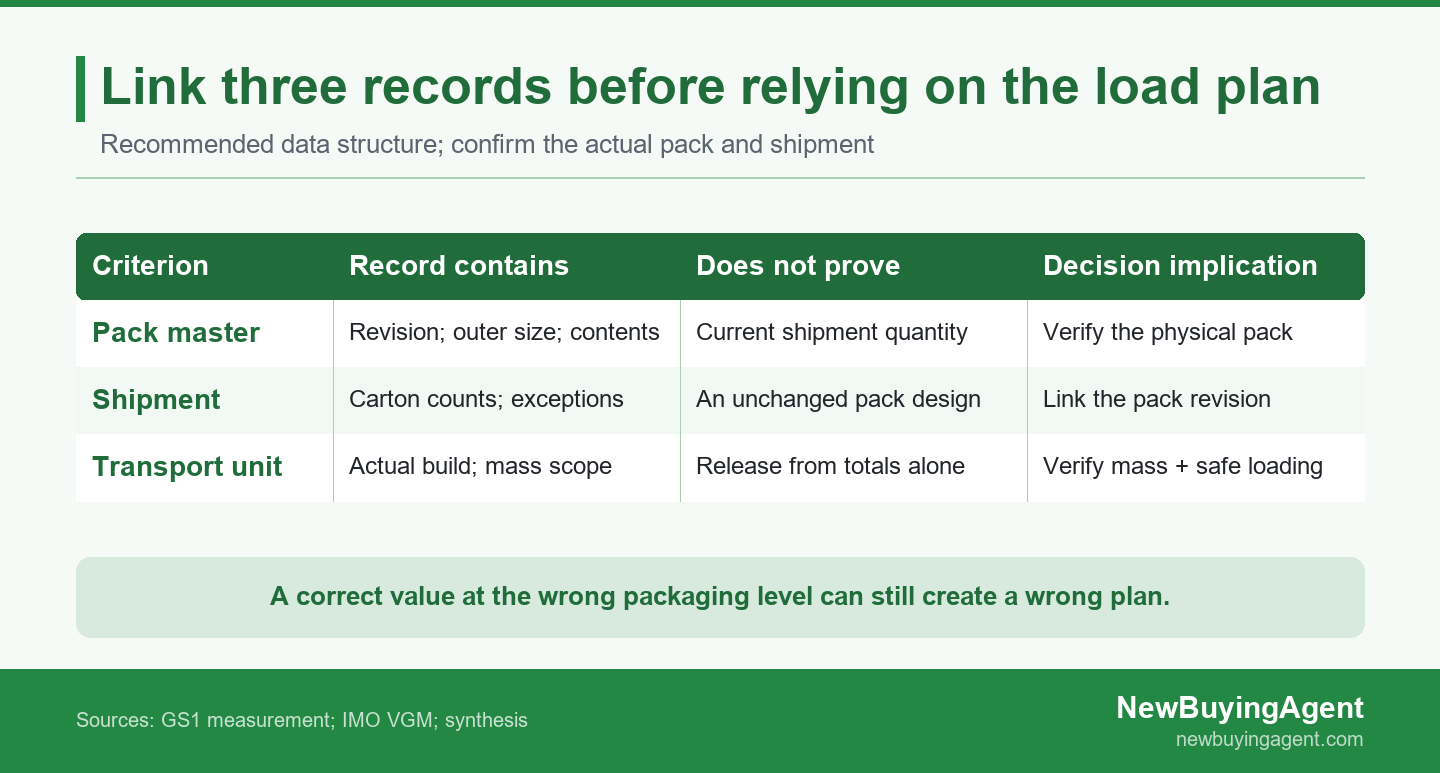
Pack specifications, shipment quantities and transport-unit totals answer different planning questions and must stay linked.
Build a carton record the planner can actually use
A useful carton record identifies the pack, the unit behind each quantity and measurement, and the evidence behind its release. Use the matrix below as a copyable working form. Populate the entry fields with actual values and keep missing inputs assigned to an owner. It is a recommended planning record, not a claim that every field is universally required by law or by one data standard.
| Field | Enter | Check | If unknown |
|---|---|---|---|
| Pack ID | SKU; pack ID; revision | Matches current pack | Identify the pack |
| Contents | Units per carton; mix | Matches packed goods | Confirm actual count |
| Carton count | Full and partial cartons | Ties to order units | Reconcile the lot |
| Outer size | Named L/W/H; unit | Measured export pack | Measure the pack |
| Gross weight | Packed carton; kg | Contents + packing | Weigh the same pack |
| Net weight | Basis stated; if needed | Kept apart from gross | Clarify the basis |
| Allowed sides | Upright or allowed turns | Matches pack limits | Confirm orientation |
| Stack limit | Layers or stated limit | Evidence + conditions | Hold extra layers |
| Pallet build | Size; height; gross | Says what is included | Confirm actual build |
| Load method | Floor load or pallets | Matches receiving need | Agree the method |
| Pack evidence | Photos; measure record | Same revision and lot | Obtain current proof |
| Status | Estimate; measured; approved | Critical gaps visible | Assign follow-up |
| Change scope | Effective lot; old stock | Versions stay distinct | Separate the records |
| Release | Owner; date; recipients | Affected plans updated | Hold firm load release |
Keep reusable pack values in the pack record; keep carton counts, partial packs and the actual pallet build in the linked shipment record. That prevents a shipment quantity from being mistaken for a permanent pack property. Derived volume and total mass should recalculate from those inputs rather than being separately typed values that can drift out of agreement.
Identify the pack and its quantity basis first
Name the product variant and the shipping pack, not only the commercial product name. State whether a quantity means saleable units, inner boxes, export cartons or pallets. Where a set contains several packages, define how those packages form a complete saleable unit. A shared SKU does not resolve a changed pack count or a different protective insert.
Where GS1 identifiers are used, the GS1 Logistic Label Guideline distinguishes an individual logistic unit’s SSCC from trade-item identification such as a carton GTIN. The SSCC requirement applies within GS1 logistic labeling; it is not a universal instruction to add an SSCC to every export carton. Retain the identifiers actually needed by the buyer, carrier and receiving system, alongside the internal pack revision.
Record external dimensions, units and gross weight
Record the finished pack’s outer length, width and height with a named unit and a stated measurement basis. Include the parts that occupy space; do not substitute internal box dimensions or the unpacked product’s size. Gross weight means the weight of that packed unit including its contents and packaging. Keep any net-weight value separate and say exactly what it excludes.
Use a diagram or labeled photograph when axis names could be misunderstood. Store the original measured values, and make unit conversions explicit rather than overwriting them without a trace. The shipment volume must use a consistent unit system. A dimension copied in millimeters and interpreted as centimeters is a different error from a physical carton-size change, but both can invalidate the result.
Add orientation, stacking and pallet assumptions
Record allowed loading orientations, stack restrictions and whether the plan assumes floor-loaded cartons or a particular pallet build. A cube total contains none of these permissions. If pallets are used, state the footprint, loaded height, gross weight, overhang and whether the pallet itself is included in each figure. Keep a packer’s proposed build distinct from an approved arrangement.
The IMO/ILO/UNECE CTU Code provides non-mandatory guidance for packing and securing across sea and land transport, including receiving and unpacking. Use it to frame the questions for competent packing and transport providers. A completed data table cannot establish that the cargo is stable, protected or safely unloadable; those decisions require the actual goods, equipment and method.
Verify physical packs and reconcile the totals
Verify measurements against the current physical export pack, then reconcile shipment quantities and totals using that same definition. Record what was checked, by whom and under which packing condition. If the supplier’s record and the observed pack differ, preserve the discrepancy until its cause is resolved. Silently choosing the smaller dimension or lower weight makes the spreadsheet tidy while leaving the planning risk untouched.
Measure the actual export pack in a defined condition
Ask for a clear measurement record showing the pack identity, condition, named axes, units and scale reading. Use suitable measurement equipment and the applicable method; confirm whether the record covers a sample pack, several packs or the specific shipping lot. A single observation does not prove every carton is identical. If variability affects a tight fit, agree how it will be measured and represented before fixing the quantity.
Packing assumptions can also affect the quote. DHL Global Forwarding’s weight guidance separates actual gross weight, including packaging and pallets, from volumetric weight calculated with a transport-specific ratio. FCL pricing does not simply follow the same volume-based method as LCL. Provide the provider with accurate pack and shipment data, then confirm the actual service’s charging basis.
For existing factories, physical-pack evidence needs to remain aligned with production and quality release. NewBuyingAgent’s factory-management service includes supplier communication, production progress, quality management and logistics coordination within the agreed scope. That broader support is relevant when recurring purchases need current factory packing information to match the products being supplied, rather than relying on a stale carton estimate.
Keep cargo totals separate from container gross mass
Reconcile units per carton against actual full and partial carton counts, then calculate volume and cargo gross subtotal for each pack revision. If a loaded pallet’s reported weight already includes its cartons, do not add those carton weights again. Add separately any transport materials that are outside the stated subtotal, and make the inclusion basis visible beside the total.
For SOLAS-applicable packed containers, IMO’s verified gross mass guidance includes packages, pallets, dunnage, securing material and actual container tare under the accepted method. A carton gross-weight subtotal alone is not VGM, and the shipper retains responsibility for its declaration. Keep the carton calculation as an input to the required process, with the actual build and verified mass established separately.
Control revisions and update the downstream documents
A packing revision needs an effective scope, an approval state and a clear path to the people using the old data. Keep the superseded record recoverable. Identify which purchase orders or lots use the new pack, and separate old stock that will still ship in the previous format. Changing the file name alone does not tell a planner which cartons will reach the loading area.
Recalculate volume, gross subtotals, pallet build, permitted layers and any quote assumptions affected by the change. Notify the factory, quality owner, logistics planner and relevant document owner. Keep a critical approval pending until the physical pack and revised arrangement are confirmed; do not convert a preliminary estimate into an approved value merely because the booking deadline is close.
The DCSA booking and bill-of-lading guide distinguishes booking-only data from shipping-instruction data and carrier acceptance of amendments. Updating an internal carton file therefore does not by itself change the carrier’s booking or document record. Ask the provider which fields and processes are affected, obtain the required confirmation, and reconcile the current quantities and packing information across the actual shipment documents.
A packing revision that changes both cube and layers
The following illustrative example uses hypothetical dimensions, quantities and weights. It shows what to recalculate when a protective insert changes the export pack, not a tested client result or an approved load plan. The product quantity stays unchanged, but the old volume and stacking assumptions no longer describe the physical cartons.
Recalculate the affected fields before releasing the revision
Assume an order uses 240 cartons with eight units in each, giving 1,920 units. The original carton measures 600 × 400 × 300 mm and weighs 12 kg gross. Its volume is 0.600 × 0.400 × 0.300 = 0.072 m³, giving 17.28 m³ and 2,880 kg for the carton shipment subtotal. These are assumed packed-carton values, not product-net measurements.
After the insert changes, the carton measures 600 × 400 × 320 mm and weighs 12.5 kg gross, with the same contents and carton count. Volume becomes 0.0768 m³ per carton and 18.432 m³ for the shipment; the carton gross subtotal becomes 3,000 kg. The revision adds 1.152 m³ and 120 kg to those subtotals. Pallets, dunnage, securing materials and container tare are outside these figures.
Now assume the current plan allows a usable stack height of 2.20 m. Seven old cartons stood 2.10 m high; seven revised cartons stand 2.24 m high, so that layer assumption fails. This available height is a hypothetical planning input, not a standard clearance. Reducing the stack or changing the arrangement requires a new quantity and protection check; the arithmetic alone does not establish which alternative is acceptable.
The buyer keeps the old pack record, opens a new revision for the affected lot, and asks the packer to validate a feasible arrangement. The logistics owner then checks the equipment, quote and document consequences. Only the confirmed new inputs move into the released plan. The result is a specific hold-and-replan decision, not an assertion that the shipment has been loaded successfully.
Release a dated pack record with the purchasing brief
The release record should identify the physical pack revision, applicable lots, measured evidence, handling assumptions and unresolved items. Name who approves each critical input and who receives a change. Purchasing can then use the same pack basis for quantity and cost decisions, while the factory and logistics provider work from a consistent current arrangement.
For a continuing procurement requirement, prepare the product specifications, SKU quantities, target price, destination and timing, current pack revision and sourcing situation. Include the packing evidence and any difference still affecting the supplied-product outcome. To discuss suitable product supply or agreed existing-factory management with the relevant factory and product/QC capability, send the purchasing requirements to NewBuyingAgent.
Frequently Asked Questions
Can product dimensions replace carton measurements for container planning?
Product dimensions cannot replace the outer dimensions of the actual export pack used in the load plan. A drawing may help with an early estimate if it clearly identifies its scope, but inserts, accessories, inner packs and the outer carton can change the occupied space. Keep the estimate labeled as provisional, then replace it with the current packed measurements before approving a firm carton quantity.
Should GS1 measurement tolerances become a container fit allowance?
A data-check tolerance does not create extra physical clearance or approve a larger load inside a container. A record can meet a data-quality rule while a particular carton still fails a tight doorway or layer arrangement. Agree the measurement basis and relevant variation, then check the actual physical fit and required clearance. Do not subtract a standard tolerance from every dimension to manufacture a better loading result.
How should mixed cartons and partial cartons be recorded?
Mixed and partial cartons need explicit contents and their own verified packed dimensions and gross weights. Do not assume a half-filled carton has half the outer volume or half the packaging weight. Link each exception to the relevant product quantities and shipping marks, then reconcile the total units. If the mixed format becomes recurring, give it a controlled pack definition rather than treating every shipment as a fresh unexplained exception.
Does this carton file replace the shipping packing list?
The carton master supports the packing list but does not replace the current shipment’s actual packing information. A reusable pack definition does not establish which cartons, quantities, marks or exceptions are being shipped on this occasion. Build and check the shipment documents against the actual goods and the buyer’s and provider’s requirements. Use the revision link to trace their assumptions, while keeping shipment-specific information current.
NewBuyingAgent
Related Resources



Get Started Today
Let's Turn Your Sourcing Goals into RealityWeChat:+86 15157124615
WhatsApp:+86 15157124615
Address:Building 10 #39 Xiangyuan Road, Hangzhou, China
