

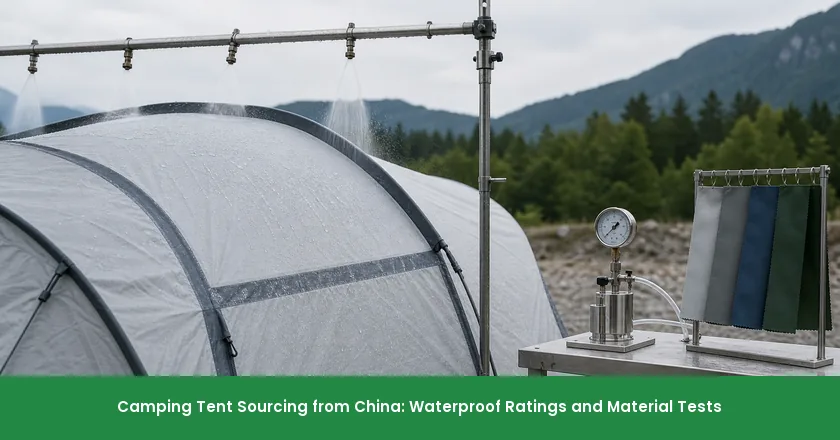
A tent factory can honestly state a waterproof rating and still leave a buyer unable to approve the product. The missing information is usually not another millimetre number. It is the tested component, the test method, the conditioning state, the material lot, and the action that follows a pass or failure. A rainfly, floor, and seam assembly do not take water in the same way. When a China sourcing brief treats them as one claim, a lab result can look reassuring while remaining disconnected from the material that will be cut into the order.
Turn a Waterproof Rating into a Component-Level Test Brief
A useful starting point is to treat the camping tent as a performance system. ISO 5912:2020 describes requirements and test methods for the safety, performance, and fitness for use of camping tents. That does not supply a universal pass value for every design. It does mean a buyer should resist letting one fabric number stand in for the finished product's intended performance.
- Name the component first. Write rainfly, floor, vestibule panel, or a specific seam assembly rather than simply writing “tent fabric.”
- Name what the method observes. Pressure resistance, surface wetting, and water impact are different questions with different decision value.
- Lock the condition to the result. Record conditioning, sample date, construction state, and whether the evidence is pre- or post-aging.
- Bind the record to a lot. The report should identify the material batch or production sample that it is meant to release.
That five-part chain is more useful than a universal “good” rating. The buyer can select a target for the intended market and use, but the factory and laboratory also need to know what is being tested and what happens when the result is incomplete. The practical output is a test brief that makes a report usable for a purchase decision, not merely presentable in a sales file.
Use Each Water Test for the Failure Route It Actually Measures
Waterproof language becomes ambiguous because several test routes can be compressed into the same commercial phrase. A controlled pressure test asks whether water penetrates a fabric under pressure. A spray method looks at what happens on the surface. An impact method considers a different form of water exposure. The buyer does not need every method by default; the buyer needs the one that matches the named component, construction, and failure route. That distinction prevents a pass in one test from being used as a proxy for every other risk.
Hydrostatic Pressure: a Controlled Barrier Check
AATCC TM127 measures a fabric's resistance to water penetration under hydrostatic pressure. In plain language, water pressure is increased in a controlled setup until the method's stated endpoint is reached. That makes it a useful barrier check for a specified cut of fly or floor material, especially when the brief states the test method, units, sample condition, and acceptance value. It does not automatically reproduce every rain, spray, abrasion, fold, or seam condition that a finished tent may encounter. The report should therefore be read as evidence for the exact pressure question it tested, not as a complete weatherproofing promise.
For a sourcing request, ask the factory to identify which construction the report represents: the coated face fabric alone, a laminated material, or a finished floor component. If the result is reported before a coating change, color change, or material-lot substitution, retain that limitation in the approval record. A number without this context is difficult to compare and impossible to tie confidently to mass production.
Surface Wetting: a Repellency Screen, Not a Pressure Result
AATCC's explanation of TM22 describes a spray exposure that evaluates the wetting pattern on a textile surface and acts as a quick screen for water repellency or finish efficacy. This is valuable when the buyer wants to know whether the outer surface sheds water as intended. It is not a replacement for a pressure-resistance result. A finish can appear to bead water at the surface while the buyer still needs separate evidence about the coated barrier, seams, or the floor's contact conditions.
Use the result to write a precise requirement: “evaluate outer-fly surface wetting by the agreed method after the stated condition.” Do not write “waterproof finish” and assume the phrase covers pressure penetration, seam performance, or aging. That small change in language keeps the supplier, laboratory, and buyer aligned on what the screening result actually means.
Impact Penetration: a Different Water Route
AATCC TM42 is a water-resistance impact-penetration method for textiles. It belongs in the conversation when a buyer has identified a dynamic water route that matters to the component, rather than simply because it has a familiar “water resistance” label. For example, it can help frame an exposure question that is not the same as holding a fabric under steadily increasing pressure. The method name alone does not justify applying it to an entire tent system.
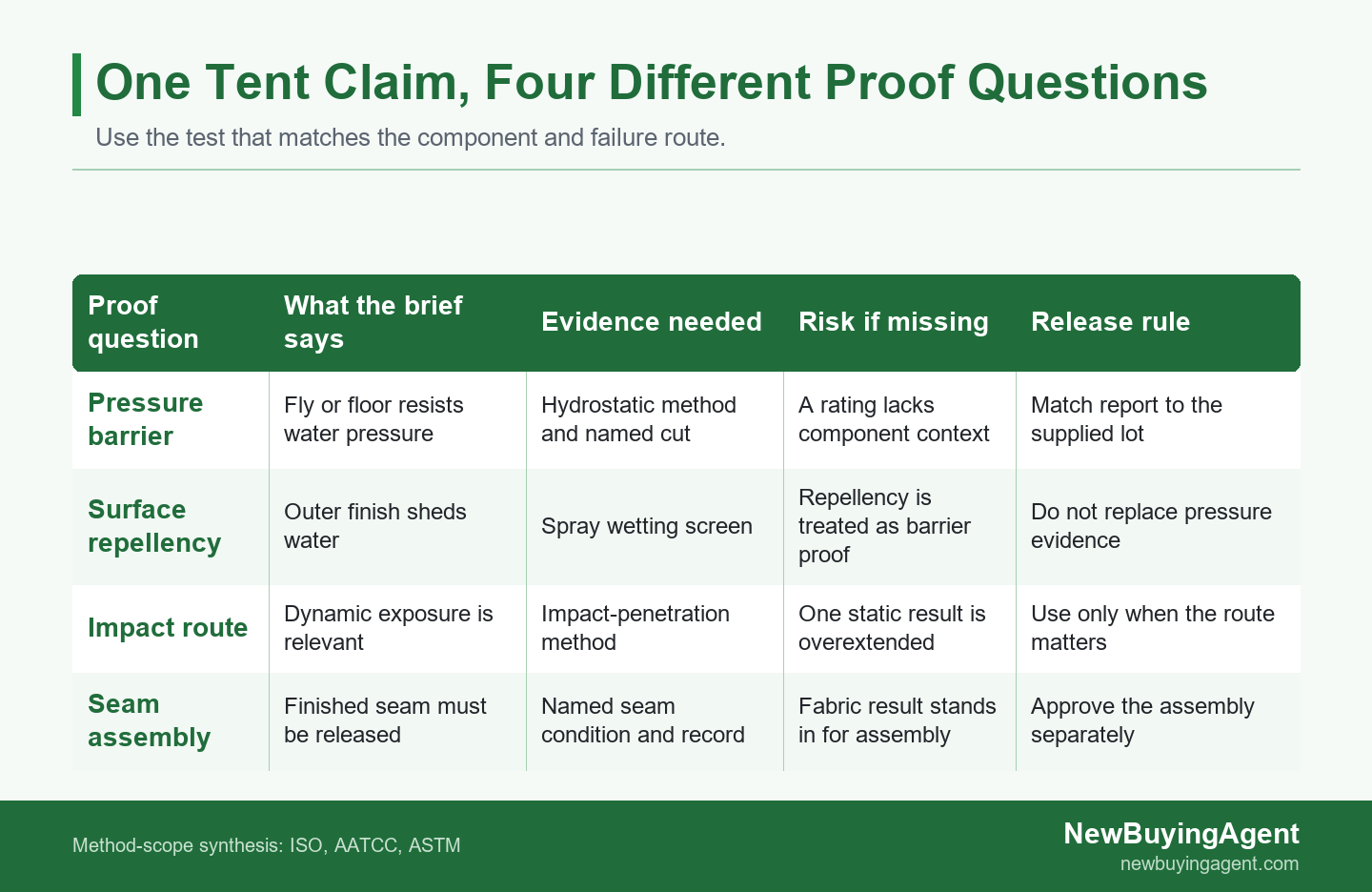
A tent waterproof claim should be split into the water route, component evidence, risk, and release rule that apply to it.
The decision rule is deliberately narrow. If the product brief does not name a relevant impact route, do not add the test just to enlarge the report package. If it does, identify the component, specimen construction, conditioning state, acceptance rule, and disposition. Otherwise a dynamic-exposure result may become another isolated data point that cannot guide a release decision.
Match Material Evidence to the Tent Component
Material evidence should follow the part that will fail, not the easiest certificate to obtain. A rainfly may need a defined surface and barrier discussion. A floor may need its own pressure and construction evidence because it faces different contact conditions. A seam is an assembly with thread, stitch, tape, adhesive, and process variables. The buyer can keep the specification readable by treating each of these as a separate evidence line, then deciding which test route and report fields apply to that line.
| Tent element | Question to write | Evidence to request | Release boundary |
|---|---|---|---|
| Rainfly | Does the surface and barrier meet the stated use condition? | Named cut, water-route method, condition, and material-lot record | Do not use a floor report as fly proof |
| Floor | What pressure and construction evidence applies to the ground-facing component? | Separate component test record and agreed material identification | Do not inherit a fly target without a written rationale |
| Seam assembly | Does the finished construction match the approved evidence? | Named assembly, process condition, and relevant retest rule | Fabric-only data cannot release the seam |
For an outdoor tent programme, the evidence map also gives a China-side sourcing team a cleaner way to review what changed between sample and production. NewBuyingAgent can use the named component and report fields as a shared reference when a factory asks whether a substitute fabric, coating, tape, or construction change still falls inside the approved requirement. That is more useful than asking for a broad assurance that the tent remains waterproof, because the buyer can see which proof must be revisited and which record controls the decision.
Coated Fabric Needs More Than a Single Water Number
ASTM D751 is useful as a reminder that coated fabrics can involve several separate property questions. Its scope includes methods such as hydrostatic resistance, tear resistance, coating adhesion, low-temperature cracking, and heat aging. The buyer does not need to request every procedure listed in a standard. The buyer should identify the properties that matter to the named fly or floor construction, then make the result traceable to the supplied material and the agreed sample condition.
This avoids two common shortcuts. The first is to assume a coating description proves barrier performance after a different production condition. The second is to let a broad “coated fabric test” label hide which property was actually evaluated. A useful request separates the properties: which water route matters, whether coating adhesion is relevant to the construction, whether the material must be checked after an agreed condition, and how the report identifies the lot. That gives the factory a buildable requirement and gives the buyer a record that can be reviewed later.
Strength and Tear Results Need a Named Test Route
ASTM D5034 covers breaking strength and elongation of textile fabrics by the grab method. That makes a grab result a defined piece of evidence, not a free-floating statement that the material is “strong.” The standard also cautions that results should not be used for simple comparisons across different tester designs or conditions. Put the selected method and relevant specimen condition in the brief so a buyer can tell what changed when a material, coating, or production condition changes.
ASTM D5587 covers a trapezoid procedure for tearing strength of many textiles, including coated or resin-treated materials, and it states that the procedure does not measure the force needed to initiate a tear. This boundary matters in sourcing conversations. A tear result can support a specified method question, but it should not be promoted into an unexplained lifetime claim for a tent. Ask which fabric construction was tested, whether it represents the supplied material, and what decision the result controls.
A Seam Is an Assembly, So Treat It as One
ASTM D1683/D1683M addresses failure in sewn seams of woven fabrics and calls out the materials and construction variables that can influence seam strength. It also says the method should not be used to predict actual wear performance. That is exactly why a tent buyer should not accept fabric data as finished-seam proof. The relevant assembly has to be named: stitched seam, taped seam, reinforcement area, or another construction where the buyer expects the evidence to apply.
For a taped or sealed construction, add the actual assembly condition to the test brief rather than assuming a sewing-method result answers every question. The goal is not to create a long laboratory menu. It is to stop an untested handoff between material evidence and finished construction from becoming the hidden weak point in the order.
Age the Risk Before You Approve the Lot
ASTM G154 covers operation of fluorescent ultraviolet lamp apparatus for exposure of materials. Its scope is also a useful limit: the practice is not a universal simulation of outdoor weathering, and results from different devices are not automatically comparable without correlation. For a buyer, the implication is simple. Do not ask for an unspecified “UV test” and assume it settles service life. Agree what condition will be applied, what component will be checked afterward, and which result reopens or blocks production release.
An agreed post-condition retest can be a sensible release gate when the buyer has written the component, method, material lot, and acceptance action. It is not a universal durability formula. Its value is procedural: it prevents a pre-condition sample result from silently becoming approval for a different material batch or an altered seam construction. This is especially important when a supplier changes a coating source, a fabric construction, or a production parameter after the initial sample is approved.
For buyers who already work with a China factory, the hard part is often keeping the approved evidence connected to the production record. NewBuyingAgent can keep a tent production lot tied to its approved evidence through China-side supplier communication, production follow-up, and quality-management support. The practical request is not “inspect everything”; it is to record which component, lot, and report are being used for the ship-or-hold decision.
Worked Scenario: Holding a Tent Balance Until the Proof Matches
Consider an illustrative Canadian outdoor brand preparing a first controlled launch of a three-person camping tent sourced from China. The order is 1,200 tents. The buyer has reserved 300 units for a controlled market trial, while the other 900 units depend on documented production release. A visual sample has been approved, and the supplier provides a laboratory sheet with a water-resistance result. At first glance, the record appears sufficient because it includes a familiar performance number.
The first problem is scope. The sheet does not identify the cut component or the fly material lot that will be converted into the remaining 900 tents. It also groups fly and floor samples under one broad requirement. The buyer therefore has a result, but not a way to tell whether it applies to the ground-facing construction, the outer fly, or the materials now entering production.
The second problem is timing. A taped-seam sample is available, yet the order brief does not say which evidence must be repeated after the agreed aging condition. The test record cannot reveal whether a changed coating, an altered tape process, or a substituted material lot should trigger a new review. The apparent pass has no written boundary.
The buyer should therefore place the 900-unit balance on full hold. The 300-unit trial designation is not a release shortcut for the rest of the order; it only defines a smaller controlled scope. The hold is not a claim that every tent is defective. It is a decision that the available evidence does not yet identify the production material or the relevant assemblies.
The correction is specific: issue a revised brief naming the fly, floor, and seam assemblies separately; state the method, conditioning state, sample date, material-lot reference, acceptance value, and exception disposition for each applicable report. If an agreed aging condition is part of the product promise, the brief must also say which component is retested afterward.
The analysis is that the report may be technically meaningful for development, but it is not yet production evidence for the held balance. The buyer trades a short hold for a decision boundary that can be checked against the actual materials and construction entering the order.
The decision is full hold for the 900-unit balance. Neither the familiar result nor the 300-unit trial designation is allowed to release that larger balance until the evidence scope matches it.
The corrective action is to reissue the brief, identify the material lot and assembly, and obtain the agreed records for the component that has changed or remains unverified. The factory can then work from an explicit correction rather than guessing which prior result still applies.
The verification gate is reached only when the revised report identifies the supplied lot and completes the stated post-condition check for the component or assembly that it is meant to support. The result must be reviewed against the prewritten release rule, not an after-the-fact preference.
This is an illustrative sourcing scenario, not a reported customer outcome and not a universal test protocol. Its purpose is to show how a buyer can keep a sample result from becoming an automatic release for an unidentified production balance.
Turn the Test Evidence into a China Sourcing Brief
A tent sourcing brief should place technical proof beside the normal commercial information. Quantity, destination market, target delivery date, packaging, and target price still matter. So do the component, method, condition, material-lot reference, acceptance value, and exception action. If those fields are separate, a buyer can compare quotes without asking a factory to infer whether a request for “waterproof fabric” applies to the rainfly, floor, seam, or a pre-production swatch.
| Brief field | What to state | Why it changes the decision |
|---|---|---|
| Product and market | Tent type, destination, intended use, quantity, delivery timing | Sets the commercial and use boundary |
| Component identity | Fly, floor, seam assembly, material construction, sample state | Stops one result being applied to the wrong part |
| Test and condition | Method, units, conditioning, acceptance value, retest trigger | Makes the report interpretable and repeatable |
| Traceability and action | Material lot, report date, reviewer, hold or release disposition | Connects evidence to the production decision |
When the buyer is sourcing a new tent rather than managing an existing supplier, NewBuyingAgent can turn a tent specification into China-sourced products. The useful handoff is a concrete purchasing need: product concept, target market, quantity, timing, packaging, and the component-level evidence that must be collected before release. That gives the sourcing conversation a shared technical reference instead of a series of vague requests for “better waterproofing.”
Before asking for a quote, give the factory or China-side sourcing partner the current bill of materials where available, product drawings or reference samples, intended use, and every decision field in the table. Flag what remains open. For example, a buyer may still need to select a test target, but can already specify the component, destination market, condition to be evaluated, and the report fields that will be required. Open decisions are manageable when they are visible; undocumented assumptions become expensive after material has been purchased or production has started.
It is also worth agreeing who can approve each change. A material-lot substitution may require a new report. A seam-process adjustment may require assembly evidence rather than a repeated fabric result. A packaging change may matter commercially but not alter the test plan. This simple ownership line prevents a late-stage conversation from drifting into “the sample was approved” when the real question is whether the altered production component remains inside the agreed proof boundary. Record the disposition in the same file as the test result so an exception does not disappear between sourcing, production, and shipment preparation.
A buyer with this level of detail can move from a product conversation to an evidence-backed sourcing plan. To request that path, send NewBuyingAgent a tent sourcing brief with the required test methods.
Frequently Asked Questions
These questions are a final check on the component, method, condition, lot, and release fields in the brief. They do not create universal performance targets; the appropriate target still depends on the tent design, intended use, destination market, and the buyer's contract requirements.
What Does a Tent Waterproof Rating Actually Measure?
A tent waterproof rating is useful only when the report identifies the tested component, method, units, conditioning state, and acceptance rule. In many buying conversations, the number refers to a fabric pressure result rather than the complete tent, every seam, or every outdoor condition. Ask what material was tested, which method was used, and whether the tested sample represents the lot being supplied. That turns an attractive claim into evidence that can support a release decision.
Should a Tent Fly and Floor Use the Same Test Target?
No, a fly and floor should be specified separately because their water routes, contact conditions, construction, and risk of failure are different. A buyer may decide that certain evidence applies to both components, but that should be a written decision rather than an inherited assumption. The brief should name each component, the applicable method, the stated condition, and the report that will be used to approve it. A shared target without that context can hide a weak floor or an unverified fly.
Which Material Tests Matter Beyond Hydrostatic Pressure?
Beyond hydrostatic pressure, buyers commonly need evidence for surface wetting, selected coated-fabric properties, strength, tear behavior, seam performance, and an agreed aging condition. The correct set is not a universal checklist. Start from the tent component and the failure route that matters to the product promise, then ask what the method can establish and what it cannot. A report is stronger when it identifies the supplied material lot and any retest trigger.
What Must a China Tent Supplier Report Before Production Release?
Before release, require the method, acceptance value, component identity, conditioning details, sample date, material-lot reference, and disposition for any exception. Add the commercial context that makes the result actionable, such as tent type, destination market, order quantity, and production timing. If a report does not identify the lot or construction it supports, it may still be useful for development, but it should not silently release an unrelated production balance.
NewBuyingAgent
Related Resources



Get Started Today
Let's Turn Your Sourcing Goals into RealityWeChat:+86 15157124615
WhatsApp:+86 15157124615
Address:Building 10 #39 Xiangyuan Road, Hangzhou, China
