

When a China factory says it has BSCI, Sedex, SMETA, or SA8000, first identify the document your customer accepts and match it to the site that will make the order. The label alone cannot complete that check.
Key Takeaways for Factory Qualification
- Start with the customer’s named social-compliance route, rather than a factory’s preferred label.
- Separate a supplier-information platform, an audit report, and a certification record before accepting a document.
- Verify the legal entity, production-site scope, current status, and authorized issuer.
- Match every record to the customer requirement, document date, findings, and documented follow-up.
The Short Answer: Choose the Required Evidence, Not the Most Familiar Label
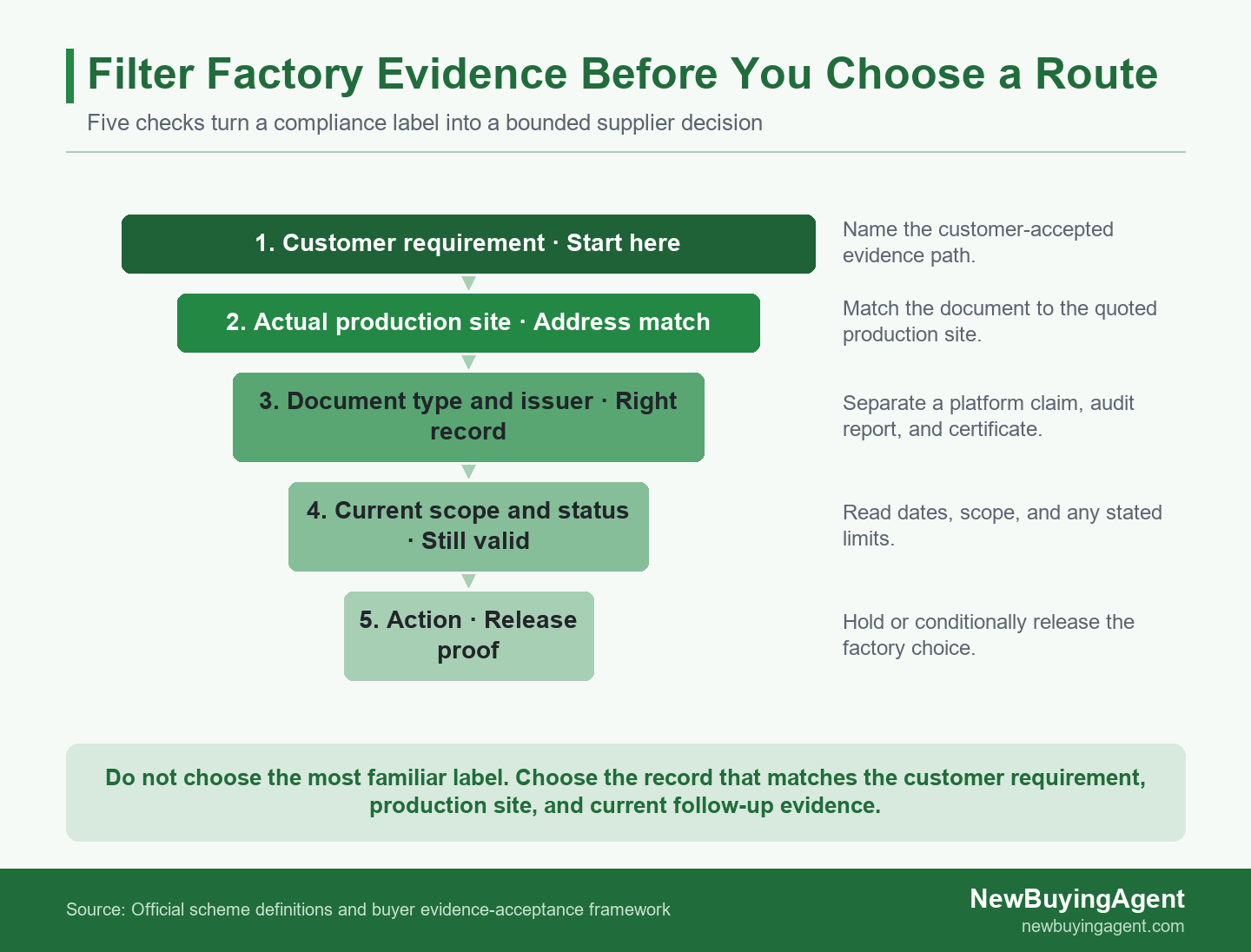
A social-compliance label is only a starting point. Release a factory choice only when the requested evidence matches the production site and the customer’s acceptance rule.
The three labels in the title are different evidence paths, not interchangeable badges. A buyer should begin with the customer’s actual requirement: does it call for a named due-diligence process, an audit report, a certificate, or another standard? The correct answer is the evidence the customer accepts for the factory and product scope at hand—not the label a supplier uses most confidently.
A practical qualification decision has four parts. First, identify the required document. Second, match it to the factory that will make the goods, not merely to a supplier group or a previous site. Third, read the scope, dates, findings, and any corrective-action record. Fourth, decide whether the evidence supports release, conditional release, or a hold. This sequence is more reliable than asking a factory, “Are you compliant?” because it turns a vague claim into records that can be checked.
Social-compliance evidence should be treated as bounded evidence. It can inform supplier qualification, but it does not prove permanent compliance, guarantee customer approval, or remove the need for buyer due diligence.
Why These Three Names Are Commonly Confused
Factory presentations often compress a platform, an audit methodology, a due-diligence system, and a certification program into one phrase: “We have social compliance.” That shorthand creates avoidable errors. A Sedex membership is not the same thing as a SMETA audit report. A social-audit report is not necessarily a certificate. A certificate does not automatically satisfy every customer’s program or cover every operation connected to a supply chain.
The labels overlap in subject matter: worker rights, working conditions, health and safety, management practices, and ethical trade. They do not automatically share an owner, document type, acceptance rule, audit approach, or validity boundary. The buyer therefore needs to ask two questions before comparing them: “What exact evidence does our customer require?” and “Which legal entity and production location will the evidence cover?”
Those questions are especially useful when a China supplier has several facilities, subcontractors, or a trading entity separate from the production plant. An old report from a different address may be relevant background, but it is not proof that the quoted factory has the required current evidence. A disciplined request protects both sides: the buyer stops making assumptions, and the factory receives a concrete list instead of an open-ended demand for “all compliance documents.”
What amfori BSCI, Sedex/SMETA, and SA8000 Actually Represent
amfori BSCI: amfori’s material centers its BSCI approach on a Code of Conduct, member-led due-diligence work, and monitoring activities. Its Code of Conduct guidance is a useful starting point because it shows that BSCI is more than an informal factory claim. If your customer is operating through amfori BSCI, ask that customer or its responsible member to specify the required monitoring route, facility, and follow-up expectations. Do not ask a factory for a generic “BSCI certificate” unless that is exactly how the customer describes its required evidence.
Sedex and SMETA: Sedex is a supply-chain data and collaboration platform. SMETA—Sedex Members Ethical Trade Audit—is its audit methodology. Sedex’s Introduction to SMETA describes the methodology and its audit context. For a buyer, the useful request is therefore not “Are you Sedex compliant?” It is “Can you provide the current SMETA report, the audit scope, the audited production address, the audit company, and the status of findings?” That phrasing asks for evidence that can be reviewed.
SA8000: Social Accountability International describes SA8000 as a social certification program and management-system standard based on internationally recognized decent-work standards. It is audited through an accredited certification system. The buyer should therefore request a current, verifiable certificate for the relevant organization and site when SA8000 is the customer requirement. That is different from asking whether a factory has undergone a social audit. The question is whether the specified production site holds the required certification in the applicable system and scope.
None of these distinctions makes one label a universal winner. The customer’s supplier program, the factory’s actual records, and the buyer’s risk priorities determine what is useful. A buyer who needs a SMETA report should not overpay for a different document solely because it sounds more formal. A buyer whose customer requires SA8000 should not accept a generic social-audit summary in its place. The names matter because the acceptance route matters.
BSCI vs Sedex/SMETA vs SA8000: Comparison for Buyers
The comparison below is designed for a buyer choosing what to request from a supplier. It is not a factory scorecard. It deliberately separates the name, the normal evidence path, the best-fit requirement, and the boundary that still needs checking.
| Route | What the name refers to | Useful when | Buyer must still verify |
|---|---|---|---|
| amfori BSCI | A member-led due-diligence approach with a code and monitoring activities. | The responsible customer’s program calls for BSCI-aligned evidence. | Who owns the requirement, the facility scope, current monitoring status, and follow-up. |
| Sedex / SMETA | Sedex is a platform; SMETA is the audit methodology used through approved audit companies. | The customer asks for a current SMETA report in a specified scope. | Audited site, methodology scope, report date, audit company, findings, and action plan. |
| SA8000 | A social certification program and management-system standard. | The customer requires a current SA8000 certificate. | Certified organization, production site, status, scope, and authorized certification body. |
One important non-substitution rule comes directly from amfori. Its guidance says that SMETA audits are not recognized within amfori BSCI’s due-diligence approach. That statement does not mean a SMETA report has no value. It means the buyer should not assume it satisfies a BSCI requirement. Ask the customer that owns the requirement before commissioning, accepting, or substituting a report.
The same discipline applies in the other direction. An SA8000 certificate may be highly relevant to a customer requirement, but it should not be treated as a blank authorization for an unrelated site or supplier. A customer program can have additional scope, recency, product, or corrective-action expectations. The comparison creates a starting decision, then the evidence record closes it.
Use This Five-Question Selection Sequence
1. What exact evidence does the customer accept? Capture the named program, audit type or certification, any required pillars or scope, and the date rule. 2. Which factory will actually produce the order? Use the quoted production address and legal entity, not just a supplier group name. 3. What document proves the requirement? Require the report or certificate, rather than a logo or platform claim.
4. Is the record current and in scope? Read issue dates, expiry information where applicable, facility details, audit scope, and any stated exclusions. 5. What happened to findings? Here, corrective action means the documented response and follow-up to an identified issue. Review that record, the responsible owner, and evidence of closure where the buyer’s process calls for it. Sedex states that only its approved Affiliate Audit Companies can conduct SMETA audits; its approved-auditor information is one useful issuer check for a SMETA claim.
When an existing China supplier needs a structured document chase, NewBuyingAgent can coordinate the request with the factory while the buyer keeps ownership of the acceptance decision. This is a China-side coordination role, not independent audit or certification work.
This sequence should stop a project at the first unresolved question. If the customer cannot state what it accepts, the buyer does not yet know what to request. If the production address differs from the record, the buyer needs reconciliation before it can use the record. If findings are material or incomplete, a conditional hold may be more responsible than a quick supplier release. To place these records inside the wider supplier-qualification process, teams can read the China sourcing guide.
An Audit or Certificate Is Evidence, Not a Permanent Compliance Guarantee
A current report or certificate can be important evidence, but it has a boundary. It reflects a stated organization, location, process, time, methodology, and follow-up record. A buyer should not turn it into a prediction that every working condition will remain compliant or that every supplier tier has been examined. The International Labour Organization’s discussion of private social-audit initiatives notes material limitations around coverage and the detection of some violations. That is a reason to use evidence carefully, not a reason to dismiss it.
For SA8000, the issuing route is also a practical check. SAAS states that its accredited certification bodies are the authorized bodies that conduct SA8000 audits and issue legitimate certifications. Use the SAAS accreditation information to confirm the certification-system boundary, then verify the certificate details against the specific production site and customer rule.
Corrective action deserves equal attention. A finding does not necessarily mean a supplier must be rejected; a clean-looking label does not necessarily mean the buyer should stop asking questions. What matters is whether the issue is within the customer’s tolerance, who owns the remedy, what evidence demonstrates progress or closure, and whether the next review must occur before production release. That turns social compliance from a filing exercise into a controlled supplier decision.
Worked Scenario: Two China Factories, One Incomplete Evidence File
The following example shows why a buyer should not choose between factories by a broad label alone. It is illustrative, not a NewBuyingAgent client case and not a prediction of an approval outcome.
Hold the Factory Choice Until the Evidence Matches the Production Site
A global home-textile buyer is evaluating two China factories for an established retailer program with a stated social-compliance requirement. The commercial team wants a clear recommendation, but the buyer keeps the social-compliance review separate from a price comparison. The buyer plans an 18,000-unit first order across 2 SKUs and needs to choose a factory within a 30-day approval window. The window is real operational pressure, yet it is not a reason to assign production before the evidence file is usable. One factory sends a current SMETA report but uses a different registered address from the quoted production site; the other says it is “Sedex compliant” but supplies no report or scope record. Neither file identifies an immediate route to release.
The customer requirement asks for accepted social-compliance evidence at the actual production site, not a generic platform membership statement. The buyer records that requirement next to the production address on each supplier file. The first report’s site address must be reconciled with the production address, while the second factory has not provided a SMETA report, audit scope, or corrective-action status. These are separate evidence gaps, not proof that either factory has failed the customer rule. Neither file supports an immediate factory choice. The buyer treats the address mismatch and missing report as separate evidence gaps rather than comparing the factories by a broad compliance label. Releasing one factory now would convert an evidence question into an unsupported commercial decision.
Place both factories on conditional hold, request site-specific documents, and release only the factory whose evidence matches the customer’s required path and production-site scope. The buyer can still progress samples and commercial clarification where that does not imply supplier approval. Create a one-page evidence request naming customer rule, factory address, requested BSCI or SMETA deliverable or SA8000 certificate, document dates, findings, and corrective-action owner. Each request identifies who will return the record and who will compare it with the quoted production location. Within 30 days, verify the selected record against the quoted production site and customer requirement; if the evidence is incomplete or out of scope, retain the hold and source a compliant alternative. A release occurs only after the evidence file, not an informal assurance, closes the stated gap. This is an illustrative example and does not claim that any audit report, certificate, factory, 18,000-unit order, or 30-day window will achieve customer approval. The customer’s own rule and the actual record control the final decision.
How China-Side Factory Coordination Fits After the Evidence Request
Once the required evidence is clear, China-side coordination can make the request easier to manage. NewBuyingAgent’s review China factory-management support can be relevant when a buyer needs an existing supplier to organize a requested file, confirm the production address, provide the current report or certificate, and respond to follow-up questions.
This is a coordination role, not an audit or certification claim. An independent audit company or authorized certification body retains its own role. The buyer still decides whether the returned evidence meets the customer requirement. The practical value of local coordination is clarity: one document list, one named factory contact, a recorded due date, and a visible follow-up path when a record is incomplete or belongs to the wrong site.
For context on the provider behind that China-side connection, readers can see NewBuyingAgent’s company background. The relevant next step remains the same: obtain evidence from the actual factory and make the customer acceptance rule explicit.
Build a Factory Evidence Request Before You Book or Accept an Audit
A clear request prevents the factory from sending an impressive but unusable file. Include the following items:
- The customer’s exact requirement, including whether it requires amfori BSCI, a SMETA report, SA8000 certification, or another named path.
- The legal entity and full address of the plant that will produce the order, plus the relevant production line or subcontracting boundary if applicable.
- The requested document type, current version, issue and expiry details where applicable, audit scope, and issuing or audit organization.
- Open findings, corrective-action status, the responsible owner, and the evidence the buyer needs before conditional or final release.
- The deadline, destination-market context, product family, and the person authorized to clarify the customer requirement.
For a new product or new factory search, those items belong in the sourcing brief before supplier outreach begins. Buyers who need China-side help structuring that request can structure a China sourcing brief with NewBuyingAgent. The service connection is about defining requirements and supplier coordination; it does not promise a social-audit result or customer approval.
Start With the Requirement and the Production Address
If you have a customer requirement but an incomplete China factory file, prepare the requirement, factory name and address, current report or certificate, scope and dates, and any open findings. Those inputs are enough to identify whether the next task is document reconciliation, a request for a specific audit path, corrective-action follow-up, or an alternate supplier search.
With that information in hand, you can request a China factory evidence review. The useful output is a bounded evidence-request and follow-up view—not a guarantee that a factory, report, or certificate will be accepted by a particular customer.
Frequently Asked Questions
The answers below keep the same boundary: check the required document, the actual production site, current status, and customer acceptance before treating a label as usable evidence.
Is Sedex the same as SMETA?
No. Sedex is a supply-chain data and collaboration platform, while SMETA is the social-audit methodology used through Sedex-approved audit companies. A buyer who needs audit evidence should ask for the current SMETA report, the audited site, its scope, dates, audit company, findings, and corrective-action information. A platform claim by itself does not say what was audited or whether the record fits the customer’s requirement.
Can a SMETA report replace an amfori BSCI audit?
Not automatically. Acceptance depends on the responsible customer’s process, and amfori says SMETA audits are not recognized as part of its BSCI due-diligence approach. Confirm the exact requirement with the customer or responsible member before commissioning or accepting a substitute report. A current SMETA report may still be useful information, but usefulness is not the same as satisfying a stated BSCI requirement.
Does SA8000 certification mean a factory needs no further review?
No. Verify the certified organization, production-site scope, current certificate status, customer requirement, and any product or supplier controls outside the certification scope. Certification can be important evidence, but a buyer should still review whether the particular order will be produced at the covered site and whether any customer-specific documentation or corrective-action conditions remain open.
What should I ask a China factory for before booking a social-compliance audit?
Ask for the customer requirement, exact factory address, current report or certificate, audit or certificate scope, issue and expiry details, issuing or audit organization, findings, and corrective-action evidence. Add the product family, proposed production site, deadline, and the person who can clarify customer acceptance. This lets the factory respond with a specific file and lets the buyer identify a gap before it becomes a late-stage supplier decision.
NewBuyingAgent
Related Resources
Get Started Today
Let's Turn Your Sourcing Goals into RealityWeChat:+86 15157124615
WhatsApp:+86 15157124615
Address:Building 10 #39 Xiangyuan Road, Hangzhou, China
