

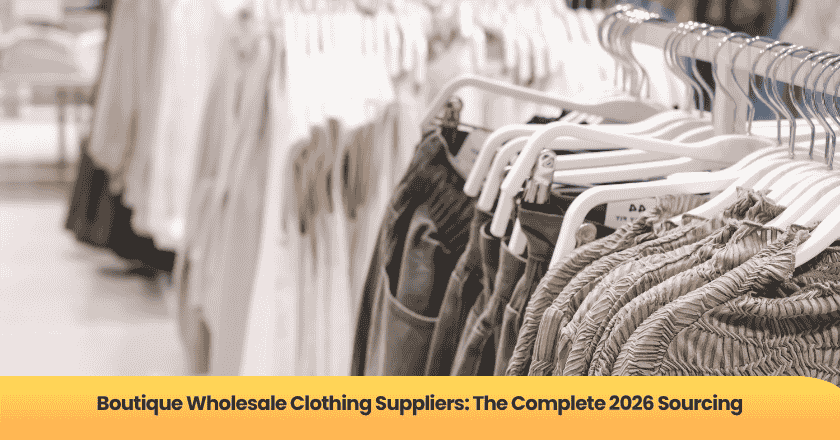
Opening: The Modern Boutique Sourcing Challenge
The boutique fashion landscape has shifted. By 2026, boutique owners aren't just hunting for cheap stock anymore—they're looking for vendors who can deliver consistency, sustainability credentials, and designs that actually sell. The gap between mass-market retailers and curated boutiques has widened, and your supplier choices now directly impact your competitive edge.
This guide cuts through the noise. You'll learn where successful boutique owners actually source inventory, how to vet suppliers properly, and what questions separate amateur shoppers from seasoned retailers.
Key Takeaways
- Direct relationship building trumps platforms — While B2B sites like Alibaba remain useful, 2026 winners are those who establish direct vendor relationships and negotiate beyond posted terms
- Minimum order quantities (MOQs) are negotiable — The "non-negotiable" minimums you see online often have flexibility, especially if you're ordering regularly and can demonstrate cash flow
- Sustainability and traceability now matter — Customers ask where clothes come from; vendors with transparent supply chains command premium wholesale rates
- Regional sourcing requires different strategies — China, Vietnam, and domestic US producers each have distinct timelines, quality benchmarks, and relationship norms
- Trade shows still beat digital research — Meeting vendors face-to-face remains the fastest way to secure favorable terms and assess quality before committing to bulk orders
- Local production solves speed problems — If you need inventory within 4-6 weeks, look domestic first; international sourcing works when you plan further ahead
How to Actually Find Quality Boutique Wholesale Vendors
Step 1: Search Beyond Page One of Google
Most boutique owners stop at the first Google results. Big mistake. Strong regional suppliers—especially smaller manufacturers—often have weak SEO. You'll find gems on pages 3 through 5.
Try these search angles:
- Boutique clothing manufacturers near [your city]
- [Fabric type] wholesale suppliers [region]
- High-volume clothing vendors small batch
- Custom apparel wholesale [your niche—e.g., sustainable, plus-size, vintage]
You're not just searching randomly. You're mapping regional hubs. Los Angeles, New York, Guangzhou, and Hanoi are still dominant, but emerging centers exist. Search them. Many smaller vendors don't spend on marketing, making organic search a goldmine.
Expert Tip: Reverse-image search competitor products on Google Lens. If you find a competitor's popular item, you often can trace it back to the manufacturer. That's legitimate reconnaissance.
Step 2: Leverage B2B Platforms Strategically
B2B sites (Alibaba, Global Sources, Made-in-China) aren't going away. But use them smarter.
In 2026, B2B platforms function as directories first, transaction platforms second. Use them to:
Identify vendors in your niche and geography
Compare baseline pricing
Assess who's consistently active (recent certifications, frequent updates)
Then reach out directly to those vendors. Ask if they'll quote you outside the platform, where both parties avoid percentage fees. Many will.
Common Mistake to Avoid: Treating B2B platform prices as final. These are opening positions. Vendors expect negotiation. If you're ordering $25,000+ in inventory, that conversation shifts dramatically.
Step 3: Attend Regional and Virtual Trade Shows
In-person trade shows remain unbeatable for supplier vetting. You see products firsthand, ask specific questions, and build relationships that platforms can't replicate.
2026 has added a wrinkle: hybrid trade shows. Many events now offer virtual attendance. It's not the same as being there, but it's faster than scheduling individual calls.
Where to find shows:
- 10times.com (filters by industry, date, location)
- Your industry association's event calendar
- Regional chambers of commerce
The LA Fashion District, Guangzhou's Baima and Shahe Markets, and Shenzhen's wholesale zones remain active. If you're serious, allocate budget for annual travel.
Expert Tip: Schedule vendor meetings before you arrive. Trade shows are chaotic. Email vendors two weeks ahead, request a 20-minute slot, and treat it professionally. Vendors respect advance planning.
Step 4: Check U.S. Customs Data for Competitor Sourcing
Want to know where your competitors source? U.S. customs logs every import. Tools like PIERS let you search publicly available shipment data.
Search for competitors' company names. You'll see:
Which countries they import from
Estimated shipment volumes
Production frequency
It's not perfect (some data is redacted for larger companies), but it shortcuts months of guesswork.
Common Mistake to Avoid: Assuming one shipment = their sole supplier. Large retailers diversify across 3-5 vendors. Track patterns over multiple shipments.
The Regional Sourcing Breakdown
China: Scale and Customization
China's apparel industry remains vast. If you need 500+ units at competitive pricing with customization, China works. Timeline: 60-90 days from order to your door.
Where to look:
- Alibaba / 1688.com (domestic Chinese platform with lower prices)
- AliExpress (faster-moving inventory, smaller orders)
- Direct outreach to Guangzhou, Hangzhou, or Shaoxing manufacturers
Minimum order quantities typically start at 100 pieces, though some factories accept 50 if you're willing to pay slightly higher per-unit costs. Negotiate ruthlessly. A manufacturer quoting $5/unit will often go to $4.20 if you show proof of repeat business potential.
Consideration: Logistics costs have stabilized but remain a factor. Consolidation services can group shipments and reduce landed costs by 15-25%.
Expert Tip: For first-time orders, use Alibaba's Trade Assurance program or arrange a letter of credit. It protects both parties and signals you're serious.
Vietnam: Ethical Production at Scale
Vietnam's garment industry emphasizes compliance and fair labor practices—major selling points in 2026. The quality is comparable to China's at 10-20% higher costs.
Minimum orders typically run 1,000+ pieces per style. Below that, you'll face rejection or premium pricing that eats your margins.
Where to start:
- Vietnam Textile and Apparel Association website
- Virtual B2B shows (less travel cost than China)
- Direct manufacturer outreach through LinkedIn
Timeline: 70-100 days, slightly longer than China due to logistics routing.
Expert Tip: Vietnam is becoming boutique-friendly as manufacturers realize smaller Western players are less price-obsessed and more committed to long-term partnerships.
Domestic U.S. Sourcing: Speed and Quality Control
If you need inventory within 6 weeks, look domestic. U.S. manufacturers offer shorter lead times, easier quality control (you can visit facilities), and marketing cache ("Made in USA" sells).
Trade-off: Expect 20-40% higher costs than offshore sourcing.
LA Fashion District remains the epicenter. Hundreds of vendors operate in this 90-block area. Quality ranges from mass-produced basics to custom pieces.
How to navigate LA Fashion District:
- Show up early (before 11 AM)
- Bring line sheets showing your target price points
- Ask vendors for intro to other vendors (community referrals matter)
Evaluating Vendors: The Real Assessment Criteria
You've found candidates. Now vet them properly.
Assess Financial Stability
Ask about:
- Years in business (10+ is safer, but new vendors exist for good reasons)
- Facility ownership (rented vs. owned; owned is more stable)
- Equipment age and maintenance records (they'll show these if professional)
- Clientele (ask for 2-3 reference boutiques; call them)
Unstable vendors vanish mid-order. You lose deposits and deadlines collapse.
Expert Tip: Request a facility tour before committing. A 30-minute video call isn't touring. Real due diligence requires seeing equipment, meeting the team, and observing workflow.
Clarify Communication and Responsiveness
Send a test question immediately after initial contact. How long until they respond? If it's 48+ hours, expect delays during production phases.
Look for vendors who:
Respond to emails within 24 hours
- Speak clear English (or your language of business)
- Use communication tools like WhatsApp or WeChat for faster back-and-forth
- Designate a single point of contact (not rotating salespeople)
Poor communication kills deals. A 3-hour time difference plus language barriers means slow communication is normal—but it shouldn't be glacial.
Verify Quality Samples
Never skip samples. Never rush this phase.
Order samples of 2-3 styles. Inspect:
- Seam consistency and strength (tug-test seams)
- Color accuracy (compare to photos under natural light)
- Fabric hand (does it feel premium? Does it wash well?)
- Hardware (zippers, buttons, snaps—do they work smoothly?)
Most vendors charge $15-50 per sample. It's cheap insurance. If the samples aren't acceptable, the bulk order won't be either.
Common Mistake to Avoid: Accepting "we can fix that in bulk production" excuses. Bulk production is just 500+ (or 1,000+) copies of the sample. If the sample is mediocre, bulk will be mediocre.
Expert Tip: If quality assessment feels overwhelming, consider third-party inspection services. Many suppliers now accept independent QC teams (either hired by you or the supplier) to inspect products before shipment. This costs $300-800 per inspection but prevents tens of thousands in losses from defective inventory.
Understand Their MOQ and Payment Terms
MOQ (Minimum Order Quantity) is their baseline. But there's usually wiggle room—especially for repeat orders. You can often negotiate if you:
- Show ability to pay (bank reference, prior Dun & Bradstreet rating)
- Order again quickly (many vendors offer discounts on second orders within 6 months)
- Bundle styles (ordering 500 pieces across 5 styles vs. 100 pieces of one style)
Payment terms are separate. Expect:
- 50% upfront, 50% on completion (most common for new relationships)
- 30% deposit, 70% on shipment (for established accounts)
- Net 30 after delivery (rare but possible with credit checks)
Never pay 100% upfront unless you've worked with this vendor multiple times. International transfers are hard to reverse.
2026 Sourcing Realities: Trends That Actually Matter
Sustainability is No Longer Optional
Customers now ask: Where was this made? Were workers paid fairly? Is the fabric recyclable or organic?
In 2026, vendors who can't answer these questions lose wholesale partners. Look for vendors with:
- OEKO-TEX certification (safe, non-toxic production)
- Fair Trade credentials
- Visible environmental practices
- Transparent factory conditions
It costs more, but it's sellable. Your markup shrinks slightly, but brand reputation strengthens.
Expert Tip: Some vendors market "greenwashing"—they claim sustainability without proof. Ask for documentation. Real certifications exist; ask to see them.
Small-Batch Flexibility Wins
The old model: Order 1,000 pieces of Style A in June, hope it sells by November. The 2026 model: Order 200 pieces, test it, reorder if it sells.
Vendors who accommodate small batches (100-300 pieces) without massive upcharges are winning. Look for them. They're adapting to boutique realities.
Expert Tip: If a vendor insists on 1,000-piece minimums, they're not a good fit for most boutiques unless you're already doing serious volume.
Nearshoring is Growing
Mexico, Colombia, and Central America are becoming sourcing hubs—closer to U.S. distributors than Asia, shorter lead times, and often cheaper than full-U.S. production. If you haven't explored these regions, 2026 is the year.
Lead times: 45-60 days. Costs: 10-15% below U.S., 10-15% above Chinese averages.
Expert Tip: Build a Vendor Calendar
Create a simple spreadsheet tracking:
- Vendor name and contact
- Lead times
- MOQ and pricing for common styles
- Quality rating (1-5 scale)
- Reorder window (when to place next order)
Boutique owners who manage this systematically—rather than scrambling ad-hoc—avoid stockouts and overstock problems. It's boring, but it works.
Frequently Asked Questions
Q: What if I don't have time to manage sourcing negotiations myself?
A: This is a real constraint for many boutique owners juggling inventory, sales, and marketing simultaneously. If you're stretched thin, you have two paths: (1) Start small and outsource later—order from one trusted vendor for 6-12 months, then expand. (2) Consider a professional sourcing agent from the beginning. Agents handle supplier negotiations, quality inspections, factory communication across time zones, and logistics—freeing you to focus on sales and business growth. You'll pay service fees or markups (typically 5-10%), but you reclaim 10-15 hours per month that would've gone to factory coordination. It's a trade-off between cost and time. Many successful boutique owners make this choice once they hit $50,000+ annual inventory spend.
Q: How long should I expect to wait for samples?
A: 5-10 business days domestically. 7-14 days from China or Vietnam, depending on factory and shipping method. Plan accordingly; don't expect overnight.
Q: What if the bulk order quality doesn't match the sample?
A: This happens. You have limited recourse internationally—inspecting before shipment is your safeguard. Always negotiate an inspection clause in your purchase order. Many vendors now accept third-party inspection (you hire an independent inspector, vendor covers costs if quality fails).
Q: Can I negotiate MOQs below what's listed?
A: Absolutely, especially for repeat orders. First-time buyers have less leverage, but it never hurts to ask. Worst case: they say no.
Q: What's a realistic markup on wholesale clothing?
A: Retail markup is typically 2.5-4x wholesale cost (you pay $10, sell for $25-40). Boutiques operate leaner than department stores, so 2-2.5x is common to stay competitive while maintaining healthy margins. Your specific markup depends on brand positioning and quality.
Q: Should I use an agent or source directly?
A: For first orders, an agent takes stress off—they handle communication, quality control, and problem-solving. But agents cost 5-10% commission. Direct sourcing saves money but requires more work. Once you're experienced, go direct. Starting out? An agent can be worth the fee.
Q: Is it safe to pay via wire transfer internationally?
A: Yes, if you trust the vendor. Use these safeguards: (1) Verify the bank details independently—call the vendor's listed phone number and confirm. (2) Use messaging apps (WhatsApp, WeChat) to confirm details in real-time. (3) Start with small orders before committing large sums. Wire fraud is real; don't be careless.
Q: How do I know if a vendor is legitimate?
A: Check: business registration in their country, years in operation, customer references, Alibaba Trade Assurance verification (if on platform), and online reviews (search vendor name + "scam" to see if problems emerge). Red flags: vendors who only accept unusual payment methods (cryptocurrency, gift cards) or rush you. Trust your gut.
Common Mistake to Avoid: Over-Committing to First Vendors
Many new boutique owners fall in love with the first vendor who responds quickly and offers great terms. They then place a huge order and cross their fingers.
This is how you end up with 500 unwearable t-shirts and a depleted budget.
Start small. Order 50-100 pieces of 1-2 styles. See how production goes, how the final products sell, and how the vendor handles post-sale issues. Then scale up with vendors who perform.
Common Mistake to Avoid: Juggling Too Many Suppliers at Once
Once you're sourcing from multiple regions and vendors, coordination becomes complex. Managing timelines across China, Vietnam, and domestic suppliers—each with different lead times, communication styles, and quality standards—quickly becomes overwhelming:
- You miss quality issues because you can't inspect everything in time
- Shipments arrive late because communication broke down
- You overpay because you're too busy to negotiate properly
- You scramble when a supplier disappears mid-production
This is where many growing boutiques hit a ceiling. They source well initially, then expansion stalls because sourcing becomes a full-time job.
Your options:
Hire a part-time sourcing coordinator — Someone to manage vendor communication, track timelines, and coordinate quality checks ($2,000-4,000/month)
Streamline to 2-3 core vendors — Become their priority customer rather than juggling ten suppliers
Outsource to a sourcing professional — Let someone else manage the coordination while you focus on sales and brand building
The third option isn't just about saving time—it's about reducing the risk of operational failures that tank profit margins.
Building Long-Term Vendor Relationships
The strongest vendors-boutique partnerships are mutual. That means:
- You: Pay on time, order consistently, provide honest feedback
- Vendor: Delivers quality, communicates transparently, accommodates your evolving needs
After 3-4 successful orders, most vendors will negotiate better terms. Some will:
- Lower MOQs for you
- Offer 2-3% discounts on repeat styles
- Prioritize your orders during busy seasons
- Allow extended payment terms
These relationships take time to build, but they're worth it. A vendor who knows you, trusts you, and wants your business is infinitely more valuable than hunting for new suppliers constantly.
When Self-Sourcing Isn't Enough: Considering Professional Support
Not every boutique owner has the bandwidth to manage sourcing independently. If you recognize yourself in any of these scenarios, it might be time to consider bringing in professional support:
You're spending 15+ hours per week on supplier coordination — Time that should go to marketing, sales, or product development is instead spent chasing factory updates, resolving production delays, and navigating language barriers.
Quality control is slipping — You can't personally inspect factories or products, so issues slip through. By the time defects arrive at your store, it's too late to negotiate refunds or replacements.
You're managing 5+ suppliers simultaneously — The complexity of coordinating different timelines, payment terms, and communication styles across multiple regions becomes unmanageable. One supplier's delay cascades into stockouts elsewhere.
Cash flow is tight — You're constantly stressed about payment timing and can't negotiate favorable terms because you lack the leverage of larger buyers. Flexible payment structures would transform your cash management.
You want to focus on what you're good at — Your strength is curation and customer relationships, not international supply chain management. Spending 30% of your time on backend sourcing feels like a poor use of your skills.
In these cases, outsourcing sourcing makes sense. Professional sourcing agents or buying services handle:
- Factory vetting and quality inspection (often using trained on-ground QC teams)
- Price negotiation and leveraging buyer networks for better rates (typically 5-10% cost savings)
- Production oversight and timeline management
- Logistics coordination and documentation
The cost? Usually 5-10% markup or service fees. The benefit? Reclaim 10-20 hours monthly, reduce quality risks, and focus your energy on growing sales. For boutiques with $100,000+ annual sourcing spend, the math often works in favor of professional support.
The key: This isn't an either/or decision. Many successful boutique owners start with self-sourcing, build relationships with 1-2 core vendors, then gradually outsource as they scale. You're not outsourcing your entire supply chain—just the coordination complexity you no longer have time to manage.
Wrapping Up: Your 2026 Sourcing Strategy
Finding quality boutique wholesale vendors isn't magic. It's research, vetting, relationships, and a willingness to start small and scale smart.
Start with this action plan:
This week: Search for vendors in your specific niche (don't just search generic terms).
Next week: Reach out to 3-5 candidates with specific questions about MOQ, lead times, and quality samples.
Week 3-4: Evaluate samples carefully. Ask hard questions about pricing and terms.
Month 2: Place a small trial order with one or two vendors. Learn their processes.
Ongoing: Build relationships, track performance, and scale with vendors who deliver.
The boutique fashion market rewards owners who source intelligently—not cheaply. Quality, consistency, and good relationships beat chasing the lowest price every time.
Your competition is out there doing this work right now. So start today.
NewBuyingAgent
Related Resources

Get Started Today
Let's Turn Your Sourcing Goals into RealityWeChat:+86 15157124615
WhatsApp:+86 15157124615
Address:Building 10 #39 Xiangyuan Road, Hangzhou, China
