

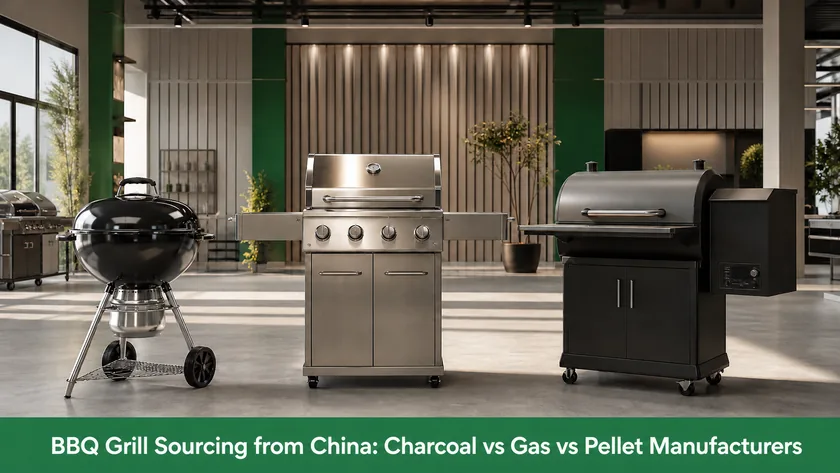
For a buyer sourcing BBQ grills from China, fuel type is not a menu choice. It is a product architecture decision that changes the bill of materials, the sample plan, the factory checks, and the market file. A charcoal grill can be primarily a heat-and-materials product; a gas grill adds a controlled fuel path; a pellet grill adds feeding, sensing, and electronic control. The safest commercial move is to choose the platform whose proof burden matches the line position, target market, and launch window—not the one that merely looks easiest in a catalogue.
The Buyer's Verdict: Source the Fuel System, Not a Generic Grill
The best grill to source is the platform whose proof burden matches the buyer's market and commercial promise. Charcoal is often the cleanest route when the proposition is a durable, value-led outdoor product with a tightly specified physical build. Gas can fit a convenience-led line, but it needs a fuel-system and destination-market route from the start. Pellet can justify a more feature-rich position only when the team can validate an interacting mechanical and control system rather than approve a polished shell.
- Choose charcoal when the release decision rests mainly on heat handling, airflow, coatings, assembly, and packaging discipline.
- Choose gas when the intended market, fuel compatibility, ignition behavior, and gas-path evidence are already defined.
- Choose pellet when the commercial case can carry functional testing for pellet storage, feed-path, fan, controller, sensor, wiring, and temperature behavior.
The comparison below is a sourcing screen, not a claim that one platform is universally safer, cheaper, or better. It tells the buyer which questions must be answered before quotations are compared.
| Fuel system | Commercial fit | Factory proof to prioritize | Release risk if treated as generic |
|---|---|---|---|
| Charcoal | Value-led, physical-build proposition | Metal, finish, airflow, ash, assembly | Heat performance is reduced to appearance review |
| Gas | Convenience-led outdoor cooking | Fuel path, ignition, burner behavior, market route | A metalwork sample hides a system gap |
| Pellet | Feature-led, controlled-cooking proposition | Feed, sensing, controls, wiring, temperature behavior | A visually approved sample lacks system-function proof |
A buyer who needs a China-sourced outdoor line should evaluate partner against this defined fuel-system brief. The useful question is whether the product path can connect the selected platform to local factory resources, product development, QC, and the market information needed for a sound quote.
The Fuel-System Sourcing Framework
Fuel type changes the factory evidence needed before a grill order is released. The useful question is how much component coupling the platform creates: in plain language, how strongly the parts interact and depend on one another for system performance. A charcoal body can fail through materials, fit, airflow, or finish. Add a gas path and ignition, and the release decision must examine their behavior together. Add pellet feeding and controls, and a fault in one part can change the product’s overall function. The Fuel-System Sourcing Framework therefore starts with the system, then builds a fuel-specific RFQ and proof plan around it.
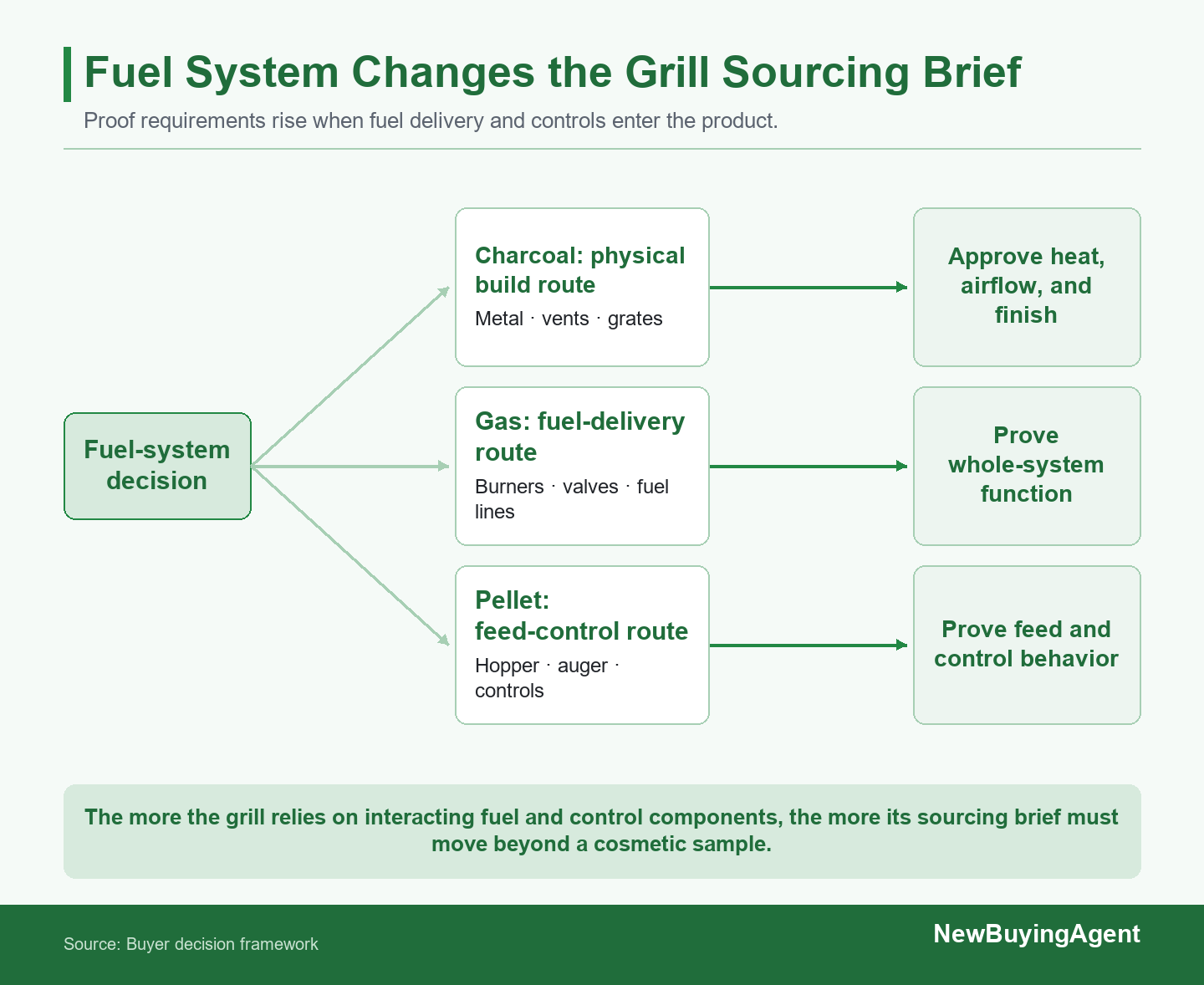
Charcoal, gas, and pellet grills need different proof before production approval.
Charcoal: The Physical Build Must Control Heat, Air, Finish, and Ash
Charcoal grill RFQs should specify physical heat, airflow, finish, and ash-management checks. The buyer should name the metal grade or thickness range where relevant, coating expectation, vent positions, grate fit, lid or bowl alignment, ash-removal design, fastener finish, and carton protection. These are not decorative details: they determine whether a production unit behaves like the approved sample after assembly, heat cycles, and ordinary handling.
NFPA’s grilling safety guidance is a useful reminder that solid-fuel and gas grilling should not be treated as the same operating context. For sourcing, that means a charcoal sample review should include observable heat, air, finish, and ash controls rather than a vague request for a “safe” grill. A factory can show a good-looking bowl and still leave the buyer without a clear standard for vents, ash handling, or post-assembly stability.
- Request component drawings or approved reference samples for the fire bowl, lid, grates, vents, legs, and ash system.
- Define the visible-finish standard after assembly and the practical heat-cycle observations the sample must pass.
- Keep accessories separate from core safety and performance parts so a low-risk side table does not distract from the combustion chamber.
Gas: The Fuel Path and Ignition System Become Release-Critical
A gas grill requires a fuel-system proof path in addition to its physical build review. Define the intended fuel configuration before sampling: LP means liquefied petroleum gas, commonly used in a portable gas grill, but its connection, regulator, hose, valve, burner, and ignition arrangement must still match the planned market and model. A gas-grill request should make those components visible in the bill of materials and sample checklist, not leave them as unnamed fittings beneath a stainless-steel hood.
For a Great Britain route, the government’s gas-appliance enforcement guidance shows why the destination market belongs in the brief from day one. The buyer should ask the factory to identify the exact configured components, show how ignition and burner behavior are checked on the sample, and state which market-specific document path is being considered. That evidence should be tied to the configuration being quoted, not to a visually similar grill from another destination.
- Record the intended gas type, connection arrangement, regulator and hose configuration, burner count, and ignition method.
- Ask what functional checks are performed on the production configuration, who records them, and what identifies the tested configuration.
- Keep fuel accessories and target-market assumptions explicit; they should not silently change between quotation, sample, and mass production.
Pellet: Mechanical Feeding and Controls Make a System Test Necessary
A pellet grill sample should demonstrate feeding, sensing, and control behavior, not merely appearance. A hopper is the container that holds pellets before a feed mechanism moves them toward the fire pot. That simple definition reveals the sourcing difference: the hopper, auger, fan, controller, sensor, wiring, combustion chamber, and user settings form one working system. A dent-free hopper or an attractive touchscreen is not proof that the system starts, feeds, responds, and recovers as expected.
NFPA's research on home grill fires is broad safety context, not a pellet-grill production standard. Its relevance is the buyer’s review discipline: a product that combines combustion with powered feeding and controls needs functional observations, clear limits, and a documented configuration. Ask the factory to state the pellet assumptions, demonstrate start-up and shutdown behavior, and show how the controller, sensor, fan, and auger are checked as a coordinated set.
- Run the sample through defined operating states rather than approving only a static showroom inspection.
- Record controller version, sensor type, wiring arrangement, auger specification, and any substitutions proposed after sampling.
- Set a re-test rule for changes to the feed, sensing, or control chain, because those changes can alter system behavior.
What a Grill Manufacturer Should Prove Before You Place an Order
The buyer should ask for evidence that ties the approved build to the production configuration. A photo-ready sample is a design checkpoint, not a complete production decision. The buyer needs a concise evidence stack: the approved configuration, critical component list, defined function checks, workmanship and packaging expectations, change-control contact, and the records that connect the sample to the production run.
Product-safety guidance for manufacturers and importers says businesses need to be able to demonstrate that products meet relevant requirements before placing them on the market. That principle matters in grill sourcing because the proof should follow the real product, not an early prototype: the UK's product-safety advice makes the evidence expectation explicit. A buyer should therefore compare factories by the clarity of their configuration records and test observations, not only by workshop footage or a list of equipment.
For a new private-label grill brief, this is also where a buyer can use NewBuyingAgent's product-supply service for a defined grill brief. The useful input is a product outcome—fuel system, configuration, destination market, target price, quantity, and timing—so the quoted China-sourced product path can be matched to local factory resources, product development, and QC capability. The service discussion should start from that evidence-bearing brief, not from a generic request for a grill catalogue.
Separate the Factory Checklist From the Market-Entry File
Market-entry evidence should be checked for the exact country and grill configuration. For the European Union, Regulation (EU) 2016/426 covers appliances burning gaseous fuels used for cooking. That does not tell a buyer that every gas grill follows one identical route; it tells the buyer to lock the destination and configuration before treating a factory sample as market-ready.
The EU’s general product-safety guidance also frames product-safety and economic-operator obligations for products placed on the EU market. Separately, Great Britain publishes business guidance on gas-appliance enforcement. The decision implication is simple: do not reuse an EU-oriented document set, label, fuel arrangement, or assumption for another market without verification.
For each destination route, confirm the role-specific requirements before approving the product file. Great Britain’s supplier and manufacturer guidance distinguishes obligations for businesses that manufacture, import, distribute, or otherwise supply gas appliances. Use that distinction as a sourcing boundary: a production checklist alone does not complete the market-entry decision.
When a buyer already has a grill manufacturer, the practical question is whether the approved build, production follow-up, and evidence trail can stay aligned. In that situation, buyers can compare the factory-management service for an existing grill supplier instead of restarting the product brief. The relevant discussion is the buyer’s intended outcome: a China-sourced grill that remains aligned on price, quality, market fit, and delivery readiness.
An Illustrative Outdoor Line: Why Three Grill Concepts Should Not Share One Approval Gate
Do not use one approval gate for grill platforms that rely on different component systems. Consider an illustrative outdoor-products retailer planning a private-label line for two markets. The team has concept images and target price bands, but the charcoal, gas, and pellet variants are being treated as three visual versions of one programme. That creates a timing illusion: one calendar can conceal three very different evidence burdens.
A Split-Release Plan for an 18-Week Launch
The charcoal, gas, and pellet concepts receive separate release gates in the illustrative plan. The buyer is an outdoor-products retailer preparing a compact charcoal grill, a three-burner LP gas grill, and a digital pellet grill for two destination markets within an 18-week launch schedule.
The order context is not a verified client case or a promised outcome. It is a planning test: three concepts share a commercial window, but not a common system. The launch covers 3 fuel-system variants across 2 destination markets.
The readiness gap is a shared generic RFQ. It contains images, dimensions, and price targets, but no separate critical-component list or destination-market file. That makes the first sample look like a single milestone even though the gas and pellet concepts need evidence that the charcoal concept does not.
The charcoal concept changes mostly through sheet metal, coating, vents, grates, and packaging.
The gas concept adds burner, valve, regulator, hose, ignition, and market-specific fuel compatibility questions.
The pellet concept adds a hopper, auger, fan, controller, sensor, wiring, and functional behavior across temperature states. The observation is not that the advanced platforms are automatically wrong. It is that their parts interact more closely. A metal or packaging correction can be isolated on the charcoal product; a change to a gas fitting or a pellet control component can require a different functional review. The same calendar therefore does not create the same release risk.
The analysis is to split the work by fuel system. Under this Fuel-System Sourcing Framework, the buyer creates three evidence tracks: physical build and heat handling for charcoal; fuel path, ignition, and market route for gas; and feed, sensing, control, and operating-state checks for pellet.
The decision is to release the charcoal platform first only if its physical-build proof is complete, while retaining gas and pellet as separate evidence workstreams. This is a commercial sequencing choice, not a claim that charcoal is always the superior product.
The corrective action is a fuel-specific RFQ and sample plan that names critical components, function checks, markets, document requests, and the approval owner for each platform.
The verification gate is clear: do not approve mass production until the sample, critical-component evidence, and destination-market file agree with the selected configuration.
Illustrative only.
Build the RFQ Around the Fuel System
The RFQ must name the fuel system and destination market before the buyer compares offers. A usable packet turns the comparison into a factory decision rather than a conversation about a reference photo. Start with the line position and the exact platform; then identify the evidence that must accompany its quoted configuration.
- Commercial brief: target customer position, intended retail range, quantity, target price, launch timing, and the market or markets to be served.
- Configuration brief: charcoal, gas, or pellet platform; dimensions; materials; critical components; cooking area; accessories; packaging; and the approved visual standard.
- Function brief: the sample checks that matter for the platform, such as airflow and ash handling, ignition and burner behavior, or feed and control response.
- Evidence brief: the records, configuration identifiers, destination-market questions, and change-notification rule required before production approval.
The non-obvious failure point is a quote that looks comparable because every supplier has priced the same outer dimensions, while each supplier has interpreted the fuel path, controller, coating, or packaging differently. Ask each factory to respond against the same critical-component and proof list. If a proposed substitution appears, decide whether it is cosmetic, functional, or market-relevant before the sample is accepted.
Once the brief is specific enough to quote, the buyer should provide the fuel system, configuration, destination market, quantity, target price, and timing so the sourcing conversation starts from a defined purchasing need instead of unstructured grill offers. To begin from that defined brief, submit a grill sourcing brief to NewBuyingAgent.
Where NewBuyingAgent Fits in a Grill Sourcing Decision
NewBuyingAgent can be relevant once the buyer has a fuel-specific purchasing brief or an existing supplier that needs local follow-up. For a new grill product, the decision starts with the required outcome: a quoted China-sourced product aligned to the selected platform, target market, price, quality, and delivery plan. For an existing factory, the issue is whether the production and quality evidence remains connected to the buyer’s approved configuration.
The difference is practical. A buyer who wants a new product path needs a defined purchasing need that can be translated into a product quotation and supply plan. A buyer with an established manufacturer needs local factory follow-up that keeps the approved grill, production reality, and delivery readiness aligned. In both cases, the Fuel-System Sourcing Framework prevents a gas or pellet grill from being reduced to a generic outdoor-metal product.
Frequently Asked Questions
The FAQ answers narrow questions after the comparison rather than introducing a new decision framework. The remaining questions are narrower than the core sourcing choice, so they can be answered directly without replacing the fuel-system comparison above.
Which grill type is simplest to source from China?
A basic charcoal grill is usually the simplest starting point because it has the fewest fuel-delivery and control components. That does not remove the need for careful review: the buyer still needs clear requirements for metalwork, coating, airflow, ash handling, stability, and packaging. It is simpler because the proof chain is more concentrated on the physical build, not because a charcoal product can be approved from pictures alone.
What should a gas grill sample prove before mass production?
A gas grill sample should prove ignition, burner behavior, gas-path integrity, assembly repeatability, and the market-specific documentation route. The buyer should also lock the fuel configuration, critical fittings, regulator and hose arrangement, and any approved substitutions. A visually good sample is not enough if the quoted production configuration or destination-market assumptions remain unclear.
Do pellet grills need a different factory review?
Yes, because a pellet grill combines a combustion chamber with powered feeding, sensing, and control components that must work together. The factory review should therefore include defined operating states, the approved controller and sensor configuration, feed-path observations, and a re-test rule for functional component changes. This is a system review, not simply a check of exterior finish and dimensions.
Can one grill platform serve multiple destination markets?
A shared platform can serve more than one destination market only when the gas, electrical, labeling, traceability, and certification requirements are validated for each route. The buyer may be able to retain common physical parts, but must not assume that a single document set, fuel arrangement, or label is transferable. Treat the market file as a controlled part of the platform, alongside the bill of materials and sample record.
NewBuyingAgent
Related Resources


Get Started Today
Let's Turn Your Sourcing Goals into RealityWeChat:+86 15157124615
WhatsApp:+86 15157124615
Address:Building 10 #39 Xiangyuan Road, Hangzhou, China
