

An approved supplier list for raw materials is a controlled record identifying which sources may supply specified materials under defined conditions. It should connect the supplier to the material specification, manufacturing site, approval evidence and review status. Approval permits purchasing within that scope; it does not automatically release every delivery for production.
A factory can assemble a product correctly and still ship the wrong result if its fabric, resin, coating or metal does not meet the agreed requirement. For a quality director overseeing production in China, the useful question is therefore more precise than whether the factory has a supplier list: can purchasing and receiving prove that the material about to be consumed belongs to the approved scope?
The Approval Decisions That Protect Product Quality
- Decision: Approve a defined material and source relationship, rather than giving an entire supplier unrestricted approval.
- How it works: Match each received lot to that approval, then apply the required verification before authorizing use.
- Risk: A supplier name can stay unchanged while the actual mill, grade, formulation or production site changes.
- Common mistake: Treating a certificate of analysis from another batch as evidence for the delivery at the factory.
Why Raw Material Approval Comes Before Finished Product QC
Raw material approval controls what enters production, while finished product quality control checks the resulting product. The controls answer different questions and work best together. Once material has been cut, molded, coated or blended, replacing it may require remaking the product; checking the approved source before consumption gives the buyer an earlier opportunity to prevent that exposure.
The depth of supplier approval should reflect the consequences of material failure and the ability to detect it. The ASQ supplier quality handbook describes additional evaluation and qualification for higher-risk sourced materials or products. This is professional guidance, not a universal statutory testing schedule. For a buyer, its practical implication is to spend more approval effort where a wrong material could compromise safety, performance or a critical customer requirement.
Consider two different checks on a fabric shipment. A visual inspection can identify obvious shade variation or damaged rolls. It cannot, by itself, establish all agreed composition or performance properties. Those properties need an appropriate specification and suitable evidence. Passing the easier check must not silently stand in for the harder one.
Build these controls into the purchasing brief and production arrangement. If the wider procurement route is still being defined, read the China sourcing guide to place material requirements alongside product specifications, sampling and factory execution. The approved list then becomes a working production control rather than a document created only for an audit.
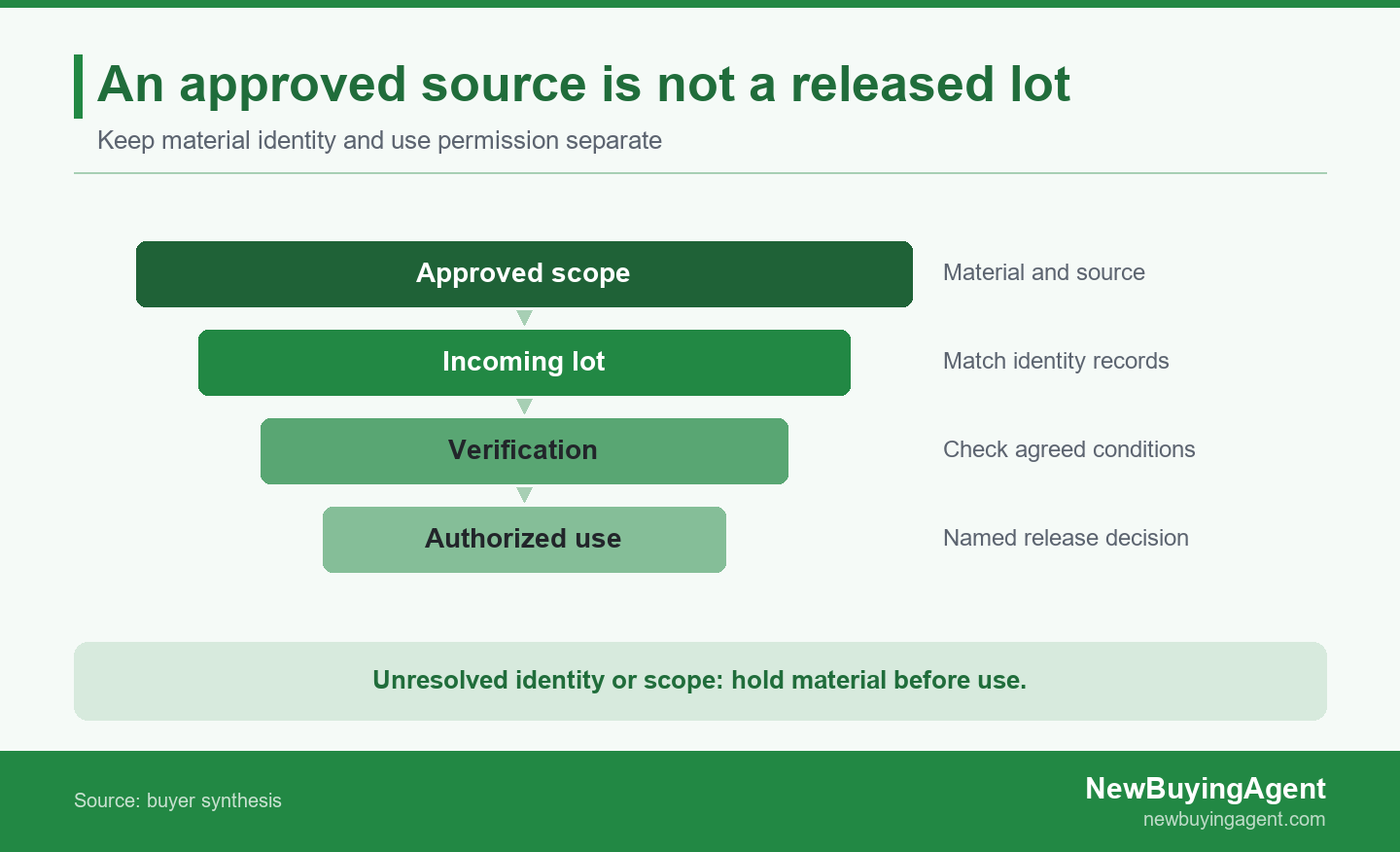
Supplier approval, incoming lot verification and permission to use material are separate decisions.
What an Approved Raw Material Supplier Entry Should Contain
Each entry should state what the supplier is approved to provide, where it is made and which specification applies. Record the intended product use when that changes the acceptance requirements. A company approved for one fabric grade, resin formulation or coating system should not be assumed suitable for another merely because both materials appear in its catalog.
The ISO and IAF auditing guidance on external providers discusses keeping approval information current, buying against defined criteria and verifying that requirements are met. It also cautions that reviewing an approved provider list alone may be insufficient. The guidance helps explain the weakness of a name-only register; it is not a substitute for the applicable standard or the buyer's product requirements.
| Approval field | Information to record | Decision it enables |
|---|---|---|
| Material and specification | Material code, grade, specification revision and intended use | Is this purchase within the approved material scope? |
| Source identity | Manufacturer, manufacturing site and distributor where applicable | Does the actual origin match the qualified source? |
| Approval evidence | Relevant evaluation, sample results, qualification records and limitations | What supports approval, and what remains conditional? |
| Receiving requirements | Batch identification, required documents and verification plan | What must be checked before this delivery is used? |
| Status and authority | Approved, conditional, suspended or rejected; approver and review trigger | May purchasing order now, and who may change the status? |
When a distributor supplies the material, record both the seller and the approved manufacturer where source identity matters. Ask how original batch markings and documents will remain linked through repacking or consolidation. Buying from the same distributor does not demonstrate that the same mill or producer supplied the material, and a distributor's internal stock number may not identify the manufacturer's batch.
For buyers sourcing a new finished product, NewBuyingAgent's product supply from China connects the purchasing requirement with local factory resources and product/QC capability. Specify material-sensitive requirements in that product brief so they can inform sourcing and the supplied product offer. Keep the factory's material approval records tied to those agreed product requirements.
How to Decide Whether a Received Material Lot Can Be Used
A delivery from an approved supplier still needs a receiving decision. Match the actual material and source to the current approval, confirm that its records identify the delivered lot, and complete the verification required for that material. Keep unresolved material out of production until the designated authority records a decision; purchasing approval and permission to consume stock should remain distinguishable.
The receiving process needs usable instructions. Warehouse staff should be able to identify a held lot without interpreting a long supplier assessment, while QC needs access to the specification and evidence behind the status. A clear material label or inventory restriction helps connect the physical stock to its release record.
Match the Batch, Source and Supporting Documents
Check manufacturer and site identity where required, material code and grade, specification revision, batch or lot number, and the relationship between labels and documents. NIST's supplier selection guidance emphasizes production and inspection documentation, treatment of rejects and lot control. These records matter because a buyer needs to identify which supplied material was affected when a problem occurs.
A certificate of analysis, or COA, reports analytical results for identified material. Its relevance depends on whether it covers the actual batch, required properties and suitable methods. Specific regulated sectors impose additional conditions: US drug component rules condition reliance on a supplier's analysis on manufacturer identity testing and establishment of the supplier results' reliability. Those drug requirements should not be applied automatically to textiles or hardware; they illustrate why a supplier document is not unconditional release permission.
Where the delivery label and report disagree, ask for a documented reconciliation or evidence tied to the received batch. A verbal assurance that the grades are equivalent does not resolve an identity mismatch. Keep the original documents as well as the correction so the later decision remains understandable.
Verify the Required Properties and Record Release
Choose checks according to the material's failure modes and the agreed acceptance criteria. Depending on the product, that may involve document review, physical inspection, measurements, laboratory testing or a controlled production trial. Identify the property each check addresses: a trial that confirms sewing behavior does not necessarily establish fiber composition, and a composition result does not establish every finished product performance requirement.
Also ask whether the measurement is suitable for the decision. NIST's metrological traceability guidance explains that traceability alone does not guarantee fitness for purpose; measurement uncertainty must suit the application. Metrological traceability concerns a measurement's connection to references. It differs from material traceability, which follows the batch through receiving and production.
The release record should identify the lot, evidence reviewed, decision, any restrictions and the authorized approver. A limited trial authorization should state which material may be consumed and for what purpose. If a lot remains held, production scheduling must respect that status; moving it to the cutting room should not become an unofficial approval.
When Material or Source Changes Require Reapproval
Review approval when a change could affect the properties, performance or compliance requirements on which it depends. Relevant triggers can include a new mill, manufacturing site, grade, formulation, subcontracted process or intended use. Specify notification obligations before placing orders, and require the factory to identify the affected material and production lots rather than reporting only that its supplier has changed.
The response depends on the product and jurisdiction. For US children's products, material change requirements require testing by a CPSC-accepted third party and a new Children's Product Certificate (CPC) when a material change could affect compliance. Relevant component sourcing changes include changes in composition or supplier. This is a scoped regulatory example, not a rule that every supplier change for every product requires the same testing. For ordinary materials, the buyer's quality authority should assess what changed and which existing evidence remains applicable.
Separate administrative changes from technical changes. A new invoicing address may call for a record update; a move to another production site may affect equipment, process controls and qualification evidence. If the supplier cannot explain the difference, hold the affected material while the source is clarified. Reapproval should close the relevant evidence gap, rather than repeat an entire qualification package without a reason.
For a buyer already working with a China factory, NewBuyingAgent's management of existing China factories is relevant to day-to-day communication, production progress and quality management. Its China-side execution team can help keep material questions connected to the actual production schedule. Define the buyer's approval authority and factory notification responsibilities in the arrangement; local follow-up does not itself authorize an unapproved substitution.
Example: A Fabric Substitution Before Bulk Cutting
In this illustrative scenario, a retailer orders 8000 units of cotton tote bags from an existing China factory. The approved fabric comes from a specified mill and grade, but the factory proposes a different mill's fabric to keep cutting on schedule. The received material is pending verification, and there is no bulk release. This example is not a reported client case.
Receiving staff find that the supplier paperwork identifies a different batch from the rolls delivered. The purchasing contact says the replacement looks similar, while QC cannot confirm that the evidence covers the specified fabric. The immediate problem is therefore unresolved source and batch identity, not a demonstrated fabric failure. Cutting the full order would consume the material before that uncertainty is resolved.
The quality manager keeps the rolls segregated and asks the factory for the actual manufacturer, grade and batch-linked records. Purchasing obtains corrected source information, and QC identifies which agreed properties need verification. A small cutting and sewing trial may be authorized separately to assess handling, but it cannot release the remaining stock or replace checks on other required properties.
After the missing evidence and relevant checks are reviewed, the designated approver can record acceptance within a defined scope, request further evidence or reject the substitution. Production updates its schedule against that decision. China-side follow-up can obtain records and coordinate the factory response, while the buyer retains its agreed approval authority. No test outcome or delivery recovery is assumed here: the useful result is a decision before bulk consumption.
How to Keep the Approved List Useful During Production
Maintain the list through receiving results, source changes and actual supplier performance, rather than treating approval as permanent. Give higher attention to materials whose failure would seriously affect the product or be difficult to detect later. Review triggers should include relevant nonconformities, repeated document mismatches and changes to the requirements that originally justified approval.
Assign a list owner and control revisions. Purchasing needs the current status before ordering; receiving needs the correct material scope; QC needs supporting evidence; production needs the lot's release status. These can be connected records rather than one oversized spreadsheet. The important point is that each team can reach the current decision and identify who may change it.
Keep material approval proportionate to the product requirement. A cosmetic feature, a structural component and a regulated product-contact material may need different evidence. Start with the consequential properties and make missing information visible. Adding certificates unrelated to those properties makes the file larger without necessarily making the next production decision safer.
What to Ask Your China Factory Before the Next Material Purchase
Ask the factory to demonstrate the path from an approved material entry to a received lot and its production release. Use a current material, not an idealized sample file. Check whether the source, specification and batch match, whether required evidence is available, and whether production can distinguish held stock from released stock. Missing links identify the next control to fix.
If you need support with an existing China factory or a new sourcing requirement, send the purchasing requirements to NewBuyingAgent. Include the product specifications, material restrictions, quantity, target price, destination and timing, and state whether the factory is already selected. Its local factory resources and product/QC capability support one-stop China sourcing; for existing factories, discuss production follow-up and quality management with the approval responsibilities clearly defined.
Frequently Asked Questions About Approved Raw Material Suppliers
Can an urgent order use a supplier that is not yet approved?
Only through an authorized exception process that is permitted for the product and applicable requirements. Record the affected material and lot, evidence needed, limits on use and decision authority. Urgency explains the request; it does not prove suitability. An exception should not silently convert into permanent supplier approval.
What happens to stock already received when a supplier is suspended?
Assess whether the suspension affects that stock. Identify the relevant lots, reason for suspension and any production already using the material. A delivery problem may have different implications from a material integrity concern. Apply holds or further checks where warranted, and record lot-specific disposition rather than assuming that every past delivery is acceptable or defective.
Is this supplier list sufficient for regulated materials?
No. Determine the applicable product and destination requirements separately. For example, the FDA's foreign supplier verification program for covered US food imports addresses food hazards, supplier performance and appropriate verification activities. A general material approval register cannot replace that program or other category-specific compliance obligations. Confirm current official requirements for the product and destination, with qualified compliance advice where needed.
Does changing the distributor always require a new manufacturer qualification?
Not necessarily. First verify whether the approved manufacturer, site, grade and batch traceability remain unchanged. Then assess the new distributor's storage, handling, repacking and document controls where relevant. If the original source cannot be established, the change cannot be treated merely as a different invoice issuer.
NewBuyingAgent
Related Resources



Get Started Today
Let's Turn Your Sourcing Goals into RealityWeChat:+86 15157124615
WhatsApp:+86 15157124615
Address:Building 10 #39 Xiangyuan Road, Hangzhou, China
