

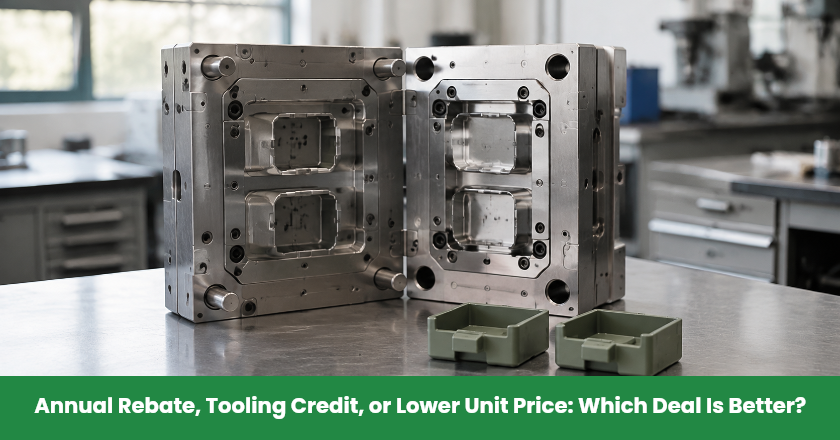
A lower unit price is usually easier to realize, an annual rebate can reward dependable repeat purchasing, and a tooling credit can be strongest when it offsets a mold you already need. None wins on its label alone. Keep the product and buying plan unchanged, then compare the amount you can actually deduct or receive, the date it becomes available, and the conditions that could prevent it.
Choose the Benefit You Can Actually Use
The better deal is the usable benefit under agreed conditions, not the largest advertised allowance. A supplier credit has limited value if it cannot pay for anything your business needs before it expires. Compare the actual deduction or settlement with the alternative invoice saving, then decide whether the extra value justifies waiting, tracking eligibility or accepting restrictions.
- Annual rebate: favor it when qualifying purchases are dependable and repayment or offset is clearly agreed.
- Tooling credit: value only the necessary tool expenditure it can replace, not the unused balance.
- Lower unit price: check that specifications, payment terms and price validity stay intact.
- Common basis: compare the same quantity and delivery plan; do not count one concession twice.
Procurement Services SA distinguishes later rebates from discounts applied at payment. Its public-procurement guideline offers a useful distinction for this comparison, although it does not govern a private import contract. The practical question is which payment changes, rather than which offer sounds most generous.
When Does an Annual Rebate Beat a Price Cut?
An annual rebate is attractive when eligible spend is reliably achievable and the settlement terms are usable. It can outperform a smaller invoice discount when the buyer already expects to meet the threshold without unnecessary purchasing. However, the extra benefit must compensate for the delay and administration, and the agreement must explain what happens if returns, late invoices or missed targets reduce eligibility.
Define the Purchases That Earn the Rebate
Ordered, delivered, invoiced and paid quantities can create different rebate totals. A purchase order issued before year-end may not count if the agreement measures fully paid invoices. Likewise, buying several product families from the same supplier does not establish that all of them share one rebate threshold.
Write down the eligible products, buying account, currency, measurement period and transaction event. Specify whether the percentage applies to goods alone or also to freight, tooling and taxes. Then establish how rejected goods, returns and other discounts change the calculation. These details determine both whether the threshold is reached and the amount to which the rate applies.
Microsoft documents separate rebate settings for ordered, delivered and invoiced transactions, including paid-invoice and credit-note options. Those distinctions appear in its rebate management documentation; they illustrate choices to resolve, not terms automatically imposed on a supplier. Ask procurement and finance to calculate one sample period independently. If their totals differ, settle the definition before accepting the offer.
Also distinguish a rebate on all qualifying purchases from one applied only above a threshold. A headline percentage does not answer that question. The supplier should provide a worked calculation for a near-threshold outcome, including the result when purchases fall just short.
Agree How the Earned Rebate Will Be Settled
An earned rebate still needs a defined claim and settlement route. A credit note is a document that reduces an amount owed to the supplier; it is not itself a bank receipt. Confirm whether settlement means cash repayment, deduction against an existing invoice, or credit usable only on future purchases.
Microsoft describes approved vendor rebate claims moving into accounts-payable credit and settlement processing. Its vendor rebate workflow separates approval from the later financial process. Your agreement should do the same: name the person submitting the claim, the supporting transaction statement, the supplier's response deadline and the settlement date.
If you may stop buying from this supplier, future-purchase credit deserves particular scrutiny. Negotiate what happens to an earned balance when the supply relationship ends. An unconditional cash repayment and a credit dependent on another order are different offers, even when both show the same amount.
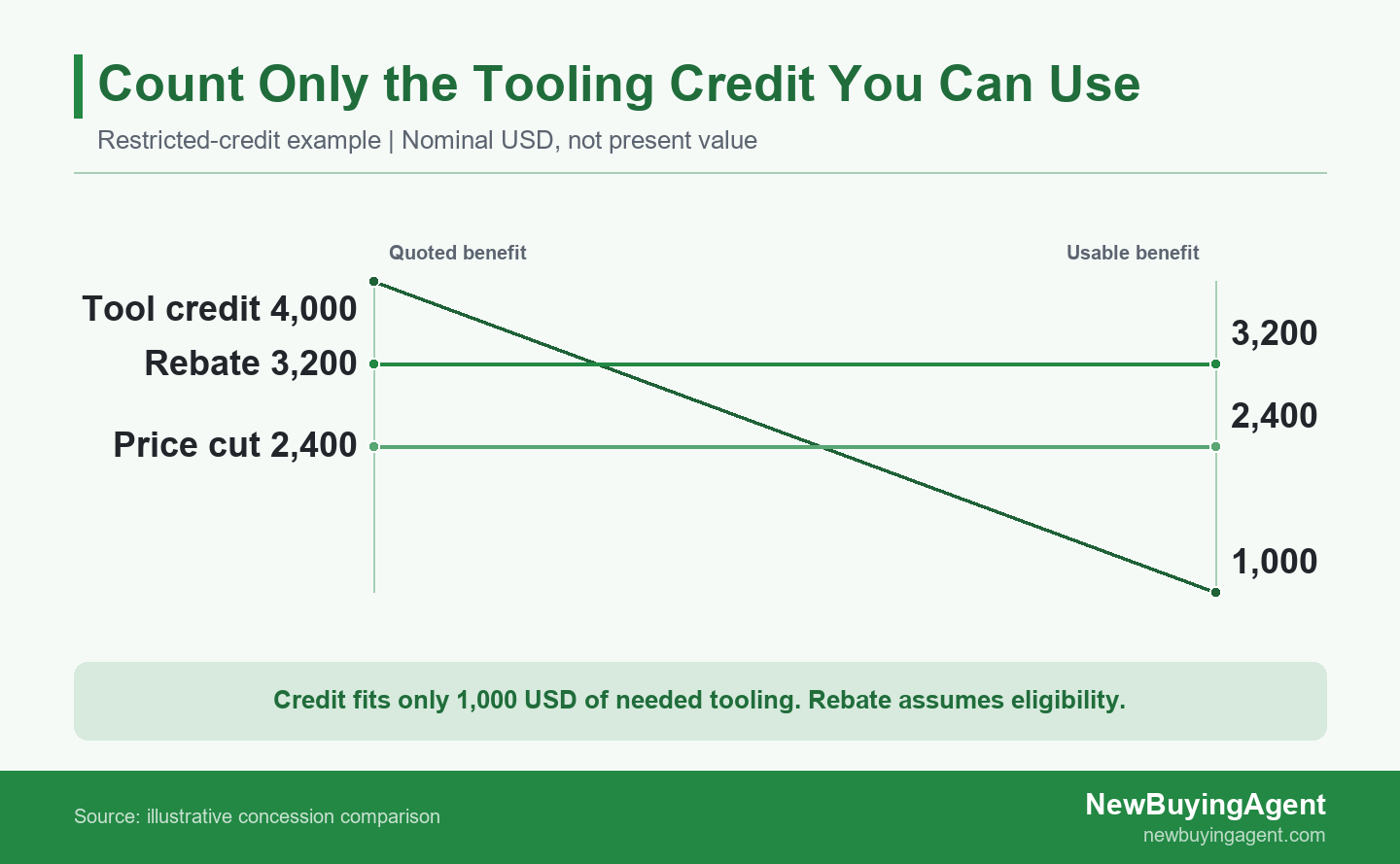
Illustrative tooling credit falls below rebate and price-cut savings after checking eligible expenditure
When Is a Tooling Credit Worth Its Face Value?
A tooling credit reduces cost only to the extent that it offsets necessary eligible tooling expenditure. A deduction from the current mold invoice can relieve a real launch expense, while an allowance for an unapproved future project may provide little immediate benefit. Before valuing either, identify the tool, the invoice it offsets, the expiry date and any purchase commitment attached to the credit.
For a simple nonrefundable allowance, a useful starting calculation is the smaller of the credit limit and the necessary eligible expenditure. Reduce that benefit further for incremental charges or obligations created by accepting it. Do not create another product variant merely to consume a credit; the extra project needs its own commercial justification.
Ask whether the quoted part price still contains tooling recovery. A supplier may reduce the separate mold invoice while recovering the same cost through each production unit. That is not necessarily an unacceptable arrangement, but both charges belong in the comparison. Request the total payable under each alternative, not two apparently independent savings.
Protolabs lists mold price, part price, mold ownership and storage as separate terms across its molding options. This manufacturer's service comparison is an example of how those terms can differ, not a universal ownership rule. In your own agreement, separate ownership, access, maintenance, storage, design-file rights and the conditions for transferring the mold to another factory. A tooling discount does not answer those questions.
For a new molded product, NewBuyingAgent's local factory resources and product-development capability support NewBuyingAgent's product-supply service: obtaining a viable product offer against the required design, materials and tooling needs. That product-level comparison matters because a cheaper tool paired with a changed part specification may no longer serve the original buying requirement.
When Is the Lower Unit Price the Safer Choice?
A lower unit price gives a repeatable saving when the product, payment terms and price validity remain unchanged. It is particularly useful when demand varies, there is no eligible tooling project, or the buyer wants the benefit reflected in each purchase rather than claimed later. The saving remains conditional on an executable quote, so check the exchange behind the reduction before treating it as certain.
Confirm the material grade, dimensions, finish, packaging, approved sample and acceptance requirements. If one quotation removes a test or substitutes a component, record it as a different offer. Similarly, specify when the lower price starts, how long it lasts, and whether a later raw-material adjustment follows an agreed formula or simply reopens the entire price.
The International Trade Administration explains that cash-in-advance requires the importer to pay the full or a significant amount before shipment. Its payment-method guidance helps identify the timing exchange if the supplier asks for earlier payment in return for the discount. Compare that proposal separately with the original payment schedule, using your own funding costs and risk assessment.
A price reduction can also bring an exclusivity obligation, a fixed annual commitment or a narrower cancellation window. Those conditions may be acceptable, but they are part of the consideration you give the supplier. The cleanest comparison keeps them unchanged; if that is impossible, show the changed obligation beside the saving instead of hiding it in a footnote.
Compare the Three Offers Against One Unchanged Order Plan
Use the same goods volume, tooling need and payment schedule to compare the three concessions with a no-concession baseline. Calculate nominal savings first, then show when each benefit reduces a payment or produces a receipt. This prevents a later rebate from appearing to fund an earlier invoice and makes clear which alternative actually reduces the launch payment for the tool.
The following figures are hypothetical, not supplier benchmarks. Assume 20,000 identical storage clips purchased during one year at 4 USD each, plus a necessary 6,000 USD mold paid for at launch. The baseline is therefore 86,000 USD. Specifications, delivery releases and other terms are identical; freight, taxes and other common costs are excluded from every row. Each concession is an alternative, not an additional benefit.
The price offer removes 0.12 USD per unit. The rebate pays 4% of the 80,000 USD goods base after year-end if 20,000 qualifying paid units are reached; assume cash arrives three months later. The tooling offer deducts 4,000 USD from the current mold invoice without a future-volume condition. Net outlay means nominal goods-plus-tool payments less the stated concession, after its settlement.
| Offer | Saving (USD) | Net outlay (USD) | Benefit timing | Main condition |
|---|---|---|---|---|
| No concession | 0 | 86,000 | None | Benchmark only |
| Lower unit price | 2,400 | 83,600 | Each payment | Unchanged scope |
| Annual rebate | 3,200 | 82,800 | After year-end | 20,000 paid units |
| Current-tool credit | 4,000 | 82,000 | Mold payment | Current mold eligible |
Based on this comparison, the current-tool credit gives the largest nominal saving and reduces the launch payment if its stated conditions hold. The annual rebate beats the unit-price reduction by 800 USD, but only after qualifying purchases and settlement. The lower unit price is preferable when that extra rebate is not sufficiently dependable or the wait is unacceptable.
The rebate row still requires 86,000 USD of goods and tooling payments before repayment; it is not an 82,800 USD funding requirement throughout the year. If only 18,000 paid units qualify, this particular all-or-nothing rebate pays nothing, whereas the unchanged unit reduction saves 2,160 USD. Do not buy unwanted units solely to protect the rebate without separately testing their cost and use.
This is not a present-value ranking. For that decision, finance should compare the actual dated cash flows for every alternative using a consistent company-approved method. Discounting only the rebate while treating all invoice savings as available at launch would introduce another unequal comparison.
Check Whether the Tooling Allowance Can Be Redeemed
An allowance for a future mold cannot be treated as a discount on the current mold unless the supplier agrees. Match the quoted allowance to the exact approved project before carrying its full value into the buying comparison. A restriction that looks administrative can change the preferred offer even when the supplier, product quantity and delivery plan remain exactly the same.
Illustrative Scenario: A Future-Tool Credit Loses Most of Its Value
Consider an importer buying the same 20,000 storage clips from China, with the current 6,000 USD mold. The team has also independently approved a 1,000 USD insert for a later necessary variant. Product requirements and releases are settled, but nobody has matched the supplier's credit annex to the tool identifiers. This is an illustrative scenario, not a NewBuyingAgent customer result.
The annex excludes the current mold: the 4,000 USD allowance applies only to future eligible tooling before expiry. The only needed eligible item is the 1,000 USD insert. A hypothetical 4,000 USD tooling allowance produces only 1,000 USD of usable savings when eligible planned tooling costs just 1,000 USD. The remaining 3,000 USD has no planned use. Because the insert is needed under every option, add its cost to every baseline; that common addition does not change the savings comparison.
With dependable rebate eligibility and cash settlement, the 3,200 USD rebate now provides more usable benefit than the restricted credit. If the rebate is too uncertain, the 2,400 USD unit-price saving also exceeds the 1,000 USD credit benefit. Procurement asks the supplier to include the current mold or remove the project restriction. If the supplier refuses, the team compares the remaining real alternatives rather than inventing another tooling project to consume the allowance.
Before approval, the buyer checks the signed annex, tool IDs, necessary invoices, expiry and eligible purchase records. For an existing Chinese factory relationship, NewBuyingAgent's factory-management service can support the product-quality and delivery side while the buyer evaluates the commercial offer. Its quality-control capability is relevant when a tool or variant changes; it does not turn this example into a promise that a rebate will be paid. Actual terms and professional advice determine contractual and accounting treatment.
Negotiate the Condition That Changes the Decision
Ask for an executable product offer with explicit concession eligibility and settlement terms. Once the comparison identifies the limiting condition, negotiate that condition rather than simply asking for a larger percentage. The useful improvement may be permission to apply credit to the current tool, a rebate threshold that fits dependable demand, or retaining the original payment schedule while reducing the unit price.
For the rebate, consider a lower threshold, graduated entitlement, more frequent settlement or a cash alternative when purchasing ends. For tooling, request a named eligible invoice, a sufficient redemption period and explicit treatment of the unused balance. For the unit-price offer, protect the approved specification and agree how any future price adjustment works. Each change should produce a revised quotation, not just an encouraging discussion.
Give finance a short comparison showing the no-concession baseline, the qualifying calculation, the dated benefit and the amount still at risk. Give the product team the specifications and tooling changes that require technical approval. These are different decisions: a commercially attractive credit should not approve an unsuitable mold, and a technically acceptable mold should not validate an uncertain credit.
Ask the supplier to confirm one normal outcome and one exception in writing. The exception might be a late invoice, a cancelled variant or the end of future purchases. Resolving that outcome before ordering is more useful than discovering after settlement that each side interpreted the allowance differently.
If the product offer itself still needs to be established, prepare the product specifications, tooling requirements, quantity, target price, destination and delivery timing, then request a product quotation from NewBuyingAgent. As a one-stop China sourcing agent, NewBuyingAgent can use those requirements to quote and supply the product; provide the competing concession terms as context so that the commercial comparison rests on the product you actually intend to buy.
FAQ
Can an annual rebate and a unit-price discount be combined?
They can be combined if the supplier explicitly agrees to both and defines the calculation order. A rebate based on the discounted goods amount differs from one based on the original price. Ask for a worked invoice and settlement example, including how returns are treated. Count the invoice reduction once, then calculate the additional rebate on its agreed base rather than adding two headline percentages automatically.
Can a rebate earned by one buying entity pay another entity’s invoice?
Do not assume the credit can move between buying entities. The named purchasing account, eligible group of accounts and permitted recipient of settlement need to be explicit. If a group consolidates purchases across subsidiaries, confirm both threshold aggregation and cross-entity offset separately. Finance and the supplier should approve the documentation and applicable treatment before one entity deducts another entity's credit from a payment.
Does a tooling credit automatically lower customs value?
No; a tooling credit does not by itself establish the correct customs value. The WTO Customs Valuation Agreement includes appropriately apportioned buyer-supplied molds provided free or at reduced cost for export production when their value is not already included. See Article 8's conditions. Give the destination customs adviser the tooling agreement, invoices and concession details rather than assuming the credit determines the declaration.
Should a performance-related credit replace defect remedies?
A performance credit should not silently replace the remedies needed for defective goods. Specify whether it is an additional incentive or an agreed remedy for a particular failure, and review that choice with appropriate advisers. Product acceptance, rework, replacement, shipment responsibility and unresolved claims still need clear treatment. Otherwise, a modest commercial credit may be offered against a problem that requires an operational solution.
NewBuyingAgent
Related Resources
Get Started Today
Let's Turn Your Sourcing Goals into RealityWeChat:+86 15157124615
WhatsApp:+86 15157124615
Address:Building 10 #39 Xiangyuan Road, Hangzhou, China
