

After the factory audit, convert each material finding into an agreed order requirement, a responsible owner, a due date, evidence of compliance and a clear condition for proceeding. Attaching the audit report to a purchase order leaves too much unresolved: the supplier may promise improvement while your purchasing team assumes production has been approved. The useful question is what must change before this particular order can move forward.
A contract control is an agreed order requirement or decision condition identifying what must be demonstrated, by whom and when, before a defined purchasing action. A hold point is the stage that cannot proceed until its agreed condition is satisfied and the authorized person approves it.
A finding about an unapproved finishing subcontractor, for example, should lead to an identified production route, permission rules for changes and product checks tied to that route. A photograph of a reorganized workshop cannot establish that the coating on your goods meets the specification. A shared control map gives purchasing, supplier quality and commercial teams a way to resolve those differences before production begins.
Make Audit Findings Change the Order Decision
An audit finding changes order risk only when the buyer and supplier agree what must be demonstrated, who is responsible and which purchasing action depends on the result. Closing a report does not automatically approve an order: the evidence may concern a management process rather than the product you will receive. Build the follow-up around the next real decision, such as qualification, bulk production or shipment.
- Specify the requirement: replace “improve quality” with the applicable product revision, process condition or traceability record.
- Assign separate responsibilities: distinguish the supplier's action owner from the verifier and the person authorized to approve the next stage.
- Match evidence to risk: use records, physical checks or appropriate testing that address the observed gap.
- Keep commercial triggers explicit: agree acceptance and payment conditions with proper legal review rather than assuming an audit result creates a remedy.
Start with the Requirement Behind the Finding
Start by linking the observed gap to a product-specific requirement and the decision it affects. Then identify the responsible owner, date, evidence and any change approval needed before the buyer proceeds. This prevents a vague audit observation from becoming an equally vague supplier promise, while keeping the response proportionate: a packing-document discrepancy and an unqualified safety-critical process should not receive the same follow-up.
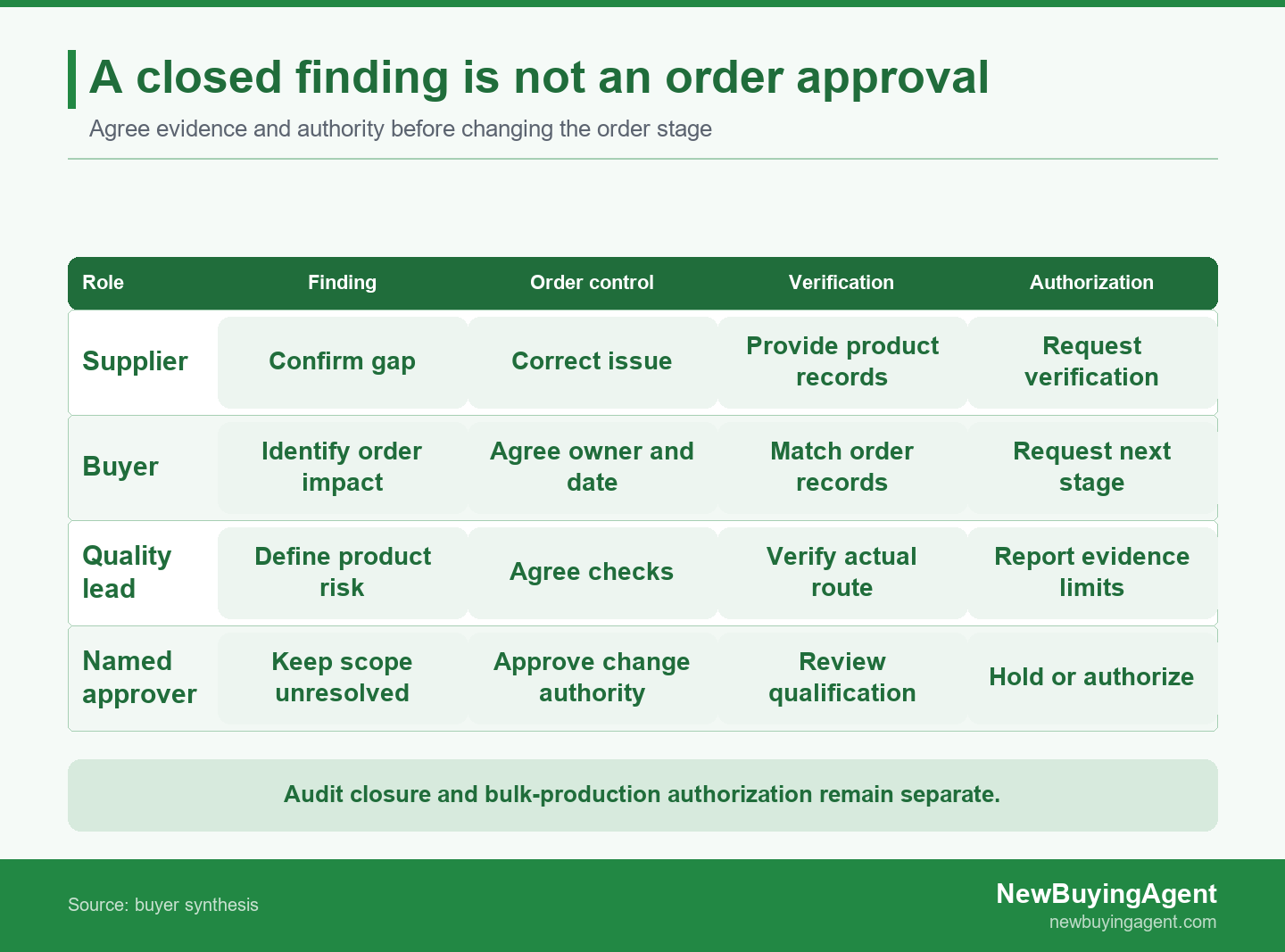
Separate audit findings, order controls, product verification and the authority to proceed.
The ISO Auditing Practices Group's guidance on documenting nonconformity describes a well-documented nonconformity through its supporting evidence, the applicable requirement and the statement of the gap. This is educational audit guidance, not a contract standard. For the buyer, its practical value is a better starting question: which requirement was actually missed, and what evidence establishes that failure?
Review the finding with the supplier before drafting the response. Record the location, process, product or records observed, and distinguish a confirmed failure from information that is still missing. If the audit says inspection records were unavailable, establish whether the checks were omitted, poorly recorded or simply not accessible during the visit. Each explanation calls for a different action; inventing the cause can send the follow-up in the wrong direction.
Also separate correction from corrective action. Correction addresses the current problem, such as isolating goods made through an unapproved process; corrective action addresses why it happened and how recurrence will be prevented. A rewritten procedure may support the latter without resolving the affected goods. For broader preparation before placing an order, read the China sourcing guide for additional sourcing context; the control map below addresses the specific post-audit handover.
Build a Finding-to-Contract Control Map
Use a control map to translate material findings into agreed specifications or attachments, responsible owners and dates, required evidence and authorization triggers. Reference the exact documents the parties intend to use, including their revisions, instead of copying the audit's wording into a general undertaking. The map is a procurement working tool: it helps the teams prepare complete instructions and identify terms that need negotiation or legal drafting.
The following entries are illustrative. They show the information to agree, rather than ready-to-sign clauses or universal technical limits. Replace role names with actual contacts and replace event-based deadlines with agreed dates wherever practical.
| Audit finding | Requirement to agree | Owner and deadline | Evidence to verify | Authorization trigger |
|---|---|---|---|---|
| Coating subcontractor undisclosed | Approved finisher, route and coating specification | Supplier quality owner; before qualification approval | Route identification and appropriate product-linked checks | Buyer quality approval before bulk authorization |
| Production lots cannot be traced | Lot identification through processing and packing | Production owner; before affected production starts | Trace a selected lot through agreed records | Verifier confirms traceability before affected stage proceeds |
| Critical measurement lacks reliable instrument records | Suitable equipment and measurement method | Supplier quality owner; before product verification | Instrument status and affected measurements reviewed | Quality authority accepts measurement evidence |
| Obsolete packing instruction at the line | Controlled current packing specification | Packing supervisor; before packing starts | Revision distribution and actual packed-product check | Authorized approver permits packing after confirmation |
For each row, name the supplier's action owner, the buyer's technical verifier and the commercial approver. These can be different people. The verifier assesses the evidence; the approver decides whether the defined stage may proceed. The purchasing owner makes sure the agreed condition reaches the contract documents, production instructions and order schedule, and tracks the response when a due date is missed.
The UK's contract-management principles emphasize clear ownership, governance and strong mechanisms for controlling changes. They concern public procurement, not private China purchase contracts. The transferable management lesson is to make the handover explicit: a sourcing team should not assume an operations team knows which unresolved findings still constrain the order.
When audit findings make the proposed supply route unsuitable, buyers also need a product supply option that meets their requirements. NewBuyingAgent is a one-stop China sourcing agent service provider for global buyers. Its product supply from China connects purchasing needs with local China factory resources and product development and quality-control capability. Carry the critical process constraints into that discussion so a better-priced offer is evaluated against the product and route you actually need.
Control Subcontracting and Process Changes Before They Happen
Identify the approved production and finishing route, including external providers, and agree who must authorize changes before they are implemented. A change request should explain the proposed provider, material or process, the affected products and the evidence needed for approval. Approval of the original factory should not silently become permission to move an important operation elsewhere, particularly when the original qualification depended on that operation.
The Auditing Practices Group's guidance on external providers considers whether purchasing requirements are correct before communication and whether outsourced processes are monitored effectively. It is educational management-system guidance. A buyer can use that distinction to ask both who performs the operation and how the supplier checks the output, without treating outsourcing itself as proof of poor quality.
Agree the scope of changes that require notice or approval. Relevant examples may include the finishing provider, material grade, tooling, inspection method or production site. Specify which proposed changes require new samples, records or testing, who bears the agreed verification costs and how a revised delivery date will be confirmed. Avoid an unworkable blanket restriction on every minor operational adjustment.
If the supplier needs an urgent substitution, require a defined request rather than accepting a retrospective explanation after goods are made. The approver can authorize a limited trial, request further evidence or decline the change. Record the affected order and revision so the decision does not accidentally extend to future products or unrelated production.
Verify the Product and the Corrective Action Separately
Qualification evidence must identify the product, actual production or coating route and agreed specification revision. If verification is incomplete, a separately authorized limited qualification batch may help generate that evidence, but it is not permission for bulk production. Define the permitted scope and segregation before the trial starts, so engineering work cannot be mistaken for approval to make the full commercial order.
Match the Evidence to the Product and Lot
A supplier-selection article hosted by NIST recommends reviewing production and inspection documentation, how rejects are handled and whether the supplier can identify the relevant production group. Applied to a post-audit control, this means asking for evidence linked to the affected product and lot. A generic certificate or a photograph of new equipment may say little about which goods were checked or what was found.
Specify the method and acceptance criteria with the technical team: what will be examined, which product or lot is covered, who performs the check and who reviews the result. For coating, appropriate adhesion or corrosion checks depend on the agreed finish, intended use and applicable specification. Do not insert an arbitrary duration, sample count or pass threshold simply to make the contract look precise.
Confirm the Correction and Prevention of Recurrence
For audit closure, the APG guidance on reviewing and closing nonconformities calls for review of correction, cause analysis and corrective action, with objective evidence that the action was implemented and effective. Depending on the finding, that review may involve documentary evidence or an on-site examination. It addresses the audit response; the buyer must still establish whether the relevant order requirements have been met.
For buyers keeping existing China suppliers, NewBuyingAgent's management of existing China factories supports production progress, product quality and logistics coordination. Its published service description includes inspections at different production stages and buyer instructions on how to handle defects. This gives buyers a China-side execution route for product follow-up, while the buyer's designated authority still makes the commercial acceptance decision.
Example: An Unqualified Coating Route for Drawer Handles
Consider an illustrative importer order for 6,000 units of metal drawer handles with an agreed coating specification. The audit identifies an undisclosed outsourced coating route and missing product-linked qualification evidence for the actual finisher and revision. Pending verification, there is no bulk authorization for this order. Only a separately authorized, segregated limited qualification batch may proceed; bulk production requires approval after the route and appropriate product-linked adhesion and corrosion checks against the agreed specification are verified.
The buyer cannot conclude that all handles will be defective; the gap is that the proposed route has not been demonstrated to meet the requirement. Purchasing therefore keeps the 6,000-unit bulk authorization on hold. The technical team may separately authorize only a defined, segregated limited qualification batch to obtain appropriate product-linked adhesion and corrosion evidence against the agreed specification.
The supplier identifies the finisher, confirms the controlled coating instructions and puts a change-approval process in place. The buyer's quality authority reviews the route and qualification results before recommending bulk release, and the designated approver records the decision. Until that verification is satisfactory, the trial remains a limited trial. This example demonstrates staged authorization, not an actual client case, a prescribed test method or approval of the whole order.
Keep Inspection, Acceptance and Payment Triggers Distinct
Separate an inspection result from contractual acceptance, payment and remedies, and agree the responsible decision and trigger for each. A failed check identifies a problem; it does not by itself establish a right to deduct payment, cancel the contract or recover every cost. The commercial team needs terms that explain how evidence, notices, rectification and the next purchasing action interact in the actual transaction.
Record whether the proposed checkpoint concerns qualification, permission to start production, shipment authorization or acceptance of delivered goods. These occur at different stages and may depend on different evidence. For payment milestones, identify the agreed amount or stage, supporting documents and decision procedure. Check that the terms do not contradict the purchase order, supplier quotation or other incorporated documents.
The UN Convention on Contracts for the International Sale of Goods (CISG) generally excludes contract validity in Article 4. Article 6 permits exclusion or variation of its provisions subject to its conditions; Article 35 addresses contractual conformity, while Articles 38 and 39 address examination and notice. Applicability, reservations and the actual effects on remedies or payment require qualified legal advice. These distinctions explain why an inspection checklist cannot settle the legal effect of a proposed payment condition.
Qualified counsel should confirm the governing law, whether the CISG applies, relevant exclusions or reservations, document hierarchy and the enforceability of notice, remedy and payment provisions. Give counsel the actual contract documents and proposed control map. This is especially important when the buyer wants withholding rights, replacement obligations, reimbursement of testing costs or cancellation triggers.
Operationally, agree who receives a failure notice, what evidence accompanies it and how the supplier's response is escalated. Define how rectified goods will be rechecked and who can approve a concession, meaning permission to accept a specific departure from the agreed requirement. Record its product and order scope; an exception for one lot should not casually become the next order's specification.
Prepare the Supply Decision with the Audit Constraints
Before the next order decision, resolve the rows that would change product conformity, production authorization or delivery readiness. Bring the supplier's proposed action, the technical verifier's evidence requirements and the commercial team's terms together in one discussion. Agree what remains open, who owns it and which stage it prevents, then place the accepted requirements into the applicable documents and schedule.
For a product quotation and supply discussion, send the purchasing requirements to NewBuyingAgent, including the product specifications, quantity, target price, destination and delivery timing. Include the critical audit findings, proposed finishing or production route and evidence conditions as purchasing constraints. Its local factory network and product/QC capability can support the discussion about supplying suitable products from China; legal drafting and approval of contractual remedies belong with qualified counsel.
Frequently Asked Questions
Can the buyer rely on an auditor closing the finding?
Audit closure does not automatically authorize the order; check the agreed product evidence and named approval decision. Ask what the closure actually covered: a revised procedure, its implementation or verified product results. Where the auditor's evidence also satisfies an order condition, the designated buyer can use it rather than repeat the same work. Record that assessment and approval against the applicable product and revision.
What if the supplier signs a general promise to improve?
A general promise leaves the operative requirement unclear; agree product scope, evidence, dates and authorization conditions in the applicable documents. Ask the supplier to explain how it will demonstrate completion and which goods are affected. If its proposed date falls after the planned production start, resolve that conflict before authorizing the stage. A signature should not conceal an unresolved requirement or an impossible schedule.
Can the buyer simply deduct payment after a failed check?
Do not assume an inspection finding creates a right to deduct payment; ask qualified counsel to confirm the contract, applicable law and notice requirements. Keep the evidence and use the agreed escalation process while obtaining advice. An agreed future payment milestone is also different from unilaterally reducing an amount already due. The appropriate action depends on the transaction's terms and legal position.
What if the proposed subcontractor changes after qualification?
Treat a changed finishing route as a new approval question and apply the agreed change-control and requalification process before proceeding. Determine which earlier evidence still applies and which relied on the original provider. Ask for the affected order scope, proposed verification and schedule impact. Where a limited trial is authorized, identify it separately; it should not expand the permission previously given for a different route.
NewBuyingAgent
Related Resources


Get Started Today
Let's Turn Your Sourcing Goals into RealityWeChat:+86 15157124615
WhatsApp:+86 15157124615
Address:Building 10 #39 Xiangyuan Road, Hangzhou, China
