

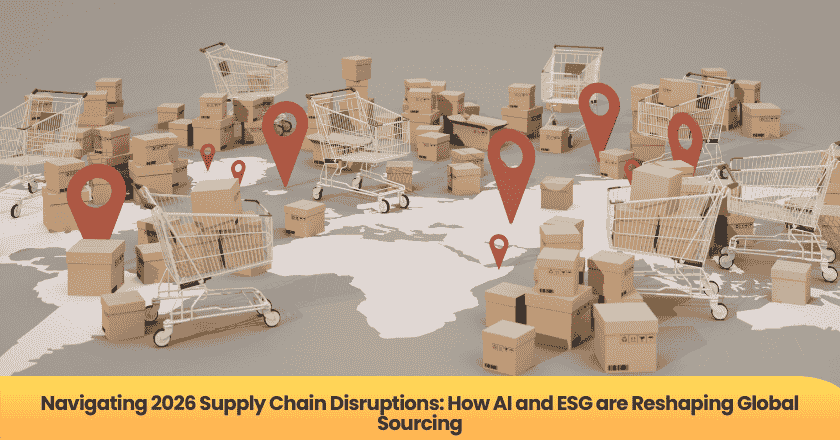
This strategic guide outlines the essential methodologies for managing high-complexity supply chains in the 2026 trade landscape. As procurement shifts from a cost-driven function to a pillar of corporate resilience, businesses must adapt to a world where logistics, environmental compliance, and geopolitical agility dictate market success.
The 2026 Sourcing Paradigm—Beyond Basic Negotiation
In 2026, the traditional approach of simply finding a factory and placing an order is no longer viable. The modern landscape is defined by the convergence of complexity, regulatory compliance, and carbon transparency. Western brands now face intense pressure from the EU Corporate Sustainability Due Diligence Directive (CSDDD) and expanded Carbon Border Adjustment Mechanism (CBAM) requirements.
Total Landed Cost (TLC) Analysis
Procurement teams now calculate product costs by factoring in variables specific to 2026, such as Digital Product Passport (DPP) implementation and real-time carbon taxes on shipping. A successful strategy ensures that a low unit price at a secondary manufacturing hub does not result in a net loss due to infrastructure delays or tariff reclassifications.
Predictive Risk Management
The focus has moved from reacting to disruptions to anticipating them through Tier-N supply chain monitoring. Identifying the source of raw bauxite for aluminum components is now just as critical as vetting the final assembly site.
Value Engineering and Innovation
Leading brands engage in co-creation with manufacturing partners. Rather than delivering finished designs, they work with factory engineers to optimize material usage and reduce assembly time. This bridges the gap between Western design expectations and Eastern production capabilities.
Risk Alert
Relying on a supplier's self-reported environmental certificates is a significant liability. In 2026, many facilities attempt to mask operational inefficiencies with offset credits. Without physical, on-site audits of energy and waste, brands remain legally responsible for inaccuracies under global transparency laws.
Advanced Manufacturing Models
Choosing between OEM, ODM, and JDM models is a foundational decision that impacts intellectual property (IP) control and research and development (R&D) overhead.
| Model | Ideal Use Case | Strategic Advantage |
|---|---|---|
| OEM | Established brands with full technical drawings. | Total control over specifications and BOM. |
| ODM | Rapid market entry with existing designs. | Low R&D cost and faster time-to-market. |
| JDM | High-tech hardware and AI-integrated devices. | Shared development risk and optimized engineering. |
JDM (Joint Design Manufacturing)
This is the fastest-growing model in 2026. Buyers and factory R&D departments co-develop products from the ground up. This approach reduces the time-to-market while ensuring that the product is engineered specifically for the factory's unique machinery.
A 7-Step Framework for Intelligent Sourcing
The 2026 workflow is a continuous loop of verification rather than a linear path.
- Market Mapping. Analyze the current capacity of specific manufacturing clusters. For high-precision sensors, this involves comparing lead times in Shenzhen against those in Penang.
- Multi-Tier Vetting. Beyond digital badges, vetting must include financial health checks, export history audits, and social credit reviews in the host country to ensure long-term stability.
- Open-Book Costing. Request detailed breakdowns including raw materials, labor, overhead, and scrap rates. Negotiation should be based on raw material market data rather than arbitrary targets.
- DFM Analysis. Before mass production, use Design for Manufacturing (DFM) analysis to identify assembly bottlenecks. In 2026, 3D metal printing is standard for rapid tooling validation.
- Digital Quality Protocols. Prioritize In-Process Quality Control (IPQC). Data-logging devices on the line monitor temperature and pressure in real-time, allowing for production halts before defects multiply.
- ESG Documentation. Compile full compliance packages including REACH/RoHS reports and carbon footprint data. This information must be formatted for immediate upload to Digital Product Passports.
- Buffer Management. Move goods through volatile networks using multi-modal logistics like sea-air routes. Setting up regional buffer hubs near target markets mitigates sudden geopolitical shifts.
Integrating Agentic AI into Procurement
The shift from basic AI to autonomous Agentic AI has fundamentally changed sourcing speed and accuracy.
- Autonomous Negotiation. AI agents handle initial price negotiations for non-critical components by utilizing historical data and target price parameters.
- Sentiment and Risk Monitoring. AI tools scan local news, social media, and satellite weather data in manufacturing zones to suggest rerouting before a local strike or flood impacts a shipment.
- Document Verification. Automated systems now verify thousands of pages of lab reports for inconsistencies or signs of forgery, a task previously requiring hundreds of man-hours.
Navigating Global Green Regulations
Environmental and Social Governance (ESG) is now a hard legal requirement. The EU CSDDD mandates that companies are legally responsible for human rights and environmental impacts throughout their entire supply chain.
Carbon Transparency
Every product must carry a carbon birth certificate. Tracking the energy mix of a factory—such as its reliance on coal versus on-site solar—is necessary to calculate Scope 3 emissions accurately.
Circular Sourcing
There is a growing demand for closed-loop materials. This involves identifying suppliers capable of incorporating certified recycled ocean plastics or taking back post-industrial waste to meet the demands of the 2026 eco-conscious consumer.
Protecting Intellectual Property and Capital
In an era of high digital transparency, IP is increasingly vulnerable. Successful firms utilize a three-pronged protection strategy.
- Local Registration. Ensure trademarks and design patents are registered in the country of manufacture.
- Split-Manufacturing. Source core proprietary components from one supplier and the housing from another, with final assembly handled by a third-party partner.
- Financial Escrow. Use secure payment gateways where funds are released only after a third-party inspection report is approved. This eliminates the risk of paying for substandard goods.
Logistics Agility—The Just-in-Case Model
The old just-in-time model has been replaced by a focus on agility.
- Near-Shoring Hubs
Many companies now use a hybrid model—80% of production in Asia for cost efficiency and 20% in regions like Mexico or Central America for rapid replenishment.
- Smart Containers
Real-time visibility is achieved through satellite-enabled IoT sensors. These provide the exact location, temperature, and tilt of a container, allowing for immediate adjustments to marketing and sales plans if delays occur.
Frequently Asked Questions
Is China still the primary sourcing hub in 2026?
China remains the most advanced ecosystem for complex electronics and machinery. However, for labor-intensive goods, Southeast Asia and Mexico have become more competitive. The choice depends on the balance of tariffs, logistics, and total landed cost.
How are the 2026 Carbon Taxes (CBAM) managed?
A detailed embedded emissions report is required for every shipment. This data is collected at the factory level and verified by auditors to avoid the heavy penalties associated with under-reporting a supply chain’s carbon footprint.
What is the typical lead time for a new launch?
A standard electronic product typically requires 12 to 16 weeks from final design to warehouse arrival. This includes prototyping, mass production, and sea freight. Utilizing AI-accelerated loops can often reduce this by 15% to 20%.
How is quality fade prevented over multiple orders?
Quality fade is prevented through randomized batch testing. Rather than only inspecting the first order, unannounced spot checks should be performed on subsequent runs, with samples sent to independent labs for material verification.
NewBuyingAgent
Related Resources
Get Started Today
Let's Turn Your Sourcing Goals into RealityWeChat:+86 15157124615
WhatsApp:+86 15157124615
Address:Building 10 #39 Xiangyuan Road, Hangzhou, China
