

Stop chasing a trend when a fresh order can no longer earn its place in the remaining demand window, or when the evidence supporting that demand has weakened enough to make another commitment unjustified. A fall in search interest should trigger investigation; it cannot decide the purchase alone. Buyers also need a separate recovery plan for stock already owned and obligations that cannot simply be canceled.
Stop the Next Commitment Before It Becomes Excess Stock
Further trend exposure is unjustified when verified demand cannot support another useful receipt or the next commitment fails the forward economics; owned-stock recovery remains a separate decision. For merchandising and category directors, an inventory exit starts by stopping avoidable exposure. Check whether comparable, in-stock sales still support the forecast; whether another receipt can serve those customers; and whether the additional cash required has a defensible return. Then choose what to do with existing stock using realistic net recovery, selling time and channel constraints.
The practical choices are different: pause a new release while evidence is missing, stop further buying when the opportunity fails, or approve a smaller commitment if revised conditions work. None automatically means destroying usable stock, canceling a firm order or discounting every variant. Give each choice an owner and a date for the next decision.
- Best for: Buyers deciding whether to release a repeat order or recover remaining trend inventory.
- Risk: Search attention, purchase demand and cancellation rights are different kinds of evidence.
- Decision: Stop avoidable new exposure, then select a recovery route for existing obligations and stock.
Verify the Exit Signal Before Acting on It
An actionable exit signal concerns a defined product variant, destination market and sales channel. A declining category headline may hide a strong core color, while aggregate sales can hide a failing novelty design. Compare periods with similar availability, pricing and promotional support. Record units sold, units returned, stock availability and the next expected receipt alongside the attention metrics that first attracted the team.
A signal becomes useful when it changes the next action. Declining purchases across comparable in-stock periods challenge the demand assumption. A later usable receipt challenges the replenishment opportunity. Rising promotional dependence challenges the expected price. Unresolved quality problems challenge whether any units should be released for sale. Investigate the mechanism rather than treating all four as one general warning about popularity.
Search interest is an early clue about attention, not a count of orders. Google Trends explains that its values are normalized relative to the selected time and geography. A falling index can justify a fresh commercial review, but it does not establish the number of customers available for a particular SKU. Match the market and period before using it beside your purchase data.
Shopify's inventory reports define days of inventory remaining as ending inventory divided by average daily units sold during the period. That historical-rate measure is useful for spotting a mismatch between stock and recent sales, but it cannot prove that trend demand will persist. A rapidly fading launch can make yesterday's average an optimistic basis for the next order.
Sales recorded during a stockout cannot reveal how many units customers would have purchased if stock had been available. Before reducing the forecast, check whether the product was actually purchasable: the relevant size, delivery region and listing must have been available. A line with missing stock needs an availability diagnosis; a fully available line with weakening purchases needs a demand diagnosis.
The matrix compares five exit signals for the same named variant, market and purchase decision. Each signal is assessed by the evidence to check, the immediate purchasing action and the evidence needed to reopen release.
| Observed signal | Check before deciding | Purchase action | Evidence to reopen release |
|---|---|---|---|
| Purchases fall | Comparable in-stock periods, traffic and returns | Pause optional release; revise demand | Revised demand supports quantity |
| Interest falls | Actual purchases for this variant and market | Investigate before changing stock route | Variant purchases support demand |
| Promotion drives sales | Net receipts and future campaign costs | Reprice the next commitment | Confirmed net-price and cost case |
| Receipt moves later | Saleable date and remaining demand | Stop or rescope the repeat | Confirmed useful saleable date |
| Quality issue appears | Release status and required checks | Hold affected stock for resolution | Written release for affected goods |
Based on this comparison, falling attention and a failed quality release need different checks and reopening evidence; neither signal alone authorizes liquidation. Use this matrix at each planned purchase release. For every warning, write down the observation, the missing check and who can resolve it. Set the next review before the last point at which a release can still be changed. There is no universal percentage decline that turns all trend products into exit candidates; the economically useful threshold depends on the order and the remaining selling opportunity.
A pause is particularly useful when evidence is incomplete but a decision is still reversible. Specify the quantity that remains unapproved and the evidence needed to reopen it. If the commercial deadline will pass before that evidence can arrive, record the missed opportunity as part of the decision. An indefinite pause with continuing material purchases is still a growing commitment.
Compare availability, traffic, price, promotion, returns and purchases at variant level before concluding that demand has declined. Use a search-interest drop as a review trigger rather than an automatic liquidation instruction. Name the evidence that would change the decision, whether that is a restored listing, a confirmed buyer or another comparable selling period.
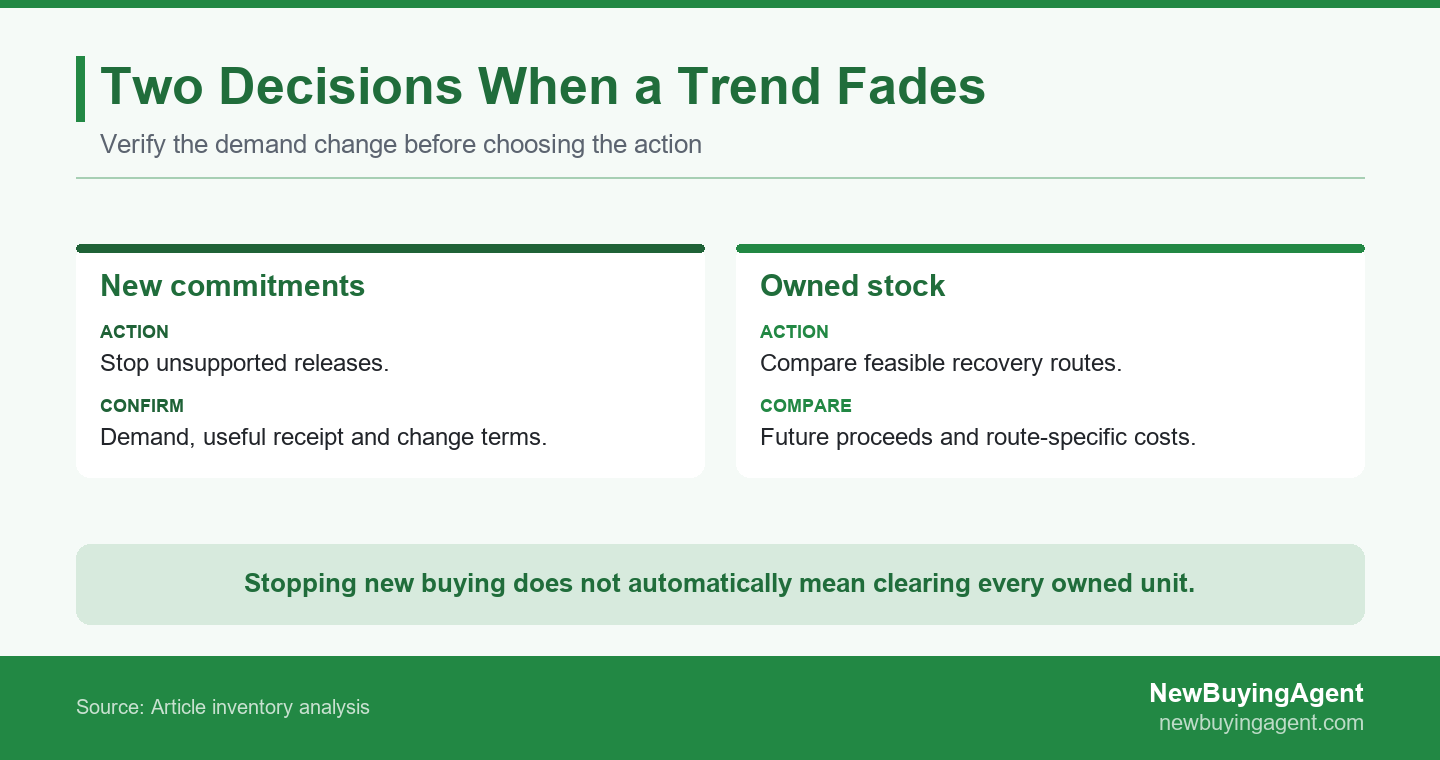
Stop unsupported new commitments, then compare feasible recovery routes for owned stock using future proceeds and costs
Close the Reorder Window When New Stock Cannot Earn Its Place
The new-order timing test runs through the date stock becomes saleable. Maersk's transit-time guidance distinguishes the ocean leg from the complete delivery journey; production, consolidation, clearance and warehouse readiness also matter. Work backward from the buyer's useful receipt date using confirmed assumptions. A vessel arriving before an event does not prove that compliant, sellable units will reach the intended channel in time.
If receipt misses that window, stop the proposed order on its present assumptions. Reconsider only a concrete change: a smaller available quantity, a confirmed earlier receipt, a supported year-round customer base or a different approved market. An attractive FOB price cannot repair the absence of usable demand. Include any extra delivery expense when testing the revised option.
Reorder only against supported demand remaining after the confirmed date stock becomes saleable. Subtract projected available stock at that receipt date after waiting-period consumption and existing allocations, including timely confirmed inbound units only once. Available physical stock has a lower limit of zero; add any still-unfilled pre-receipt backlog only if it is not already included in post-receipt demand. Keep damaged or unreleased goods separate, and treat a negative net replenishment result as no new quantity required. A plausible demand forecast can still justify no additional purchase when the existing pipeline already covers it.
When demand is unclear, NewBuyingAgent's market-fit product analysis can provide context for the next assortment decision. Its Trending Products service offers a free Bestseller Market Analysis Report and design or style optimization. Use that input alongside your own channel sales, stock exposure and remaining selling window. A market report cannot by itself establish a cancellation right or guarantee that existing stock will sell.
Choose the Best Remaining Use for Stock You Already Own
The next order and the existing inventory answer different economic questions. Money already spent and unrecoverable does not become a reason to spend more. OpenStax's relevant-cost analysis focuses on future amounts that differ between choices. Use that distinction to compare a new purchase, a change to production and a recovery plan without pretending the original inventory investment disappears from business reporting.
Split exposure into three groups. First, identify unapproved purchases and optional repeat quantities that can still be stopped. Second, list open commitments, including dedicated packaging, materials, work in progress and finished goods, with their actual change or cancellation terms. Third, count stock already owned and available for disposition. An approved deposit is not evidence that every remaining payment or production step is unavoidable.
Ask the China-side contact for the current production status and written options, including costs and dates. A request to stop buying is an internal instruction until the other party confirms any agreed change to its commitments. Keep purchase approval, production change, quality release and shipment release distinct. The category manager should not authorize a broad stop that accidentally removes the resources needed to protect or lawfully handle existing goods.
Build a small worksheet with separate rows for each available route. Use the same stock quantity and decision date, then estimate net cash collected, future fulfillment costs, storage or campaign spending and the timing of recovery. Include returns and any selling restrictions in the assumptions. A quoted clearance price without a credible buyer or channel is an unconfirmed option, not guaranteed recovery.
Keep the commercial recovery decision separate from financial reporting. IAS 2 measures inventories at the lower of cost and net realisable value, with net realisable value based on estimated ordinary-course selling price less estimated completion and selling costs. Finance should assess the applicable reporting requirements; a buyer's comparison of future cash routes does not by itself determine an accounting entry.
Use one decision date and one horizon for the stock being compared. Include residual units at the end of the horizon, the cost of freeing warehouse space and any material difference in the timing of receipts. If a channel transfer competes with profitable regular sales, include that lost contribution where relevant. Do not silently treat an unknown recovery value as confirmed cash.
Run the Exit Decision With the Same Inventory and Time Horizon
The preferred recovery route produces the strongest supported future net cash from the same owned inventory over the same period, subject to assumptions that could reverse the choice. The following hypothetical comparison uses 600 saleable units, a 30-day horizon and complete future route costs. It keeps a late repeat-order decision separate from the recovery decision, so stopping fresh supply does not predetermine how the existing stock is sold.
In the hypothetical example, 600 saleable owned units face 300 supported sales before the demand window closes; a 400-unit repeat arrives after that window and is stopped subject to confirmed cancellation terms.
In the hypothetical 30-day comparison, holding returns USD 2100 from 300 sales at USD 10 less USD 900 future costs, clearing all 600 returns USD 2700 at USD 6 less USD 900 costs, and a confirmed lot offer returns USD 2400 less USD 200 costs or USD 2200; the hold route includes zero net recovery from the residual 300 units as an explicit assumption.
| Route for 600 units | Assumed receipts | Future costs | Net recovery |
|---|---|---|---|
| Hold for 30 days | 300 × $10 = $3,000 | $900 | $2,100 |
| Clear within 30 days | 600 × $6 = $3,600 | $900 | $2,700 |
| Confirmed lot sale | $2,400 | $200 | $2,200 |
Based on this comparison, clearance recovers $500 more than the confirmed lot offer and $600 more than holding. The clearance result depends on selling all 600 at the assumed price and cost. It is not enough to schedule a promotion; the buyer needs a credible channel and enough demand to support its receipts. The lot offer provides a different degree of certainty that the decision maker should consider alongside expected recovery.
At $3,600 clearance receipts, total future clearance costs of $1,400 leave $2,200, equal to the lot offer. Clearance leads only below that cost threshold on these assumptions; above it, the lot offer leads. If sellout becomes doubtful, revise the quantities, receipts and residual recovery before comparing again. A spreadsheet cell marked unknown is a request for evidence, not permission to assume full sellout.
The hold route's zero terminal recovery is an explicit conservative assumption for the remaining 300 units, not a prediction that they are worthless. A credible later buyer or reusable product components could change it. Obtain that evidence before adding value to the model. All figures here are illustrative management analysis, not market benchmarks, an observed client result or an inventory valuation opinion.
Record what actually happens after authorization: quantity sold, refunds, route costs and recovery date. A campaign can move units while producing less cash than expected. Keep replacement purchases outside the exit route unless separately justified; otherwise a shrinking warehouse count can conceal a new production obligation. This makes the exit result useful for the next product-selection decision.
Turn the Exit Decision Into a China-Side Instruction
A practical exit has several possible routes: continue selling selected variants, reduce price, transfer to a permitted channel, negotiate an agreed production change or use an appropriate recovery route. Evaluate each against the actual condition of the goods and the receiving channel. A saleable product with slowing demand is different from a product with a safety or conformity problem; commercial clearance cannot resolve those problems.
For the United States, CPSC resale guidance states that recalled products cannot lawfully be offered for sale. Ordinary clearance is not a remedy for a recall. Separate restricted, recalled or potentially unsafe goods from the commercial exit pool, and determine the applicable handling route for the product and destination before a sale or transfer.
Use a short authorization sheet to make the decision executable. Record the SKU and version, quantities on hand and in progress, approved route, minimum acceptable net recovery, spending limit and the date after which the decision expires. Name the person controlling listings and promotions as well as the person controlling purchase releases. This prevents marketing from announcing an exit while purchasing continues with the previous forecast.
Freeze unapproved releases and obtain written status for finished goods, work in progress, dedicated materials and packaging. Confirm the remaining obligations and available alternatives, including costs and dates, with the other party. Name the buyer authorized to accept a change. An internal stop instruction does not itself amend a firm order or establish a cancellation entitlement.
| Control | Instruction to record | Owner and proof |
|---|---|---|
| Optional repeat | Hold named quantity and version | Purchasing: release status |
| Firm production | Request status and agreed change options | China-side contact: written response |
| Owned stock | Approve channel, quantity and spending cap | Category lead: route authorization |
| Quality release | Identify restricted or unresolved units | Quality lead: release or hold |
| Net recovery | Reconcile receipts, refunds and costs | Finance: actual route result |
For a paused order, the observable outcome is a hold on the named optional release, with no unapproved dedicated materials added. For an existing-stock exit, it is the authorized quantity entering the agreed channel and the actual net proceeds being reconciled. Review exceptions by variant. A strong neutral color may deserve continued sale even when a fashion print fails the next-order test.
For a replacement line or a narrower repeat plan, define what remains commercially supportable before requesting China product sourcing. NewBuyingAgent is a one-stop China sourcing agent for global buyers, using local factory resources, product development and QC capability, cost negotiation and delivery coordination to supply products against the purchasing need. The useful outcome is an appropriately scoped product offer, including the quantity, product version and timing the buyer can justify.
Send the product and specification, firm quantity, target price, destination, useful receipt date and current sourcing situation when you submit the revised product brief. Add the repeat quantities that remain conditional and any approved packaging changes. Keep the inventory exit decision with the responsible buyer; the sourcing brief should explain what can still be bought and under what conditions, so the next offer starts from the revised demand case.
Frequently Asked Questions
Is there a sell-through percentage that always means exit?
No single sell-through percentage establishes an exit decision across products, buying windows and supply conditions. A low rate early in a long selling period means something different from the same rate just before a short window closes. Check the remaining stock, useful receipt date and future economics alongside the percentage. Set a product-specific review trigger that leads to an actual purchase or recovery decision, rather than using a universal cutoff.
Should a paid deposit force the buyer to finish the order?
A paid deposit does not by itself determine whether finishing the order is the best remaining choice. Confirm the agreement, production status, remaining payments and any negotiated change or cancellation option. Compare the future consequences of those actual options, including the cost of incomplete materials or goods. Do not assume that a supplier must accept a stop request or that the entire remaining balance is avoidable.
When can a stopped trend product be reordered again?
Reorder a stopped trend product when fresh purchase evidence, feasible receipt timing and acceptable forward economics support a new commitment. Require fresh evidence for the actual variant and channel, then confirm that a new receipt can still serve the demand at acceptable economics. A return of attention alone does not restore the old purchase approval. Keep any reopened order distinct from the existing-stock recovery plan, and compare its incremental commitment with a smaller or later alternative.
Should every remaining unit be moved to a discount channel?
A discount channel should receive stock only when its demand, net recovery and product or channel requirements support that route. Review colors, sizes and product versions separately before a blanket promotion. Keep useful variants at justified selling terms where that remains the better route. Check whether a mixed offer would move weak stock only by discounting stronger units, then record the combined recovery and any restrictions before approving it.
NewBuyingAgent
Ressources associées



Commencer aujourd'hui
Transformons vos objectifs d'approvisionnement en réalitéWeChat:+86 15157124615
WhatsApp:+86 15157124615
Adresse : Bâtiment 10 #39 Xiangyuan Road, Hangzhou, Chine
