

A tool can arrive in perfect condition and still produce parts that fail the approved drawing. When a mold, die, jig or fixture moves from one Chinese factory to another, the shipment is the visible part of the job; the records, condition evidence and receiving-machine fit decide whether production can restart.
Tooling transfer between Chinese factories is the controlled handover of a mold, die, jig or fixture, together with its drawings, qualification records, maintenance history and liability, from one supplier to another. The physical asset is only one part of the package.
The buyer's decision is therefore not whether the tool can be moved, but whether the receiving factory can reproduce the qualified part, and who owns the risk while it cannot.
Transfer the Evidence, Not Just the Tool
Approve a tooling transfer only when ownership, records and receiving capability are each documented, because the real risk is not the shipment but an unqualified part entering production. The physical move is the easy part to price and the hardest part to undo.
- Confirm ownership and custody: agree in writing who owns the tool, who controls it during the move and who carries loss or damage.
- Assemble the records: send the approved drawing, 3D model, tool history and last qualification file with the asset.
- Match the receiving machine: check tonnage, platens, tie bars, ejector pattern, hot-runner control and utilities against the tool as built.
- Re-qualify before release: prove the first parts on the new machine, not on the promise of the move.
Confirm Ownership and Custody Before the Tool Moves
Establish in writing who owns the tool, who has custody during the move, and who carries loss or damage until the receiving factory accepts it. Ownership is a contractual fact, so the party holding the tool is not automatically the owner.
Start with the paper trail that proves the buyer's title: the tooling agreement or purchase order, the asset or mold number, the invoice or payment record, and proof that the outgoing supplier has been paid. Where a supplier claims an unpaid balance or a lien, that claim has to be resolved before the tool is loaded, because a dispute at the gate can strand an otherwise finished transfer. For imported tooling held under customs supervision, confirm whether the tool can be moved at all without breaching its import arrangement.
Custody is the second question. Agree the packing method, the lifting points, the transport route and the exact moment at which risk passes from the outgoing factory to the buyer or the receiving factory. Photograph the packing and record the seal number. If the tool is damaged in transit and no one recorded its condition beforehand, the loss is hard to attribute.
| Transfer gate | Evidence to hold | Risk if the evidence is missing |
|---|---|---|
| Ownership and custody | Tooling agreement, asset record, payment proof, custody and risk-transfer terms | The tool is held, refused or damaged with no agreed owner |
| Documents and records | Approved drawing and 3D revision, tool history, qualification file | The receiving factory cannot reproduce or explain the qualified part |
| Condition record | Dated photographs, measurements, packing and seal records | Transit damage and pre-existing wear cannot be separated |
| Receiving capability | Machine fit check, hot-runner and utility compatibility | The tool arrives but cannot be installed or run as built |
Read the table as a gate sequence, not a checklist to complete in any order. A missing ownership record stops the move before anything else matters, while a missing condition record can still be reconstructed at the factory if both sides cooperate. The reason is that each gate protects a different decision; the buyer's job is to know which gate is still open and to hold the release that depends on it.
For a buyer changing supplier and continuing the same product, NewBuyingAgent's local factory resources and product-development capability can connect the transfer package to the supply brief. Its product-supply service provides a route to source the product against those requirements while the tool and its records are settled.
Ownership and custody decide whether the tool can move at all. The next gate decides what the receiving factory actually knows when the tool arrives.
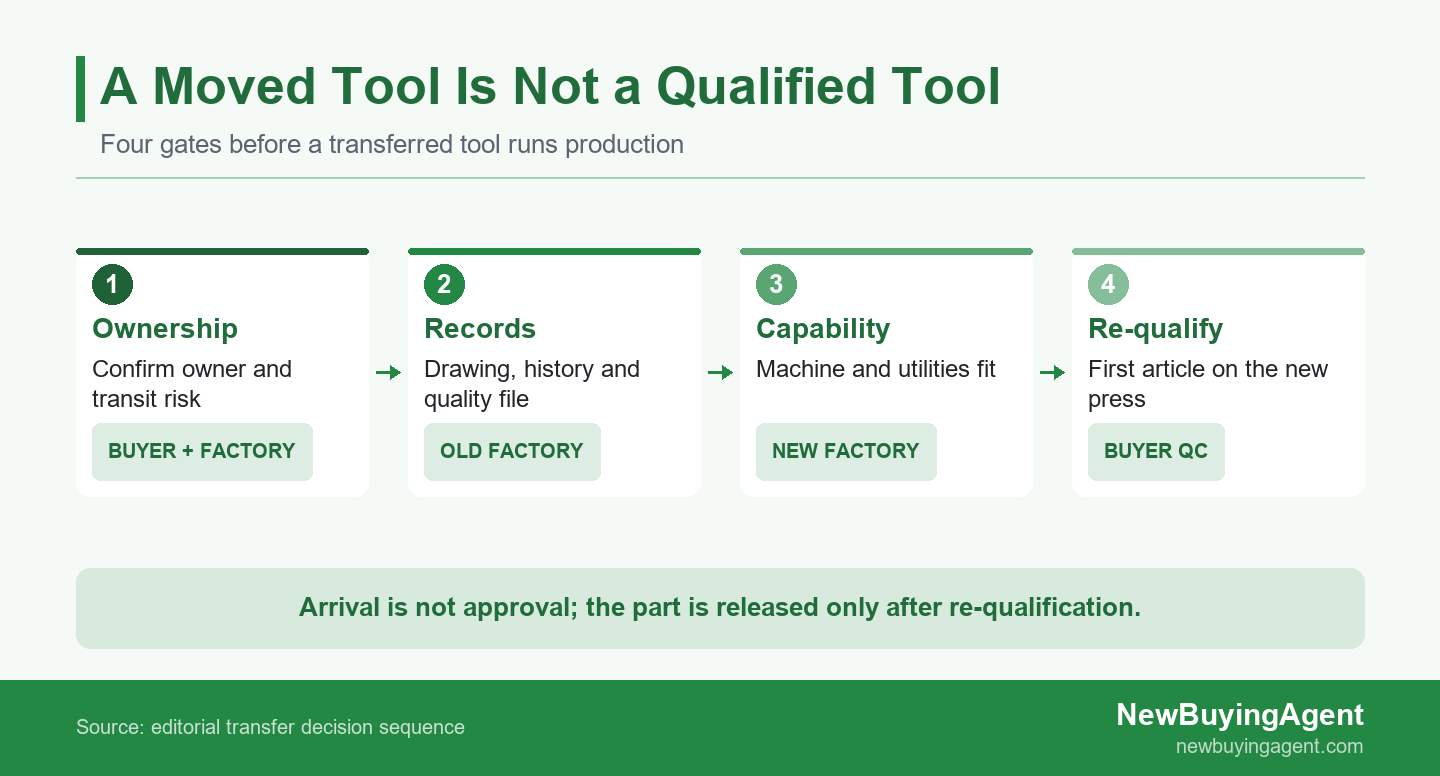
Four transfer gates linking ownership and records to receiving-factory capability and re-qualification
Build the Transfer Package Before You Negotiate the Move
Assemble drawings, history and qualification records as one transfer package, and treat an incomplete package as a reason to pause the move. A tool without its records is a used metal asset, not a qualified production system.
Match the Drawing and 3D Data to the Last Approved Revision
Hand over the exact approved drawing and 3D data revision, and confirm the receiving factory can open and use the file formats it receives. The revision that was qualified is the only revision worth transferring, even if a newer concept exists.
A neutral exchange format reduces the risk of a broken handover. NIST explains that the STEP file format, formally ISO 10303 Part 21, represents parts, assemblies and product and manufacturing information for exchange between CAD, CAM and inspection software. Sending STEP files alongside the native CAD and the PDF drawing gives the receiving factory a readable reference even if it uses different software.
State which file is authoritative when the drawing, the 3D model and the tool itself disagree. Record the revision number, the release date and the approving person. If the tool was modified after the last drawing release, record that change as a marked-up revision rather than a verbal note.
Carry the Tool History With the Asset
Send the maintenance log, shot count, repair record and engineering-change history so the receiving factory knows what it is actually inheriting. A tool that has been repaired or re-cut does not behave like a new tool, and the receiving factory should not discover that from the first parts.
The history should answer a few concrete questions: how many cycles the tool has run, which slides, inserts, lifters or wear plates have been replaced, whether a gate or cooling channel was modified, and what problems the previous factory saw. The China manufacturing and product guide places those records inside the wider manufacturing chain the receiving factory is stepping into. Where the history is incomplete, mark the gap explicitly rather than implying that the tool is in original condition. A short, honest history is more useful than a tidy file that hides a known repair.
Keep the Qualification File Attached to the Tool
Keep the last qualification file with the tool, including dimensional reports, functional test results, the gauge list and process settings, so the new factory starts from evidence rather than assumption. The qualification file is the baseline that a later first article inspection is compared against.
The credibility of that baseline depends on how it was measured. ILAC, the international laboratory accreditation cooperation, publishes guidelines on decision rules and statements of conformity, and on the metrological traceability of measurement results. A dimensional report is only as strong as the calibration behind the gauge that produced it.
That is why the gauge list matters as much as the report. NIST describes its calibration services as designed to help makers and users of precision instruments achieve high levels of measurement quality, and the same discipline applies to a factory gauge: it should carry a current calibration record that can be shown at the transfer.
Where the product serves a demanding customer, the required records may be customer-specific rather than generic. In automotive, the IATF describes its quality standard as having a strong orientation to the customer and consolidating previous customer-specific requirements.
That requirement is mandatory in its own automotive context and does not apply here. The transferable lesson is narrower: when a customer has its own approval rules, a tooling transfer usually needs that customer's sign-off, not just an internal one.
Package these records together and list them in the transfer agreement. When a record is unavailable, write down what will replace it, such as a fresh dimensional layout on the receiving machine, and who will pay.
Separate Reversible Preparation From Irreversible Change
Allow reversible preparation such as quoting and planning, but hold irreversible tool work until the missing document or capability question is closed. This keeps the project moving without committing steel, fixtures or a production slot to an unproven transfer.
A technical file is the ordinary way to keep that kind of decision auditable. Regulation (EU) 2023/1230 requires that before drawing up a declaration of conformity, the manufacturer prepares technical documentation for machinery placed on the EU market.
In that context the regulation is mandatory, and it does not apply to a mold or die itself. The transferable lesson is to keep a file that describes what was made, to which revision and with which evidence, so a later reviewer can reconstruct the decision.
Write the hold as a specific condition, not a vague caution. For example, hold the cavity and cooling work until the receiving factory confirms the machine fit and the approved revision; release everything else that can be reversed without scrap. Name the person who can lift the hold and the evidence they need to see.
Agree Condition, Damage and Liability at Both Ends
Record the tool condition with dated photographs and measurements before packing, and agree who bears the cost of damage found at the other end. Condition evidence protects both sides: it stops a pre-existing crack being blamed on transport, and it stops transit damage being absorbed as normal wear.
By analogy with work-equipment safety, the UK Health and Safety Executive groups its machinery guidance around assessing risk and choosing the right machine and control measures.
For a tool with sharp edges, heavy inserts, springs or hot-runner wiring the lesson is not a legal requirement but a practical one: the condition record is also a safety record, so note lifting points, guarding or interlock features and any modification that affects safe handling.
Measure the features that will be used to judge the tool later, such as critical cavity dimensions, parting-line condition and known wear areas, and keep the method consistent. Repeat the same checks when the tool arrives, before it is cleaned or stripped. If the tool is insured in transit, confirm the policy responds to the way it is packed and lifted, because a poorly prepared load can void a claim.
Check That the Receiving Factory Can Actually Run the Tool
Match the tool to the receiving factory machine before the move: tonnage, platens, tie-bar spacing, ejector pattern, hot-runner control and utilities must fit the tool as built. A tool that fits the drawing can still be impossible to install on the wrong press.
The China sourcing guide covers the wider process a factory change sits inside; the machine check is the part that cannot be skipped.
Work through the physical interfaces in order. Confirm the clamping tonnage and the tie-bar spacing against the tool's dimensions, then the platen size and the ejector pattern. Check the hot-runner controller type, the robot or take-out interface, the mould-temperature controllers, and the water or oil circuits the tool needs. If the tool uses a special controller, sequence valve or hydraulic core pull, confirm the receiving machine supports it or budget for an adapter.
Capability is not only about the machine. Ask whether the receiving factory has run this type of tool before, who will set the process, and whether it can hold the cycle time the part needs. For example, a factory that has never run a valve-gate hot runner may install the tool and still struggle to hold the process window.
Hold the Unqualified Detail, Not the Whole Project
Separate reversible preparation from the affected production release, and define the condition that closes the hold. The goal is to protect the part without freezing every activity on the project.
Illustrative Example: A Moved Tool That Fails First-Part Dimensions
In this illustrative example, a consumer brand plans 20,000 units of a household enclosure from a two-cavity tool moved from one Chinese supplier to another. The tool, the approved drawing and a partial dimensional report exist, but the cooling layout and the maintenance record are missing, and the previous factory mentions 1 gate repair that was never documented.
The tool arrives undamaged and the receiving press matches the listed tonnage, so the move looks complete. The first parts run, but several key dimensions fall outside the approved tolerance. With no maintenance record and no cooling layout, the receiving factory cannot tell whether the cause is the undocumented gate repair, a cooling difference, or its own process settings.
The project decision is to hold the affected production lot while allowing reversible preparation such as fixture setup and material planning. The team reconstructs the missing records with the outgoing supplier, inspects the tool condition at the repaired gate, and repeats a scoped first article inspection on the receiving press using the approved revision as the baseline.
Before releasing the production lot, the buyer compares the new first article dimensions with the approved revision and confirms the tool condition; only then does the process window get approved. This example ends with a scoped release decision, and it invents no measured deviation, defect rate or passed inspection result.
Re-Qualify the Part on the Receiving Machine
Re-qualify the part on the receiving machine with a first article inspection and capability evidence before accepting production. Arrival and a few good-looking parts do not prove that the tool and the new machine reproduce the qualified dimensions.
For buyers keeping an existing Chinese factory, the challenge is following the re-qualification through production rather than choosing a new design. NewBuyingAgent's existing-factory management service connects local follow-up and quality-control capability with that ongoing supply work, while the buyer's technical team keeps ownership of the acceptance criteria.
A first article inspection answers whether the tool is right; acceptance sampling answers whether a lot is acceptable, and the two are not interchangeable. The NIST handbook defines a single sampling plan by the sample size and the number of defectives above which the lot is rejected. That is a lot-acceptance rule, not a substitute for measuring the first parts against the drawing.
The surrounding quality system should make that distinction routine. BSI describes ISO 9001 as a standard that helps organizations monitor and continually improve the quality of their products and services. A transfer is exactly the kind of change that a working system should detect, record and verify.
Define the first article plan before the tool moves: which dimensions, which functional checks, how many cavities and how many parts. Keep the cavity identity so a good sample from one position does not hide a problem in the other. Record the process settings with the samples, because a later change to cooling, resin or cycle time may invalidate the earlier evidence.
Put the Transfer Package Into the Sourcing Brief
Write the transfer package, condition record and re-qualification requirement into the sourcing brief so suppliers quote against the same scope. An undefined "tool transfer" hides very different levels of work.
The brief should list the tool, its ownership evidence, the approved revision, the records that exist and the records that must be reconstructed. Ask the receiving factory to confirm the machine fit, the setup responsibility and the first article plan in its quotation. Clarify who pays for tool repair or modification found during the transfer, and whether a revised first article after a fix is included.
For a tool moving between Chinese factories, prepare the drawing and approved 3D revision, the tool history, the critical part requirements, the order quantity, the destination and the delivery timing. NewBuyingAgent can use its local factory resources and product-development and quality-control capability to review the transfer package and develop a product quotation aligned with those requirements. With that brief ready, request a tooling transfer review from NewBuyingAgent.
Frequently Asked Questions
Who owns the tool during a transfer between two Chinese factories?
Ownership of a tool transferred between two Chinese factories depends on the contract and the payment record, not on which factory currently holds it. The buyer should confirm title in the tooling agreement or purchase order, keep the asset number and payment record, and settle any claim from the outgoing supplier before the tool is loaded. Custody is a separate question: even when the buyer owns the tool, the outgoing factory may control it until the transport handover point. Agree who carries loss or damage during the move, and record the risk-transfer moment, because a dispute about ownership at the gate can stop an otherwise finished transfer.
What is the minimum document set for a tooling transfer?
At least the approved drawing and 3D revision, the tool history and the last qualification file should travel with the tool. The drawing and model define what to build, the history explains what the tool has been through, and the qualification file provides the baseline for a later first article inspection. Add the gauge list and process settings if they exist. If a record is genuinely unavailable, write down what will replace it, such as a fresh dimensional layout on the receiving machine, and agree who pays before the tool moves.
Does a moved mold need a new first article inspection?
Yes, a moved mold needs a new first article inspection before production acceptance, even when the tool itself is unchanged. The tool, the machine, the utilities and the process settings all affect the finished part, so the evidence from the old factory does not automatically transfer. Define the dimensions, functional checks, cavity coverage and sample size in advance, and keep cavity identity so a good sample from one position does not conceal a problem in another. Acceptance sampling may support later lot decisions, but it does not replace the first article.
Can the receiving factory be liable for defects caused by the tool condition?
Liability follows the condition record and the transfer agreement, so a tool that arrives without a condition record is hard to argue about fairly. Without dated photographs and measurements from before the move, a pre-existing crack, worn insert or undocumented repair cannot be separated from transport damage or the receiving factory's process. Record the tool condition at both ends, using the same features and method, and state who bears the cost of damage found on arrival. A clear condition record protects both sides and makes the first article result easier to interpret.
NewBuyingAgent
Related Resources
Commencer aujourd'hui
Transformons vos objectifs d'approvisionnement en réalitéWeChat:+86 15157124615
WhatsApp:+86 15157124615
Adresse : Bâtiment 10 #39 Xiangyuan Road, Hangzhou, Chine
