


Evergreen products need dependable repeat supply, seasonal products need commitments bounded by a selling window, and viral products need a limit on exposure while demand is still being tested. The practical difference is what a category director can justify buying before the next useful receipt. For China-sourced assortments, product specifications, capacity and arrival timing must support that decision alongside the demand forecast.
Match the Commitment to the Demand You Can Support
Supported persistent demand calls for repeat-supply controls, seasonal demand needs a fixed buying window, and unproven viral demand requires capped commitments. Compare the same product requirements and complete supply time before changing order size or customization. A product can combine all these demand patterns, so protect the repeatable base separately from any seasonal uplift or attention-driven increment.
- Best for: Routine replenishment fits a supported baseline; window-bounded buying fits demand with an identifiable end; capped trials fit uncertain persistence.
- Risk: A bestseller label or low unit quote cannot establish whether another order will arrive while customers still want it.
- Decision: Specify the firm quantity, conditions for more units and the event that ends further buying.
Classify the Demand, Not Just the Product
A demand classification reflects how long demand is likely to remain usable and what evidence supports its recurrence. Examine sales for the actual variant, market and channel, including periods when stock was available and promotions were comparable. Treat the labels as working purchasing assumptions that can change when evidence changes; a familiar product category does not establish a dependable demand pattern for every style within it.
- Evergreen demand: A continuing customer need supports a recurring baseline across the planning horizon. Sales can still fluctuate or decline.
- Seasonal demand: Calendar, climate or an event concentrates the opportunity into a defined period. A year-round base may remain outside the peak.
- Viral demand: A sharp attention-driven increase creates a possible opportunity whose persistence and purchase conversion need validation.
Forecasting: Principles and Practice defines seasonality as a pattern with a fixed and known period, and explains that trend and seasonality can coexist. For a buyer, that distinction separates a recurring calendar effect from an isolated spike. A holiday uplift and a sudden creator mention may occur together, but they do not provide the same evidence for the next purchase.
A sales-priority grade answers another question. Shopify's ABC inventory analysis grades products by revenue contribution, without including item cost in the grade calculation. It can help identify lines needing attention, but the grade alone does not prove a durable demand base or an attractive next order. Add purchase economics and the remaining selling horizon before choosing a sourcing model.
Consider an everyday travel pouch with a holiday gift color and a newly popular decorative motif. Separate the ordinary pouch baseline, the gift-period increment and the unproven motif spike. If you count the entire launch surge as permanent baseline demand, the next order may combine three different exposures without anyone approving their individual risks.
Evergreen, seasonal and viral are demand lenses rather than mutually exclusive permanent product categories. Separate the supported baseline from seasonal and attention-driven increments, then ask whether repeat stock can arrive while the relevant demand is still usable. A confirmed window permits quantity and margin evaluation; an unconfirmed or missed window needs a changed scope or stop decision.
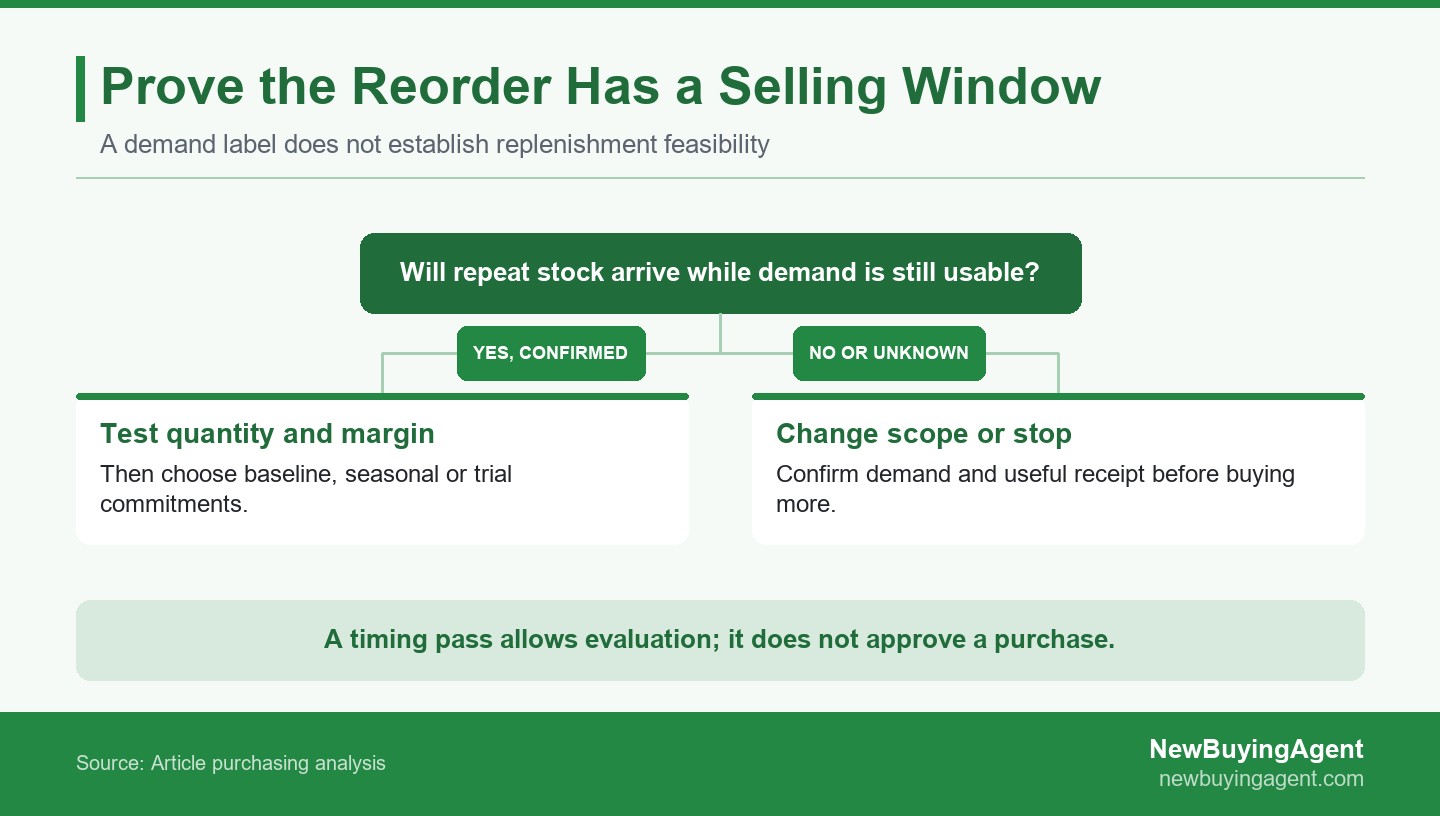
Replenishment needs a usable selling window before quantity and margin checks; an unconfirmed window requires a changed scope or stop decision
Compare the Three Sourcing Models on the Same Terms
The comparison below applies the three sourcing models to four demand cases, including the mixed assortment illustrated above. The mixed case combines the three demand lenses; it is not a fourth model. Product specification, destination, landed-cost scope, available stock and time to usable receipt stay aligned. Each case is assessed by its supporting evidence, purchase commitment and repeat or exit rule, without ranking product types by profitability.
| Demand case | Supporting evidence | Purchase commitment | Repeat or exit rule |
|---|---|---|---|
| Persistent baseline | Recurring purchases beyond next receipt | Coverage with repeatable specs | Recheck stock and margin; reduce if baseline weakens |
| Seasonal opportunity | Dated window and remaining sales | Limit dated versions and leftover stock | Repeat only before the useful deadline |
| Unproven viral spike | Purchase conversion and demand persistence | Cap materials, packaging and stock exposure | Expand only with purchase and supply evidence |
| Mixed-demand assortment | Separate baseline, dated uplift and unproven spike | Approve each part of demand separately | Recheck each increment; do not carry the full launch surge forward |
Based on this comparison, the sourcing model should govern the commitment attached to each part of demand. A repeatable base can justify continuity controls; a short window needs a dated ceiling on further stock; an unproven spike needs a ceiling on money and product obligations. None removes the need for an approved specification, quality evidence or a feasible receipt.
Build the Order Around the Demand Pattern
The selected sourcing model becomes actionable through explicit purchase terms agreed before more units are approved. Define what is firm, what can still change and which confirmation is required for the next commitment, including materials and packaging already authorized. An irreversible commitment is money or a product obligation that cannot be canceled without a loss; counting only finished goods can understate the exposure you have accepted.
For a merchandising team deciding which newly popular style merits a supply request, NewBuyingAgent offers AI-assisted market-fit product analysis and a free Bestseller Market Analysis Report. Use that input to refine the customer need, style and price hypothesis, then distinguish the product you can commit now from later quantities that still depend on evidence. Analysis can support selection without guaranteeing that the spike will persist.
Evergreen: Protect Repeatability and Stock Coverage
An evergreen model needs repeatable specifications, stock coverage through replenishment and periodic revalidation of the underlying demand. Preserve the approved material, dimensions, workmanship and packaging version so later batches serve the same customer need. A lower repeat quote should trigger a scope check if it changes a feature on which the baseline depends.
The reorder point must reflect uncertainty as well as average demand. NC State's reorder-point tutorial explains that longer lead times and greater demand and lead-time variation generally increase safety-stock needs for a given cycle service level. Use that relationship to revisit coverage when supply changes; the tutorial does not establish a universal buffer percentage or a service target for your assortment.
For each repeat decision, estimate stock available when the new order becomes saleable, after consumption and allocations during the wait. Count relevant inbound stock once and exclude units unavailable to the intended channel. Projected physical stock has a lower limit of zero; add still-unfilled pre-receipt backlog only if it is not already included in demand after receipt. Compare that projected position with demand after receipt, then check minimum quantity, cash and contribution at the current landed cost. A baseline that is shrinking may justify reducing or ending routine replenishment.
Seasonal: Bound Orders by Useful Arrival and Residual Value
A seasonal model bounds further purchases by demand remaining after receipt, the last useful arrival and the expected value of leftover stock. Set that useful-arrival date early enough to sell the added quantity before the opportunity closes. Reordering near the season's end is defensible only if the actual receipt, quantity and demand distribution still support sales or an explicitly approved carryover plan.
MIT's inventory teaching presents the single-period newsvendor model as a trade-off between excess inventory and lost sales under uncertain demand. This helps explain a seasonal commitment when there is only one useful ordering opportunity. It does not supply your demand distribution, selling price or leftover recovery; those inputs need product-specific evidence before an optimal quantity can be claimed.
Distinguish repeatable components from dated finished goods. A plain accessory may retain value after a holiday, while event-specific printing or packaging may sharply limit reuse. Confirm what can actually be carried forward, the cost of storage or rework and whether next year's specification will still apply. Do not use the current retail price as the assumed recovery value of unsold units.
Viral: Limit Exposure Until Purchases Support Expansion
A viral-product model caps irreversible product, material and inventory commitments until purchase evidence supports an expansion. Agree the maximum loss the business can accept if the attention fades, then evaluate the proposed quantity and any dedicated development against that limit. A smaller trial is useful when its specification, cost and receipt still make the test commercially meaningful.
Google Trends reports normalized relative search interest for a selected time and location, rather than a count of product purchases. A spike can prompt investigation, but it cannot by itself establish purchase conversion, unit demand or how long customers will keep buying. Check observed orders, availability, returns and dependence on a particular promotion or creator before extending the forecast.
Keep any proposed material flexibility or reduced customization explicit in the product brief. These are options to confirm, not automatic factory capabilities. If the minimum run or dedicated packaging exceeds the approved downside limit, change the scope or decline the product. A strong launch can justify another review; it does not retroactively make unlimited earlier exposure prudent.
Test All Three Models Against the Same Supply Delay
The same supply assumption across demand cases reveals which evidence changes the purchasing decision. Count time until goods are received, accepted and available to the intended channel, with the actual prerequisites for another run. A faster demand curve cannot shorten unfinished production or transport, so a promising sales result still needs to survive the receipt test before you authorize a repeat order.
Be precise about the transport endpoint. Maersk distinguishes time on the water from door-to-door shipping time, including activities before and after the vessel journey. Add any excluded production, inspection, clearance or receiving work when building the complete repeat duration. Confirm the route and booking conditions rather than using a general transit range as a promise.
In this hypothetical 2027 comparison, an approved accessory has the same specification, destination and repeat supply scope in every case. An order released on 1 September takes 42 calendar days to become saleable on 13 October. A seasonal demand cutoff of 20 October with a 14-day allowance to sell the added quantity requires receipt by 6 October and order release by 25 August.
These are illustrative elapsed-day assumptions, not China lead-time benchmarks; real supplier, transport and receiving calendars must replace them. The seasonal release deadline has already passed at the review date. The evergreen case has purchase evidence supporting a baseline beyond the expected receipt, while the viral case has only a recent attention spike and no validated persistence.
| Same repeat supply | Demand evidence | Decision on the proposed order | What could change it |
|---|---|---|---|
| Evergreen: receipt13Oct | Supported baseline beyond receipt | Evaluate quantity against projected stock, cash and margin | A weakening baseline or changed supply conditions |
| Seasonal: receipt13Oct | Useful receipt needed by6Oct | Stop the unchanged repeat plan; it misses the boundary | Confirmed earlier receipt or a supportable revised quantity/window |
| Viral: receipt13Oct | Persistence after receipt unproven | Do not scale solely from attention; retain the exposure limit | Purchase evidence and feasible supply supporting a bounded expansion |
The repeat order can still be evaluated against the evergreen baseline, misses the original seasonal receipt boundary by seven days, and remains unsupported for the viral spike. The point is the different commitment each evidence set can support. Changing a product label without changing the evidence or feasible receipt would leave the original purchasing problem unresolved.
Translate the Demand Model Into a China Sourcing Brief
A demand-based product request identifies firm quantities, conditional quantities and a limit on further obligations. The category owner should supply the demand evidence and commercial boundaries; purchasing should reconcile them with confirmed product and supply conditions. This gives the sourcing partner a defined requirement to quote and the buyer a proposal that can be assessed against the intended market opportunity.
| Brief item | Buyer supplies | Confirmation to request | Decision it supports |
|---|---|---|---|
| Product and version | Specification, samples and permitted alternatives | Repeatability and effect of changes | Same product outcome across orders |
| Demand split | Supported baseline, dated uplift, unproven increment | Feasible quantities and minimums | Firm versus conditional units |
| Timing | Destination, useful receipt and latest release | Complete supply duration and prerequisites | Buy, revise scope or stop |
| Commercial exposure | Target price, cash and downside limit | Cost scope, payment terms and authorized materials | Affordable commitment and leftover-stock plan |
A category buyer seeking repeatable accessories or home products can discuss China product supply with NewBuyingAgent, whose stated capabilities include local factory resources, product development, quality control and flexible payment support. These are relevant when the same assortment needs a stable core specification and different commitments for seasonal or experimental variants. Ask for the proposed product scope and repeat conditions so price, consistency and timing can be evaluated together.
The sourcing brief should distinguish the firm order, conditional repeat demand and maximum exposure, with the specification, quantities, destination, target price and receipt requirements. Include your current sourcing situation and any materials or packaging already approved, so both parties understand what remains changeable.
When those requirements are clear, submit the demand-based product brief to NewBuyingAgent to discuss a scoped supply proposal. Mark which quantities you can authorize now and which require another demand or timing review. The practical aim is a product offer whose commitments fit the opportunity, with the next buying decision tied to the evidence that could justify it.
Frequently Asked Questions
When can a viral product move into routine replenishment?
A viral product can earn a repeat-supply model when durable purchase evidence supports demand beyond replenishment, but one successful launch alone does not establish that persistence. Look for repeat purchasing across relevant selling periods, availability conditions and acquisition channels, then check the expected receipt against remaining demand. Reassess the downside if the original creator, promotion or platform stops generating orders. Move only the supported baseline into routine replenishment; keep any continuing spike separate until it earns the same confidence.
Should a factory minimum decide which sourcing model to use?
A factory minimum constrains which order sizes are feasible, but it does not establish the demand persistence or selling window needed to justify them. Compare the minimum with demand after useful receipt, projected stock and the downside you can accept. A smaller approved scope or another feasible product configuration may help, but both need confirmation. If the minimum still exceeds a defensible commitment, decline the order rather than relabeling the product to justify buying more.
Can payment terms make a larger seasonal commitment sensible?
Payment terms can improve the timing of cash outflows, but a larger seasonal commitment still needs supportable demand, useful receipt and acceptable leftover-stock exposure. Compare the total liability as well as the deposit and balance dates. Deferred payment may reduce immediate cash pressure while leaving the buyer responsible for unwanted materials or finished units. Confirm cancellation and change terms, and evaluate the product economics independently of the financing schedule before increasing a firm quantity.
Who should approve a change from one sourcing model to another?
A model change should be approved by the buyer responsible for the commercial commitment, using updated demand evidence and confirmed product and supply constraints. The analyst should explain the changed demand assumptions, while product and supply owners confirm effects on specification, materials, capacity and receipt. Finance should assess any increased cash or downside exposure. Record the authorized quantity and next review condition so a revised label cannot silently approve a larger order.
NewBuyingAgent
Ressources associées



Commencer aujourd'hui
Transformons vos objectifs d'approvisionnement en réalitéWeChat:+86 15157124615
WhatsApp:+86 15157124615
Adresse : Bâtiment 10 #39 Xiangyuan Road, Hangzhou, Chine
