

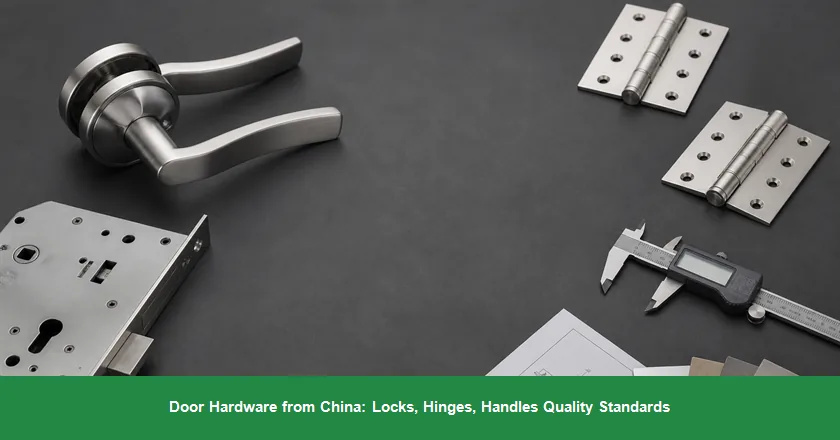
A usable hardware release connects the opening, function, evidence, and acceptance rule. That sounds administrative until a buyer receives a polished lever sample, a generic corrosion report, and a quotation that says “same as sample.” None of those items confirms that the lock function, hinge preparation, handle mounting, finish variant, and intended door opening are actually the same decision. For a safety-critical or commercial opening, the practical review order is usually lock function first, hinge compatibility second, and handle finish or ergonomics third—unless the project information gives a different consequence order.
The buyer should use the door opening—the door, frame, hardware application, and intended use—as the unit that joins those decisions. A component can be acceptable in isolation and still be the wrong choice for the opening. That opening-level approach gives a China factory a clear brief without turning a factory report into a universal compliance certificate. Destination-market rules, project specifications, listed assemblies, and responsible project parties still determine the final requirements.
The Evidence That Keeps a Good Sample From Becoming a Bad Installation
Before releasing a door-hardware order, make four decisions visible in writing. First, identify the opening: interior guest room, exterior entrance, corridor, accessible route, fire-rated opening, or another stated application. Second, define what each item must do there: secure, hang, pull, latch, close, or provide egress. Third, ask for evidence matched to the exact ordered variant. Fourth, state the acceptance criteria: the observation or result that the buyer accepts for that order line.
- Opening: record the door type, frame or preparation reference, destination market, and any project or listing constraint.
- Function: name the lock function, hinge application, handle interface, handing where relevant, and the connected components.
- Evidence: tie the sample, drawing revision, factory declaration, and any test record to the same variant.
- Acceptance: say what is observed, who approves it, and what happens if a sample, document, or report does not match.
This four-part record is an opening evidence pack: a buyer-owned document that connects an opening, the ordered hardware, a controlled sample, the available evidence, and a release rule. It does not replace an architect, door consultant, code official, laboratory, or listing authority. Its job is narrower and valuable: it makes the factory request reviewable before the order becomes expensive to correct.
Start With the Door Opening, Then Map Each Hardware Standard
Door hardware does not sit under one universal quality label. The BHMA standards overview lists distinct ANSI/BHMA A156 families for hinges, locks and latches, cylinders, and architectural trim. That is the useful starting point for a China order: identify the component family, then attach it to the intended opening and market requirement. Do not ask a supplier to “meet ANSI/BHMA” without naming the product, function, applicable edition, and project-specific evidence expected.
Door, frame, and hardware decisions are also interdependent. The Door and Hardware Institute notes that many door, frame, and hardware standards affect how openings are specified, detailed, furnished, and installed in its standards course overview. A buyer does not need to become the project specifier to use that lesson. It is enough to stop copying a catalog name into a purchase order and instead build one line for each opening component and interface.
If the buyer is still shaping materials, finish direction, and product requirements, it can help to browse the China manufacturing and product guide before requesting a factory quote. That resource supports the product-definition stage; it does not decide which building or fire-door requirements apply. Once the product brief is buyer-approved, NewBuyingAgent can use it to coordinate the China-side sourcing conversation without deciding the project's compliance requirements.
Locks: Specify the Function and Interface, Not Just the Lever Style
A lock line should say what the opening needs the hardware to do. Is the required function privacy, passage, storeroom, classroom, deadbolt, electrified access control, or another buyer-approved function? Then record the connected details that prevent substitution by appearance: latch arrangement, cylinder or keying requirement where applicable, strike, door preparation, handing, trim, and the drawing or sample revision. A lever silhouette is not a lock function, and a beautiful handle cannot repair a lock body that does not match the door preparation.
For an initial China quotation, the buyer can distinguish between what is fixed and what still needs confirmation. Fixed inputs may include the door preparation drawing, function, finish family, destination market, order quantity, and sample reference. Open questions may include the factory's recommended construction, compatible interface, lead time, or test evidence route. That division lets the supplier answer a real manufacturing question without being invited to guess at a hidden project requirement.
Hinges: Tie the Hinge to Door Weight, Geometry, and Preparation
Hinges are easy to under-specify because the component looks simple. The buyer should connect the hinge to the actual door geometry, the intended use, the frame and door preparation, the material and finish, and any project rule for the opening. The factory needs the relevant drawing or preparation reference, not just a photo of a five-knuckle hinge. This is also where a requested substitute should be treated as a fresh compatibility question rather than an automatic cost-saving change.
Keep the request factual. Do not turn a catalog rating into a promise that every door will perform the same way. Ask the factory to identify the offered hinge variant, construction, finish, mounting pattern, sample revision, and documents it can provide. The buyer or responsible project party can then compare that response with the door schedule and applicable requirements before approval.
Handles: Separate the Visible Finish From the Mounting and Function
A handle set often receives the most visual attention, yet appearance approval is only one part of release. Control the finish code, base material, mounting template, spindle or linked lock interface, screw or fixing set, door thickness range where relevant, and the exact sample revision. A variation in any one of those fields can produce a handle that looks right in the carton but cannot be installed as intended.
Application may also change what “right” means. For example, the U.S. Access Board's door and gate hardware guidance addresses handles, pulls, latches, locks, and other operable parts in its stated accessible-door context. That is not a global default for every market. It is a reminder to name the destination-market application and confirm the relevant project requirement before a supplier assumes that a handle style is sufficient.
Prioritize Locks, Hinges, and Handles by Failure Consequence
For a safety-critical or commercial opening, use this conditional review order: lock function first, hinge compatibility second, and handle finish or ergonomics third. The order is not a claim that locks matter more on every project. A decorative pull on a hospitality project may be commercially decisive, and an exterior pivot or continuous hinge may deserve the first review. The point is to put the component that can most seriously change the opening's required function at the front of the sample and document review.
- Lock function and interface: confirm what the door must do, the required operation, and the connection to strike, cylinder, preparation, or access system.
- Hinge compatibility: confirm the door and frame relationship, intended application, mounting pattern, and the offered construction before treating a finish sample as approval.
- Handle finish and use: confirm the visible target, mounting template, grip or operation requirement where applicable, and the variant-to-sample match.
This order also improves factory communication. A buyer can say, “The lock function and preparation are release-critical; do not substitute them,” while allowing the supplier to propose a finish process or packaging detail for review. The same logic applies to coating evidence: use a test because it answers the stated finish question, not because its name sounds like a blanket statement that every durability question has been settled.
Turn Finish and Function Requirements Into a Factory Test Pack
A test method is not the same thing as a purchase-order acceptance rule. ASTM B117 describes the apparatus, procedure, and conditions for a salt-spray environment, while its scope says it does not prescribe a specific product's test specimens, exposure periods, or interpretation of results. That distinction matters for locks, hinges, and handles: a report title alone does not tell the buyer whether the tested sample, condition, finish variant, and evaluation rule match the order.
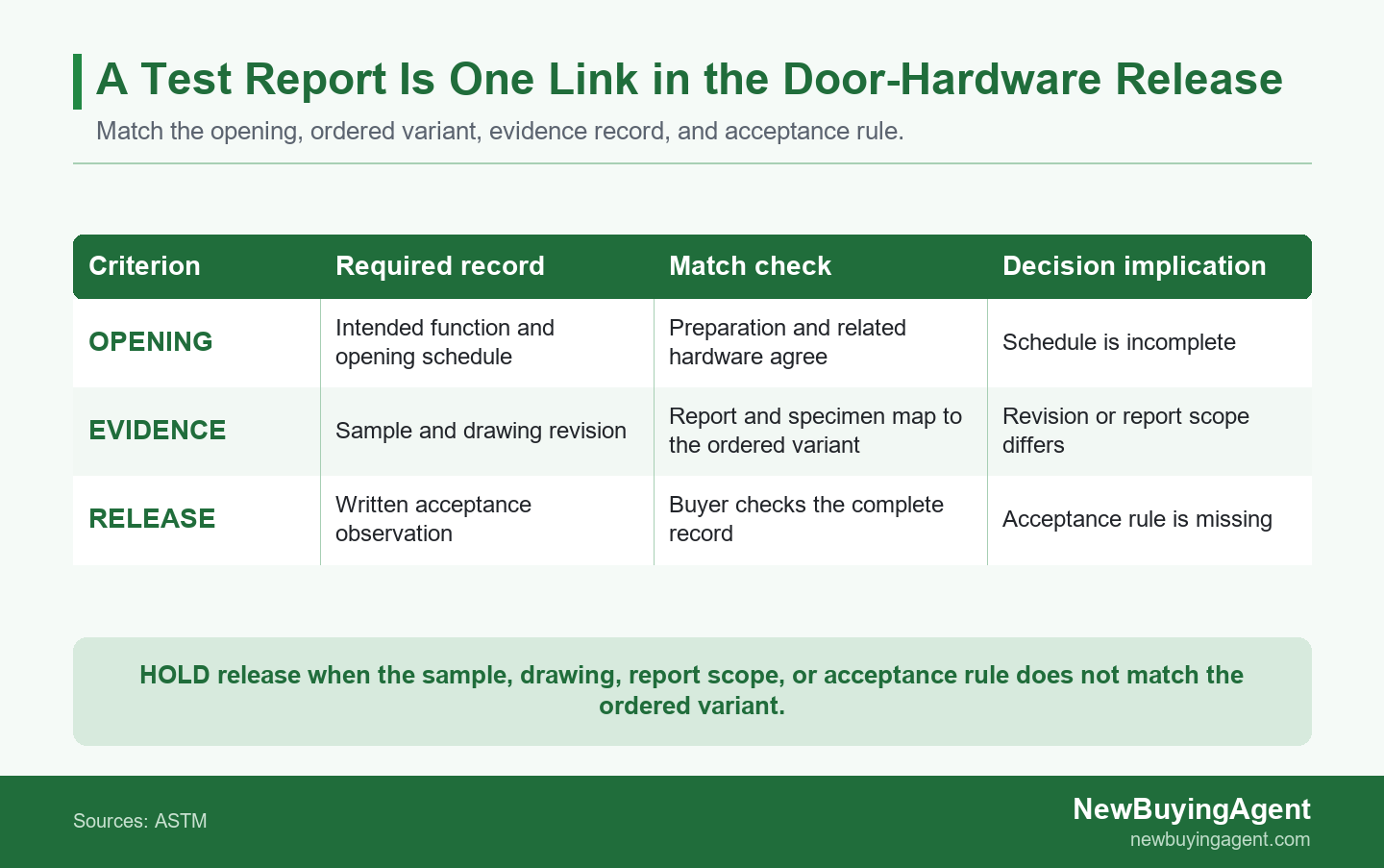
A test report is useful only when it is matched to the intended opening, ordered variant, and written acceptance rule.
A factory test pack should therefore be short but specific. For each evidence request, state the ordered variant, sample or drawing revision, material or finish, method, test condition or duration if the applicable product specification requires it, observation point, acceptance rule, reporting format, and who approves the result. If any of those fields is unknown, record it as an open decision instead of allowing the report to imply more than it proves.
The same discipline applies beyond corrosion work. ASTM's D3359 tape-test page describes a method for assessing coating-film adhesion and notes its limitations. A cosmetic finish reference, a crosshatch or tape test, a corrosion exposure, a function cycle, and a dimensional check are different evidence items. The buyer does not need all of them by default; it needs the ones relevant to the opening, material, finish, intended use, and destination-market or project requirement.
| Evidence field | What the factory should identify | Buyer release question |
|---|---|---|
| Ordered variant | Part number, finish code, sample and drawing revision | Is this the exact item being ordered? |
| Method and specimen | Named method, test piece, material, finish, and condition | Does the record apply to this hardware variant? |
| Acceptance observation | What was examined, recorded, and reported | What result permits approval, hold, or escalation? |
| Opening interface | Mounting pattern, lock interface, door or frame preparation | Can the approved sample be installed as scheduled? |
This is where a China-side factory review adds practical value: the buyer can ask for the marked sample, revision-controlled drawings, and the factory's report scope in one package rather than collecting unrelated attachments. The buyer still owns the acceptance criteria. A sourcing coordinator can make mismatches visible; it should not silently convert an incomplete report into approval.
Treat Fire-Rated and Exit-Door Hardware as an Assembly Decision
Fire-rated and exit-door hardware deserves a harder boundary. UL's guide to fire-rated doors discusses hardware such as hinges, locks, panic hardware, and fire-exit hardware in the context of complete assemblies and installation requirements. A generic supplier statement, a component report, or an attractive sample cannot by itself approve a fire-rated opening.
For these openings, ask the responsible project parties to identify the applicable code, listing, door and frame construction, required hardware configuration, and installation path before the China order is released. Put that requirement in the brief and ask the factory to identify the exact offered component, records, and limitations. NewBuyingAgent can coordinate documents and production follow-up around the buyer-approved brief. It does not approve a fire door, certify an assembly, or replace the authority having jurisdiction.
A Hotel Handle Set Scenario: Stop an Incomplete Release
Reconcile the Record Before Releasing the Affected Variants
Consider an illustrative hospitality order for 120 guest-room corridor openings. The preliminary order is 1,200 handle sets across 4 finish variants and 4 sample cartons, with compatible hinges and lock functions still being finalized. The buyer has an approved appearance sample and a finish test report but has not frozen the mounting template, opening schedule, or sample-to-order revision record.
One carton contains the preferred finish, but its spindle and mounting template do not match the buyer's latest door preparation drawing. The factory report identifies a corrosion test method but does not connect the tested specimen or evaluation rule to the four ordered finish variants.
The appearance sample and report cannot carry the full release decision because the physical interface and the report scope do not match the buyer's order definition. Hold the affected handle-set release, keep non-conflicting quotation work moving, and issue a revised opening evidence pack that names the accepted mounting template, finish code, tested specimen, and acceptance observation for each variant.
Require the factory to return marked samples, revised drawings, a variant-to-report map, and an opening schedule check before release. Release only after the corrected sample, drawing revision, report scope, and buyer-approved order line agree for all 4 finish variants. Illustrative operational control only; it does not decide code compliance, listing status, or commercial fitness for every project.
If the buyer already works with that China hardware supplier, it can be useful to review China factory-management support for an existing supplier. The practical role is to coordinate the product records, sample confirmation, factory follow-up, quality-control evidence, and logistics handoff under the buyer's approved requirements—not to decide compliance on the buyer's behalf.
That discipline protects both sides of the conversation. The buyer stops asking a factory to guess what “approved” means. The factory gets a concise list of what must be corrected and can respond against the actual order. The result is not more paperwork for its own sake; it is a smaller, traceable decision that keeps an appearance sample from carrying responsibilities it was never designed to carry.
Where China-Side Sourcing Support Changes the Hardware Handoff
NewBuyingAgent can use a buyer-approved opening evidence pack to coordinate China product sourcing, factory communication, production follow-up, quality-control evidence, and logistics coordination. That role becomes useful when the buyer has clearly stated the product need: opening type, destination market, order quantity, lock or hinge function, finish direction, sample reference, and any required documents. The buyer and responsible project parties retain the application, code, listing, and final acceptance decisions. For a new product, see how NewBuyingAgent supplies products from China.
For a new product or a fresh China factory search, the strongest handoff is not “find me a door handle.” It is a compact brief that says what the opening needs, which component details cannot change without approval, what evidence is required, and how a sample or report will be accepted. That gives the factory room to quote and develop within the buyer's boundary.
Before starting that conversation, gather the opening schedule, drawings or preparation references, target finish, intended market, required documents, sample photos or approved sample references, expected quantity, packaging needs, destination, and any fire-door or accessibility requirement already identified by the responsible project team. Then submit door-hardware requirements to NewBuyingAgent when the brief is ready for China-side sourcing coordination.
Frequently Asked Questions
Which door-hardware standard should a China supplier follow?
The relevant standard depends on the component, the door opening, and the destination-market requirement. Name the applicable standard family, edition where the project specifies one, lock or hinge function, finish, and evidence expected for that order line. A broad statement such as “meet all standards” leaves the factory without a testable instruction and leaves the buyer without a clear approval basis.
Is a salt-spray report enough for door-hardware quality?
No. A salt-spray record can be useful, but it should be matched to the exact hardware variant, finish, specimen, condition, and buyer-defined evaluation rule. It does not replace function checks, dimensional or interface confirmation, appearance approval, or any destination-market and project requirement. Use the report as one evidence item, not as a stand-alone release decision.
What should be checked on a door-hardware sample first?
First confirm that the sample matches the specified opening, function, mounting preparation, finish, and document revision. Then confirm that any test record identifies the same material and finish variant. This order exposes the expensive errors early: a wrong lock interface, incompatible mounting template, unapproved finish variation, or report that belongs to another sample.
Can a China sourcing agent approve fire-rated hardware?
No. A sourcing agent can coordinate documents, factory follow-up, sample confirmation, and quality-control evidence. The applicable code, listed door assembly, installation requirements, and responsible qualified project parties determine whether fire-rated or exit-door hardware is acceptable. Keep that boundary explicit in the factory brief and do not treat a sourcing conversation as an approval path.
NewBuyingAgent
Related Resources


Commencer aujourd'hui
Transformons vos objectifs d'approvisionnement en réalitéWeChat:+86 15157124615
WhatsApp:+86 15157124615
Adresse : Bâtiment 10 #39 Xiangyuan Road, Hangzhou, Chine
