

Choosing one factory or two is not a debate about which model sounds safer. It is a decision about whether an order can recover before its commercial window closes. A buyer can have two quotations on file and still face the same missed launch, stockout, or chargeback if the second factory cannot work from current specifications, pass the required checks, and take volume in time. Start with the order’s failure exposure, then ask what a usable second route can actually restore.
Use Dual Sourcing Only When a Second Source Can Actually Recover the Order
A second supplier is valuable when it can restore supply within the order's commercial window, not merely when its name appears in a sourcing file. The practical question is not “Do we have another factory?” but “Can another factory receive the current product package, prove the relevant controls, and release useful output before the customer-facing deadline?” That distinction prevents a dual-source plan from becoming a paper exercise.
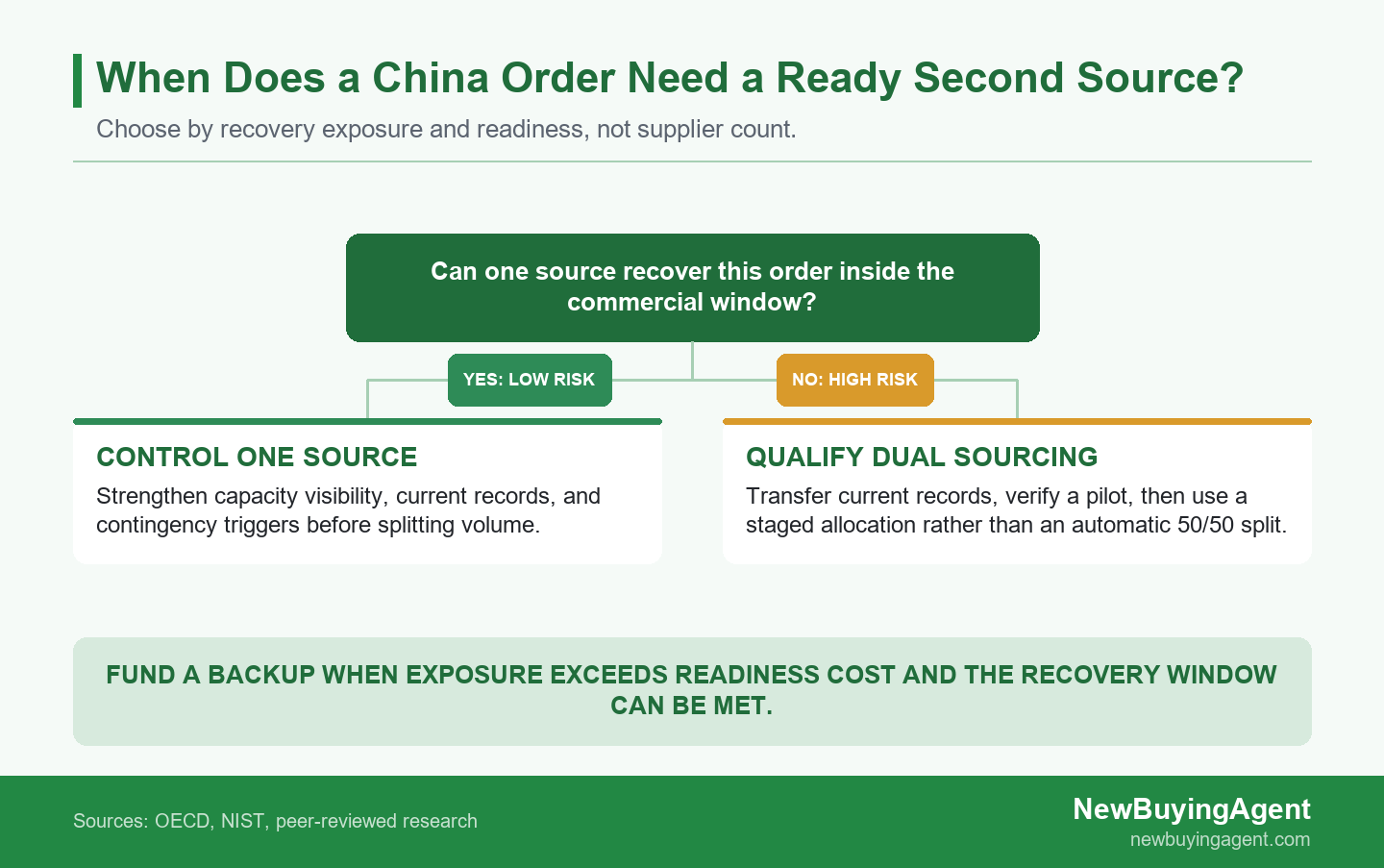
Two-branch decision diagram showing when low recovery exposure favors a controlled single source and when high exposure with a ready backup favors dual sourcing
The OECD describes redundancy and flexibility as two basic building blocks of supply-chain resilience. For a China order, redundancy matters only if it is paired with flexible information, capacity, and approval paths; otherwise a second name adds administrative work without adding recoverable supply. Read the OECD report.
- Keep one source when the product cannot be transferred inside the order’s recovery window.
- Qualify a second source only with current records, a proven pilot, and a dated capacity commitment.
- Fund readiness when credible order exposure is greater than the cost of keeping that route usable.
Use one source when concentrated learning, tooling control, and volume economics matter more than immediate substitution. Use two sources when the loss from a failed order is material and the backup can be kept ready at a proportionate cost. The answer may differ by SKU, season, and customer promise inside the same buying program.
What Single and Dual Sourcing Change for a China Order
Single sourcing concentrates learning and volume; dual sourcing exchanges some concentration efficiency for a tested recovery option. A primary source is the main factory expected to carry the main order allocation. With one primary source, the team can deepen process knowledge, consolidate demand, and focus corrective action. With two working sources, it spends more on matching samples, records, inspections, and allocation discipline in return for a possible route around a disruption.
The UK Department for Business and Trade identifies diversification as identifying alternate sources of supply to create flexibility in the supply chain. That framing is useful because flexibility is the outcome to test, not a fixed instruction to split every purchase order. Buyers new to supplier structure can use the China sourcing guide to frame the supplier decision, then compare the specific product, market window, and approval requirements at hand. Read the UK framework.
| Decision lens | Single source | Dual source |
|---|---|---|
| Best fit | Complex, low-volume, or tightly integrated products | Material exposure with a realistic, testable recovery route |
| Main gain | Concentrated learning, leverage, and operational focus | A rehearsed alternative for capacity, quality, or delivery shocks |
| Main exposure | One disrupted line can hold the whole order | Two lines can drift unless requirements and evidence are shared |
| Evidence to ask for | Capacity view, control plan, change notice, and escalation contact | Pilot result, matching records, first-allocation capacity, and release gate |
| Wrong reason to choose it | “The incumbent has never caused trouble.” | “A second quotation makes us protected.” |
What a Single Source Can Still Do Better
A single source can be the better model when the product is hard to reproduce, volume is too low to sustain two qualified lines, and the supplier has transparent controls. An engineered assembly with customer-specific tooling, a narrow material tolerance, or a long learning curve may lose more through duplicated qualification than it gains from a nominal split. In that setting, strengthen the one-source arrangement with capacity visibility, change-control records, timed escalation, and a documented search path for a future alternative.
Single sourcing also makes sense when splitting a small order would starve both factories of the volume needed to stabilize yield. The goal is not to punish concentration. It is to understand what would happen if the primary source misses a specification, loses a sub-tier input, or cannot hold a promised production slot. NewBuyingAgent uses that order-specific view to help global buyers assess China supplier options without assuming that one portfolio pattern fits every product. A credible one-source plan therefore records the trigger that would begin an alternate-source search before the order becomes irrecoverable.
What a Second Source Must Be Able to Do
A backup is qualified only when it can make the specified product, prove comparable controls, and receive a viable allocation before an emergency. A qualified backup is a second factory that has shown it can make the current product and take a planned allocation. Its evidence should cover the approved specification package, material or component route, samples or pilot output, test method, capacity window, and the person who can authorize the first release.
A price comparison alone cannot prove any of those points. Nor is a 50/50 allocation automatically safer: an untested split can double the number of quality variables while failing to reserve enough capacity for recovery. Start with the smallest allocation that exercises the backup’s records and process. Increase it only when the evidence shows that the source can carry a larger share without creating a new delivery or quality risk.
Score the Order Risk Before You Split Volume
Score the order's failure exposure, recovery window, and replacement difficulty before deciding whether dual sourcing deserves its cost. Failure exposure includes the contribution at risk, expedite and rework expense, retailer penalties, lost campaign spend, and any damage from an empty shelf or missed launch. The recovery window is the time between detecting a problem and the last date on which replacement output still has commercial value. Replacement difficulty captures how much product knowledge and validation must move. Switching readiness is how quickly the buyer can move work to another factory with correct records and evidence.
NIST says supply-chain mapping and risk assessment can identify sources of risk and support plans that identify secondary or alternative suppliers. Map the product path far enough to see whether a factory change also changes a toolmaker, critical material, packaging component, test lab, or export handoff. The map turns a vague desire for resilience into a list of dependencies to verify. Read NIST guidance.
Separate Supplier Failure From Switching Failure
A buyer should measure not only whether the primary factory may fail but also whether the business can detect, approve, and switch work early enough to respond. That capability can be weak even when a factory is capable in principle, because artwork is outdated, a component is single-sourced, the inspection standard is ambiguous, or nobody owns the release decision.
A U.S. Commerce review assesses supplier diversity by the number and concentration of suppliers for a specific input or process. Count sources at the constraint, not only at the finished-product level. Two finished-goods factories that rely on the same specialized part or tool may still leave the order exposed at the point that matters. Read the U.S. Commerce review.
For each critical SKU, rate the evidence on a simple three-level scale: ready, partly ready, or unready. “Ready” means the backup has current files, a proven process, visible capacity, and a release route. “Partly ready” means it can make a sample but has not demonstrated the intended material, capacity, or test result. “Unready” means the buyer has a lead or quotation but no proof that a switch would protect the order.
Use an Exposure Threshold Instead of a Fixed Split Percentage
Maintain a second source when the order's plausible failure exposure exceeds the annual cost of keeping that source genuinely ready. This is a decision rule, not a claim that every risk can be priced perfectly. It directs attention to the cost of a meaningful backup: sample work, documentation transfer, process verification, small allocation, inspections, and capacity reservations where appropriate.
For an illustrative order, suppose 8,000 units could miss a seasonal window. At $6 contribution at risk per unfilled unit plus $12,000 in expedite/rework, plausible exposure = $60,000; if keeping a genuine backup ready costs $18,000 annually, a pilot is justified. This isn’t an industry average or prediction; it is a transparent comparison that a buyer should replace with its own contribution, terms, and timing. If the exposure is low or the product cannot be transferred in time, improve the one-source controls instead of funding a decorative dual-source program.
NIST recommends assessing supply-chain inputs, processes, and outputs before disruptions become pressing problems. Review the threshold before the buying season and again when product complexity, order value, or customer commitments change. Read the NIST article.
Build a Backup That Can Start, Not Just Be Named
A ready backup requires portable product information, visible capacity, trial evidence, and a defined first allocation; a quote alone is not recovery capacity. Put the approved specification, bill of materials where shareable, artwork, packing rules, test method, inspection points, and change history into a controlled package. The backup should make against that package and show exactly where its process differs. Differences may be acceptable, but they must be visible before volume moves. Buyers can review relevant sourcing cases.
UK government foresight recommends pre-qualified backup capacity where substitution is hardest. The principle applies especially to products with specific tooling, compliance evidence, fragile materials, or narrow seasonal delivery windows. A sourcing partner can help validate local factory options and sequence this evidence, but the buyer should still define the commercial deadline and acceptable release criteria. Read the UK foresight report.
Capacity evidence needs equal care. Ask what line, shift, material route, and production week would support the first allocation; ask which existing commitments could displace it; and record the earliest point at which the backup must be told to start. The important outcome is a dated, testable first allocation rather than an open-ended promise.
Before releasing that allocation, compare the pilot with the primary route against the same operational questions: which records control the build, how is the critical material released, what inspection points stop a defect, and who can confirm shipment readiness. Document any acceptable variance instead of relying on verbal alignment. The buyer should also decide whether the backup needs its own export handoff, packaging approval, or compliance check. This short preflight reduces the risk that a technically workable factory becomes unusable because a supporting step was never transferred.
For buyers who need support from supplier identification through sampling and production follow-up, review the product-supply path for a new China source. That path is most useful when it converts an order requirement into a dated package of sample, quality, capacity, and shipment evidence rather than an untested supplier list.
Finally, rehearse the communication path. A late quality finding must reach the person who can compare the available evidence, approve a transfer, and adjust shipping priorities. This is where source concentration and decision concentration can combine: two factories do little good if approvals still wait on scattered files or an unavailable sign-off.
A practical rehearsal starts with a deliberately small problem: a specification clarification, a packaging revision, or a short controlled run. Ask the candidate backup to receive the changed record, identify its production consequence, and return a dated response with the relevant owner. Then compare that response with the primary source’s actual route. The exercise reveals whether version control, language handoffs, quality criteria, and escalation contacts will travel with the product. It can also reveal an acceptable reason to keep the product single-sourced, such as a unique tool, an immovable approval, or an allocation too small to sustain a second line. Either answer is useful because it replaces an assumption with observed operating evidence.
Once that record is in place, case material can be read for transferable decision conditions rather than as a promise that a different product or order will behave the same way. The useful comparison is between the evidence that made another order recoverable and the evidence, timing, and constraints that apply to the buyer’s own order.
Test the Portfolio Rule With a Capacity Escalation Scenario
A portfolio rule should tell the buyer when repeated capacity signals warrant a controlled second-source pilot instead of waiting for a missed shipment. Consider a 20,000-unit seasonal order supplied by one approved factory. The factory reports two consecutive schedule changes while a critical material lead time grows. Neither signal proves failure, but together they reduce the time available for a recovery decision.
At that point, the buyer does not need to move half the order automatically. It can preserve the primary source’s volume while commissioning a defined 6,000-unit pilot path with a candidate backup. The pilot must receive the current package, use the intended material and packaging route, and meet the same evidence gate applied to the primary source. The decision is then based on readiness rather than anxiety. Buyers can see how existing China factories can be managed locally.
Illustrative Scenario: Escalate From Monitoring to a 6,000-Unit Backup Pilot
A global home-goods brand with an established China supplier and a seasonal retail launch window is reviewing a program that has been produced successfully for two prior seasons. An illustrative 20,000-unit storage-product order has a planned launch window and a proposed 6,000-unit backup pilot. The final 8,000 units sit closest to the launch date, so an avoidable delay there carries more commercial weight than a delay earlier in the program. The primary source has approved product records, while the potential backup has a quote but lacks current carton artwork, packing criteria, and pilot evidence. It is therefore a lead, not a recovery route.
The primary factory gives three successive capacity updates that push the final 8,000 units closer to the buyer's launch window. A second factory can quote, but has not received the latest carton artwork or approved packing standard. The buyer has not yet reserved capacity or approved a pilot at the potential backup factory.
When repeated capacity warnings occur on a 20,000-unit order, use a documented pilot and verification gate before moving a planned allocation to the backup source. The issue is not simply whether the primary factory will fail. The buyer has 8,000 units exposed and an unready backup, so it cannot rely on a split until the current product and packing records travel and a pilot is verified. Hold the primary allocation in place, release a controlled 6,000-unit pilot to the backup after document transfer, and retain 6,000 units with the primary until the backup meets the agreed pilot checks. This staged release avoids making a larger transfer on confidence alone.
Send the current sample record, bill of materials, carton artwork, inspection criteria, and packing photos; confirm backup capacity and a dated pilot plan. Keep any change or variance in the same controlled record set so that the comparison remains meaningful. The verification gate requires pilot output, applicable test or inspection evidence, packing confirmation, a named release owner, and written capacity confirmation for the intended production week. If any element is missing, the buyer keeps the allocation with the primary source while the backup remains under qualification. This is an illustrative decision model. The correct quantities, allocation, and verification criteria depend on the product, demand window, tooling, compliance requirements, and contracts. The scenario does not establish a universal split percentage or predict a supplier outcome.
Turn the Decision Into a China Sourcing Brief
A useful sourcing brief names the order exposure, critical specification, volume window, current supplier status, and the evidence a second source must produce. Add the earliest date a switch must be approved, the maximum pilot quantity, the inspection and test requirements, and the decision owner. This brief keeps a buyer from requesting “a backup supplier” when what the order really needs is a controlled, dated recovery option.
Use the brief in the next supplier review and assign a status to each high-risk SKU: retain one source with stronger controls, qualify a backup through a pilot, or keep the product under observation until the exposure changes. The discipline is valuable even when the answer remains single sourcing, because it makes the assumptions visible before they become urgent.
Before contacting any supplier, make the brief operational: state which version of the specification is controlling, what evidence must accompany the sample or pilot, who can approve exceptions, and which date ends the recovery window. That level of precision lets a sourcing discussion move quickly from a general request for alternatives to the real decision: whether a second line can protect the customer commitment without opening an uncontrolled quality path.
For a China sourcing discussion grounded in a specific product, order window, and evidence requirement, NewBuyingAgent invites buyers to request a China sourcing review with the order brief. Bring the current specification package and the dates that make recovery commercially meaningful; those two inputs make the single-versus-dual decision far more concrete.
Frequently Asked Questions
Should Every Product Have Two Active Suppliers?
No, not every product benefits from maintaining two active suppliers at the same time, because readiness value differs by order. A second source is worth funding when its tested recovery value exceeds its readiness cost. Complex products, low-volume programs, and items tied to specialized tooling may be better managed through one transparent source plus stronger capacity, quality, and escalation controls. The decision should be made SKU by SKU, with the delivery window and replacement difficulty stated clearly.
What Makes a Backup Supplier Qualified for Production?
A qualified backup can work from the current product package, use an acceptable material and component route, and prove its readiness before an order emergency. It should also show relevant sample or pilot evidence, reserve a realistic capacity window, and receive a defined first allocation. A contact, factory introduction, or quotation alone does not demonstrate that the backup can recover an active order.
How Much Order Volume Should a Backup Receive?
Start with the smallest allocation that proves the backup’s process, capacity, shipment handoff, and ability to follow the current controlled product record. The right quantity depends on the exposure at risk and the volume the factory has actually demonstrated, not on a universal 50/50 rule. Increase allocation after evidence is reviewed; do not shift more volume simply because a second supplier has agreed in principle.
When Should a Buyer Start a Second-Source Pilot?
Start before a disruption consumes the recovery window. Repeated capacity warnings, longer material lead times, concentration at a critical component, a high-value launch, or a narrow seasonal delivery date are common triggers. The pilot should have its own specification package, evidence gate, allocation limit, and decision owner so that it creates a real option rather than another unverified quote.
NewBuyingAgent
Related Resources

Heute beginnen
Lassen Sie uns Ihre Beschaffungsziele in die Realität umsetzenWeChat:+86 15157124615
WhatsApp:+86 15157124615
Adresse: Gebäude 10 #39 Xiangyuan Road, Hangzhou, China
