

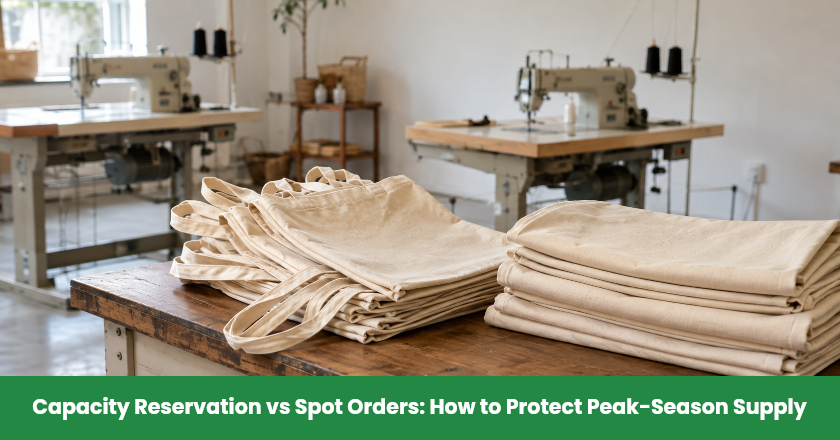
A lower reserved unit price can still leave an importer with a higher purchasing bill if demand falls. Equally, waiting for a clearer forecast can leave no production window capable of delivering before the season ends. The choice between capacity reservation and spot orders is therefore about two uncertainties: how much you will need, and whether later supply can arrive in time.
For buyers sourcing from China, the useful comparison separates the reservation fee, the obligation to purchase goods, and the production allocation actually accepted by the supplier. Paying early only helps when those commitments fit the selling window.
Reserve Predictable Demand, Keep Uncertain Demand Flexible
Reserve predictable demand when the fee buys credible, usable supply within the selling window and the downside cost is acceptable. Keep uncertain demand flexible through spot orders only if qualified later supply can still reach the destination on time. A mixed plan can protect a base quantity, but it does not make the unreserved upside secure.
- Quantity: Reserve a defensible demand base, not an optimistic sales target.
- Capacity: Obtain an accepted product allocation and production window, not merely a payment receipt.
- Cost: Separate non-creditable fees from deposits credited against purchases.
- Timing: Test arrival at the required destination, not just factory completion.
Compare What Each Purchasing Method Commits You To
Capacity reservation secures an agreed production allocation in advance, with the final purchase quantity governed by the arrangement. A spot order relies on price and availability when that order is placed, without an earlier capacity commitment. Neither label tells you whether stock already exists, whether a fee is refundable, or whether the buyer must purchase a minimum quantity.
A call-off is the release instruction confirming the quantity to put into production under an existing arrangement. By contrast, an early firm purchase order commits the buyer to an agreed purchase quantity now, subject to its terms. A capacity reservation can preserve more flexibility, but only if the written obligations actually permit it.
The comparison below uses equivalent product requirements and the same destination delivery window. Capacity reservation and spot orders are the primary alternatives; an early firm order is a benchmark, and reserved base plus spot upside is a combination of the two. Cells describe commercial structures, not guaranteed supplier performance.
| Purchasing route | Early cash commitment | Quantity obligation | Availability protection | Best demand condition |
|---|---|---|---|---|
| Capacity reservation | Agreed reservation fee | Defined by agreement | Accepted allocation only | Defensible base |
| Spot order | No prior capacity fee | Quantity ordered later | Later availability | Uncertain, with time |
| Early firm order | Agreed purchase payment | Firm ordered quantity | Accepted order schedule | Stable firm demand |
| Reserved base + spot upside | Fee for base allocation | Separate base/upside terms | Upside remains uncertain | Stable base, variable upside |
Based on this comparison, reservation is the stronger fit when a credible demand base needs scarce production time but the final release is not yet firm. Spot purchasing offers more freedom before commitment when later qualified supply remains feasible. An early firm order suits settled requirements; combining reservation and spot supply is useful only if the buyer accepts the remaining upside risk.
Inderfurth and Kelle model combined reservation and spot procurement under uncertain demand and spot prices in their capacity-reservation research. That is a mathematical context for evaluating a mix, not proof that a particular percentage works for every importer.
Start with a timing question: could a later order still arrive before the goods are needed? If not, evaluate an early commitment for the demand worth protecting. If yes, flexibility remains an option, although future availability must not be assumed.
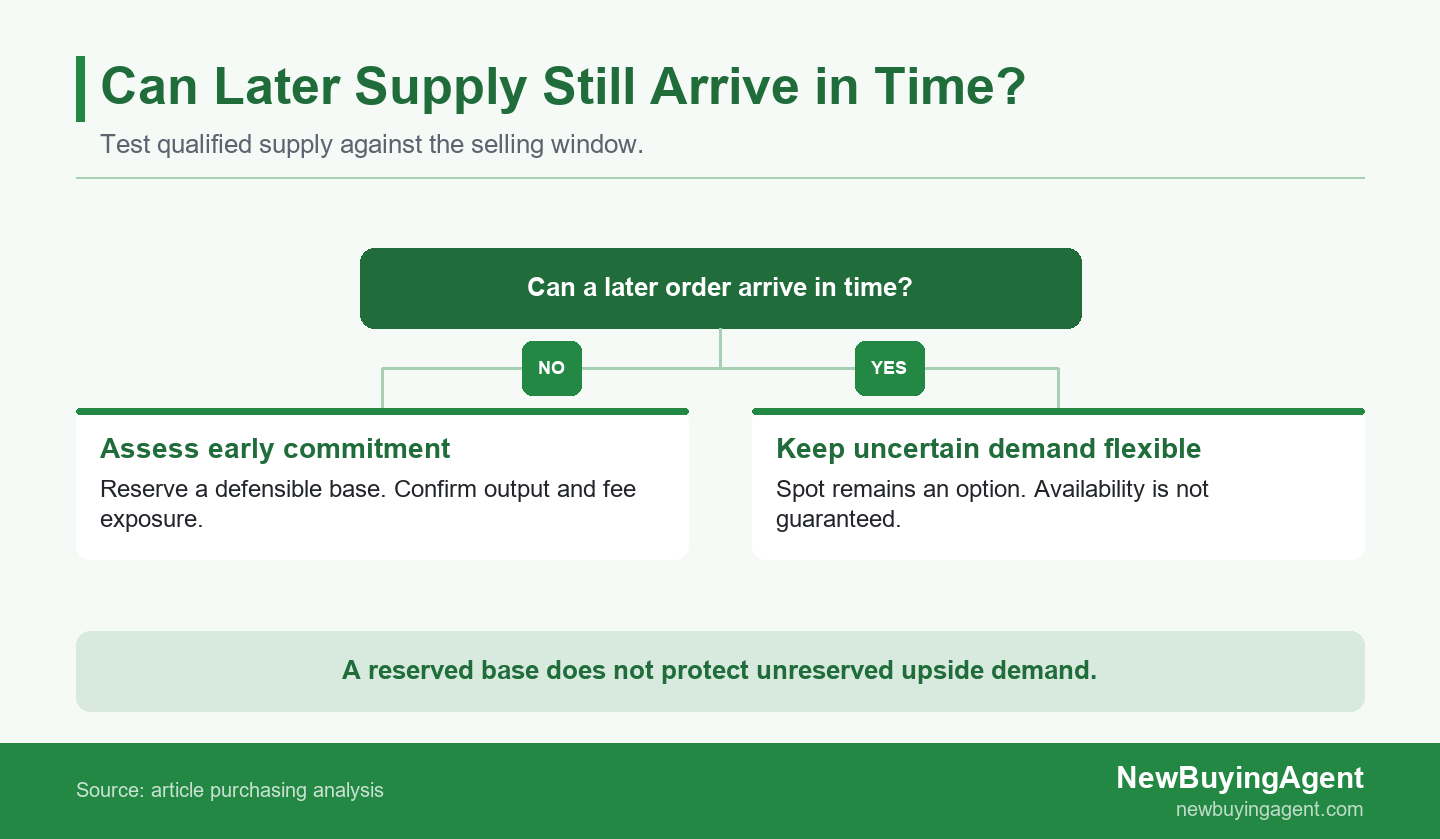
Choose between an early capacity commitment and later spot purchasing by testing the delivery window
Choose How Much Demand Deserves a Reservation
Separate defensible base demand from uncertain upside before requesting a reservation. The base should reflect orders, repeat demand and a realistic selling period after subtracting usable stock and existing inbound supply. Treat launch aspirations and unconfirmed promotions as a different demand band, because the cost of reserving them remains real even if the sales never materialize.
Check the forecast at the product level. A collection may have stable total demand but an unsettled color mix. Reserving generic sewing capacity could remain useful, while buying custom-dyed fabric for every projected color could create unwanted inventory. Ask which production decisions can wait and which require an earlier commitment; do not describe all of them as one flexible reservation.
NIST describes value-stream mapping as examining material, process and information flows. Applied to this purchasing decision, that means locating where a forecast becomes a material purchase or production instruction. This application does not calculate the right reservation quantity; it identifies the commitments that a quantity decision will trigger.
For a seasonal collection with uncertain specifications, NewBuyingAgent's local China factory resources and product-development capability can support a product offer built around the buyer's quantity range, quality requirements and delivery needs. The practical objective is a supply quotation for the collection, with feasible product choices, rather than committing early to a variant that may change. This is the relevant starting point for NewBuyingAgent's product-supply service.
Check Whether the Reserved Slot Can Produce Your Goods
A reservation request becomes useful planning evidence only when the supplier accepts an identifiable allocation for your product and production window. Confirm the quantity or working time, product assumptions and conditions that could reduce the allocation. A transfer receipt proves payment; it does not independently establish that the relevant materials, equipment and finishing resources are available.
Boulaksil and colleagues study a shared-line manufacturer that can accept or partly reject reservation requests in their capacity-allocation model. The practical distinction is important: requested capacity and accepted capacity are different records. Ask the supplier to acknowledge the latter explicitly.
Find the Production Bottleneck Before Paying
Reserved line hours cannot produce usable goods if a required material or finishing process is unavailable. For canvas bags, sewing time may be open while printed fabric, handles or final packing remain constrained. Ask what output the slowest necessary operation can support in the proposed window, including the capacity already committed to other orders.
A NIST manufacturing case used process mapping to identify bottlenecks in a US finishing plant. It is not a China sourcing case, but it illustrates why the main production machine is not necessarily the operation controlling delivery.
Request a dated material-readiness position and a schedule covering the constrained operation. If a subcontracted process is essential, establish whether its slot is accepted too. A supplier's general monthly output figure cannot answer whether your particular mix can be completed during the week you need.
Work Back From the Required In-Stock Date
Start with the date goods must be usable at the destination, then work backward through delivery, shipping cutoffs, inspection, possible correction, production and material release. This establishes the latest feasible call-off date. The reservation deadline may be earlier if the supplier needs advance notice to hold that production window.
Maersk distinguishes production lead time from customer lead time, which includes shipping, storage and final delivery, in its lead-time explanation. Factory completion therefore cannot stand in for arrival. The carrier's spot-freight product is separate from the spot procurement decision discussed here.
Use the actual route and current supplier schedule to set allowances. A standard number of weeks is not a substitute for those dates. If the next reliable sales update comes after the latest feasible call-off, the buyer must choose between committing under uncertainty and accepting that some demand may go unserved.
Calculate the Cost of Using Less Reserved Capacity
Compare the entire purchasing payment at realistic usage levels, not only the quoted unit prices. A fixed, non-creditable reservation fee can exceed the unit-price saving when too little reserved capacity is used. A deposit credited against purchases has different economics, so establish the credit, refund and minimum-purchase terms before putting numbers into the comparison.
Keep product specification, acceptance criteria, currency, destination and freight basis consistent. Then show financing, storage, cancellation exposure and potential shortage consequences separately. If spot goods cannot arrive on time, their lower price is not a like-for-like service alternative; the decision becomes whether paying for continuity is worth the commercial benefit.
Illustrative Scenario: A Seasonal Canvas Tote-Bag Order
Consider an importer planning up to 10,000 canvas tote bags for a seasonal collection. Before fee approval, the supplier proposes reserving capacity for 6,000 units. Successive sales reviews lower the defensible base to 3,000 units, although the upside forecast remains unchanged. The buyer now needs to test the proposed commitment against demand it can defend.
The illustrative terms are a fixed $2,400 non-refundable, non-creditable fee plus $5.00 for each bag actually ordered. All amounts are in USD; the fixed fee remains payable even when only 3,000 units are purchased. Comparable qualified spot supply is assumed available within the same delivery window at $5.60 per bag. There is no minimum-purchase or take-or-pay obligation: unused capacity does not create an additional purchase bill. These are example assumptions, not supplier quotations or client results.
In this illustrative example, a 2,400 USD fixed fee and 0.60 USD unit saving break even at 4,000 purchased units. The calculation is 2,400 divided by 0.60. At that quantity, both routes cost $22,400 under the stated assumptions. The comparison changes on either side of that point:
- Use 6,000 units: reservation costs $2,400 + $30,000 = $32,400; spot purchasing costs $33,600. Reservation saves $1,200.
- Use 3,000 units: reservation costs $2,400 + $15,000 = $17,400; spot purchasing costs $16,800. Reservation costs $600 more.
The lower execution price no longer justifies the proposed fee on the revised base forecast. Before approving payment, the buyer should ask for a smaller or staged reservation and obtain its actual fee rather than assuming the original fee scales proportionally. If the supplier keeps the offer unchanged, management must either justify the continuity premium or choose the qualified spot route while it remains feasible.
Recalculate using the written revised terms and confirm the output window before treating the change as an improvement. This example measures direct purchasing payments only; financing, inventory, freight differences, shortage losses and supplier non-performance could change the decision. The 4,000-unit crossover is not an optimal reservation quantity, and reserving 6,000 units would not protect the remaining 4,000 units of upside demand.
Define the Reservation, Release Deadline and Failure Response
Confirm what the supplier allocates, what the buyer must pay, when quantities become firm and how a missed window will be handled. These details should connect the commercial arrangement to the actual product schedule. An unexplained reservation fee leaves too much uncertainty about what the buyer has secured and what happens when either side changes the plan.
- Allocation: Identify the product family, quantity or hours, production window and material-readiness assumptions.
- Payments: Separate capacity fees, credited purchase deposits, material commitments and any minimum purchase obligation.
- Release deadline: State the final quantity-confirmation date and what expires if the buyer misses it.
- Supplier shortfall: Agree on early notification, revised delivery options, treatment of paid fees and the point for switching plans.
Keep quality approval separate from scheduling approval. ASQ supplier-evaluation guidance includes quality-system assessment and prototype or sample testing. A booked slot does not replace that evidence, and peak-season pressure should not silently change the product acceptance criteria.
Where a buyer already has a factory, NewBuyingAgent's local communication, production follow-up and quality-control capability can support coordinated delivery of the agreed products. This becomes useful when a reservation must be followed through material readiness, production progress and quality checks across time zones. The relevant existing-factory route is NewBuyingAgent's factory-management service.
For the buyer's internal handover, keep one current record of approved quantities, committed payments and the next irreversible date. Procurement should not continue using an earlier forecast after sales has reduced it. These are commercial planning questions rather than a legal agreement template; obtain appropriate contract advice for material commitments.
Choose a Purchasing Route Before the Release Deadline
Choose capacity reservation for a credible base when the supplier's accepted output window and the fee exposure are both acceptable. Choose spot orders for uncertain demand only while later qualified supply can still arrive on time. If neither route meets the selling window, change the assortment, launch quantity or customer promise rather than approving a commitment that cannot deliver.
An early firm order is a reasonable benchmark when the product, quantity and demand are already settled: paying for flexibility that will not be used may add unnecessary cost. A mixed route is more appropriate when the base is stable but additional demand is uncertain. Its limit should be visible in the sales plan, so teams do not sell the entire upside as though it had the same supply protection as the reserved base.
Assign the final release decision to a named buyer with an agreed sales forecast and finance approval. Review sooner if demand shifts, a material date slips or the supplier changes the accepted allocation. The useful result is a purchasing decision before the deadline, not another forecast update after flexibility has already expired.
If the next step is sourcing the seasonal products, prepare product specifications, quantity bands, target price, destination and delivery timing. NewBuyingAgent is a one-stop China sourcing agent that quotes and supplies China-sourced products against buyer requirements. Include the defensible base and uncertain upside in that brief so the product quotation can reflect the purchasing decision; request a product quotation from NewBuyingAgent.
Frequently Asked Questions
Can the same factory handle reserved and spot quantities?
Yes, if it distinguishes the accepted allocation from additional quantities subject to later availability. Keep separate quantity and delivery confirmations, even when both sit under one commercial relationship. Extra orders should not silently consume the reserved allocation or inherit its delivery promise. Ask the supplier to identify which window each additional quantity would use before making the corresponding sales commitment.
Can unused capacity roll into the next season?
Only if the supplier agrees to a rollover and identifies the replacement window and any additional fee. A credit balance is not the same as usable capacity for the next collection. Check whether the later season uses different materials or production processes, and whether the credit expires before that demand becomes firm. Do not assign full value to an unusable rollover.
Can reserved capacity move between colors or SKUs?
Only within the product mix and change limits the supplier has accepted. Equal unit counts can require different sewing time, changeovers or finishing work. Ask whether the reservation is measured in pieces, hours or a defined mix, then confirm the proposed transfer before releasing it. A flexible line allocation also does not automatically release the buyer from materials already purchased.
Does reserving capacity also fix the product price?
Not necessarily; capacity allocation and product pricing are separate commercial terms. Establish the price-validity period, any agreed adjustment basis and who approves a revised price before production release. If the product price remains open, test the reservation decision under that uncertainty rather than treating today's indicative quotation as fixed. A capacity fee by itself does not settle the future purchase price.
NewBuyingAgent
Related Resources

Heute beginnen
Lassen Sie uns Ihre Beschaffungsziele in die Realität umsetzenWeChat:+86 15157124615
WhatsApp:+86 15157124615
Adresse: Gebäude 10 #39 Xiangyuan Road, Hangzhou, China
