

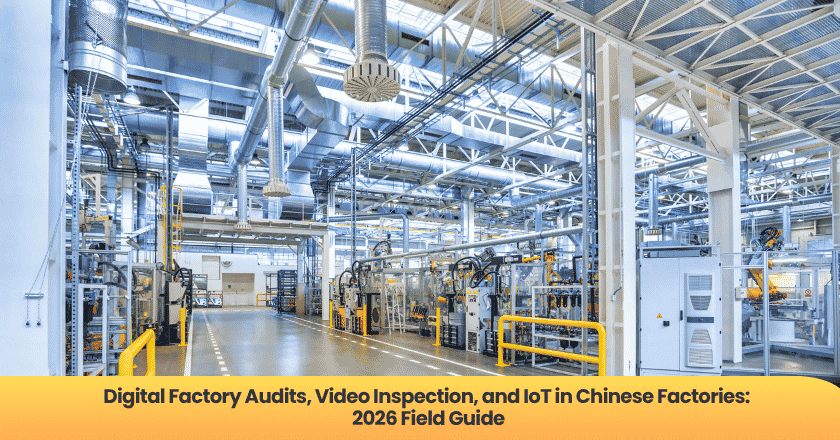
Key Takeaways
- Live video factory audits (1–3 hour scheduled walk-throughs streamed via WeChat Work, Teams, or Zoom) are now standard practice for first-time supplier qualification — they catch most "fake factory" patterns that a photo album would miss.
- In-process video inspection during production (rather than only at PSI) lets buyers verify production is actually running on their order, not on someone else's batch with photos from earlier.
- IoT factory monitoring — temperature/humidity sensors, machine-uptime monitors, environmental data loggers — is increasingly standard in mid- and high-tier factories, and increasingly available as data buyers can access.
- The biggest 2026 gain isn't the technology, it's the chain-of-custody documentation the technology produces — every dispute, claim, and recovery case starts with whether you have time-stamped evidence of what happened when.
- Limits remain: video can be staged, IoT data can be falsified, and remote audits don't catch everything an in-person visit catches. Treat digital audits as a complement to (not replacement for) physical verification on high-stakes engagements.
Why Digital Audit Got Real After 2020
Pre-2020, most foreign buyers either visited Chinese factories in person, sent third-party auditors (SGS, Bureau Veritas, QIMA), or skipped factory verification entirely and crossed their fingers. The pandemic era forced a third path: remote, digital factory audits via video conferencing.
Five years on, this third path has matured from "good enough during COVID" to a legitimate alternative for many use cases — and an essential complement for almost all of them. Three things changed:
1. Bandwidth and tooling. Most Chinese factories now have stable enough WiFi or 5G to support 1080p video streaming for 1–3 hours. WeChat Work (企业微信) supports multi-party video and screen sharing in ways that weren't viable in 2020.
2. Buyer expectations. Buyers who got used to remote audits during COVID now treat them as the default for first-pass supplier qualification, with in-person visits reserved for serious engagements or when something specific needs to be confirmed.
3. Supplier compliance. Chinese factories that want to attract foreign buyers in 2026 know that being willing to do a live video walk-through is table stakes. A factory that refuses or delays video audits is signaling something — often that the "factory" is a trading company representing factories that don't know about you.
What a 2026 Digital Factory Audit Actually Looks Like
A typical first-time supplier video audit runs 90 minutes to 2 hours and follows this rough script:
Pre-audit (asynchronous):
Supplier sends business license (per article #28), production capacity claims, certifications (ISO 9001, BSCI, Sedex, BSCI, etc.), product portfolio, customer references
Buyer or sourcing partner reviews documents and prepares specific questions
Audit session (live):
Reception and conference room intro (10 min) — meet the GM, sales contact, and quality lead. Verify identities against business license.
Walk through production floor (40 min) — supplier operator carries phone or tablet. Buyer asks operator to point camera at specific machines, work areas, raw material storage. Buyer asks unscripted questions about specific orders running on the floor.
Visit warehouse and shipping area (15 min) — verify finished goods inventory, packaging, shipping documentation.
QC and lab area (15 min) — see actual QC equipment, calibration records, retain samples from past production runs.
Q&A and verification (20 min) — discussion of production capacity, lead times, payment terms, contract willingness, NNN signing.
What a competent auditor watches for during the live walk:
Is the factory actually producing? (Workers present, machines running, materials staged)
Are the certifications visible? (ISO certificates posted, calibration stickers on equipment)
Does the production scale match claims? (10 production lines claimed but only 3 visible is a red flag)
Are there other customers' products visible? (Helps confirm the factory has genuine business beyond your inquiry)
Does the GM seem to know the production process? (Reseller/trading company patterns often produce GMs who can't answer technical questions)
Post-audit deliverables:
Video recording (with supplier's permission)
Annotated screenshots of key observations
Audit report scoring the supplier on production capability, quality systems, compliance, and risk indicators
Common Mistake: Letting the supplier control the script. A staged factory tour shows you exactly what the supplier wants you to see. A real audit involves unscripted requests — "now turn left and show me the raw material storage that's behind that door," "show me the QC station for the order you're running today," "let me see the back of that machine." A supplier resistant to unscripted requests is a flag.
In-Process Video Inspection: Beyond PSI
PSI (Pre-Shipment Inspection) catches finished-goods quality issues, but only after production is complete. By PSI time, the order is finished and any rework is expensive. Video inspection during production catches issues earlier.
The pattern that works in 2026:
During-Production Inspection (DUPRO) at 30–50% completion of the order. Inspector (in person or via supplier-side video) walks the production line, samples in-progress units, checks for spec drift, confirms raw materials match the approved bill of materials. Issues caught at DUPRO are corrected on the remaining production rather than at finished-goods rework.
Live video DUPRO is increasingly standard for buyers who can't have a physical inspector on every order. The buyer (or sourcing partner) joins a 30–60 minute video call during production, asks the supplier to walk specific operations, samples specific units. The recording becomes evidence if quality issues emerge later.
Cost: traditional in-person DUPRO USD 200–400. Live video DUPRO is essentially free if you have the time, or USD 100–200 if you outsource the time.
Chain-of-Custody Photos
A growing 2026 practice is requiring the supplier (or your sourcing partner's QC team) to provide a defined photo set at production milestones:
Raw materials received (with delivery date)
Production start (first units off the line)
50% completion sample
Pre-PSI ready stock with carton labels
Container loading
Each photo includes a timestamp, a visible PO number, and ideally a recognizable factory landmark (so the photo can't be substituted from another order). The cumulative photo set establishes that the goods you're paying for were actually produced by the factory you contracted with, on the timeline they claimed.
This is especially important after the supplier-side compromised email pattern discussed previously — chain-of-custody photos with consistent visual signatures make it harder to fake "production progress" reports remotely.
IoT in Chinese Factories: What's Actually Deployed in 2026
Industry 4.0 marketing has run ahead of factory-floor reality for a decade, but 2026 is a real inflection point. Three categories of IoT deployment are now common in mid- and higher-tier Chinese factories:
1. Environmental monitoring. Temperature and humidity sensors in storage areas (especially relevant for foods, cosmetics, electronics with sensitive components). Data is logged and accessible — increasingly through web dashboards the buyer can be granted view access to.
2. Machine-level monitoring. Production-line equipment with uptime sensors, OEE (Overall Equipment Effectiveness) tracking, and output counters. Some factories share OEE dashboards with major customers as a transparency signal.
3. Quality-data instrumentation. Inline measurement equipment (dimensional, weight, electrical) with data captured automatically rather than manual log books. The data trail is independently audit-able and shows that QC actually happened when claimed.
What you can ask for: as a buyer with a meaningful order, you can typically request:
Read-only access to environmental monitoring dashboards for storage areas holding your goods
OEE data for the line running your order during the production window
Inline QC measurement data for your order's units (with PO traceability)
Suppliers with good IoT discipline will share this; suppliers without it will deflect. Either response is information.
Expert Tip: Frame IoT data requests as a partnership benefit, not a surveillance demand. "Our QA team monitors environmental conditions for all our supply chain — can we get view access to your warehouse temperature dashboard? It helps us spot issues early." This usually gets a yes; framing it as "we don't trust you" usually gets resistance even from honest suppliers.
Where Digital Audits Hit Limits
Digital factory audits are powerful but not complete. Three categories of risk are still better detected by in-person visits:
1. Subcontracting and capacity fraud. A factory that subcontracts your order to a smaller workshop nearby can stage their main floor for the video audit and quietly subcontract the actual production. The video walk-through doesn't detect this; an in-person visit during production sometimes does.
2. Material and quality substitution. A vision-based camera walk through finished goods can't tell you whether the cells in a battery are the brand specified or a cheaper substitute. Material verification often requires destructive testing or specialized instrumentation that's not on the video tour.
3. Labor and ethical compliance. BSCI/SMETA/Sedex audits of labor conditions, working hours, child labor, and ethical compliance are difficult to do credibly via video. A factory can present a clean shift to the camera while operating differently the rest of the time. For brands with ethical-sourcing requirements, in-person third-party audits remain the standard.
The 2026 best practice is layered verification: video audit for first-pass qualification + in-person QC visit on the first major order + chain-of-custody photos on every order + periodic in-person reaudit (typically annually). The combination catches more than any single layer alone.
Setting Up Your Own Digital Audit Workflow
If you're doing video audits yourself rather than through a sourcing partner, the playbook:
1. Schedule with intent. Don't accept the first time slot the supplier offers. Pick a time that aligns with active production hours (morning shift on a weekday) — this lets you see actual operations.
2. Have a written script. Plan the walk-through: reception → production floor → warehouse → QC → conclusion. List specific things to ask for at each stop.
3. Insist on live video, not edited recordings. Edited videos can hide whatever the supplier wants to hide. Live video catches the unscripted moments.
4. Have a Mandarin speaker on the call (yourself, your team, or a sourcing partner). Body language and tone of voice from the operator and GM tell you a lot — but only if you understand what they're saying.
5. Record the session with the supplier's permission (typically given without resistance). The recording is your evidence base.
6. Score consistently. Use the same audit rubric across suppliers so comparisons are meaningful. A simple scorecard: production capability (1–5), quality systems (1–5), compliance documentation (1–5), risk indicators (1–5), GM/sales credibility (1–5).
7. Follow up with documentation requests. After the audit, request specific documents: certifications referenced during the call, customer references, sample photos of past production. The follow-through validates what you saw.
Frequently Asked Questions
Can a video audit replace an in-person factory visit?
For first-pass supplier qualification, often yes. For first major orders or high-stakes engagements (major investment in tooling, complex IP, regulated products), no — pair the video audit with at least one in-person visit before scaling.
What if the supplier refuses to do a video audit?
Treat it as a serious red flag for a first-time relationship. Reputable Chinese factories in 2026 do video audits routinely for foreign buyer qualification. Refusal usually means the supplier has something to hide or is a trading company representing factories that don't know about your inquiry.
Can the supplier fake a video audit?
Partially. They can stage the visible areas, but they can't fake unscripted responses to specific questions, can't fake the GM's technical knowledge, and can't fake the volume and variety of products visible on a working factory floor. The audit catches more than the supplier expects to need to fake.
Are these IoT data feeds reliable, or can they be falsified?
The reliability depends on whose system generates them. First-party data from the supplier's own systems is more vulnerable to manipulation; data from independent monitoring services (some 2026 factory IoT vendors offer this as a service) is harder to manipulate. For high-stakes deployments, independent monitoring is worth the small cost premium.
What about live video during my own physical visit?
Useful pattern: combine the in-person visit with live streaming back to your home-office team. The on-the-ground person handles the chop-signing and physical verification; the home-office team participates in the audit walk-through and reviews documents in real time. This gets the best of both modalities.
NewBuyingAgent
Related Resources
Heute beginnen
Lassen Sie uns Ihre Beschaffungsziele in die Realität umsetzenWeChat:+86 15157124615
WhatsApp:+86 15157124615
Adresse: Gebäude 10 #39 Xiangyuan Road, Hangzhou, China
