

Buyer's Consolidation: How to Combine Shipments from Multiple Suppliers
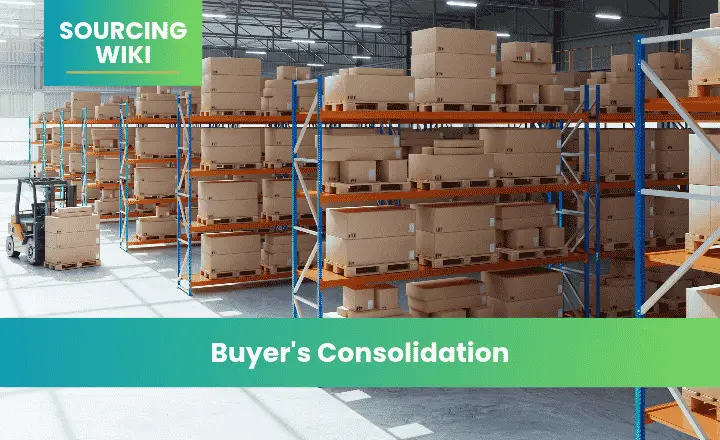
When purchasing products from several suppliers, arranging a separate shipment for every order can increase freight costs and create additional coordination work. Each shipment may require its own collection, handling, shipping arrangements, and destination procedures.
Buyer's consolidation offers another approach: goods purchased by one buyer from multiple suppliers are brought together at an agreed location and prepared for shipment as a combined consignment.
This approach is particularly relevant to importers sourcing different products or components from several factories in China. Instead of arranging independent shipments, buyers can coordinate the orders around a shared shipping plan.
However, consolidation requires more than simply sending all goods to the same warehouse. Delivery schedules, cargo identification, packing information, export documentation, and container loading must be coordinated before shipment.
What Is Buyer's Consolidation?
Buyer's consolidation is a shipping arrangement in which goods from multiple suppliers are collected and combined for one buyer before being shipped to the destination.
For example, an importer may purchase furniture from one factory, lighting products from another, and home accessories from a third. Rather than shipping each order separately, the buyer arranges for the goods to be delivered to a designated consolidation location.
After the deliveries are received and prepared, the cargo can be loaded together into one container or arranged as a combined shipment.
In ocean freight, buyer's consolidation is commonly used to build a Full Container Load (FCL) shipment from orders that would otherwise move separately or through individual Less-than-Container Load (LCL) shipments.
The key characteristic is that the consolidated goods belong to the same buyer, even though they originate from different suppliers.
How Buyer's Consolidation Works
A typical arrangement follows this structure:
- One buyer places orders with multiple suppliers.
- Each supplier prepares its own goods and delivers them to an agreed consolidation location.
- The receiving party records and identifies each delivery.
- The buyer or its appointed service providers coordinate cargo preparation and shipping documents.
- The goods are loaded together and shipped to the destination.
The exact arrangement depends on the shipment, export procedures, and the responsibilities agreed between the buyer, suppliers, warehouse operator, and freight forwarder.
Buyer's Consolidation vs. LCL vs. FCL
These terms are related, but they describe different aspects of shipping.
- Buyer's Consolidation describes how a buyer combines purchases from multiple suppliers.
- LCL (Less-than-Container Load) describes a shipment that shares container space with cargo from other shippers.
- FCL (Full Container Load) describes a shipment booked as a full container, whether or not the container is physically filled to capacity.
Buyer's consolidation often results in an FCL shipment, but it can also be arranged through consolidated LCL services when the combined volume does not justify a dedicated container.
| Shipping arrangement | How it works | Typical situation |
|---|---|---|
| Separate supplier shipments | Each supplier arranges its own shipment | Small orders with different delivery schedules |
| LCL | A buyer's cargo shares container space with other shippers' cargo | Shipment volume is relatively small |
| FCL | A container is booked for one shipment | Cargo volume or shipping requirements justify a dedicated container |
| Buyer's Consolidation | One buyer's purchases from multiple suppliers are combined before shipment | Multiple orders are coordinated into one shipping plan |
An important distinction is that buyer's consolidation does not automatically mean one commercial invoice, one export declaration, or one customs entry. Documentation and customs procedures depend on the parties involved, the export arrangement, and destination-country requirements.
How Does Buyer's Consolidation Work?
A successful consolidation plan starts before the goods are ready. Buyers should coordinate suppliers, delivery dates, cargo details, and shipping arrangements in advance.
Step 1: Collect Order and Supplier Information
Start by preparing a consolidated order list covering all suppliers involved.
The information should include:
- Supplier name and factory location
- Purchase order number
- Product descriptions and SKU details
- Ordered and expected quantities
- Estimated production completion dates
- Estimated carton count, dimensions, and gross weight
- Destination and shipping requirements
This information helps determine whether the suppliers' orders can be combined efficiently and where the consolidation location should be.
Step 2: Select a Consolidation Location
The goods need to reach a common location before they can be combined.
Depending on the supplier locations and shipping arrangements, this may be a freight forwarder's warehouse, a container freight station (CFS), or another agreed facility.
When selecting a location, consider:
- Distance from each supplier
- Domestic transportation costs
- Access to the intended export port
- Available storage and cargo-handling facilities
- Receiving capacity and operating schedules
- Whether the facility can accommodate the products being shipped
A location that is convenient for one supplier may create additional transportation costs for the others. The total cost should be considered rather than choosing a warehouse based only on its location or storage price.
Step 3: Coordinate Supplier Deliveries
Each supplier should receive clear delivery instructions before dispatching the goods.
These instructions should specify the receiving address, contact person, delivery deadline, reference or booking number, and carton identification requirements.
It is also important to establish a common cargo cut-off date. If one supplier delivers late, the buyer may need to postpone the shipment or arrange a separate shipment for the delayed goods.
For this reason, production completion dates and warehouse delivery dates should be treated as two separate milestones.
Step 4: Receive and Identify Each Delivery
When the goods arrive, the receiving party should record the delivery against the corresponding purchase order and packing list.
Typical receiving checks include:
| Check item | What to verify |
|---|---|
| Supplier identity | Confirm which supplier sent the delivery |
| Purchase order | Match the goods to the correct order |
| Carton quantity | Compare received cartons with the packing list |
| Product identification | Check SKU, model, color, and other identifiers |
| Carton dimensions and weight | Record actual shipping information |
| Outer packaging | Note visible damage, moisture, or other abnormalities |
| Shipping marks | Confirm carton labels and references are clear |
These checks help identify shortages, incorrect deliveries, and packaging problems before the goods are loaded.
A warehouse receiving check should not be confused with a complete product quality inspection. If the buyer needs product functionality, workmanship, or specification checks, these should be arranged separately with an appropriate inspection service provider.
Step 5: Prepare the Consolidated Cargo
After receiving, the goods may need additional preparation before shipment.
Depending on the products and buyer's requirements, this may include:
- Sorting goods by supplier, purchase order, or SKU
- Applying or checking shipping marks
- Repacking damaged or unsuitable cartons
- Preparing pallets where appropriate
- Separating products that require special handling
- Confirming the final carton count, dimensions, and weight
Not every shipment requires all these activities. Any repacking, relabelling, or additional handling should be agreed in advance because it may add costs and affect the cargo schedule.
Step 6: Arrange Documentation and Container Loading
Before loading, the buyer and relevant service providers should reconcile the final cargo information with the shipping documents.
Depending on the transaction and export arrangement, documents may include:
- Commercial invoices
- Packing lists
- Export customs declaration information
- Shipping instructions
- Bill of Lading (B/L)
- Product-specific certificates or permits, where required
The buyer should confirm who is responsible for preparing each document and completing export procedures. Goods from different suppliers may require separate commercial and export documentation even when they are transported together.
Once the cargo is ready, the freight forwarder or appointed logistics provider can coordinate container loading and the onward shipment.
Benefits of Buyer's Consolidation
Buyer's consolidation can improve shipping efficiency, especially when an importer regularly purchases from multiple suppliers.
Reduced Shipping Costs
Shipping several small orders independently may involve repeated collection, handling, documentation, and destination charges.
Combining orders can reduce duplicated costs and make better use of container space. However, savings are not automatic. Warehouse receiving, storage, domestic transportation, consolidation, and loading charges must also be included in the calculation.
Simplified Shipment Coordination
Instead of tracking multiple independent shipments, buyers can coordinate their orders around a consolidated shipping plan.
This can make it easier to monitor cargo readiness, arrange shipping schedules, and communicate with the relevant logistics providers.
Better Visibility of Incoming Goods
A central receiving point provides an opportunity to record deliveries from different suppliers in one place.
Buyers can compare received quantities with purchase orders and packing lists, identify missing cartons, and address visible packaging problems before shipment.
More Flexible Product Purchasing
Buyers do not necessarily need to purchase every product from one factory simply to simplify shipping.
They can work with different manufacturers based on product requirements and then evaluate whether combining the orders is practical.
Potential Challenges and Risks
Although buyer's consolidation has clear advantages, it also introduces coordination requirements that should not be overlooked.
| Potential issue | Why it matters | How to manage it |
|---|---|---|
| Different production schedules | One delayed supplier may hold up the entire shipment | Set delivery deadlines and define a cut-off date |
| Incorrect cargo information | Differences in carton counts, dimensions, or weights can affect shipping arrangements | Collect and reconcile updated packing lists |
| Unidentified cartons | Goods from different suppliers may become difficult to distinguish | Use consistent shipping marks and PO references |
| Additional warehouse costs | Storage and handling charges may reduce expected savings | Confirm charges and free storage periods in advance |
| Documentation differences | Multiple suppliers may have different invoicing and export arrangements | Confirm document responsibilities before loading |
| Special cargo requirements | Certain products may require specific handling or shipping arrangements | Disclose product characteristics before booking |
| Damage during handling | Additional movement and repacking may affect packaging condition | Agree on handling procedures and record cargo condition |
The Late Supplier Problem
One of the most common challenges is a mismatch in production schedules.
For example, suppose three suppliers have the following estimated delivery dates:
| Supplier | Products | Expected warehouse arrival |
|---|---|---|
| Supplier A | Furniture | June 5 |
| Supplier B | Lighting | June 9 |
| Supplier C | Home accessories | June 18 |
If the planned loading date is June 20, Supplier C leaves very little time for receiving checks and cargo preparation.
The buyer should therefore establish a realistic delivery window and decide in advance what happens if one supplier cannot meet the deadline.
Possible options include waiting for the delayed goods, shipping the available cargo first, or arranging a separate shipment for the remaining order. The best option depends on the cost and urgency of each order.
Buyer's Consolidation: When Does It Make Sense?
Buyer's consolidation is not suitable for every shipment. The decision should consider total cargo volume, supplier locations, delivery schedules, product characteristics, and the destination.
It is generally worth evaluating when:
- You purchase from several suppliers in the same country.
- Individual orders are too small to justify separate FCL shipments.
- The suppliers can deliver within a reasonable time window.
- The goods have compatible shipping and handling requirements.
- Combining the orders may reduce repeated shipping and destination charges.
It may be less practical when suppliers are located far apart, production schedules differ significantly, or one urgent order cannot wait for the others.
How to Compare Separate Shipments and Consolidation
Before choosing an arrangement, request cost estimates for both options.
| Cost component | Separate shipments | Buyer's consolidation |
|---|---|---|
| Supplier-to-port transportation | May be charged separately for each supplier | May be combined or coordinated |
| Warehouse receiving | Depends on each shipment arrangement | Usually applies to incoming deliveries |
| Storage | May be limited or unnecessary | May apply while waiting for other suppliers |
| Cargo handling | Charged according to individual shipments | Includes consolidation and loading activities |
| Main freight | Quoted separately | Quoted for the combined shipment |
| Documentation | Depends on the number and type of shipments | May be simplified, but not necessarily reduced to one document |
| Destination charges | May be repeated for separate shipments | May be reduced depending on the final shipping arrangement |
The comparison should use the total cost from supplier pickup to final destination, not just the ocean freight rate.
Checklist Before Arranging Buyer's Consolidation
Before confirming a consolidation plan, buyers should make sure the following details are clear:
- All participating suppliers and purchase orders are identified.
- Each supplier has a confirmed production and delivery schedule.
- The consolidation location and receiving contact are confirmed.
- Delivery instructions and carton marking requirements are shared.
- Each supplier provides an updated packing list.
- Receiving, storage, and handling charges are confirmed.
- Product-specific handling or shipping requirements are disclosed.
- Export documentation responsibilities are agreed.
- The final cargo volume and weight are confirmed before booking.
- A contingency plan is in place for delayed suppliers.
A clear plan helps prevent avoidable delays and makes it easier to evaluate whether consolidation is genuinely cost-effective.
Frequently Asked Questions
Is Buyer's Consolidation the same as LCL shipping?
No. Buyer's consolidation describes combining purchases from multiple suppliers for one buyer. LCL describes sharing container space with cargo from other shippers. A buyer's consolidated cargo may be shipped as FCL or, depending on its volume and arrangement, as LCL.
Can I combine products from different factories in one container?
Yes, provided the products can be transported together and the relevant shipping, export, and import requirements are met. The buyer should confirm cargo compatibility, documentation, and handling arrangements before loading.
Does Buyer's Consolidation always reduce shipping costs?
No. It can reduce duplicated freight and handling costs, but warehouse receiving, storage, domestic transportation, and consolidation charges may offset the savings. A comparison of total costs is necessary.
Do all suppliers need to be in the same city?
No. Suppliers can be located in different cities, but transportation distance and collection costs should be considered. Suppliers located relatively close to one another may be easier and less expensive to consolidate.
Can I consolidate goods that are ready at different times?
Yes, if the consolidation facility can receive and store the earlier deliveries until the remaining goods arrive. However, storage fees, cargo readiness, and the planned vessel schedule should be considered.
Does one consolidated shipment mean one commercial invoice?
Not necessarily. Each supplier may issue its own commercial invoice depending on the sales transactions and export arrangements. The buyer should confirm the required documentation structure with the exporter and customs or freight service providers.
Is Buyer's Consolidation suitable for small orders?
It can be, but the economics depend on the combined volume and total handling costs. For smaller shipments, ordinary LCL may be more practical than arranging a dedicated container.
Conclusion
Buyer's consolidation can help importers coordinate purchases from multiple suppliers without arranging every order as an independent shipment. By bringing goods together at an agreed location, buyers may reduce duplicated shipping costs, improve cargo visibility, and simplify shipment coordination.
The key is to plan beyond the container itself. Supplier delivery schedules, receiving records, packing information, documentation, and total logistics costs all affect whether consolidation will work.
For businesses sourcing products from multiple manufacturers in China, NewBuyingAgent helps buyers connect with manufacturing resources and coordinate product sourcing based on their purchasing needs. Buyers can then evaluate suitable shipping arrangements with their appointed logistics providers to bring the orders together efficiently.
References
- Flexport – Buyer's Consolidation: https://www.flexport.com/products/buyers-consolidation/
- United Nations Trade and Transport Training – Training Manual on Operational Aspects of Multimodal Transport, Chapter 3: The Concept and Practice of Cargo Consolidation: https://unttc.org/sites/unttc/files/2022-06/Training%20Manual%20on%20Operational%20Aspects%20of%20Multimodal%20Transport.pdf
Related Knowledge Base
Sourcing Practices & Insights: Buyer's Consolidation: How to Combine Shipments from Multiple Suppliers
Latest Sourcing Guides




ابدأ اليوم
دعنا نحول أهداف التوريد الخاصة بك إلى واقعWeChat:+86 15157124615
WhatsApp:+86 15157124615
العنوان: مبنى 10 #39 طريق شيانغيوان، هانغتشو، الصين
