

A useful business WeChat setup is not mainly about getting faster replies. The real risk is allowing a fast chat to become an undocumented approval, an unclear sample instruction, or an unverified payment change. For a US or EU buyer working with China suppliers, the safer model is simple: use chat to coordinate, a dated recap to assign ownership, and controlled documents for commercial commitments. That division preserves the convenience of a live conversation without asking a message history to carry the weight of a specification, purchase order, or finance approval.
WeChat is one communication option, not a universal requirement and not a substitute for supplier validation. The practical aim is to make each contact easy to place, each request easy to act on, and each high-consequence change easy to verify. This failure happens because a single chat thread can blur evidence, ownership, and approval authority when work moves quickly. The steps below focus on that operating discipline rather than app screens or fixed cultural rules.
Set Up WeChat as a Working Channel, Not a Shortcut
A business WeChat routine should separate fast coordination from decisions that require a controlled record. At the platform level, Tencent describes WeChat and Weixin as separate but interoperable services, with WeChat aimed at users outside mainland China. That context makes the app a sensible channel to prepare for, but it does not turn a chat into a commercial control system.
- Be recognisable: show a real name, company, role, and practical availability without oversharing personal details.
- Make the first request routeable: name the reason for connecting, product context, and the next item you will send.
- Give each chat a job: keep one decision or deliverable together, then write down the owner and deadline when it changes work.
- Pause high-risk changes: a bank, beneficiary, address, or login request needs independent verification before action.
The result is not a rigid etiquette script. It is a shared boundary: chat can accelerate evidence collection and clarification, while the buyer’s agreed records carry commitments that could affect price, quality, timing, or money movement.
Build a Profile a Supplier Can Place in Seconds
A business profile should identify the person, company, role, and practical availability without exposing more information than company policy permits. Asialink Business notes that day-to-day business communication in China is often conducted through WeChat and recommends sharing a digital business card once connected. A recognisable profile gives that card context before the recipient opens a file or a long message.
Use the name by which suppliers should address you, plus your company and role. “Maya Chen | Northshore Home | Product Development” is more useful than an abbreviated personal name or a company logo with no person behind it. Add a professional photo if it fits the buyer’s policy, and include a time-zone cue in the profile or opening message when response timing matters. A supplier should not have to search an old email thread to work out whether the new contact owns samples, quality comments, or freight questions.
Keep the profile informative, not exhaustive. Do not place passport details, payment information, personal phone numbers, passwords, confidential drawings, or internal approval limits in it. If one phone is used for personal and business conversations, the same rules apply: make the business purpose clear, then keep sensitive information in the buyer’s approved files and systems.
A short digital business card, company website, or one-page capability introduction is enough for most first exchanges. The next goal is not to present every requirement at once; it is to make the correct person willing and able to route the first useful request.
Make a First Contact That Has a Clear Business Purpose
A first contact should state identity, company, purpose, product context, and the next item the buyer will send. WeChat contact exchange is increasingly common in China business settings. That is a useful reason to make the connection clear, not a reason to send an unstructured “Hi” and wait for the supplier to infer the job.
WeChat contact exchange and a digital business card are practical ways to make a business connection recognisable in China-oriented work. The U.S. Commercial Service notes that WeChat contact exchange is increasingly common in China business settings. These are practical ways to identify a person and company after connecting, not a fixed rule for every supplier, app user, or product discussion. A buyer should still make the commercial purpose clear in the first message and validate a new contact before sharing sensitive material.
Start with a compact message that a busy contact can scan: who you are, the company, why you are connecting, the product category, and the next artefact. For example: “Hello, I’m Maya from Northshore Home in the UK. We are reviewing a bamboo storage range and would like to discuss a revised sample. I will send our current specification and photo reference after you confirm the best contact for samples.” This gives a purpose without forcing price, drawings, and every question into the first message.
When the next step is an RFQ (request for quotation), identify the product, quantity range, target destination, and decision timing before sending detailed files. Label attachments with a version and date. If a QR code or WeChat ID comes from a new intermediary, validate the counterparty through an established company channel before sharing sensitive specifications. Buyers who need a broader preparation sequence can read NewBuyingAgent's China sourcing guide before supplier outreach.
Etiquette here is practical. A precise request gives the recipient a way to respond, delegate, or ask a focused question. Vague requests create more back-and-forth, then make it harder to identify which message was tied to the sample, quote, or revision under discussion.
Use Three Channels So Fast Messages Do Not Become Lost Decisions
Use chat for fast coordination, a written recap for ownership and timing, and controlled documents for commercial commitments. This operating model applies the fraud-control principle in IC3 guidance to establish another communication channel for significant transactions. The point is not to create duplicate paperwork; it is to prevent speed from disguising a change in authority.
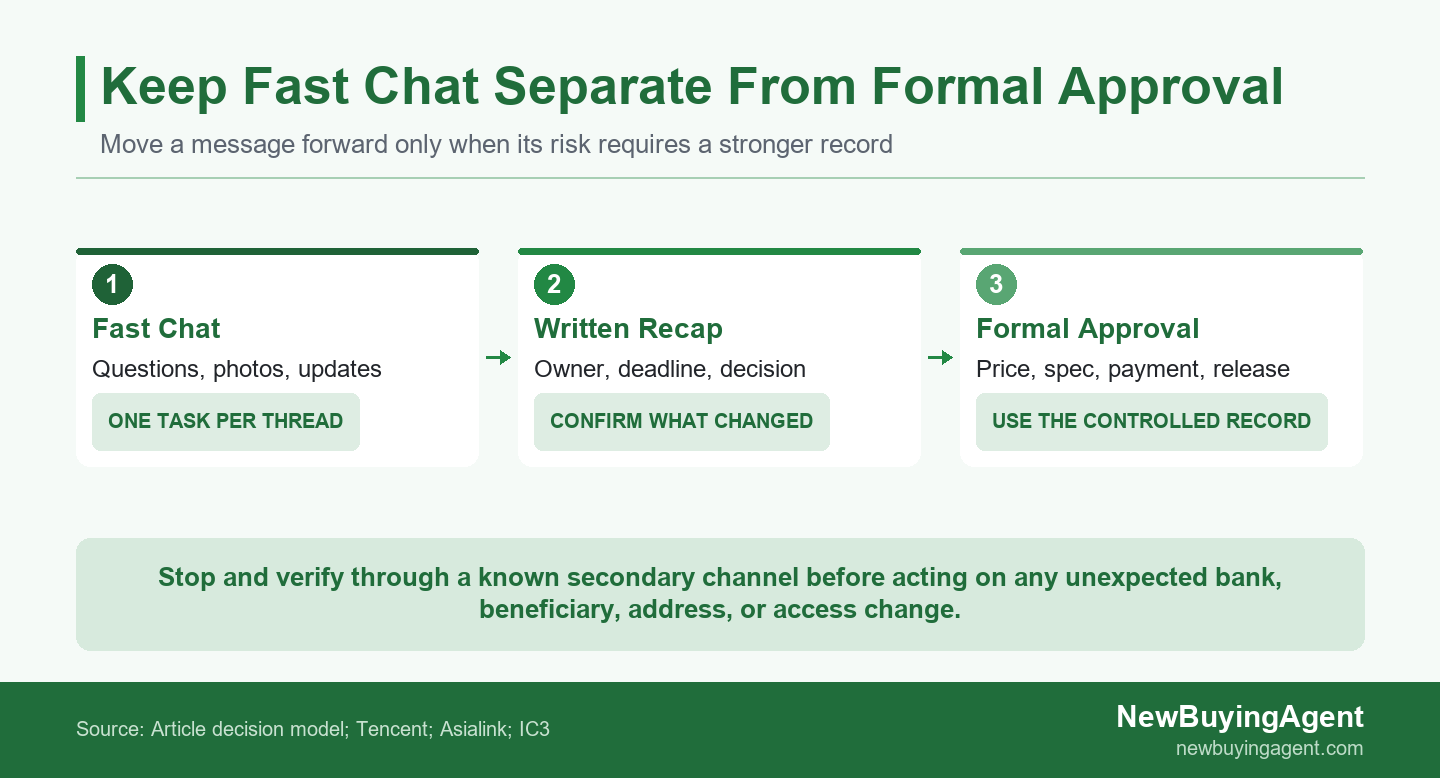
Three-channel flow separating WeChat chat, written recaps, and formal sourcing approvals
| Channel | Use it for | Record it in | Do not let it authorise |
|---|---|---|---|
| WeChat chat | Photos, availability, clarification, meeting times, and evidence requests | The thread plus a named follow-up item | A bank-detail change, final commercial approval, or release decision |
| Written recap | What changed, who owns the next step, and when it is due | A dated email, shared log, or approved project record | A substitute for the underlying specification, PO, or finance control |
| Controlled document | Specifications, purchase orders (POs), approved samples, payment instructions, and release authority | The buyer’s agreed document or approval system | Informal live coordination that belongs in the chat |
Based on this comparison, a buyer does not need to move every conversation out of WeChat. The decision rule is narrower: move the information when it changes a commercial commitment or when a future reviewer must be able to identify the approved version, owner, and timing without interpreting a long chat history. For buyers who already have a China factory, the same record discipline can support production updates, quality evidence, and logistics coordination; where local follow-through is needed, see how NewBuyingAgent manages communication with existing China factories.
Keep Each Chat Thread to One Decision or Deliverable
One clear task per message cluster makes the requested evidence, owner, and deadline easier to identify. Instead of mixing a packaging correction, a freight question, and a new product idea in one run of messages, name the object and the decision need: “Sample V3: please confirm whether the handle photo is from the revised mould by 15:00 China time.” The contact can then answer, forward the request, or ask for the missing evidence without searching for the question.
Use a group chat only when each participant has a defined reason to be there. State whether a reply is needed from the supplier contact, factory engineer, quality person, buyer, or freight coordinator. When someone sends a photo, ask for the relevant version, date, or carton/sample identifier in the same exchange. That small discipline becomes valuable when a comment must later be checked against an approved specification.
For buyers who already have a China factory, the same message structure can support production updates, quality evidence, and logistics coordination. The value comes from a visible request, an identified owner, and a record that keeps the supplier’s next action connected to the controlled product or quality decision.
Turn Verbal or Chat Agreement Into a Written Recap
A dated recap should identify the decision, affected product or sample, owner, deadline, and the formal record that carries approval. A useful recap can be five lines: “Sample V3; handle colour corrected; factory to send six photos by 15:00 China time; Maya to review by 10:00 UK time; final approval remains in the sample approval file.” It creates a reference point without pretending that the recap itself replaces the approved document.
Send the recap when the conversation crosses a decision boundary: a new cost basis, revised specification, sample acceptance, delivery-date change, or issue that needs escalation. If the answer remains a simple availability check, a recap may add needless friction. If it changes a purchase order, payment, or shipment release, chat-only memory is too weak a record. The buyer should point the conversation back to the controlled document and keep the version visible.
Be Direct About the Issue Without Making the Conversation Personal
A buyer can escalate firmly by naming the observed gap, required evidence, decision owner, and timing rather than assigning motives. The U.S. Commercial Service emphasises long-term relationships and continuous communication in China business. That context supports making the next action clear without avoiding a material quality or timing issue.
Lead with the observable fact: “The carton photo does not show the revised warning label in Specification V4.” Then state what is needed: “Please provide two photos of the current carton from the production line and confirm which version is in use.” Add an owner and a time: “If this cannot be confirmed by 16:00 China time, please include the production manager so we can agree the next review point.” This language stays specific about the gap and avoids statements such as “you ignored the requirement” when the evidence has not established motive.
Escalation is most effective when the buyer has already separated the discussion into a visible task and recap. The supplier can see the product, evidence, owner, and requested decision. If the issue affects a contractual remedy, shipment release, or a formal quality dispute, follow the buyer’s contract and escalation procedure rather than trying to settle it solely in WeChat.
Treat Payment and Account Changes as a Stop-and-Verify Event
Pause an unexpected bank, beneficiary, address, or access change until it is independently verified through a known secondary channel. The IC3 advises using a secondary channel or two-factor authentication to verify account-information changes. A familiar chat name is not independent confirmation that the instruction is genuine.
Use out-of-band verification, meaning a separate, known communication route. Call a number already held in the buyer’s supplier master data, use a pre-agreed finance contact, or confirm through the controlled payment process. Do not use a number, link, or QR code supplied only in the unexpected message. Record who verified the change, how, and when before any funds move or a destination address is amended.
Urgency, an unexpected login request, or a request for credentials should trigger verification rather than an immediate response in chat. The FTC advises businesses to verify suspicious requests with a number they already know is correct, rather than a number in the message. Separately, the FTC warns that scammers create urgency so people act before checking. Treat pressure as a stop signal, especially when the requested action changes money, account access, or delivery instructions.
This is a communication control, not legal or fraud advice. Buyers should follow their own finance, information-security, and incident-response policies. The useful habit is modest: if an instruction is consequential and unexpected, move it out of the chat and verify it independently.
An Illustrative Three-Day Sample Review Sequence
A three-day sample review can preserve urgency when chat requests the evidence and a controlled record carries the approval. The example below is illustrative, not a NewBuyingAgent customer case. It shows the operational difference between a quick response and a decision that another buyer or colleague can later understand. When the work is a new-product brief rather than an existing-factory follow-up, buyers can ask NewBuyingAgent to turn purchasing requirements into a China product quote once the product, quantity, destination, timing, and open decision are clear.
Day 1–3: Request, Recap, Then Approve
An identified sample request, dated recap, and controlled approval can keep a three-day review moving without treating chat as the approval record. In this illustrative case, a buyer in London is reviewing 1 revised sample and 6 packaging photos for a 2,000-unit home-goods order with a factory contact in Ningbo. The buyer has an RFQ and the current specification, but needs a decision before day 3 of an internal review.
On day one, the chat contains a revised-sample message without a version reference, and the six requested packaging photos are not tied to the sample or target ship week. The issue is not a slow reply; it is that the buyer cannot know which evidence supports the next approval. The buyer sends one request naming Sample V3, the six photos, the owner, and a China-time response deadline, then asks that final approval stay in the controlled sample record.
On day two, the supplier sends the evidence and the buyer posts a dated recap. On day three, approval proceeds only when the identified sample, all 6 photos, and the controlled approval record agree. If they do not agree, the buyer asks for correction rather than treating the earlier chat confirmation as acceptance. This is an illustrative example, not a NewBuyingAgent customer case.
When a Communication Gap Needs China-Side Follow-Through
A complete product brief and a clear record of the open decision give a China-side sourcing partner a better basis for product supply or existing-factory follow-through. If the buyer is developing or buying a new product, state the product description, specifications or photos, quantity, target price, destination, timing, and the unresolved sample or quote question. If the buyer already has a China factory, bring the current supplier contact, production or quality evidence, and the decision that has stalled.
NewBuyingAgent is a one-stop China sourcing agent for global buyers. In a new-product discussion, its local China factory resources and product-development and quality-control capability can connect the brief to product supply. In an existing-factory discussion, the useful starting point is the current evidence and communication gap, not a generic request for help. The better the brief and record, the less time is spent reconstructing what the supplier message meant.
A useful brief distinguishes confirmed facts from items that still need a decision. It names the product, intended quantity, destination, timing, target price where known, and the relevant contact or current factory history. It also labels the source of each important attachment and the date or version that should control the next review. This prevents a China-side discussion from starting with a plausible but incomplete chat summary, then spending its first exchanges rebuilding the decision trail. For a project-specific next step, send the product brief and current communication gap to NewBuyingAgent.
Frequently Asked Questions
Should a buyer use a personal or company WeChat profile?
Use a profile that clearly identifies the person, company, role, and business purpose while following the buyer’s device and privacy policy. A personal account can still work for business if the recipient can quickly place the person and the request. The key is not the account label; it is whether sensitive information stays out of the profile and the business context is clear.
How should I introduce myself in a WeChat request?
State your name, company, reason for connecting, product category, and the next item you will send. A short message that identifies the buyer and the immediate decision is more useful than a long company introduction. Keep sensitive drawings, credentials, payment data, and final commercial terms for validated contacts and controlled records.
Can WeChat messages replace a purchase order?
A chat message can coordinate work, but it should not replace a purchase order, controlled specification, or independently verified payment instruction. Chat can clarify day-to-day work and show where a question began, but commercial approvals should be captured in the purchase order, specification, or agreed written record. A dated recap can point people to the current decision and owner; it should not become a substitute for the document that carries authority.
What should happen when bank details change in chat?
Pause the payment change and verify it through a known secondary contact path before any funds move, even when the chat account appears familiar. Use a previously verified phone number or the buyer’s normal finance process, not a number or link supplied only in the new message. Record the verification and follow company security procedures if anything remains uncertain.
NewBuyingAgent
Related Resources


ابدأ اليوم
دعنا نحول أهداف التوريد الخاصة بك إلى واقعWeChat:+86 15157124615
WhatsApp:+86 15157124615
العنوان: مبنى 10 #39 طريق شيانغيوان، هانغتشو، الصين
