

A China sourcing agent adds value beyond price when the agent reduces costs that do not appear in the first quote: weak factory cooperation, quality drift, buyer time, payment pressure, unsellable products, freight surprises, and document mismatch. The real question is not whether the agent is cheaper; it is whether the delivered product outcome is better.
Key Takeaways
- Price is only one layer of sourcing value: the buyer also pays for time, quality risk, delivery uncertainty, and cash-flow pressure.
- The best value comes from hidden-cost reduction: factory resources, QC evidence, payment flexibility, product-market fit, and logistics discipline can protect margin.
- NewBuyingAgent's advantage is resource-backed supply: buyers provide purchasing needs, and NewBuyingAgent uses local factory resources to supply China products with better price, quality, and service.
Price Is the Easiest Value to See, Not the Only Value
A China sourcing agent's value should not be judged only by whether the first unit quote is lower than a direct factory quote. Price is important, but hidden costs often decide the final profit. Buyer time, rework, late shipment, weak packing, missing documents, quality drift, and poor product-market fit can erase a cheaper first price.
According to US trade due-diligence guidance from Trade.gov due-diligence guidance, overseas claims should be verified before buyers rely on them. That changes how buyers should evaluate a sourcing agent: the agent is valuable when it converts claims into evidence and reduces the buyer's exposure before deposit, production, payment, and shipment.
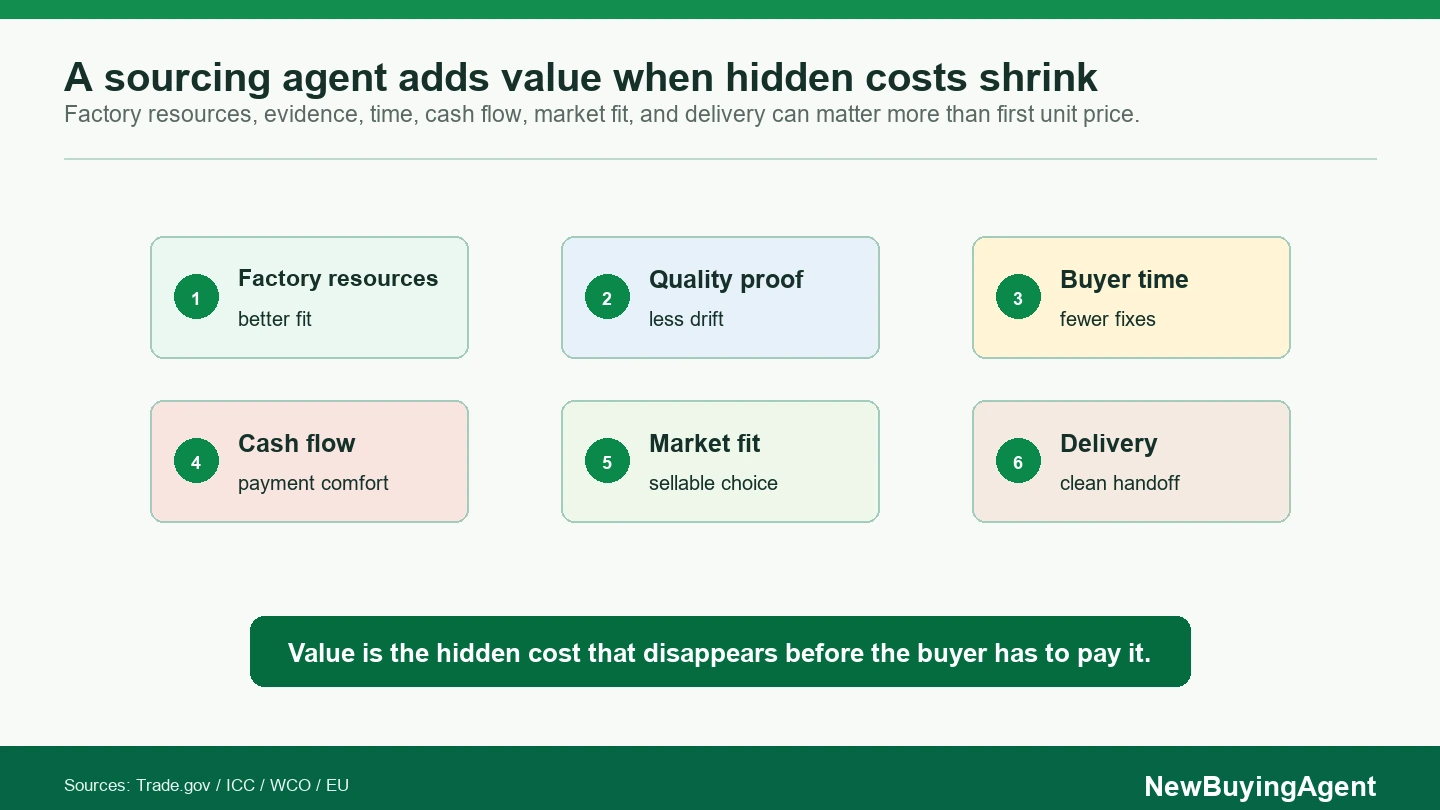
A sourcing agent adds value when factory resources, quality evidence, time, cash flow, market fit, and delivery reduce hidden cost.
The Top 8 Value Levers Beyond Price
The value levers below help buyers compare a sourcing-agent path against direct factory communication. Some levers matter more for new products. Others matter more for repeat orders, regulated products, seasonal goods, or buyers without local China execution capacity.
| Value lever | What the buyer gains | Where it shows up | Decision rule |
|---|---|---|---|
| Factory-resource leverage | Better category fit and cooperation | Quote quality and product version | Use resources to improve outcome, not to collect names |
| Quality evidence | Fewer late surprises | Sample, production, packing, and release | Approve evidence before balance payment |
| Time recovery | Less buyer coordination load | Communication and corrective action | Price management time into total cost |
| Cash-flow comfort | Less pressure before revenue returns | Payment timing and shipment release | Compare cost with payment terms |
| Market-fit support | Fewer unsellable products | Product selection and style decisions | Do not source only because a quote is cheap |
| Delivery reliability | Clearer freight and document handoff | Packing, documents, and destination receipt | Compare delivered usable product |
1. Factory-resource leverage
A sourcing agent adds value when local factory resources improve category fit, cooperation, cost negotiation, and production reliability. The goal is not for the buyer to receive a long list of factory names. The goal is to turn the buyer's purchasing need into a China-sourced product path that fits price, quality, and delivery.
NewBuyingAgent's local China factory network and 50,000+ cooperated factory resources matter here because buyers often cannot reach enough cooperative production options alone. The agent's value appears when those resources improve the supplied product outcome, not when they simply create more conversations.
2. Product-version control
Many sourcing failures happen because the quote, sample, production batch, packing file, and shipment documents describe slightly different products. A sourcing agent adds value by locking the version that the buyer actually wants to buy, then making sure later changes are visible before they become expensive.
According to US Commercial Service background-check guidance from Commercial Service background-check guidance, business claims should be checked before commitment. In product sourcing, the equivalent is checking product claims: material, finish, accessory, label, carton, test evidence, and delivery term should match the same order file. This is especially important when a buyer asks several factories or agents to quote the same product but receives different assumptions hidden under the same product name.
3. Quality evidence before payment
A sourcing agent adds value when the buyer sees evidence before balance payment or shipment. Evidence may include approved sample records, production photos, in-process checks, inspection reports, packing photos, carton marks, and corrective-action results. The value is not only defect detection. It is leverage before release.
NewBuyingAgent's product development and QC capability is relevant because quality control begins before final inspection. Buyers who give clear product requirements can receive a sourcing path that prices quality expectations into the product, rather than treating QC as a late repair step. For higher-risk orders, the buyer should define what evidence is needed before balance payment, not only what defect rate is acceptable at the end.
4. Buyer time recovery
Direct factory sourcing consumes time through emails, late calls, translation, sample clarification, factory chasing, inspection review, document correction, and freight coordination. A sourcing agent adds value when it reduces the buyer's coordination load enough to free time for sales, merchandising, channel growth, or customer service.
A simple scenario shows the point. If a buyer spends 30 extra hours fixing an order to save 3% on unit price, the savings may disappear when management time, delayed launch, and rework are counted. The right comparison is delivered usable product, not only factory quote versus agent quote.
5. Payment and cash-flow support
Cash flow can matter as much as unit price. A cheaper direct quote may require a larger deposit, faster balance payment, or less shipment evidence before release. A sourcing agent adds value when payment timing, trust, and evidence reduce pressure before the buyer has sales revenue or inventory turnover.
NewBuyingAgent's flexible payment support should be discussed as a margin and cash-flow advantage, not as a generic payment promise. It matters when the buyer needs to align deposit, production evidence, shipment timing, and cash recovery more comfortably. The buyer should ask how payment timing connects to sample approval, production progress, inspection evidence, and shipment release.
6. Market-fit product selection
A product can be cheap and still fail if it does not fit the buyer's market. A sourcing agent adds value when it helps avoid unsellable inventory, weak styling, wrong packaging, or an overcomplicated SKU mix. This is especially important for categories where buyers compare many styles, colors, sizes, or bundles.
NewBuyingAgent's AI-driven hot-product analysis and market-fit sourcing capability can help buyers shape the product direction before sourcing locks in. The value is not only finding production; it is avoiding products that look good in a factory sample room but fail in the buyer's channel.
7. Logistics and document discipline
Freight cost, carton data, delivery term, packing method, and export documents can change the real cost of a China order. A sourcing agent adds value when the shipment file matches the goods and the buyer knows who owns each handoff before the cargo moves.
According to US trade shipping guidance from Trade.gov shipping guidance, shipping choices affect cost and timing. According to US trade export-document guidance from Trade.gov export-document guidance, common documents are used in trade and should align with the shipment. The buyer's practical rule is to check freight and documents before shipment, not after the factory says goods are ready. This is where an agent's local execution can protect the handoff between finished goods, cartons, invoice wording, and destination receipt.
8. Landed-cost clarity
A sourcing agent adds value when the buyer can compare true cost across product, packing, QC, freight, duty, payment timing, and delay risk. This does not mean every agent should promise the lowest landed cost. It means the buyer should see which assumptions are included before choosing a path.
According to ICC Incoterms rules, cost and risk responsibilities are defined through trade terms, while according to the WCO Data Model, structured trade data matters for cross-border information. Together, they reinforce the same buyer rule: price is useful only when product identity, carton data, and delivery responsibility are clear.
When a Sourcing Agent Adds the Most Value
A sourcing agent adds the most value when the order has enough complexity to create hidden cost. That includes new products, multi-SKU orders, customized packaging, strict quality expectations, seasonal timing, fragile goods, regulated products, tight cash flow, or buyers without local China follow-up capacity.
New products need market and production judgment
New products create uncertainty around specifications, supplier cooperation, sample changes, MOQ, packaging, and sales channel fit. A sourcing agent can reduce the learning cost by using category experience and local factory resources to build a more practical product path. The buyer still needs to define target customer, price band, destination, and quality expectations.
According to US trade special-document guidance from Trade.gov special-document guidance, some products may require certificates for standards, safety, or health. That matters for new-product sourcing because evidence requirements should be considered while the product is still being shaped, not after the first production batch is finished.
Repeat orders need consistency, not only lower price
Repeat orders can fail when the second or third batch changes material, finish, accessories, labels, or packing. A sourcing agent adds value by helping keep the approved version stable and making changes visible before release. The buyer should track version records, not only reorder by product name.
If the buyer already has a supplier but lacks China-side management, NewBuyingAgent can fit as the local management route that keeps supplier communication, production progress, staged quality evidence, and door-to-door logistics connected to one order outcome. That scenario is different from new product sourcing, but the value still goes beyond price because it protects quality, timing, and delivery confidence.
Where NewBuyingAgent Fits Beyond Price
NewBuyingAgent's strongest value beyond price is the combination of one-stop China sourcing, local industrial-cluster factory resources, product development and QC capability, 30+ years of trade/manufacturing/QC experience, AI-driven product analysis, flexible payment support, and multi-industry case experience.
Buyers tell NewBuyingAgent what they need to buy, including product specs, quantity, target price, destination, and timing. NewBuyingAgent then uses its China-side resources to quote and supply products from China with better price, quality, market fit, payment comfort, and delivery confidence.
If the buyer wants to compare sourcing paths, start with NewBuyingAgent service options. If the product need is already clear, use NewBuyingAgent's purchasing inquiry channel to share the brief and request a quote-to-supply response.
How to Decide Whether the Value Is Worth the Fee
The fee is worth it when avoided hidden costs are larger than the visible service cost or margin. Buyers should estimate the cost of extra coordination time, delayed launch, rework, quality claims, air freight, document correction, storage, cash-flow pressure, and unsellable inventory. Then compare that estimate with the sourcing-agent path.
A useful decision rule is to ask: what does this agent reduce that I would otherwise pay for later? If the answer is only "a lower unit price," the buyer should be cautious. If the answer includes factory cooperation, quality evidence, payment timing, market fit, logistics, and delivery records, the value is broader and easier to justify.
According to the EU Access2Markets import guide, import preparation connects product and shipment information before goods enter the EU. Even for buyers outside Europe, the broader lesson is useful: a sourcing agent adds value when it keeps product identity, documents, and receiving assumptions consistent enough that the destination market can accept the goods without costly rework.
The fee decision becomes clearer when the buyer assigns rough numbers to hidden costs. Estimate the cost of one delayed launch week, one urgent air-freight correction, one failed inspection, one carton relabeling round, one documentation mismatch, and the internal hours spent chasing answers. Those are not abstract risks; they are the places where a sourcing agent either creates value or exposes that it is only adding another communication layer.
Buyers should also look at value by order stage. Before deposit, the agent should improve product choice and quote clarity. During production, it should protect version control and quality evidence. Before shipment, it should align packing, documents, freight, and payment timing. After delivery, it should leave a cleaner repeat-order file. If value is visible across those stages, the fee is easier to defend than a small unit-price difference.
Frequently Asked Questions
How does a China sourcing agent add value beyond price?
A China sourcing agent adds value by reducing hidden costs in factory cooperation, product-version control, QC evidence, buyer time, payment pressure, market fit, logistics, and documents. The real value is the delivered usable product outcome, not only the first unit quote.
Is a sourcing agent worth it if direct factory prices are lower?
A sourcing agent can still be worth it when hidden costs are higher than the visible price gap. Direct factory sourcing is attractive when the buyer controls specs, QC, documents, freight, and supplier communication. Agent value rises when those layers are weak.
What should buyers send before asking for a sourcing quote?
Buyers should send product specs, quantity, target price, destination, delivery timing, packaging needs, quality expectations, current supplier status if any, and known risk concerns. A clearer brief helps the agent quote the correct product version instead of guessing.
Does NewBuyingAgent only help with new product sourcing?
No. NewBuyingAgent can help buyers source new China-supplied products, and it can also support buyers that already have China suppliers through China-side factory management that connects local communication, production progress follow-up, staged QC, documents, and door-to-door logistics to the final order result.
NewBuyingAgent
Related Resources

ابدأ اليوم
دعنا نحول أهداف التوريد الخاصة بك إلى واقعWeChat:+86 15157124615
WhatsApp:+86 15157124615
العنوان: مبنى 10 #39 طريق شيانغيوان، هانغتشو، الصين
