


Supplier corrective action aging is the elapsed time that a supplier problem remains open from its recorded opening date to a reporting date. It shows how long corrective work has remained unresolved; days overdue instead measures time beyond an agreed deadline.
A supplier can close several easy cases quickly while an older quality problem stays unresolved. That is the blind spot this key performance indicator (KPI) addresses: the unfinished work behind an apparently improving closure report.
Read the Unfinished Work, Not Just the Closed Cases
Supplier corrective action aging is most useful when it keeps open risk separate from completed work. A closed-case average tells you how quickly finished cases moved, but it cannot show how long unresolved cases have waited. Review open age, overdue status and product exposure together, then decide which owner needs to act and what evidence will demonstrate progress.
- Preserve the clock: Keep original opening and due dates alongside approved revisions.
- Expose the tail: Show the oldest cases and age bands, not only an average.
- Check effectiveness: Distinguish a change being implemented from evidence that it works.
- Prioritize exposure: A newer uncontrolled defect can deserve faster action than an older contained issue.
Why Faster Closure Can Hide an Older Backlog
Average closure time can improve simply because recent, easier cases have been completed. The oldest open corrective action does not enter that calculation at all, so its continued delay remains invisible unless you show the open population separately. Keep both views: completed-case speed for throughput, and open-case age for the work still requiring attention.
Consider an illustrative reporting exercise. Two closed cases took 30 and 40 calendar days, giving a 35-day average: (30 + 40) ÷ 2. Adding two further closures of 5 and 7 days reduces that average to 20.5 days: (30 + 40 + 5 + 7) ÷ 4. Neither calculation includes the cases that remain open.
At the reporting cut-off, four separate open cases have ages of 12, 28, 47 and 90 days. The 90-day case still needs a decision even though the closed-case result looks better. This is an illustration of population selection, not evidence that a particular supplier has manipulated its results or that 90 days is always unacceptable.
Use the long-open cases as the starting list for investigation. Ask whether each is waiting for supplier work, buyer approval or effectiveness evidence, and whether current orders remain exposed. Those answers determine the intervention; a shorter closure average cannot supply them.
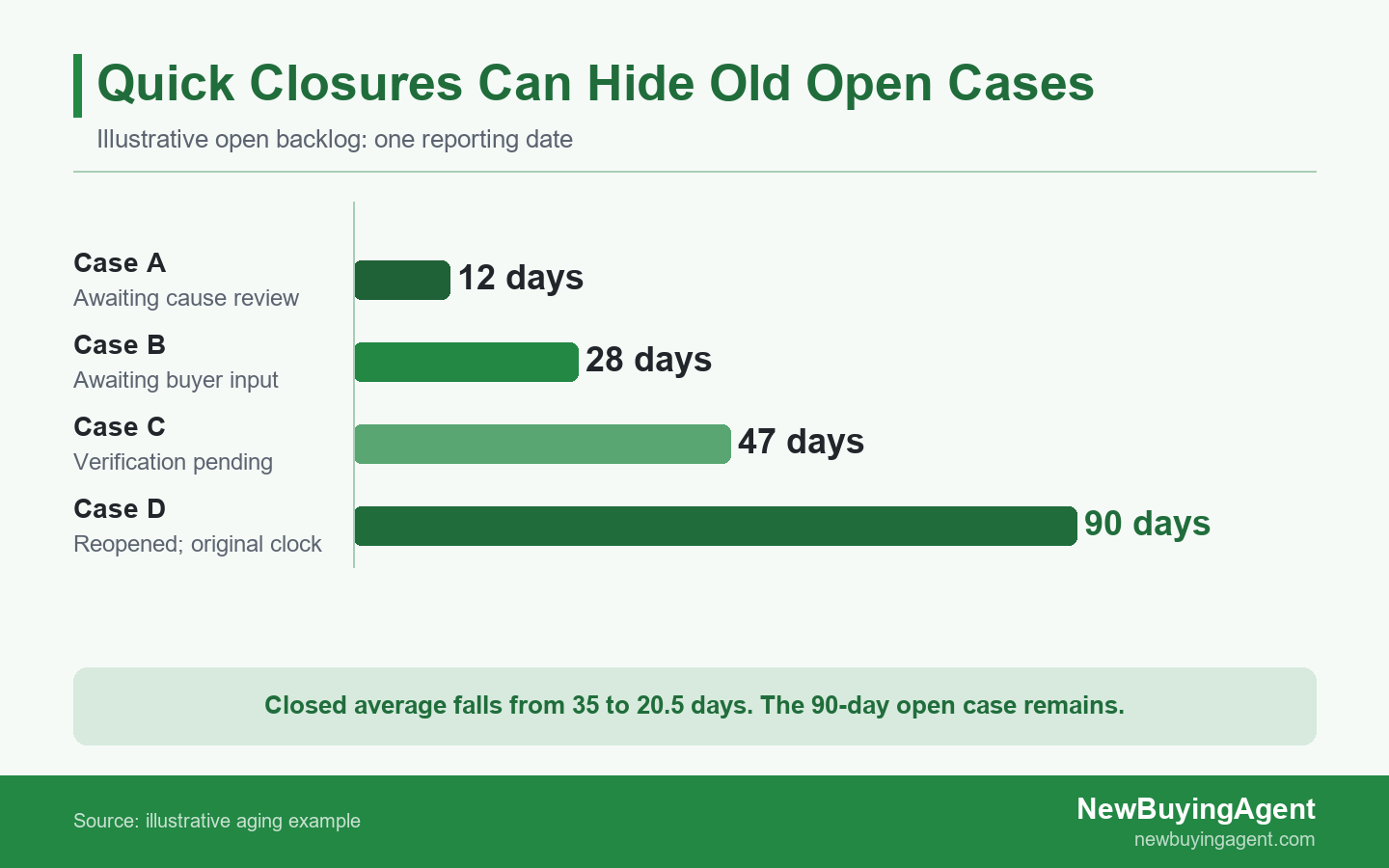
Four open corrective actions range from 12 to 90 calendar days in an illustrative backlog
Define the Corrective Action Clock Before Comparing Suppliers
Agree the opening event, reporting cut-off and closure rule before comparing supplier aging. Preserve original dates even when a deadline is extended, and give implementation its own milestone rather than treating every uploaded report as closure. Otherwise, two factories can report different ages for the same elapsed time simply because their administrative practices differ.
Open Age and Days Overdue Answer Different Questions
For the calendar-day convention used here, open age = reporting date − opening date. For an unresolved case, original-due overdue days = max(0, reporting date − original due date). A case due on the reporting date therefore has zero overdue days; its open age may already be substantial.
Choose a start event the buyer can audit, such as the date the corrective action request is formally issued. Also retain the defect discovery date: otherwise, delays before opening the request disappear from view. If the contract uses working days, apply the agreed holiday calendar consistently and label the report accordingly. Do not compare a China working-day calculation with a calendar-day result without conversion.
An action opened on August 14, 2026 and due on September 15 is 28 calendar days old on September 11, but it is not overdue. An action opened on July 26 and originally due August 25 is 47 days old and 17 days overdue at that same cut-off. Age describes elapsed time; overdue status describes performance against a particular commitment.
Keep separate fields for the original due date, current approved due date, revision reason and approver. A revised-date overdue measure helps manage the current plan, while the original-date measure preserves the earlier commitment. Use unambiguous dates such as 2026-09-11 in the shared record.
Separate Implementation from Verified Closure
Record implementation and verified closure separately. Replacing a fixture, changing a work instruction or submitting a corrective action report can establish that a task was completed; it does not automatically demonstrate that the original problem will stop recurring. Keep an explicit awaiting-verification status so completed implementation does not disappear into either “nothing done” or “fully resolved.”
The distinction follows the sequence in ASQ's eight-disciplines method: interim containment is separate from implementing corrective actions and verifying their effectiveness. For a buyer, sorting the current lot and correcting the production cause therefore deserve different milestones. Containment protects current exposure while the longer-term change is evaluated.
A useful governance parallel appears in NASA OIG's explanation of open recommendations: closure follows completed and verified corrective actions. This is an audit example, not a rule for consumer-product suppliers. Its practical lesson is to define who reviews the evidence before a record becomes closed.
Set that evidence requirement when agreeing the action: affected product or process, acceptance criteria, verification opportunity and reviewer. Once accepted, calculate closure cycle time from the original opening date to the verified closure date. Continue showing implementation timeliness separately so a genuine observation period does not conceal work that was finished on schedule.
Build an Aging View That Exposes the Tail
A useful aging view shows how many cases remain open, where their ages fall, which are oldest and which have missed a due date. Add risk, current status and the next evidence requirement so the report supports action. Keep missing-date records visible as exceptions rather than dropping them from the count and making the backlog appear healthier.
The following illustrative snapshot uses September 11, 2026 as the reporting date. All four records remain unresolved, including the case reopened after premature closure. “Due” means the original verified-closure due date; all ages and overdue values use calendar days.
| Case | Opened / due in 2026 | Open age / overdue | Current blocker |
|---|---|---|---|
| A | Aug 30 / Sep 20 | 12 / 0 days | Cause review |
| B | Aug 14 / Sep 15 | 28 / 0 days | Buyer input |
| C | Jul 26 / Aug 25 | 47 / 17 days | Verification pending |
| D | Jun 13 / Jul 13 | 90 / 60 days | Reopened; evidence missing |
The open-case mean is 44.25 days: (12 + 28 + 47 + 90) ÷ 4. Two of four cases are overdue against original due dates, so the original-due overdue share is 50%. Example age bands of 0–30, 31–60, 61–90 and over 90 days contain 2, 1, 1 and 0 cases respectively. These are reporting bands, not acceptance limits.
Behind the summary, retain a unique case ID, supplier and product/lot scope, severity, containment status, owner, dates, blocker and next review. If a due date is missing, report that exception separately and state the denominator used for overdue percentage. Do not label an undated case “on time.” Save periodic snapshots to distinguish newly opened cases, closures and unresolved carryover.
Before using the report in a supplier discussion, reconcile disputed records. Procurement Journey's performance guidance recommends consulting suppliers on factual accuracy. Apply that principle to opening dates, returned evidence and buyer approval delays; agreement on the facts does not require accepting an unsupported closure.
For an existing China factory, an overdue status becomes more useful when it is tied to current production evidence. NewBuyingAgent's existing-factory management service combines local supplier communication with production follow-up and quality-control capability. Its pre-production, in-process and final-stage inspections can provide product evidence for the buyer's review, reducing reliance on a supplier's status message alone.
Escalate by Risk and Shipment Exposure, Not Age Alone
Prioritize uncontrolled product exposure before treating age as a simple queue. A new defect affecting goods about to ship can require immediate containment, while an older action may have effective interim controls and a justified verification wait. Use aging thresholds to trigger a review of ownership and evidence, not automatic shipment release, penalties or supplier removal.
This risk-based approach is consistent with New Zealand Government Procurement's monitoring guidance, which links reporting frequency to risk and strategic importance. The guidance does not prescribe a universal corrective-action deadline. Set the review cadence around the product consequence, shipment schedule and reliability of the interim controls.
For an overdue case, identify what prevents the next milestone. A factory quality owner may need process records; production management may need to release machine time; the buyer may owe an approved specification or a test decision. Escalate to the person able to remove that blocker, with a dated next action and a required output. Sending the same reminder to a sales contact may change neither capacity nor evidence.
Make the escalation rule observable. For example, a missed agreed milestone triggers owner review; an unresolved blocker at that review goes to the manager who controls the needed resource. An ineffective containment measure triggers immediate reassessment regardless of the age band. Record the rule before reviewing results, and examine whether repeated extensions signal an unrealistic plan or insufficient attention.
If investigation shows that the retained factory cannot achieve a required product feature consistently, the next sourcing brief needs to capture that limitation. NewBuyingAgent's product-supply service uses local China factory resources and product-development/QC capability to turn purchasing requirements into quoted products. The relevant input is the required specification and performance, not simply the age of the old action.
Keep Reopened Actions and Extensions Visible
When a corrective action is reopened because its resolution was ineffective or unverified, retain its original opening date and due-date history. Record the reopening date, new work and approvals separately so the current plan remains understandable. This preserves total elapsed time without pretending that all of it was active supplier work or erasing the previous closure decision.
Illustrative Scenario: A Closed Report, an Unverified Carton Change
Consider Case D as an illustrative order of 3,600 storage baskets across 3 lots, with a carton change affecting 1 lot. The action opened on June 13 and was originally due July 13. A September 6 report marks the change closed, but the specified verification record is missing. At the September 11 cut-off, the unresolved action is 90 days old, not the 5 days since that report.
Missing verification is not proof that the new carton failed. It means the buyer cannot yet accept the claimed resolution. The quality lead restores the original case to open, records why the prior closure was premature and retains the 60-day original-due overdue value. The affected lot receives its own release assessment; the case age alone does not decide the disposition of all three lots.
The factory quality owner links the carton revision to the affected product and arranges the agreed verification. The buyer names the reviewer who will check sample identity, test conditions and results against the acceptance criteria. If the evidence supports effectiveness, that reviewer can authorize closure; if it does not, the owner revisits the cause and action rather than uploading the same report again.
This is a reporting and decision example, not a client result or a prescribed packaging test. A genuinely different failure may warrant a new linked case, while recurrence of the same unresolved cause should preserve its history. Keeping those relationships visible makes reopening informative instead of turning it into an apparent new success opportunity.
The underlying quality principle is broader than recordkeeping. ASQ's root cause analysis guidance explains that analysis must be part of a larger problem-solving effort to produce improvement. A convincing explanation of the carton problem is therefore a starting point for action and verification, not the finished outcome.
Use the Aging Report to Change the Next Supply Decision
Turn persistent corrective-action aging into a specific factory commitment or a better requirement for the next product order. The report should identify what remains unresolved, who can change it and what evidence is due next. Keep commercial planning separate from product acceptance so a pressure to improve the metric does not become a reason to close weak evidence.
Agree the reporting rules with the supplier before using them to judge performance. CIPS's procurement cycle guidance recommends agreed KPIs and resolving relationship issues through actions and timescales. For aging, that means a shared opening event, due-date history and verification rule, rather than a deadline imposed retrospectively to make a score look worse.
At the next review, select the cases where a decision can change production exposure: an approval to provide, a verification to schedule or a process limitation to address in future supply. Record the decision beside the case. A backlog becomes manageable when those outputs change, not merely when its colors change.
If unresolved quality weaknesses are affecting your next China product order, prepare the product specification, quantity, target price, packing requirements, destination, delivery timing and unresolved quality concerns. As a one-stop China sourcing agent for global buyers, NewBuyingAgent uses local factory resources to quote and supply products around those quality and delivery requirements. With that purchasing brief ready, request a product quote from NewBuyingAgent.
Supplier Corrective Action Aging FAQ
Can a spreadsheet track corrective action aging?
Yes, if dates, statuses and ownership are controlled rather than freely overwritten. Use unique case IDs, protected calculation fields and an edit history for due-date or closure changes. Keep evidence links accessible to the reviewer and save dated snapshots. A shared spreadsheet becomes unreliable when several people overwrite the same status without recording why; that is the point to strengthen controls or consider a dedicated system.
What if there are no open corrective actions?
Show zero open cases and mark average open age and overdue percentage as not applicable. There is no open-case denominator, so displaying a zero-day average can suggest a speed achievement that did not occur. Also check whether incoming defects, complaints and rejected evidence are actually being logged. An empty register is reassuring only when the process for recognizing and opening relevant issues is working.
How should low-volume products be handled when verification needs another run?
Keep the case awaiting verification and record the next realistic opportunity to test effectiveness. Show when implementation finished, why observation is delayed and who will review interim controls. Agree whether another suitable verification method can answer the same question; do not substitute convenience for relevant evidence. If the product is discontinued, document the approved disposition and residual risk rather than inventing a successful production result.
Should supplier rankings use the same aging target?
Compare suppliers only when their case definitions, risk categories and closure rules are sufficiently similar. Show case counts and the mix of simple corrections versus complex process changes before interpreting an average. A supplier with more openly reported problems may look worse than one with incomplete logging. Use comparable groups and examine individual high-risk cases before turning aging into an overall supplier ranking.
NewBuyingAgent
Related Resources



ابدأ اليوم
دعنا نحول أهداف التوريد الخاصة بك إلى واقعWeChat:+86 15157124615
WhatsApp:+86 15157124615
العنوان: مبنى 10 #39 طريق شيانغيوان، هانغتشو، الصين
