


Repeat-order forecast error should trigger a review of demand, minimum order terms and available capacity before the next purchase order is released. Recalculate what the business needs, identify which factory constraints still bind, and confirm a dated production slot. A lower forecast alone does not reduce the supplier's MOQ or release an existing commitment. For a category director managing recurring China procurement, the useful output is a revised order proposal with explicit assumptions and decisions.
Reset Demand, Minimums and Capacity Separately
Forecast revisions change a planning assumption; they do not automatically change factory commitments. A sound reset checks comparable demand evidence, separates finished-goods and packaging minimums, and tests the resulting order against available capacity on the required dates. The buyer can then approve the inventory exposure and service risk knowingly, rather than replacing the old forecast with another unsupported order quantity.
- Definition: Forecast error measures the gap between a frozen forecast and the corresponding actual result.
- Risk: Observed sales can understate demand during stockouts, while a smaller goods order can still leave dedicated materials or packaging.
- Decision: Net the revised demand against usable inventory and firm receipts, apply confirmed order constraints, then verify the dated capacity and change terms.
Measure the Error Against the Forecast You Actually Used
A useful error review compares the forecast actually used for the ordering decision with matching actual demand. The SKU, channel, unit of measure, forecast origin and horizon must stay consistent, or the apparent improvement can come from changing the comparison itself. Stockouts, promotions, returns and customer-order timing also need context before a sales shortfall is treated as evidence that future demand has fallen.
Save the forecast version before revising it. If the team ordered against a forecast prepared before the selling window, evaluate that version rather than a later update containing information unavailable at the time. Separate a repeated directional miss from a single unusual week. Category totals can conceal an overforecast in one color and an underforecast in another, leaving the factory with the wrong product mix even when total units look reasonable.
Forecasting: Principles and Practice distinguishes forecast errors from fitted residuals and defines mean absolute error, or MAE, as the average size of errors without their signs. Use a signed measure alongside MAE to distinguish direction from magnitude. With error defined as actual minus forecast, a negative mean error indicates overforecasting. These measures describe past performance; neither is an automatic instruction to subtract a fixed amount from every future forecast.
In a hypothetical textile-pouch example, the four weekly forecasts are 800 units each and actual demand is 500, 900, 600 and 400 units. The corresponding errors are -300, +100, -200 and -400 units. Forecast total is 3200 units against actual total of 2400 units; mean error is -200 units per week and MAE is 250 units per week. All values are illustrative, with comparable weeks and no stockouts assumed.
That last assumption matters. The AWS forecasting whitepaper explains that sales can be lower than potential demand when an item is out of stock. Keep availability history beside the sales series, and flag constrained periods instead of interpreting every zero as weak interest. If lost demand cannot be estimated reliably, preserve that uncertainty in the reset brief; do not fill the gap with an invented uplift or simply repeat the latest sales average.
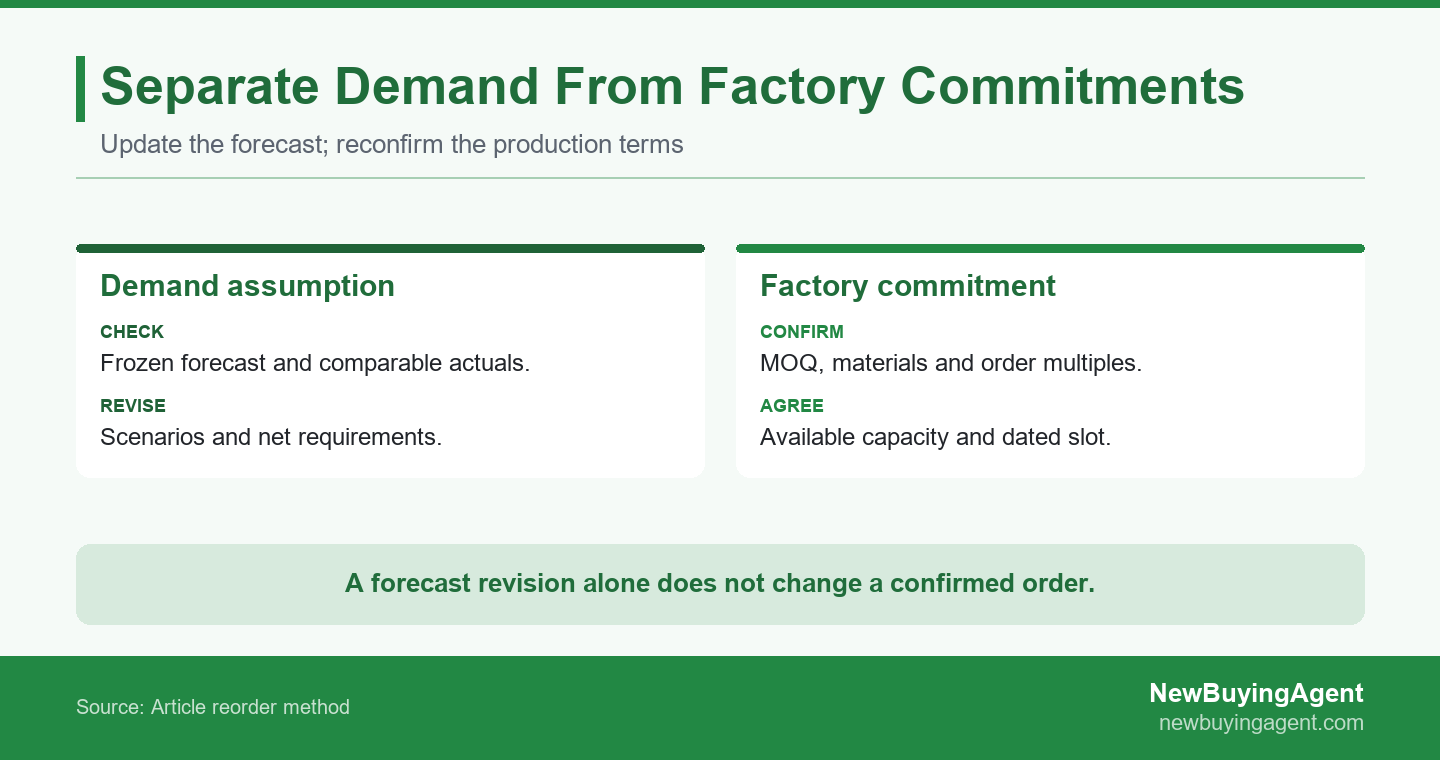
Revised demand changes the planning assumption while MOQ, materials and a dated factory slot still require separate confirmation
Reopen the Minimum Order Assumptions
The binding minimum is a production or commercial condition that must be confirmed separately from the revised demand forecast. Finished-goods runs, colors, materials, packaging and carton quantities may have different constraints, so an overall MOQ can hide the real source of inventory exposure. A useful negotiation identifies which condition can change, what the revised price includes and who owns any dedicated stock left behind.
MOQ means minimum order quantity; it is not the same as the quantity that minimizes total inventory cost. MIT's inventory teaching material presents economic order quantity as a tradeoff between ordering and holding costs under stated deterministic assumptions. That model does not determine a supplier's negotiated minimum. A factory may accept a smaller run for a setup charge, but the buyer still needs to compare the total cost with the exposure from buying and holding more goods.
The table compares five factory-order constraints for the same SKU scope, specification revision and required receipt window. Each is assessed by what needs confirmation, the available reset option and the inventory or commercial exposure it leaves with the buyer. These constraints can coexist: changing one does not waive the others, and a proposed reset remains conditional on supplier acceptance.
| Assumption | What to verify | Possible reset | Buyer exposure |
|---|---|---|---|
| Goods run | Minimum per run and SKU | Smaller run or paid setup | Price and surplus goods |
| Color/material | Minimum per color or lot | Fewer variants or shared input | Mix and dedicated material |
| Packaging | Print minimum and pack size | Standard pack or revised print run | Unused printed stock |
| Order multiple | Carton or batch increment | Agreed packing configuration | Rounding above net need |
| Capacity | Available dated slot | New timing or confirmed extra slot | Delay or reservation cost |
Based on this comparison, negotiate the constraint that creates the excess rather than asking only for a lower headline MOQ. Reducing color variety may address a material minimum; changing a printed sleeve may address packaging exposure. Neither change automatically increases the production slot or preserves the previous unit price.
Microsoft's quantity-modification documentation treats minimum order quantities and order multiples as separate planning settings. The distinction is useful even without that software: an order can meet a minimum yet still need rounding to a carton or batch increment. Ask the factory to confirm both conditions and their unit basis. Check whether an acceptable total can be split across variants, rather than assuming that the same minimum applies to the assortment as a whole.
For a buyer retaining a China textile factory, a local team can help confirm whether the proposed fabric, construction and packaging changes preserve the approved product. NewBuyingAgent's product and quality-control capability is relevant to that review. Keep the revised specification and commercial acceptance together; a cheaper minimum is a poor reset if it introduces an unapproved material change or leaves responsibility for unused stock unresolved.
Convert Revised Demand Into a Feasible Order
A revised demand estimate becomes an order proposal only after usable supply and the confirmed quantity constraints are applied. Low, base and high cases make the consequences visible, but they remain planning scenarios unless a statistical model gives them a justified probability interpretation. The buying decision also needs a timing check, because a window total can appear sufficient while stock runs out before the replenishment arrives.
For the next four-week window in the hypothetical pouch example, assume demand scenarios of 1800, 2400 and 3200 units. There are 500 usable, unallocated units on hand and 400 firm receipts, giving 900 available units. Assume the receipts and any new order arrive before they are needed, with no backorders, other allocations or additional safety-stock target. Net requirements are therefore 900, 1500 and 2300 units. These assumptions simplify the example; they are fields to verify in a live plan.
The factory's goods MOQ is 1000 units and its order multiple is 200 units. For each positive net requirement, select the smallest multiple that meets both the requirement and the minimum. The resulting orders are 1000, 1600 and 2400 units. The example has 1800 units of available dated capacity: the base order fits, while the high case has a 600-unit shortfall. These are hypothetical constraints, not market benchmarks or confirmed supplier terms.
| Scenario | Demand units | Net need units | Order units |
|---|---|---|---|
| Low | 1800 | 900 | 1000 |
| Base | 2400 | 1500 | 1600 |
| High | 3200 | 2300 | 2400 |
The low and base orders both exceed their net needs because of the confirmed constraints. Record the resulting surplus in the inventory and cash review rather than relabeling it as forecast demand. If net need is zero or negative, the calculation does not justify placing the MOQ merely because the factory offers it. Review any separate contractual commitment, then decide whether to defer, change the scope or accept a deliberately authorized stock position.
Packaging can create a second exposure. If dedicated printed sleeves have a 2000-piece minimum, the 1600-unit base order leaves 400 unused sleeves. Agree their ownership, storage, condition, artwork version and future-use terms separately. A goods order that fits the sales plan can still fund packaging that becomes obsolete before the next reorder. Do not count those sleeves as finished goods available to satisfy demand.
The scenario-forecasting discussion in Forecasting: Principles and Practice uses plausible alternative developments to support contingency planning. In this example, a buyer might link the low case to a retailer delaying a promotion and the high case to a confirmed wider rollout. Document such drivers and the evidence that would change the authorized case. The range is not a calibrated prediction interval, and sending the high case to a factory does not itself authorize that quantity.
Confirm Available Capacity Against the Required Dates
Available capacity is the output the factory can allocate to the specified product on the required dates after existing commitments and relevant constraints are considered. A nominal weekly production figure cannot establish that a repeat order will fit, especially when materials, bottleneck operations or packing resources are shared. The confirmation must connect a quantity to a feasible schedule and distinguish production completion from dispatch and delivery.
Microsoft's finite-capacity planning documentation describes planning that considers resource limitations and already-reserved capacity; when capacity is unavailable, dates may move. The buyer-facing lesson is to request the available slot rather than total theoretical output. This does not require a supplier to use that software, and a planning-system result alone is not evidence that material, quality approval or the commercial reservation has been secured.
Ask for the material-ready date, the operation that limits throughput, the available resource allocation and the planned production start and finish. Add inspection, any agreed rework allowance, packing and dispatch readiness. Then work backward from the required arrival date using the logistics plan. A factory promising production completion by the selling deadline has not promised that goods will be available in the buyer's warehouse by then.
In the worked example, the base proposal stays within the stated slot. The high case requires a decision: confirm additional capacity and materials, change the delivery schedule, reduce the scope or accept a defined service shortfall. Treat an offered extra shift or alternate production line as a proposal to verify. Product approval, quality controls, labor availability and the incremental cost still need an owner before the extra output is promised downstream.
A reservation also needs boundaries. Record the product and revision, quantity, dates, price or reservation charge, confirmation expiry and the latest point at which the buyer can change the release. Identify whether the agreement reserves only a production slot or also commits materials. A rolling forecast can help the supplier plan, but its planning horizon should not be confused with the shorter period in which releases or materials become firm.
Repeat the capacity check when a material date, product mix or required arrival changes. Confirm what the new response replaces so the buyer and factory do not maintain two competing schedules. Keep the prior acceptance and the revised confirmation in the order record; a verbal statement that the factory will try harder does not resolve a quantified gap or establish a new delivery commitment.
Send a Reset Brief With Named Decisions
A reset brief is useful when it asks the factory and buyer to resolve named decisions with supporting evidence. It should show the frozen forecast, revised demand assumptions, net requirements, binding minimums and dated capacity response in one versioned record. The final approval belongs to identified owners, with clear treatment of inventory exposure, commercial changes and the point after which further revisions need fresh agreement.
| Brief field | What to enter | Acceptance check |
|---|---|---|
| Demand basis | SKU, channel, window, forecast version and error notes | Comparable actuals; stockouts flagged |
| Order proposal | Demand cases, usable stock, firm receipts and net need | No duplicated allocation or late receipt |
| Minimums | Run, color/material, packaging and order multiple | Factory confirms binding conditions |
| Capacity | Material readiness, available slot and required dates | Quantity and schedule fit together |
| Commercial decision | Price change, dedicated stock and change cutoff | Buyer and factory accept in writing |
| Release owner | Authorized quantity, version, owner and review trigger | Planning cases remain separate from firm release |
Use the brief as a checklist before release: the demand owner approves the revised assumptions, procurement confirms the commercial terms, the factory accepts the production scope and dates, and the delivery owner checks the arrival plan. Store the accepted version with the purchase order. At the next review, compare the same forecast horizon and track whether the change reduced unwanted stock or merely shifted the problem into materials, late delivery or a missing variant.
When a category's demand appears to have changed structurally, NewBuyingAgent's AI-assisted product analysis and free Bestseller Market Analysis Report can inform market-fit selection and design or style optimization. Request the report for the products being considered alongside the reorder decision. It supports product exploration; it does not replace the buyer's channel forecast or establish demand for the specific quantity under review.
For buyers keeping an existing China supplier, factory management in China provides a relevant execution path. NewBuyingAgent describes local supplier communication, production progress and quality management, staged inspections and logistics coordination. An agreed scope can connect the revised product requirements to factory follow-up, quality control and delivery coordination. Confirm the actual minimums, costs and reservation terms with the supplier rather than assuming that local management guarantees a smaller MOQ or extra capacity.
To discuss that scope, share the repeat-order reset brief with the product specification, current factory situation, proposed quantity, destination, required timing and the open MOQ or capacity decisions. Identify which quantity is approved and which cases are still for planning. The next order can then proceed against an accepted specification and schedule, with unresolved assumptions visible to the people responsible for deciding them.
Frequently Asked Questions
Does a lower forecast cancel an existing purchase order?
A lower forecast does not by itself cancel a purchase order or release committed material. Check the accepted order, material authorization, change deadlines and any cancellation or rescheduling terms. Ask the supplier to confirm the revised quantity, timing and charges in writing. Keep a forecast update separate from a contractual change request, and retain the acceptance that establishes which version now governs the order.
What forecast accuracy target should trigger a reset?
There is no single forecast accuracy target that determines the right reset for every SKU. Consider error direction and size alongside stockout exposure, holding cost, product life, lead time and the binding minimums. Define a review trigger that reflects those consequences and the evidence available. A small percentage error can still matter for a costly or short-lived product, while a large error on sparse demand may need a different evaluation approach.
Can a repeat order have a lower MOQ at the same price?
A repeat order may qualify for different terms, but a lower MOQ at the same unit price requires supplier agreement. Reusable materials, unchanged artwork or fewer variants may help; setup, packing and dedicated-input costs may still bind. Request a revised quote with the scope, quantity basis and unused-stock treatment stated clearly. Compare total exposure rather than assuming that an established supplier relationship removes the economics of a smaller run.
Should the factory receive every forecast scenario?
A factory can receive a labeled scenario range for planning if the authorized commitment is clearly separated. Mark each case with its assumptions, dates and decision trigger, then identify the firm release and any separately approved material or capacity reservation. Agree how updates will be communicated and accepted. This helps the supplier prepare without turning a speculative high case into an unintended purchase or an unsupported delivery promise.
NewBuyingAgent
موارد ذات صلة



ابدأ اليوم
دعنا نحول أهداف التوريد الخاصة بك إلى واقعWeChat:+86 15157124615
WhatsApp:+86 15157124615
العنوان: مبنى 10 #39 طريق شيانغيوان، هانغتشو، الصين
