

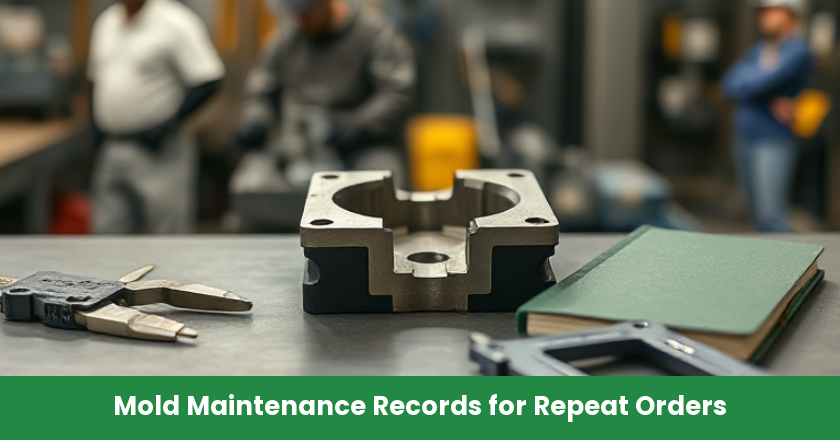
A repeat order is only as reliable as the mold that will run it. If a tool has been repaired, re-machined or run far past its last inspection, the same drawing can still produce a different part, so a buyer needs the tool’s current condition in writing before releasing the next run.
Mold maintenance records are the dated log of a tool’s service life: cumulative shot counts, repairs and welding, component replacements, dimensional checks and the process settings used at each run. They are the evidence a buyer uses to decide whether a repeat order will match the approved part.
The buying question is therefore narrow: which records show that this tool can still hold the part’s critical dimensions on the next run?
A Repeat Order Depends on Tool Condition, Not a New Price
Require a maintenance record set that shows the mold’s current condition before committing to a repeat run. A repeat order is not a reorder of a proven part; it is a new production run on a tool that has aged, been repaired or changed hands. The record is what turns that uncertainty into a decision the buyer can defend.
- Start with the tool, not the price. A lower repeat price means little if the tool can no longer hold the critical dimension.
- Read the condition signals. Shot count, repairs, welding and dimensional checks each describe a different part of the tool’s state.
- Name the owner and the trigger. The factory should keep the record current and escalate when a signal crosses the agreed limit.
- Release on a measured check. The record schedules verification; the measured tool and first-off parts release production.
What Counts as a Mold Maintenance Record
A mold maintenance record is the dated history of what has happened to the tool, not a one-page summary of how many parts it produced. The useful set covers five categories: cumulative shot count, repairs and welding, replaced components, dimensional checks, and the process settings used at each run. Each entry should carry a date and a named owner, so the record can be read as a timeline rather than a claim.
| Record category | Question it answers | Release condition it supports |
|---|---|---|
| Shot count | How far into its service life is the tool? | Whether the next run still fits the maintenance interval |
| Repairs and welding | What changed the tool’s geometry? | Whether the earlier dimensional record still applies |
| Replaced components | Which wear parts are new? | Whether the gate, insert or cooling detail still matches the approved design |
| Dimensional checks | Did the tool hold the drawing? | Whether the critical feature still meets its tolerance |
| Process settings | How was the approved part made? | Whether the repeat run starts from the same window |
The table points to one release rule: a repeat order is approved when the category that controls the part’s critical dimension has a current, dated check. A record that covers output but not that dimension cannot support the decision.
Shrinkage is one reason the produced dimension can move even when the drawing does not change. The scope of ISO 294-4 on moulding shrinkage defines it as free shrinkage measured parallel and normal to melt flow, and notes that it represents the maximum value of any restricted shrinkage. A tool change that alters flow or cooling can therefore shift the finished dimension.
The acceptance framework also has to be explicit. ISO 20457 on moulded-part tolerances specifies manufacturing tolerances for plastic moulded parts within a specified datum system and allows additional specifications where a feature is functional. That is why the buyer, not the factory summary, should decide which features the record must measure. Buyers new to these terms can review the China manufacturing and product guide for the surrounding process context. These standards describe how moulding shrinkage and moulded-part tolerances are defined; they do not oblige a buyer to adopt a particular standard, and the record requirement here is a purchasing practice rather than a legal duty.
Evidence to Request Before Approving a Repeat Run
A repeat order should be released on the tool’s current condition, and the record is the buyer’s only view of that condition before production restarts. Wear and repairs change the tool’s dimensional baseline over its life, so a summary written for management cannot show whether the next run will match the approved part. The evidence request should therefore ask for the dated entries behind the summary: which cavity was worked on, what was changed, and what was measured afterwards. With that evidence, the buyer can set a release condition instead of accepting an assurance.
A complete request names the tool, the cavity, the feature that controls the part’s fit or function, and the date of the last check. It also asks who performed the work and where the original measurement is kept, because a record that cannot be traced to a person and a file is hard to rely on later.
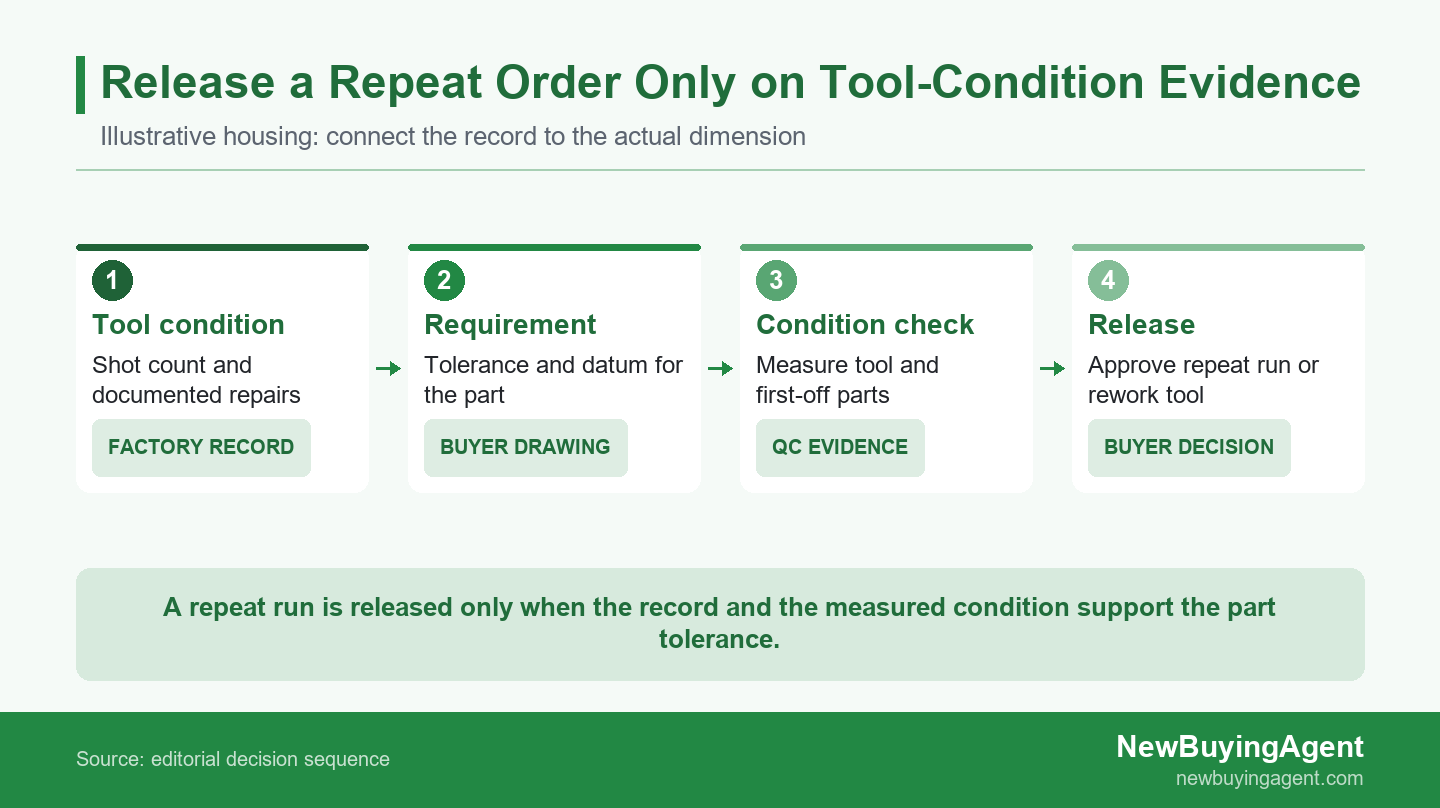
Four-stage sequence linking tool condition and part tolerance to a measured check and repeat-order release
For a buyer sourcing a molded product, NewBuyingAgent’s local factory resources and product-development/QC capability can carry the tool-condition requirement into the supply brief. Its product-supply service provides a route to source the product against those requirements, with the record and verification scope agreed for the project.
Shot Count and Cycle Data
A shot count is the number of moulding cycles a tool has completed, and it is the first number a buyer should ask for in writing. It places the tool against its maintenance interval and shows whether wear parts are due for replacement. The count is only useful with its context: the material, the cycle time and any period of accelerated running.
Machine-level practice treats the whole system as a life-cycle question. ISO 20430 on injection moulding machine safety specifies essential safety requirements for the machines and addresses significant hazards during the life cycle of the machinery, referencing ISO 12100:2010. For the buyer, the practical point is that tool and machine condition are managed over time, not confirmed once at the first order.
Process conditions drift with the tool as well. The scope of ISO 11443 on plastics fluidity explains that melt fluidity depends on temperature and also on shear rate and shear stress. A process record that lists only a temperature is therefore not a complete description of how the approved part was made, and the repeat run should start from the fuller window that produced it.
Repair, Welding and Replacement History
A repair is not a maintenance detail; it is a change to the tool that can move the part’s dimensions. Welding a worn edge, replacing a gate insert or re-machining a sealing surface all alter the cavity, and the dimensional check taken before that work no longer describes the tool. Each repair entry should record the date, the affected cavity and feature, the reason, and the measurement taken afterwards.
Risk-management practice supports documenting that work rather than relying on memory. ISO 12100 on machinery risk assessment describes procedures for identifying hazards and estimating and evaluating risks during relevant phases of the machine life cycle, and gives guidance on the documentation and verification of the risk assessment. The same discipline applies to a repair that could affect the product: record it, then verify the result.
Handling and clamping belong in the history too. ISO 23582-1 on clamping systems sets essential safety requirements for magnetic clamping systems used to affix a mould to the platen and lists the basic hazards and events in its Annex A. A tool that has been removed, re-clamped or moved between machines should carry that event in the record, because handling can disturb alignment that the earlier measurement assumed.
Assign Owners, Timing and Escalation on the Factory Side
A maintenance record stays useful only if someone owns it between orders. The factory should name the person responsible for updating the log, the interval at which the tool is checked, and the trigger that escalates a problem to the buyer. Without those three, the record is a historical document rather than a live control.
The owner is usually the toolroom lead or the production engineer who holds the mold, and the buyer should be able to reach that person through the factory’s account contact. The interval should follow the tool’s own evidence: shot count, material abrasiveness and the tightness of the critical tolerance. The escalation trigger is the important part for a buyer. A dimensional check that moves outside tolerance, a repair that touches a functional feature, or a tool that has been moved or re-clamped should all raise the item to the buyer before the next run is scheduled.
Responsibility should also be split honestly. The factory owns the tool work and the measurements; the buyer owns the acceptance decision and the drawing that defines it. That split keeps the factory from approving its own repair and keeps the buyer from trying to direct the repair method from a distance.
Decision Rules and Boundary Cases for a Worn Tool
Release a repeat run when condition evidence supports the tolerance requirement; otherwise repair, re-qualify or replace the tool. The rule is easy to state and harder to apply, because the answer depends on the feature that controls fit or function and on what the record can actually show.
Four outcomes cover most cases. Release the run when the critical feature has a current dimensional check and there is no unrecorded repair. Release conditionally, with a first-article check before full production, when the record is complete but the tool is close to its interval. Hold the run when a repair lacks a post-repair measurement, when the tool has moved, or when the record does not identify the affected cavity. Replace or rebuild when re-machining cannot restore the datum within tolerance.
Two boundary cases are worth stating because they are easy to get wrong. A low order quantity does not lower the requirement: a small repeat order can still carry a sealing or assembly dimension that a worn tool will miss. Cosmetic wear, by contrast, may be acceptable when it does not touch a functional feature, and the buyer should say so explicitly rather than treating every mark as a defect.
Illustrative Example: A 25,000-Shot Housing Tool at Its First Repeat Order
For an illustrative 25,000-shot two-cavity housing tool, a worn gate insert and an undocumented repair leave the sealing dimension unverified until the tool is measured.
In this illustrative example, a consumer brand is reordering a household housing that has already been produced once. The repeat order is 25,000 units from a two-cavity mold that has already run about 25,000 shots. Each housing has 1 sealing feature, and the drawing tolerance on it is fixed, but the tool history is incomplete.
The factory summary reports normal production and on-time output. It also shows that a gate insert was replaced, but the entry carries no date and no dimensional check. Because a replaced gate insert can change the flow and the local shrinkage around the sealing feature, the earlier dimensional record no longer describes the current tool. The summary answers output while leaving the critical dimension unverified.
The buyer’s decision is to hold the repeat run until the affected feature is measured. The factory re-measures the sealing feature, records the repair and its date in the tool history, and re-qualifies the first-off parts against the drawing tolerance. Only then does the order move to full production.
Before full production is released, the measured tool condition and the first-article dimensions are checked against the drawing. This example is illustrative: it claims no measured deflection and no passed dimensional result, and actual acceptance depends on the real drawing and the real measurement.
Verify Tool Condition Before Release, Not After Defects Appear
A record can show that the tool was serviced; it cannot show that the tool is within tolerance now. Verification is the step that closes that gap: measure the critical feature on the tool and on the first-off parts, and compare both with the drawing before the run is released. The first article is the small set of parts from the start of the run that carries that approval.
Material data sits on the same boundary. ISO 17744 on pvT measurement describes how specific volume is measured with temperature and pressure, and explicitly notes that the result cannot be used directly for injection-moulding simulation. A material card or an old data sheet is therefore not a substitute for measuring the part that the tool actually produces.
For buyers retaining an existing Chinese factory, the work shifts from setting the requirement to following it. NewBuyingAgent’s existing-factory management service connects local follow-up and quality-control capability to the agreed maintenance and first-article checks, while the buyer keeps the acceptance decision. The trial plan should also name the features to measure, the measurement condition and the functional test that matters to the application.
Put the Maintenance Requirement Into the Repeat-Order Brief
Request the record set, a condition report and a first-article plan alongside the repeat-order quotation. The requirement belongs in the brief next to the quantity, price and delivery terms, so competing suppliers answer the same question. It should state who owns the record and what triggers an escalation, not only what the factory is expected to produce.
Specify the critical feature, the datum it is measured from, and the condition under which the first-off parts are approved. Clarify whether a repair after the last check requires a new measurement, and whether the first-article check is included in the quotation or billed separately. These are commercial scope questions, and they are easier to settle before the order than after the tool has run.
For a repeat order, prepare the part drawing and tolerance requirements, the mold history and shot count, the quantity and forecast, the target price, the destination and the delivery timing. NewBuyingAgent can use its local factory resources and product/QC capability to develop a repeat-order quotation aligned with those maintenance and quality requirements. With that brief ready, request a repeat-order quote from NewBuyingAgent.
Frequently Asked Questions
How long should a factory keep mold maintenance records?
Keep them for the working life of the mold and transfer them when the tool moves. A tool can run for years across several orders, so a record that stops at the first shipment cannot describe the condition of the second. The practical rule is that the history travels with the tool: if the buyer paid for the mold, the buyer should be able to obtain the log and the latest dimensional checks. If the factory changes or the tool is re-clamped, the new owner needs the previous entries to plan the first inspection.
Can a buyer rely on the supplier’s maintenance summary alone?
No; ask for the dated entries behind the summary when the tool condition affects a critical dimension. A summary is usually written for management and reports output, not geometry. The entries that matter for a repeat order name the cavity and the feature, the work performed, the date, and the measurement taken afterwards. If the summary cannot be traced to those entries, treat the critical dimension as unverified and plan a first-article check before full production.
What is a normal maintenance interval for an injection mold?
There is no single safe interval, because the right schedule depends on the tool’s own history, the material, the cycle and the part tolerance. A filled or abrasive material wears a gate or an insert faster than a simple unfilled resin, and a tight sealing dimension leaves less room for wear than a decorative surface. Set the interval from the tool’s recorded checks and adjust it when a measurement moves toward the limit, rather than applying a fixed number of shots to every mold.
Who owns the maintenance records when the buyer paid for the tool?
The buyer who paid for the mold normally owns the mold and should control its records and access. Ownership matters at the end of a supply relationship: if the tool is transferred, the record should transfer with it, so the next factory can plan its first checks instead of starting blind. Before the tool is moved, agree in writing what history will be handed over, in what form, and who keeps the original.
Does a new supplier need the previous factory’s maintenance records?
Yes, when the tool transfers, because the new factory needs the tool history to plan its first inspection and to avoid repeating an old repair. A tool that arrives without records is an unknown: the new supplier cannot tell whether a critical feature was re-machined or how many shots it has run. The buyer should treat the first production run at the new factory as a re-qualification, with a first-article check against the drawing before full release.
NewBuyingAgent
Related Resources
ابدأ اليوم
دعنا نحول أهداف التوريد الخاصة بك إلى واقعWeChat:+86 15157124615
WhatsApp:+86 15157124615
العنوان: مبنى 10 #39 طريق شيانغيوان، هانغتشو، الصين
