

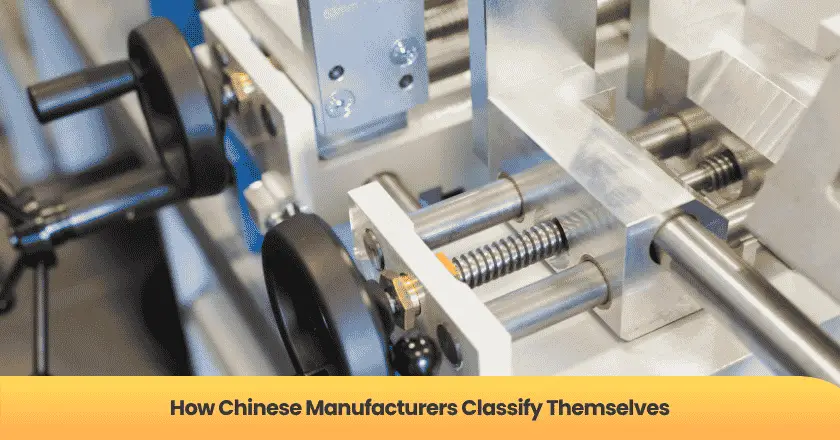
Two suppliers send quotes for the same injection-moulded housing. The English signatures read Sales Manager at what both call a manufacturing company. One registered name ends in 工贸有限公司, industry and trade Co., Ltd. The other ends in 国际贸易有限公司, international trade Co., Ltd. Nothing in the English correspondence distinguishes them, and the two Chinese names have already answered a question the buyer spent three weeks trying to settle by email.
Chinese manufacturers sort themselves using a vocabulary built for their own market: name conventions, statistical thresholds, tax status, government designations and certification. Reading those signals costs nothing and tells you more than any English-language sales page will.
Key Takeaways
• A Chinese registered company name follows a fixed structure and its industry element signals what the business actually does.
• The suffix 工贸 marks a firm doing both manufacturing and trade, which is common and worth recognising.
• Above-designated-size is a statistical reporting threshold set at 20 million yuan of annual revenue, not a measure of prestige.
• General taxpayer status determines whether a supplier can issue special VAT invoices and handle export refunds properly.
• Company certifications describe the management system, while product certifications describe the goods, and buyers conflate the two constantly.
What the Company Name Already Tells You
English trading names are chosen for foreign buyers and mean nothing. The registered Chinese name is assigned under fixed rules, and those rules make it readable.
How a Chinese Company Name Is Built
Four elements appear in order: the administrative region, the distinctive brand element, the industry or business characteristic, and the organisational form. A name such as 宁波市华信电器有限公司 reads as Ningbo, Huaxin, electrical appliances, limited company. The third element is where your answer usually sits.
That element is not decorative. Registration authorities expect it to reflect the actual business, so a company calling itself 电器 in its registered name is registered around electrical goods. Buyers who only ever see an English name are working without the single most accessible piece of evidence available to them.
The Industry Elements Worth Knowing
制造 and 机械 point to manufacturing. 科技 is common among electronics and newer firms. 实业 suggests a broader industrial holding, often with several activities under it. 进出口 and 国际贸易 mark a trading operation. 厂 as an organisational form usually indicates an older or smaller production unit rather than a modern limited company.
工贸 deserves its own mention because it appears constantly and confuses foreign buyers. It combines industry and trade, describing a company that both produces and sells on. Those firms are frequently the most practical counterparties for mid-sized orders, since they own production yet are set up to handle export paperwork.
Organisational form carries information too. 有限公司 is the ordinary limited company and covers most suppliers you will meet. 集团 indicates a group with affiliated companies beneath it, though it signals less about scale than buyers assume and should be checked against the register rather than taken at face value. A name ending in 厂 is worth a question, since it often belongs to a workshop that has never restructured.
Expert Tip:Ask for the Chinese registered name in your first message, alongside the quotation. I phrase it as needing the exact name for my records, which is true and entirely routine. Suppliers send it without hesitation. Ten seconds of reading the industry element then tells you whether the next question should be about tooling capacity or about which factory they buy from. Buyers who skip this spend weeks establishing by inference what the name states outright.
Production, Trade, and the Integrated Middle
Chinese suppliers divide themselves into production enterprises, trading enterprises and integrated firms doing both. The three behave differently, and the middle category is the one Western sourcing advice tends to ignore.
The Three Self-Descriptions
A production enterprise owns equipment and employs operators. A trading enterprise buys and resells, holding no production assets. An integrated industry-and-trade firm runs a factory while maintaining a separate commercial arm, often because the factory sits in one town and the sales office in a coastal city with better logistics and staff.
That split explains something buyers frequently misread as deception. When a supplier says the factory is two hours away, this is often simply the structure, not evasion. Ask whether the production entity and the contracting entity are the same registered company, and whether they share ownership.
Why Real Factories Present as Trading Companies
Small manufacturers sometimes contract through an affiliated trading company for practical reasons, including export handling and tax administration. The factory exists, the goods are theirs, and the invoice comes from a different name.
This is ordinary and it still needs documenting. Record both entities, confirm the relationship in writing, and make sure quality obligations reach the party that controls production rather than only the one issuing your invoice.
Confirming the production entity is straightforward once you know to ask. Request the name and address of the site that will actually build your order, then compare it against the company you are contracting with. Where the two differ, ask how they are related. Genuine integrated firms answer this in one sentence, because the arrangement is unremarkable to them and they explain it several times a month.
Common Mistake to Avoid:Treating an integrated industry-and-trade firm as a middleman and negotiating accordingly wastes your position. Buyers push for the factory behind the trading name, get told there is no other party, and conclude they are being handled. In many cases the same owners run both entities and the price already reflects factory economics. Ask instead whether the production site is theirs and who owns it, which is a question with a verifiable answer rather than an accusation with no useful reply.
Official Classifications That Carry Weight
Beyond self-description sit labels assigned by government bodies. Each has a defined meaning, and each is regularly overstated in sales material.
Above-Designated-Size Is a Threshold, Not a Compliment
Suppliers often mention being an above-designated-size enterprise. The term comes from statistics rather than industry standing. China's National Bureau of Statisticsdefines above-designated-size industrial enterprisesas industrial legal entities with annual main business revenue of 20 million yuan or more, a threshold raised from 5 million in 2011.
The label therefore means the firm is large enough to file into the monthly industrial statistics, and nothing more. The statistics office notes that an above-designated-size enterprise can simultaneously count as a micro enterprise under the separate size classification, since revenue and headcount are measured independently. Useful as a floor, useless as a ranking.
Other designations sit above that threshold. National and provincial programmes recognise high-technology enterprises and specialised small and medium firms, and admission generally involves review of research spending, patents and product focus rather than a simple revenue test. These labels tell you a company has passed an assessment and invested in documenting itself. They still say nothing directly about whether it can build your product to your specification.
Tax Status Reaches Your Paperwork
General taxpayer status matters more to you than most buyers realise. Chinese VAT rulesset the small-scale taxpayer thresholdat five million yuan of annual taxable sales, above which a business registers as a general taxpayer. General taxpayers issue special VAT invoices, which is what makes input credits and export refund procedures work properly.
The registration rules were updated again for 2026, and the tax administration hasset out how and when general taxpayer status takes effectrelative to the registration date. A supplier that cannot issue special VAT invoices is generally a smaller operation, which is not disqualifying and does shape how your export documentation gets handled.
Expert Tip:Ask whether the supplier is a general taxpayer and whether it handles export declarations itself. Two short questions, and together they place a company more accurately than any capability claim. I've found the answers also predict responsiveness on documentation later, because firms that run their own export paperwork have staff who understand what you need and firms that outsource it have to ask somebody else every time.
Certifications and Platform Labels
The final layer of self-classification is what a supplier has been certified or badged as, and this is where the most confusion lives.
Company Certificates and Product Certificates Are Different Things
ISO 9001 certifies a quality management system. It says a company documents its processes and audits them, and it makes no statement whatsoever about whether your specific product is any good. Social compliance audits work the same way, describing labour and facility conditions rather than output.
Product certifications are the opposite. Marks required for your market attach to a specific product tested against a specific standard, and they do not transfer between products or between factories. A supplier holding ISO 9001 and a certificate for a different model has told you nothing about the item you are buying.
Social compliance schemes deserve a note because buyers name them loosely. An audit report against a social compliance standard covers working hours, wages, safety and facility conditions at a named site on a named date. It is a snapshot of one factory, it expires, and it does not travel to a subcontractor that the same supplier might use next season.
Reading Platform Badges Honestly
B2B platform labels confirm that some verification happened. What was verified varies, and it usually covers company registration and sometimes a site visit rather than production capability or quality outcomes.
Treat a badge as evidence the company exists and is worth a conversation. The underlying registered name, the industry element within it, the tax status and the specific product certificates are what actually answer your question, and all four can be checked independently of any platform.
Expert Tip:Ask for the certificate number and the issuing body on every certification mentioned, then verify it with the issuer rather than the supplier. Certificates circulate, expire and occasionally belong to a neighbouring company. This takes about five minutes per certificate and it is one of the highest-value five minutes in supplier assessment. Suppliers with genuine certification supply the details immediately, because their customers ask for them constantly.
How NewBuyingAgent Reads the Supply Base for You
Every signal above is readable, and reading them one supplier at a time is a slow way to build a shortlist. The harder constraint is that the pool most buyers can see is a narrow slice of what exists.
Only less than 5% of China's factories are within your reach. NewBuyingAgent gives you 100% Access to China's Factories through its 50,000+ cooperated partner factories—no language/region/time zone barriers. Its local reputation gets you full factory cooperation.
A wider pool changes what selection can achieve, and selection is where the commercial difference is made.
NewBuyingAgent's wide factory network lets it pick low-cost, high-cooperation suppliers. Even with its margin included, it cuts your costs by 5%-10%.
NewBuyingAgent is your perfect partner for global sourcing from China, backed by 30 years of expertise in trade, manufacturing and quality control. Its mission is to make China sourcing effortless and profitable for global buyers.
Frequently Asked Questions
What does 工贸 mean in a Chinese company name?
It combines the characters for industry and trade, marking a firm that both manufactures and sells on. These companies typically own production while running a commercial arm that handles export. For mid-sized orders they are often the most practical counterparty, since you get factory economics with staff who understand international paperwork.
Does above-designated-size mean a supplier is large?
It means annual main business revenue of at least 20 million yuan, which is a statistical reporting threshold rather than a size ranking. A company can meet it while employing very few people. Treat it as confirmation of a minimum scale and look at headcount, floor area and equipment for the real picture.
Why does it matter whether my supplier is a general taxpayer?
General taxpayers can issue special VAT invoices, which underpins input credits and export refund handling. Suppliers below the five million yuan threshold may operate as small-scale taxpayers, which is legitimate and can complicate export documentation. Ask early, since it affects who ends up named as exporter on your paperwork.
Is ISO 9001 enough to trust a factory's quality?
No. It certifies that a quality management system exists and is documented, not that your product meets any standard. Treat it as a hygiene factor and rely on your own written specification, an agreed sampling standard and inspection at defined stages for actual quality assurance.
How do I check a Chinese company name is real rather than a trading style?
Compare the Chinese name on the quotation against the name on the business licence, character for character, and confirm both against the public enterprise register. English names and website branding carry no legal weight. Where the invoicing name differs from the name on the licence, ask which entity is the contracting party before any payment is discussed.
Conclusion
Chinese manufacturers are not hiding what they are. They describe themselves precisely, in a vocabulary that most foreign buyers never learn to read. Ask for the registered Chinese name, note the industry element, check tax status, and separate company certificates from product certificates. Four habits, none of them expensive, and together they replace a great deal of guesswork. For buyers who would rather have that reading done across a much larger supply base, NewBuyingAgent handles factory selection, quality control and delivery from China.
Partial Sources:
1. National Bureau of Statistics of China — industrial statistics Q&A, definition of above-designated-size industrial enterprises and its relationship to the enterprise size classification —https://www.stats.gov.cn/hd/cjwtjd/202302/t20230207_1902277.html— accessed 6 August 2026
2. State Taxation Administration, via the State Council policy database — announcement unifying the small-scale VAT taxpayer threshold at five million yuan of annual taxable sales —https://www.gov.cn/zhengce/zhengceku/2019-10/23/content_5444141.htm— accessed 6 August 2026
3. State Taxation Administration — explanatory note on general VAT taxpayer registration procedures and effective dates, 2026 —https://fgk.chinatax.gov.cn/zcfgk/c100015/c5246541/content.html— accessed 6 August 2026
NewBuyingAgent
Related Resources
ابدأ اليوم
دعنا نحول أهداف التوريد الخاصة بك إلى واقعWeChat:+86 15157124615
WhatsApp:+86 15157124615
العنوان: مبنى 10 #39 طريق شيانغيوان، هانغتشو، الصين
