

Introduction
You send the same denim jacket spec to three factories. One quotes fast and low, one quotes high, one asks smart questions about the wash. The gap usually isn't luck. The low quote came from a town that makes nothing but jeans, where the wash house sits next door and the fabric mill is a truck ride away. The high quote came from a region that has never specialized in denim and is quietly outsourcing half the job.
Garment manufacturers in China aren't interchangeable. The country's apparel industry is clustered by city and by product type, and where a factory sits tells you a lot about what it makes well. Read the map right and you route your order to the place built for it.
Key Takeaways
• Chinese apparel production clusters by city, and the cluster signals what a factory makes best.
• Match your garment type to the region that specializes in it, not to whichever factory quotes first.
• Denim, knitwear, sportswear, and tailored woven goods each have their own dominant hubs.
• A factory inside its natural cluster gets you better pricing, shorter lead times, and steadier quality.
• Use the cluster map to sanity-check a quote before you commit, especially a surprisingly cheap one.
Why Geography Signals Capability
China's garment clusters formed where materials, skilled labor, and buyers concentrated over decades. Each major hub built a specialty, and the whole supply chain grew up around it. A denim town has its dye and wash houses, its stretch-denim mills, and its finishing shops within a few miles. That density is the reason a specialized factory beats a generalist on the same order.
The practical payoff is concrete. A factory in the right cluster sources fabric faster, fixes problems quicker, and prices tighter, because its suppliers are neighbors rather than distant vendors. A factory making your product outside its natural cluster carries hidden freight and coordination costs that quietly land in your quote.
China still anchors global apparel production in 2026, holding roughly a third of world apparel exports by most industry estimates. The point for a buyer isn't the headline share. It's that the depth exists, so choosing the right slice of it matters more than choosing China at all.
Expert Tip: When a factory quotes you, ask where its fabric and key processing steps happen. A specialist names mills and wash houses in its own town or province. A generalist gets vague, or admits the fabric ships in from far away and the wash is subcontracted. That distance is where lead times stretch and quality drifts. The nearer a factory's supply chain sits to its own floor, the more of the schedule and quality it actually controls.
The Major Garment Clusters and What They Do Best
The map gets useful once you tie product types to places. A handful of clusters dominate specific categories, and knowing them narrows your search before you contact anyone.
Guangdong: fast fashion, denim, and full supply chains
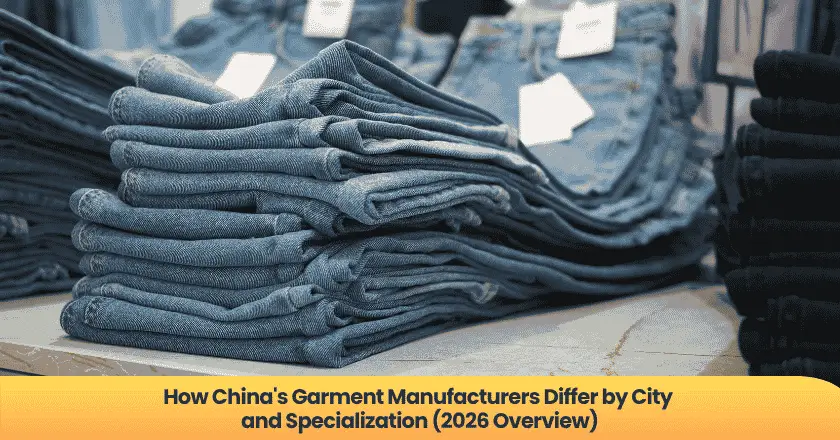
Guangdong province, centered on Guangzhou, Dongguan, and Shenzhen, is the deepest and most flexible apparel base in China. It handles fast fashion, women's wear, high-volume basics, and the widest range of trims and fabric access in the country. Within it, Xintang in Guangzhou is known as a denim capital, reportedly producing a large share of China's jeans output, with dye and wash houses clustered tightly around the cut-and-sew factories.
Dongguan's Dalang town built its name in knitwear, and sweaters in particular. Industry accounts commonly credit the town with making around one in six of the world's sweaters, backed by the largest wool wholesale market in China. That concentration of wool and yarn suppliers means a sweater factory there has its raw material on the doorstep, which shortens sampling and keeps yarn costs competitive. Shenzhen leans toward design-driven, small-batch, and e-commerce-focused production, useful for brands needing fast samples and quick turnarounds. Its factories are comfortable with on-demand and small-run work that a high-volume basics plant would decline.
Zhejiang and Jiangsu: fabric, knitwear, and tailored goods
Zhejiang province is the fabric engine. Keqiao in Shaoxing hosts the largest textile market in Asia, spanning millions of square meters and tens of thousands of suppliers, and it's often cited as handling roughly a quarter of the world's fabric trade. When fabric choice drives your product, sourcing from a factory near Keqiao means samples move faster and swatch options run far wider than a factory buying fabric from a distance can offer. The region is strong in knitwear and technical fabrics as well, and its mills tend to sit close to the finishing capacity those fabrics need.
Jiangsu and the wider area around Suzhou lean toward premium cotton, tailored and structured garments, and higher-end woven goods. Suzhou carries a long reputation for silk and better-constructed clothing, and its factories are used to the tighter tolerances that European and Japanese brands demand. For structured pieces like blazers, shirting, and lined garments, this is the kind of cluster worth paying a bit more to reach, because construction quality is exactly what these factories compete on.
Common Mistake to Avoid: Sending a technical sportswear or structured-tailoring order to a fast-fashion cluster because the quote came back cheapest. Fast-fashion hubs are built for speed and volume on simpler garments, not for performance fabrics or precise construction. The result is a product that looks right in photos and fails in fit or durability. Match the garment's complexity to a cluster known for that complexity, then compare quotes inside that shortlist rather than across mismatched regions.
Sportswear, Knitwear, and Vertically Integrated Hubs
Some categories reward a different kind of factory. Performance sportswear and heavy knitwear depend on controlling fabric and finishing in-house, so the strongest players in these areas are often vertically integrated, meaning they run knitting, dyeing, cutting, and sewing under one roof.
Fujian province, around Jinjiang and Quanzhou, is the sportswear and activewear powerhouse. It grew around major domestic athletic brands, which built a deep local ecosystem for performance fabrics, bonding, and athletic construction. A running-short or compression-legging order finds specialists here that a general apparel town can't match. The same region is a major footwear center, so brands building a full activewear range sometimes find apparel and shoe capacity within reach of each other.
Ningbo in Zhejiang anchors large-scale, vertically integrated knitwear and sportswear. The region is home to some of the world's biggest knitwear manufacturers, the kind that produce for major global sportswear brands from yarn all the way to final packing. That integration is why they hold quality steady across enormous runs.
The trade-off is scale. Vertically integrated giants deliver consistency, but their minimums and processes suit steady, sizeable volume more than a first 200-piece test run. A smaller brand often fits better with a mid-sized specialist in the same category and region, close enough to the ecosystem to benefit from it without being a rounding error at a giant.
Expert Tip: For sportswear and knitwear especially, ask a factory whether it knits and dyes in-house or buys finished fabric. In-house control usually means tighter color consistency and fewer surprises on stretch and recovery, because the factory owns the whole chain. A cut-and-sew shop buying fabric on the open market can still do good work, but you'll want extra fabric approvals up front. Knowing which model you're dealing with tells you where the risk sits before production starts.
How to Use the Cluster Map When You Source
Reading the map changes how you shortlist. Start from your garment type, name the cluster known for it, and build your candidate list inside that region first. This is faster than searching a platform blind, and it filters out mismatched factories before they waste your time.
The map also works as a quote check. A very low price from a region with no history in your product is a question, not a bargain. It often means the factory is brokering your order to a real specialist elsewhere and adding a margin, which adds a layer between you and the people actually making your goods. Reaching the strongest factories in a cluster is the harder part, since many of them don't market in English and don't appear on the platforms most buyers search.
One more practical use: the map helps you plan a sourcing trip. If your range spans denim and knitwear, you can group factory visits by region rather than crisscrossing the country. A buyer who understands that denim sits in one town and sweaters in another books a route that covers both in days, not weeks. The same logic applies remotely, where a partner on the ground can visit clustered factories on your behalf far more efficiently than chasing scattered suppliers.
Common Mistake to Avoid: Treating the cluster map as the whole answer and skipping factory-level checks. The right region raises your odds, but clusters hold weak factories alongside strong ones, and a denim town still has shops that cut corners. Use the map to build a smart shortlist, then vet each candidate with samples, a capability check, and ideally an audit. Geography narrows the field; it doesn't replace the diligence that confirms a specific factory can deliver your order.
How NewBuyingAgent Connects You to the Right Cluster
Knowing which cluster fits your garment is one thing. Reaching the best factory inside it, from another country and language, is another. This is the gap a sourcing partner closes.
NewBuyingAgent is your perfect partner for global sourcing from China, backed by 30 years of expertise in trade, manufacturing and quality control. The cluster map only helps if you can actually get into the right factories, and most buyers can't. Only less than 5% of China's factories are within your reach directly, and the 95% you can't reach often offer far better prices.
NewBuyingAgent gives you 100% access to China's factories through 50,000+ cooperated partner factories, with no language, region, or time zone barriers, and local reputation that secures full factory cooperation. That access spans the clusters this article describes, from denim towns to knitwear hubs. Because its wide factory network lets it pick low-cost, high-cooperation suppliers, NewBuyingAgent cuts your costs by 5%-10% even with its margin included. Its 20,000+ product development and QC experts ensure your products match market needs and stay high-quality, which matters most when a cluster's best factories sit beyond a language barrier.
Frequently Asked Questions
Which Chinese city is best for garment manufacturing?
There's no single best city, because the right one depends on your product. Guangdong suits fast fashion, denim, and broad supply-chain access. Zhejiang leads on fabric and knitwear, Fujian on sportswear, and the Suzhou area on premium tailored goods. Match the cluster to your garment rather than chasing one universal answer.
Does it really matter which cluster my factory sits in?
In most cases, yes. A factory inside its natural cluster has fabric mills, trim suppliers, and skilled labor nearby, which shows up as better pricing, shorter lead times, and steadier quality. A factory making your product outside its specialty usually carries hidden freight and coordination costs that reach your final price.
How do I find the strongest factories in a cluster?
The best specialists often don't market in English or appear on the big B2B platforms. Trade shows in the relevant region, referrals from other brands, and a local sourcing partner who knows the cluster all reach further than a platform search alone. Combining channels gives you the widest and best-vetted shortlist.
Should a small brand use a large vertically integrated factory?
Usually not for a first run. Large integrated manufacturers deliver excellent consistency but suit steady, sizeable volume, and a small order can get low priority. A mid-sized specialist in the same category and region often gives you the ecosystem's benefits with more attention and a workable minimum.
Is China still worth it for apparel in 2026?
For most mid-to-high-complexity garments, the cluster depth and supply-chain integration remain hard to match. China still accounts for roughly a third of global apparel exports by industry estimates. The advantage now lives in specialization and speed rather than the lowest possible unit cost.
Conclusion
China's garment industry isn't one market, it's dozens of specialized ones, and the city on a factory's address often predicts the quality on your invoice. Start from your product, name the cluster built for it, and shortlist inside that region before you compare a single price. If reaching the strongest factories in that cluster from a distance feels out of reach, NewBuyingAgent can put the right specialist and a working QC system behind your order.
NewBuyingAgent
Related Resources
ابدأ اليوم
دعنا نحول أهداف التوريد الخاصة بك إلى واقعWeChat:+86 15157124615
WhatsApp:+86 15157124615
العنوان: مبنى 10 #39 طريق شيانغيوان، هانغتشو، الصين
