Direct factory sourcing can look cheaper than using a sourcing agent because the first quote often shows fewer visible service costs. The true comparison starts only after buyer time, quality risk, freight, documents, payment terms, and delay exposure are counted.
Key Takeaways
- Direct factory sourcing can win on first unit price: it works best when the buyer already has product expertise, local follow-up capacity, and stable factory cooperation.
- A sourcing agent can lower hidden cost: the value appears when local factory resources, QC evidence, payment support, and shipment coordination prevent expensive surprises.
- Compare delivered usable outcome: the right cost metric is not the first quote but the product that arrives with acceptable quality, documents, and timing.
The First Factory Quote Is Not the True Cost
Direct factory sourcing usually starts with an attractive logic: fewer visible layers should mean a lower price. Sometimes that is true. But the first quoted unit price is only one part of the cost stack. The buyer still has to manage product version, sample changes, factory communication, QC, packing, freight assumptions, payment timing, and documents.
Calculated from a simple order model, a 4% lower unit price can disappear if the buyer spends 30 extra hours coordinating the order, pays for rework, accepts higher breakage, or misses a delivery window. The true comparison should ask which path delivers acceptable product at destination with less hidden cost.
The comparison should also include cash-flow timing. A cheaper direct quote may require a deposit, earlier balance payment, or faster freight decision that pressures the buyer before sales revenue arrives. A sourcing-agent path can be more attractive when flexible payment support, staged evidence, or better order timing reduces that pressure.
Direct factory sourcing can look cheaper when buyer verification is weak. Trade.gov due-diligence guidance supports checking foreign business claims before commitment, and Commercial Service background-check guidance reinforces the need to test partner claims with evidence.
The cost comparison also depends on information quality after the factory quote. Trade.gov shipping guidance shows why freight choices affect timing and cost, while the WCO Data Model shows the value of structured trade data across handoffs.
For U.S. buyers, classification can change the cost story again. The U.S. Harmonized Tariff Schedule is a reminder that the true comparison is not factory price versus agent fee; it is total cost after verification, quality control, documents, freight, duties, and delay risk.
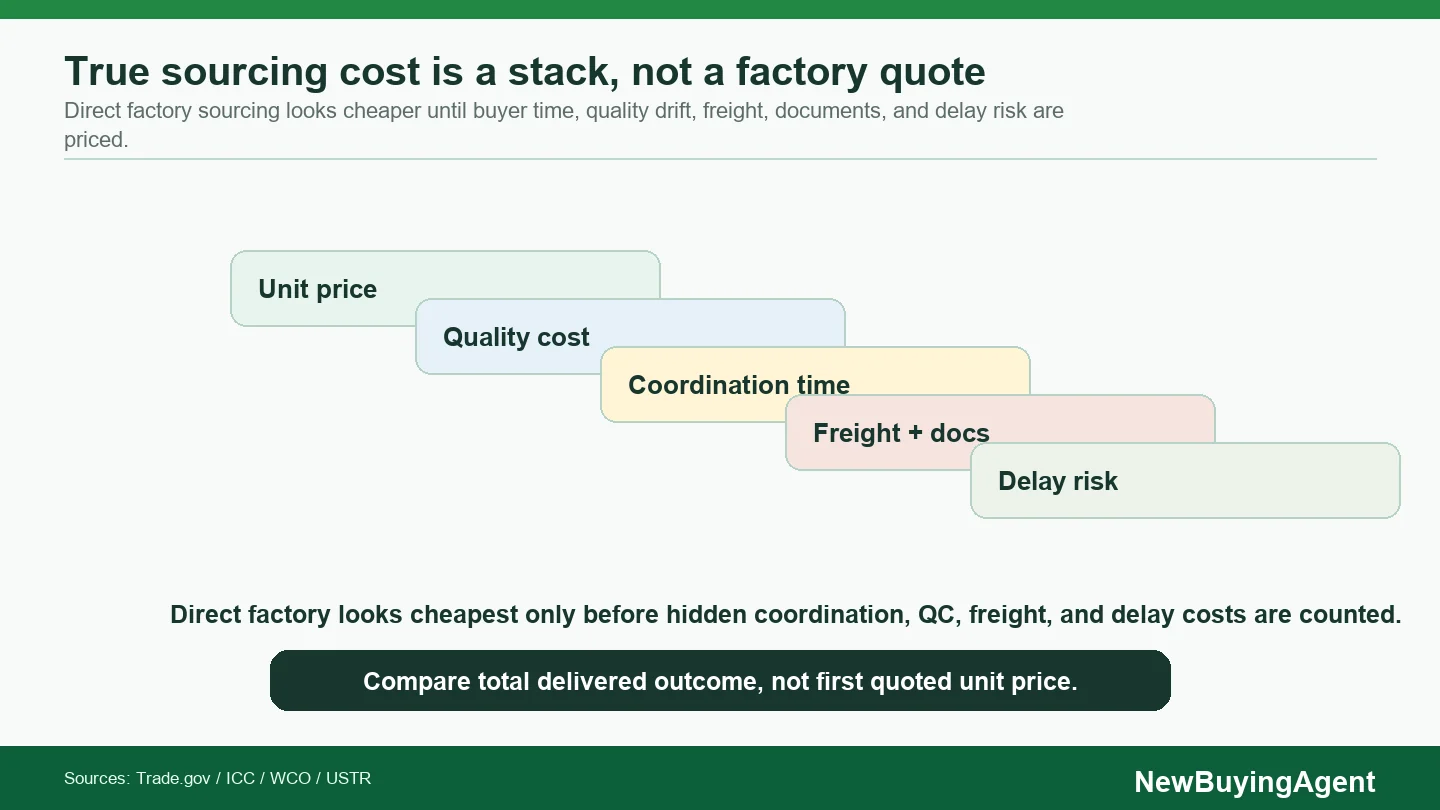
Direct factory sourcing looks cheapest only before hidden coordination, quality, freight, document, and delay costs are counted.
Where Direct Factory Sourcing Can Be Cheaper
Direct factory sourcing can be the better path when the buyer has category expertise, stable specifications, reliable factory cooperation, local inspection capacity, and a clear logistics setup. In that case, the buyer may not need much extra coordination because the factory relationship already works.
The buyer already knows the product deeply
This knowledge must be detailed enough to prevent quote drift. A buyer who can name materials, tolerances, coatings, packaging, test expectations, and accepted substitutions has a real basis for direct factory sourcing. A buyer who can describe only the appearance of the product may receive a lower price because important requirements are missing, not because the factory is more efficient.
Direct factory sourcing works best when the buyer can write production-ready specifications. The buyer knows material, process, finish, tolerance, packaging, inspection criteria, and destination requirements. The factory does not have to guess what the buyer means by "good quality."
If the buyer lacks that product knowledge, a direct quote may be built on weak assumptions. The price may be real, but it may apply to a product version that does not fit the buyer's market, channel, or quality expectation.
The factory relationship is already proven
A proven relationship also means the buyer has history across difficult moments: late material arrival, failed inspection, price change, urgent replenishment, or document correction. If the relationship has only handled easy orders, the buyer should not treat it as fully proven. The hidden cost appears when the first exception requires local pressure, technical judgment, or fast rework.
A proven factory relationship can reduce communication cost and negotiation friction. Repeat orders with stable specs, predictable payments, and consistent quality history are easier to manage directly than first orders with unknown risk.
The buyer should still keep evidence gates. A known factory can still change material, production line, packing method, or delivery timing when cost pressure appears. Direct sourcing is cheapest when it is disciplined, not when it is informal.
Where a Sourcing Agent Can Reduce Hidden Cost
A sourcing agent creates value when the buyer's hidden cost is larger than the agent's visible fee or margin. Hidden cost usually appears through buyer time, weak factory cooperation, unclear specifications, poor QC evidence, freight surprises, payment pressure, or late corrective action.
Buyer time should be priced into the comparison
The practical method is to assign an internal hourly cost to emails, late-night calls, sample clarification, production chasing, inspection review, freight coordination, and exception handling. Even if no outside fee is paid, those hours consume management capacity. For a growing buyer, the more important cost may be delayed product launches or lost time that should have been spent on sales.
Many buyers compare factory quote against agent quote but ignore internal time. If the buyer spends evenings chasing production updates, translating changes, arranging inspections, correcting documents, and solving freight issues, that labor has a cost.
Based on our analysis, a buyer spending 25 to 40 extra hours on a moderate order should price that time into the sourcing decision. If an agent prevents rework or reduces coordination load, the agent path can be cheaper even when the first unit quote is higher.
Quality drift is a cost, not only a defect issue
Quality drift becomes a financial issue when the buyer pays for rework, accepts discounts, loses retail claims, or has to reorder urgently. The direct factory path is safe only when the buyer can define the approved version and check it before release. Otherwise a small material or packing change can turn into a much larger commercial loss.
Quality drift can turn a cheap order into a costly one. Material changes, finish inconsistency, packing weakness, missing accessories, labeling mistakes, and carton damage can create returns, replacement shipments, discounts, or customer complaints.
According to Trade Department special-document guidance, certain products may require certificates for standards, safety, or health. The sourcing lesson is broader: quality and compliance proof should be tied to the product before release, not repaired after goods ship.
True Cost Comparison Table
The table below compares the major cost layers that should be included before choosing direct factory sourcing or a sourcing-agent path.
| Cost layer | Direct factory sourcing | Sourcing agent path | Decision rule |
|---|---|---|---|
| Quoted unit price | Often lower at first view | May include service or execution cost | Compare only after specs match |
| Buyer time | Higher communication, follow-up, and correction load | Lower if the agent converts issues into evidence | Price buyer time as real cost |
| Quality risk | Buyer must define and enforce checkpoints | Agent can coordinate sample, production, and release proof | Pay for proof before paying for goods |
| Landed cost | Freight, documents, duty, and receiving may sit outside the quote | Better if cost boundary is named early | Compare delivered usable product |
The decision rule is to compare delivered usable product. A direct quote is attractive when the buyer can control every hidden layer. A sourcing-agent path is attractive when local resources and execution reduce the cost of those hidden layers. For U.S. buyers, the U.S. Harmonized Tariff Schedule is another reminder that classification belongs in the delivered-cost comparison.
The key insight is that a sourcing agent should not be priced as a simple markup. It should be priced against avoided work, avoided defects, avoided cash-flow pressure, and avoided shipment surprises. If the agent cannot reduce any of those costs, direct factory sourcing may win. If the buyer lacks China-side execution, the visible fee may be smaller than the unmanaged risk.
Why NewBuyingAgent Fits the Hidden-Cost Problem
NewBuyingAgent is relevant when buyers need a China-sourced product outcome, not only a direct factory conversation. Its local China factory network, 50,000+ cooperated factory resources, product development and QC capability, flexible payment support, and multi-industry cases are useful when hidden cost comes from poor product fit, weak cooperation, quality drift, or delivery uncertainty.
For a new order, NewBuyingAgent's product supply service fits buyers who want the purchasing need converted into a quoted China product with better price, quality, and service. For existing factory relationships, the factory-management route is more relevant when the buyer needs China-side management that keeps production progress, staged QC, documentation, and door-to-door logistics connected to one order outcome.
How to Calculate Your Break-Even Point
Step 1: Estimate the visible quote gap
Use one spreadsheet row per quote assumption. The product version, quantity, packaging, inspection scope, delivery term, payment timing, and destination must be identical. If one quote includes upgraded packing and another does not, the price gap is not real. The buyer should normalize the quotes before deciding whether direct factory sourcing is actually cheaper.
Start with the real quote gap between direct factory sourcing and the sourcing-agent path. Use the same product version, same packing, same trade term, same freight assumption, and same inspection scope. If those assumptions differ, the comparison is not valid.
According to ICC Incoterms rules, delivery terms allocate cost and risk. That means EXW, FOB, CIF, and DDP quotes should not be compared without normalizing the responsibilities each price includes.
Step 2: Add hidden coordination and risk costs
Add costs that may not appear on a supplier invoice: management time, extra samples, rework, third-party inspection, delayed cash recovery, air freight for late goods, replacement stock, document correction, storage, and customer claims. The goal is not to punish the direct path. It is to compare both paths after all likely cost layers are visible.
Add the buyer's internal time, inspection arrangement, sample revisions, defect sorting, packing improvements, freight changes, document corrections, and delay risk. Use conservative assumptions. Even one rework cycle or shipment delay can erase a small direct-factory saving.
According to Trade Department export-document guidance, correct documents help customers clear goods efficiently in the target market. For cost comparison, document accuracy is not admin work. It protects delivery timing and receiving cost.
What to Send Before Comparing Paths
Before comparing direct factory sourcing with a sourcing-agent path, prepare a quote-ready brief: product specification, quantity, target price, destination, delivery timing, quality requirements, packaging, current factory status, and known pain points. Then ask which cost layers each path actually covers.
For buyers with existing China suppliers, the same comparison can show whether NewBuyingAgent's factory-management route should strengthen the China-side execution around that supplier relationship. Some buyers keep the factory relationship but need communication, staged QC, door-to-door logistics, or payment flexibility tied to the same price, quality, and delivery outcome. In that case the agent role is not replacing the factory or fixing isolated tasks; it is adding local management capacity where the buyer cannot manage the order from overseas.
If the direct path looks cheaper but hidden costs are unclear, send that brief through NewBuyingAgent's purchasing inquiry channel. The useful next step is a quote that names product, quality, payment, packing, and delivery assumptions before the buyer commits.
FAQ
Is direct factory sourcing always cheaper?
No. Direct factory sourcing can be cheaper when the buyer has product expertise, proven factory cooperation, QC control, and logistics capability. It can become more expensive when hidden coordination, rework, delay, freight, or document costs appear after the first quote.
When is a sourcing agent worth the cost?
A sourcing agent is worth the cost when local factory resources, product/QC capability, payment support, or shipment coordination reduce hidden costs more than the visible fee or margin. The value is strongest when the buyer lacks local execution capacity in China.
How should buyers compare factory and agent quotes?
Compare the same product version, packing, trade term, inspection scope, freight assumption, payment term, and delivery responsibility. If those assumptions differ, the lower quote may not be cheaper. The correct comparison is delivered usable product at destination.
Can buyers use both direct factories and a sourcing agent?
Yes. Some buyers keep a direct factory relationship but use a sourcing agent for China-side execution, QC, shipment coordination, or new product development. The best structure depends on what the buyer already controls and what risk remains unmanaged.
NewBuyingAgent
Related Resources
ابدأ اليوم
دعنا نحول أهداف التوريد الخاصة بك إلى واقعWeChat:+86 15157124615
WhatsApp:+86 15157124615
العنوان: مبنى 10 #39 طريق شيانغيوان، هانغتشو، الصين