A China design-patent decision is a legal assessment of a qualifying product appearance and application record; a factory CAD-release decision is a buyer-controlled choice about what information is needed for the current commercial step.
Those decisions often arrive on the same day. A factory needs drawings to comment on tooling, finish, tolerances, or a first quote. The buyer wants to move quickly, but a full design archive may disclose more than that factory decision requires. The practical response is not to assume that a CAD file, a factory conversation, or a confidentiality document settles the IP question. It is to define the current factory purpose, control the permitted revision, and pause for qualified China IP advice when the full visual design may need protection.
This is practical sourcing-risk guidance, not legal advice or patent-filing instruction. A qualified Chinese IP lawyer or registered patent agent should assess patentability, filing materials, ownership, priority, disclosure exceptions, contracts, and enforcement for the specific product and markets involved. The framework below helps a buyer organize the factory-side handoff around that professional advice.
NewBuyingAgent can coordinate a buyer-approved commercial brief with China factories once the buyer has set the permitted revision and disclosure boundary. That operational support does not include deciding patentability, filing sufficiency, ownership, or enforcement.
The Pre-Sharing Decisions That Protect a China Design Launch
The buyer needs a product-version rule, a disclosure gate, an access record, and a legal escalation point before broad factory outreach. Together, those controls turn a vague request for “the CAD” into a specific decision: which file version is being considered, what the factory needs to decide now, who may receive it, and what must happen before the buyer releases anything more sensitive. The CNIPA English text of the Patent Law supplies the formal design-rights context; this four-part sequence is an operational control, not legal advice.
- Decision: Treat a full CAD archive as a later release gate, not the default starting point for every quote request.
- Risk: Ask qualified China IP counsel or a registered patent agent about the filing and disclosure sequence when the visual design may matter.
- How it works: Label every release by product revision, purpose, recipient, and buyer approval.
- Bottom line: A sourcing process can keep moving with a controlled factory package while the legal question receives the right review.
That does not mean a buyer should starve a factory of information. It means information should be released in proportion to a current task. A rough commercial brief can support an initial discussion. A limited technical subset may support a tooling estimate. The design drawings and related application materials may require a different legal and commercial gate.
What a China Design Patent Can—and Cannot—Do Before Factory Outreach
China design-patent protection is tied to a qualifying product design and the application record, not to the mere existence of a CAD file or a factory conversation. The CNIPA English text of the Patent Law defines a design in relation to the overall or partial product appearance specified by law. Article 23 makes prior-design timing relevant: a design known to the public before filing may affect the analysis. That is why a buyer should discuss timing with qualified professionals before assuming that a broad release is harmless.
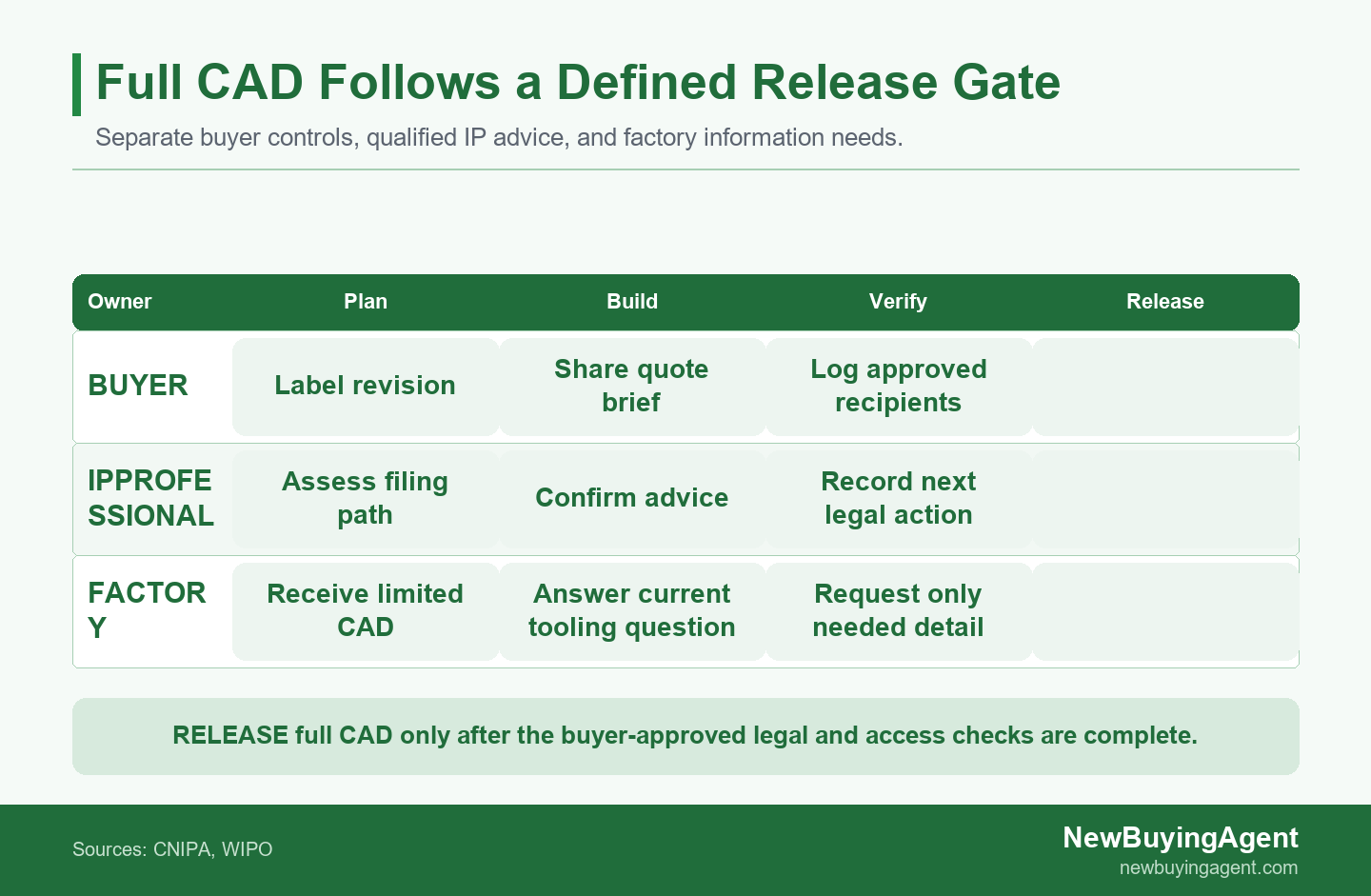
Swimlane showing buyer, IP professional, and factory CAD-release responsibilities
In plain language, a prior design is a design already known to the public before the relevant filing date. The legal effect of a particular disclosure is fact-specific. CNIPA lists limited statutory exceptions in Article 24, and an adviser must determine whether any exception, priority route, or filing path actually applies. The useful buyer action is narrower: do not rely on an informal “we will keep it confidential” message as the reason to send every drawing.
Design protection is also not necessarily a whole-product question. CNIPA’s 2021 revision Q&A notes the availability of partial-design protection for applicable filings from June 1, 2021. That update is a reminder to show counsel the actual visual features and product context, rather than reducing the discussion to a filename or a finished-product label. Whether a particular feature qualifies remains a professional legal question.
For factory outreach, the distinction matters because a factory may need dimensions, material, a finish target, a reference sample, or an estimated volume before it needs every design view. The buyer should specify the immediate manufacturing question, then let legal advice shape the full-release boundary. That sequencing supports faster sourcing without overstating what the sourcing record can prove.
Use a Disclosure Ladder Before Sending CAD
A staged disclosure ladder matches the information released to the factory decision that must be made now, rather than treating the full CAD archive as the default quote package. This is an original sourcing framework, not a substitute for a legal filing strategy. Its value is that it gives the buyer a repeatable way to name the permitted package, the decision it supports, the recipient, and the point at which full CAD must wait for a qualified filing or disclosure decision. The CNIPA Patent Law provides the formal design-rights context behind that escalation point.
A simple four-gate ladder works well for new-product sourcing. Gate one is a commercial brief: product function, target market, intended quantity, target price, material direction, finish reference, timing, and a non-confidential image or sketch where appropriate. Gate two is the legal escalation: the buyer asks qualified Chinese IP counsel or a registered patent agent how the proposed design, drawings, filing timing, and disclosure plan should be handled. Gate three is a limited technical package for a specific factory task. Gate four is a full-release decision tied to the buyer’s approved legal path and an access record.
The ladder makes the “why” visible. A preliminary quote often needs product size, material family, expected order conditions, and visual direction. A tooling review may need selected dimensions or controlled views. A factory does not automatically need a complete editable archive merely because it is interested in the project. When the buyer can explain the current question, the factory can respond to that question instead of receiving a wider package by default.
| Release gate | Factory decision supported | Buyer control before release | What does not follow automatically |
|---|---|---|---|
| 1. Commercial brief | Interest and indicative quote | Product function, quantity, market, timing | Full design CAD |
| 2. Legal escalation | Filing and disclosure path | Qualified China IP review | A patentability conclusion from the factory |
| 3. Limited technical subset | Tooling or sample feasibility | Named revision, recipient, purpose | Permission to forward the archive |
| 4. Conditional full release | Detailed manufacturing preparation | Approved legal and access checks | A guarantee of final patent scope |
Based on this comparison, the data a factory receives should become more specific only when the buyer’s decision and evidence become more specific. If a buyer needs help turning the commercial inputs into a controlled product brief, it can be useful to review the China manufacturing and product guide before outreach. The guide supports product-definition work; it does not replace China IP advice.
For an early supplier discussion, NewBuyingAgent can work from the buyer-approved product brief to clarify the present manufacturing question with China factories. That China-side coordination should use the permitted revision and release scope supplied by the buyer; it does not include deciding whether a design is patentable or what an IP filing should contain.
File or Get Formal Advice Before Releasing the Full Design Package
When the full package exposes the visual design that may be the subject of a China application, the full-release decision belongs after qualified China IP advice or filing action, not after an informal factory request. The WIPO China chapter on patent case management explains why filing and priority dates can materially affect design-patent analysis. That is enough reason to make the full-release call a deliberate escalation, not a routine email attachment.
“File first” is not a universal instruction. The right action could be filing, a priority review, a different rights strategy, a contract review, a modified release plan, or a conclusion that design-patent protection is not the relevant tool. The buyer should obtain that answer from a qualified professional. A sourcing team can prepare a clean product record and preserve the current revision while the adviser identifies the appropriate next step.
For a practical handoff, send counsel the product name, use, visual feature in question, the latest drawings or photographs, existing public exposure, intended markets, factory timetable, and what the factory says it needs now. Ask for a clear operational output: what can be released, to whom, under what condition, and whether a filing or another action must happen first. That makes the legal response usable in a real production calendar.
Share Only the Manufacturing Detail Needed for the Current Gate
A buyer can separate functional quote inputs from the fuller design package by labeling the permitted revision, purpose, recipient, and expiry of each release. This is not a claim that a label creates legal protection. It is a simple control that prevents the estimate package, the sample package, and the full production archive from becoming one untracked folder with unclear permissions. The WIPO guide to China design patents distinguishes the application’s design-identification materials from this commercial release control.
For example, an estimate package may identify the product function, core dimensions, material family, expected finish, target quantity, packaging direction, and the particular tolerance question a factory must answer. A sample package may add selected views or dimensions necessary to make a prototype. The full package may include distinctive visual details, editable files, or manufacturing data that the buyer has reserved for a later gate. The boundary should be specific enough that the factory knows what question it is answering and the buyer can see when the request expands.
Use neutral, plain labels rather than relying on informal messages: revision, purpose, approved recipient, no onward sharing without buyer approval, and review date. A buyer can then decide whether the next request is a normal expansion of the same task or a different release that needs counsel, a new agreement, a changed product brief, or another approval. The point is disciplined factory communication, not a promise that information can never be misused.
Keep Ownership and Access Records Separate From Patent Rights
A release register and file-version record can show who received what and why, but they do not by themselves create, validate, or enforce a design-patent right. The WIPO guide to China design patents describes how drawings or photographs and a brief description help identify the design in the application context. A commercial access log has a different job: it helps the buyer retrace a release and identify whether a later factory request relates to the same revision.
A useful register can be a controlled project sheet rather than a complicated system. Record the product or project reference, file name, file hash or revision label if used internally, release date, recipient organization and contact, purpose, package contents, restrictions communicated, buyer approver, and next review trigger. Keep the buyer’s legal counsel and filing materials in their own controlled path. Do not ask a factory contact or sourcing coordinator to make a legal judgment merely because they can see the log.
| Record field | Practical sourcing use | Legal boundary |
|---|---|---|
| Revision label | Stops an old file being treated as current | Does not establish patent scope |
| Recipient and date | Shows who received a defined package | Does not decide contract enforceability |
| Purpose | Connects a file to a quote or sample question | Does not decide patentability |
| Approval gate | Shows why a wider release was or was not allowed | Does not replace professional IP advice |
CNIPA publishes a design-protection guide that provides formal protection context. The operational register remains a procurement control. Keeping those two records distinct prevents a buyer from overstating the value of an email trail while still gaining the real benefit of version and access discipline.
The CNIPA English implementing rules provide further design-application document context. They are useful for understanding that formal application materials follow a separate legal process; they do not turn an internal release sheet into a filing record or a legal opinion.
An Illustrative Three-Factory CAD Release Decision
Release the Estimate Package, Not the Entire Archive
A constrained release can keep a three-factory quote process moving while the buyer holds the full CAD package for a qualified filing or disclosure decision. A global furniture-hardware buyer is preparing a new handle with a distinctive visible profile for China production. The 3 factories need enough information to assess tooling and finishing before the buyer selects a production path. The buyer has a controlled product brief but has not received a filing opinion or a complete application package. The CNIPA Patent Law is the legal context for the illustrative escalation; the scenario itself is not legal advice.
Situation: The team holds 8 CAD files, including four views that show the visible profile and two files with mounting detail. One factory asks for the entire package before it can comment on tooling tolerance and finish. The following example is illustrative, not a client case or a legal recommendation.
Problem and action: The visible profile may be relevant to the design question, while the immediate factory decision needs only a constrained technical subset. The buyer should not assume that a factory request determines what it is safe or necessary to release. Release a labeled, limited factory package for the first estimate; hold the full CAD package until qualified China IP counsel or a registered patent agent confirms the appropriate filing and disclosure path.
Controlled result: Create a release register showing each file name, revision, intended factory purpose, recipient, date, and buyer approver. A counsel-approved filing or disclosure decision, plus a checked access log and the exact approved CAD revision, is required before full-package release. Illustrative operational control only; it does not decide whether the design qualifies for a patent or whether any agreement is enforceable.
The corrective action is to release the six files needed for an estimate, retain two controlled design files, and permit full release only when the buyer's defined legal and access checks are met. The CNIPA Patent Law provides the formal context for this illustrative escalation. If the project is already with an existing supplier, the buyer can review China factory-management support for an existing supplier to coordinate the buyer-approved local follow-up; that service path does not make the factory-management team the legal decision maker.
That conditional-release approach is often more useful than an all-or-nothing answer. A full stop can delay a legitimate quote. An unbounded release can create a record the buyer later struggles to explain. By separating the immediate factory question from the fuller legal decision, the buyer preserves options. If a factory cannot answer the current question without a wider package, that becomes a new request with a named owner and a documented escalation path.
Use China-Side Sourcing Support Without Delegating Legal Judgment
China sourcing support can coordinate a buyer-approved product brief and factory communication, but patentability, application sufficiency, ownership, and enforcement decisions stay with qualified IP professionals. That boundary lets a sourcing partner add value where it belongs: making the factory question clear, checking that the approved revision is used, collecting commercial feedback, and helping the buyer turn a controlled brief into a workable China product-supply conversation. NewBuyingAgent’s product-supply service follows that commercial coordination role.
For a new product, NewBuyingAgent is relevant once the buyer can state the product function, target quantity, destination, timing, allowed reference materials, and the current disclosure rule. Its local China factory resources and product-development/QC capability can help turn that defined brief into practical factory communication. Buyers can see how NewBuyingAgent supplies products from China when they want to move from requirements to a quoted product path rather than collect disconnected factory discussions.
The right handoff is concrete. Start each factory request with a release instruction that names the product revision, receiving organization, exact files or reference views allowed, narrow commercial question, and buyer who owns the next approval. A China-side coordinator can collect tooling comments, quote clarifications, materials questions, and sample feedback against that instruction without widening the file set on its own.
If a supplier asks to forward drawings to a subcontractor, requests editable source files, or says that another engineering team needs a broader package, treat that as a new release request. Log the reason, compare it with the original purpose, and give the buyer a short decision record: what changed, why it is needed, which revision is affected, and whether qualified IP advice is required before the transfer. This keeps a production conversation moving while making expansion visible.
The same discipline helps when factories give different feedback. The buyer can compare manufacturing responses to the same controlled brief rather than to several evolving versions of the design. It also creates a useful audit trail for commercial management, but it does not decide the legal effect of an agreement, disclosure, application, or later enforcement. Where timing is tight, the next step can be a short written approval rather than an informal call, so the scope of the permission remains legible after the conversation ends.
Before that conversation, keep the IP decision in the right place. Provide the sourcing team with the buyer-approved commercial brief and permitted file set, not an instruction to decide whether a design should be filed, whether an agreement is sufficient, or whether a right is enforceable. If the buyer is ready to discuss China product supply with that boundary in place, contact NewBuyingAgent with a controlled product brief
Frequently Asked Questions
Should I file a China design patent before sending CAD to a factory?
A buyer should obtain qualified China IP advice before releasing full CAD when the design may need China patent protection or public-disclosure timing is uncertain. CNIPA’s Patent Law makes prior-design and filing-date context important, but the right filing or disclosure path depends on the actual design, prior exposure, intended markets, and available rights. Ask a qualified Chinese IP lawyer or registered patent agent for a product-specific view, then translate that advice into a permitted factory package and release gate.
Does an NDA or NNN agreement replace a China design patent filing?
No, a confidentiality agreement and a design-patent application address different risks, so neither should be presented as a substitute for qualified legal advice on the other. A contract may be relevant to confidentiality or permitted use, while a patent application concerns a different legal route. The appropriate documents, wording, parties, and timing are fact-specific. Keep a signed agreement and a release register in their proper roles, and obtain counsel on the legal effect they may have.
What CAD can a buyer share before the full design package is ready?
A buyer can share only the functional and commercial detail needed for the current factory decision after defining which drawings, files, and revisions are approved for that gate. An indicative quote may need a product function, material direction, approximate dimensions, quantity, finish, and a limited reference view. A tooling or sample question may need more. Label the allowed revision, recipient, purpose, and review point, then escalate any request for the full package through the buyer’s approved legal and commercial process.
Can a China sourcing agent decide whether a design is patentable?
No, a China sourcing agent can coordinate a buyer-approved factory brief but should not decide patentability, filing sufficiency, ownership, or enforcement. The useful sourcing role is commercial and operational: clarify the factory’s present question, route the permitted technical package, preserve revision discipline, gather quote or sample feedback, and coordinate approved next steps. Legal analysis should remain with qualified China IP counsel or a registered patent agent who can assess the specific product and facts.
NewBuyingAgent
Related Resources
ابدأ اليوم
دعنا نحول أهداف التوريد الخاصة بك إلى واقعWeChat:+86 15157124615
WhatsApp:+86 15157124615
العنوان: مبنى 10 #39 طريق شيانغيوان، هانغتشو، الصين