

A business continuity plan for a critical China supplier is an agreed record of the orders at risk, acceptable interruption, authorized recovery actions, decision owners, communication and tests. Its purpose is to protect the buyer’s customer commitments when normal supply fails. A factory may restart successfully and still deliver too late, so the plan should follow approved goods all the way to the required destination.
Build it with the supplier before relying on a recovery promise. Use current purchase orders, approved product records and the customer schedule; treat supplier-risk findings as inputs rather than repeat the factory audit. The guidance below is a practical planning synthesis, with an explicitly illustrative example and no assumption that one recovery deadline suits every product.
Protect the Customer Commitment, Not Just the Factory
Protect specified customer commitments with named owners, credible recovery options and tested assumptions rather than treating a supplier emergency document as proof of continuity. Start with the products, quantities and arrival dates that matter most, then agree who can authorize each response. A usable plan identifies both the supported commitment and any remaining gap; it does not turn an uncertain restoration estimate into a guaranteed shipment.
- Decision: Define minimum acceptable approved output and its latest arrival before accepting a recovery option
- Common mistake: Counting unreleased stock or an unqualified backup as immediately available supply
- How it works: Give each action an owner, permission boundary, evidence record and review trigger
- Risk: Keep customer priority and product-change decisions separate from factory restart authority
The Supplier Continuity Plan Framework
The Supplier Continuity Plan Framework connects scope and owners, impact and tolerance, recovery options, activation and communication, and exercise and review. It is a descriptive buyer synthesis, not a proprietary method or certification standard. Recovery options need owners and evidence that approved goods can reach the customer within tolerance; the same records should show what happens when no ready option can meet that limit.
Keep the working plan short enough for its owners to use during a disruption. Put the current action sheet and contacts first, with controlled attachments for affected orders, specifications, stock, option evidence and messages. Keep attachments tied to the next decision.
Scope and Owners
Define the covered supplier site, approved products and purchase orders, with a buyer plan owner, supplier response owner and named deputies; keep safety, commercial and quality authority distinct. Record which other orders are outside this plan. A supplier may serve several buyers, so confirm the quantity or capacity available to your program rather than assume access to its whole output.
NIST’s manufacturing continuity guidance recommends primary and alternate contacts for key functions. Its Puerto Rico manufacturing experience is useful planning guidance, not evidence of China disruption frequency. For this joint plan, convert the contact list into clear authority: who confirms stock, who releases product, who approves extra spending and who agrees a revised customer date. Test contact details across the relevant working hours.
Connect these records to the purchasing brief described in the China sourcing guide. Include the approved drawing or sample reference, specification version, packing requirements, purchase-order balance and destination. The continuity plan should point to the same product baseline used for ordinary supply, so an emergency response does not quietly start making a different item.
Impact and Tolerance
Record unacceptable customer impacts and the latest acceptable arrival for minimum approved output; a factory restart target is not the same as the buyer’s tolerable interruption. Ask the buyer’s sales, operations and inventory owners which commitment fails first. Identify consequences such as a missed launch, an assembly stoppage or an agreed service shortfall, and state the assumptions behind each limit.
The UK Cabinet Office’s historical continuity toolkit distinguishes a maximum tolerable period of disruption from a recovery time objective and relates impact analysis to critical activities and resources. It is voluntary guidance, not a current Chinese legal requirement. Apply the distinction to this order: the recovery target should leave room for checks and transport before the customer limit is reached.
Do not assume that all stock buys the same amount of time. Separate released finished goods from work in progress, damaged or quarantined goods, and stock already allocated to another commitment. State the minimum acceptable quantity and the duration of any reduced service. If demand is uncertain, calculate more than one plausible demand case and identify the decision that changes between them.
Recovery Options
Each recovery option records available conforming quantity, first arrival and continuing capacity, prerequisites, approval owner, evidence date and failure conditions. Possibilities include using released inventory, restoring the original process, reserving another approved line, sourcing a qualified alternative or agreeing a reduced customer commitment. Choose the options that address the actual bottleneck; an alternate assembly line cannot fix a missing critical input.
Give each route a readiness state such as ready, conditional or under development. Explain the missing condition rather than invent a resilience score. For example, a route may have accepted pilot goods but no confirmed production slot; another may have usable stock but no freight booking. Owners should know which evidence changes that status and who can approve the move to a live commitment.
Activation and Communication
Agree activation thresholds before an incident and separate confirmed facts from estimates in messages; the supplier controls site response while the buyer approves customer priorities and commercial exceptions. A threshold can be a projected miss of the protected arrival date or loss of a necessary release capability. It should connect to the plan’s tolerances rather than wait for a dramatic disaster declaration.
Record primary and fallback channels, acknowledgement expectations and the escalation route if an owner is unavailable. Set update timing to the speed of the incident and the next decision, with a stated time zone. The plan should identify who may contact customers, logistics providers and other affected parties, and which information they may share; it does not authorize uncontrolled disclosure of other customers’ orders.
Exercise and Review
Exercise and review the agreed records, with an action owner and closing evidence for each failed assumption; a meeting-only exercise cannot establish physical output or freight readiness. Review the plan when product versions, production sites, critical inputs, order exposure or decision owners change, and after a relevant incident. Keep superseded copies distinguishable so the response team does not revive an obsolete option.
Use a version owner to distribute revisions to the people who invoke the plan. Mark which option changed and whether previous commitments remain supported. If a route loses readiness, notify the buyer owner before it is used again; a new document version alone does not repair the underlying capacity or arrival gap.
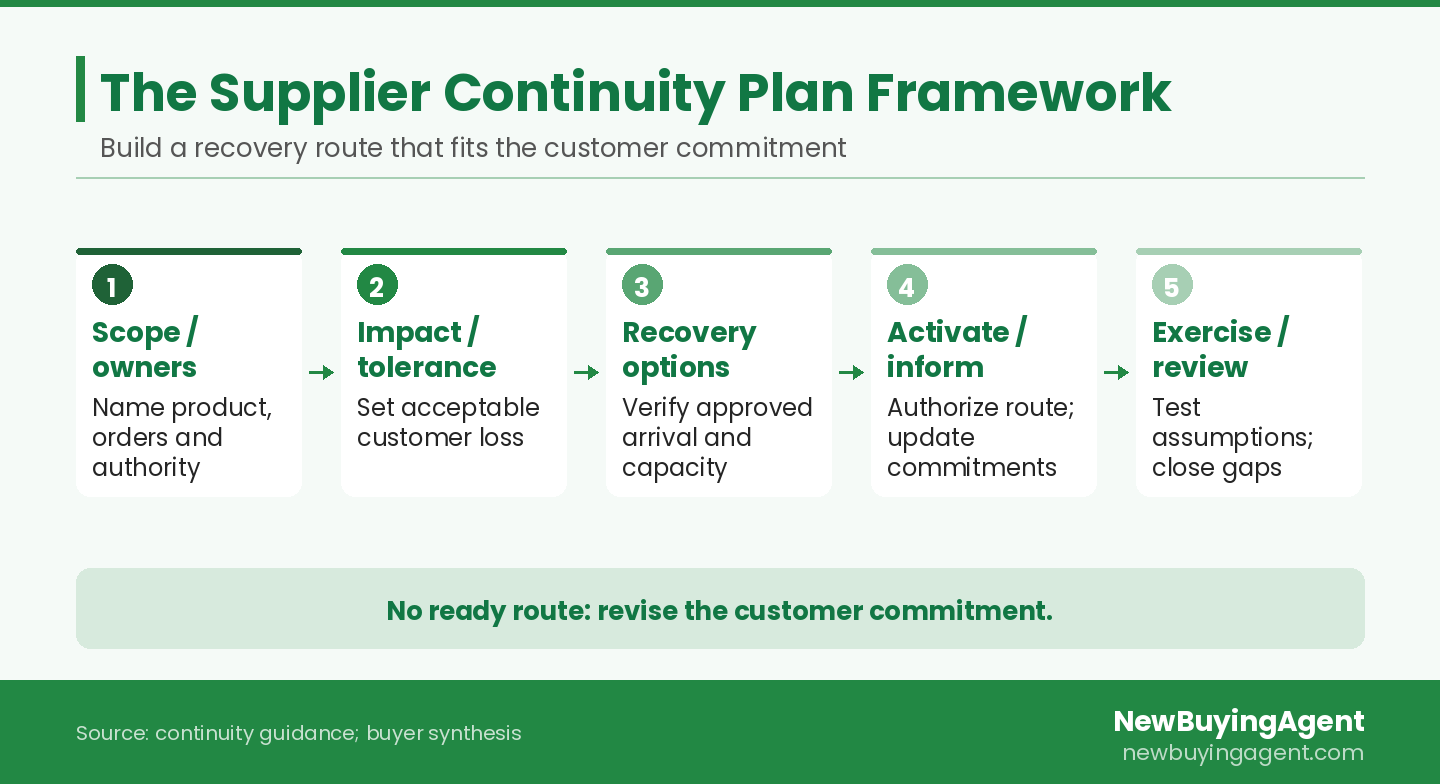
Supplier continuity planning links owners, tolerance, recovery options, activation, and tested customer commitments
Choose Recovery Routes Against the Same Order Limit
Compare recovery routes by the same approved product, usable quantity and customer arrival requirement; retain unready options as development actions rather than commitments. The cheapest or fastest factory restart can still be the wrong route if it depends on an unapproved material, unavailable tooling or delayed delivery. Choose a route only after its prerequisites and authority fit the protected order, then keep a fallback for its most important uncertainty.
NIST’s manufacturing supply-chain resilience guidance discusses supplier relationships, diversification and adapting supply sources, production schedules or products. These are possible response families, not proof of immediate backup readiness. Translate the menu into a dated option card for this product: what can arrive, how much, from which approved process and with which evidence. A proposed product change belongs in a separate approval decision.
| Route | Usable supply evidence | Timing record | Permission boundary |
|---|---|---|---|
| Released inventory | Lot identity, release and allocation | Packing, dispatch and arrival | Buyer agrees customer allocation |
| Original-site recovery | Safe access, process checks and first lot | Restart plus release and transport | Supplier restart; designated quality release |
| Approved alternate route | Current product evidence and reserved capacity | Mobilization through first usable arrival | Buyer approves commercial changes |
| Reduced customer commitment | Verified available quantity | Agreed partial arrival and remainder | Customer agreement through buyer owner |
Read the option card from arrival backward. Confirm product release and transport first, then ask whether the supplier’s recovery schedule supports them. Record whether the first shipment clears only the urgent customer order or also restores ongoing replenishment. An initial small lot and a stable production rate solve different problems; neither should be substituted for the other in a customer promise.
NIST’s supplier evaluation guidance recommends examining quality systems, production and inspection records, and lot controls. Applying that evidence discipline to recovered or alternate output is a buyer recommendation; an emergency does not itself approve a product change. Retain the applicable inspection and test criteria, and identify the person who may accept the recovered lot against them.
When the current plan leaves a genuine replacement purchase uncovered, NewBuyingAgent’s product-supply service turns purchasing needs into quoted China-sourced products using local factory resources and product development and quality-control capability. Bring the product requirements and continuity constraints into the supply request. Access to those resources can support a practical sourcing path, but it does not imply immediate qualified capacity or a guaranteed emergency delivery.
Activate the Plan Before the Recovery Window Closes
Activate when verified or credible projected disruption threatens the agreed product/order tolerance, even while the final recovery date remains uncertain; escalate missing authority, unsupported dates or unapproved product changes. The first response should preserve people’s safety, establish affected scope and make the next decision possible. Run the buyer’s customer-impact review alongside the supplier’s recovery assessment rather than waiting for a complete site-restoration report.
Solenis asks suppliers to notify its category leader as soon as an actual or potential event could affect supply. This is a company-specific supplier-program example, not a universal legal reporting deadline. The transferable lesson is to agree an early-warning owner and channel while the order still has response time. Record what information is known and when the next useful update will arrive.
A useful first message identifies the event, affected site, product versions and purchase-order quantities; verified usable stock; projected arrival gap; response owner; and next update time. Label uncertain estimates plainly. If information changes, update the decision record as well as the email thread. Keep one authorized customer message so factory, buyer and logistics estimates do not become conflicting promises.
For an existing China supplier, local production and quality visibility can be the missing input. NewBuyingAgent’s factory-management service supports production progress, quality management and logistics coordination. Relevant China-side evidence can help the buyer evaluate the recovery schedule and remaining order exposure, while the agreed buyer and supplier owners retain their commercial, safety and release decisions.
Illustrative Order: Warehouse Fire and Customer Allocation
Situation and problem: In this illustrative tabletop, an importer has 12,000 units of stainless serving trays across orders, with 4,000 units affected by a supplier warehouse fire. After personnel safety response, the supplier verifies 2,400 units of unaffected released stock, leaving 1,600 units short. The customer needs the affected 4,000 units within 8 days, while the proposed replacement arrival is 11 days. These are assumed quantities and timing, not a NewBuyingAgent customer case.
Action: In the assumed example, 11 days exceeds the 8-day tolerance. The buyer requests customer agreement for a partial 2,400-unit allocation and a revised commitment for the remaining 1,600 units, instead of promising all 4,000 units on the original schedule. The supplier reserves the unaffected stock, confirms its lot and packing identity and checks the dispatch path. The buyer records the customer decision and keeps the shortfall open.
Result of the exercise: The response has a supported partial route and a separately owned recovery gap; it has not recovered the full original commitment. Participants verify whether the agreed partial shipment can arrive in time and whether the first recovered lot meets the product requirements. If either check fails, the buyer revises the customer discussion again. The example shows a decision process, not a measured commercial outcome or a universal allocation rule.
Recheck Before Returning to Normal Supply
Return to normal supply only after the supplier verifies safe controlled recovery, the designated quality owner accepts the recovered lot, and the buyer confirms the updated customer commitments and remaining exposure. Restarting a machine does not close damaged-stock questions, deferred inspections, backlog or customer allocation. Record the checks that distinguish the first recovered lot from ordinary repeat production.
Agree who ends incident status and what evidence that decision uses. Keep unresolved shortfalls, insurance or contract matters and corrective actions visible after operations resume, with their own owners. A closure note should identify which commitments are restored and which remain revised. This prevents the phrase “factory is back to normal” from hiding a buyer order that is still incomplete.
Test the Plan and Close the Failed Assumptions
Test whether participants can retrieve current product/order records, reach deputies, choose an authorized route and explain a customer arrival commitment; track and retest failed assumptions. Start with a safe tabletop of a plausible disruption and add targeted evidence checks for physical dependencies. Success means that the agreed response can be carried out with current information, or that a specific gap is found and closed before the route is relied on.
NIST SP 800-84 defines tabletop exercises as discussion-based and describes design, evaluation and after-action reporting for IT plans. The method directly helps test order-information and communication recovery; physical supplier capacity needs separate proof. For the supplier plan, rehearse loss of access to purchase orders, inspection records or normal messaging without disrupting live production.
Choose exercise objectives before writing the scenario. Ask a deputy to retrieve the current product version, identify affected orders, exclude unreleased stock and draft the first update. Introduce a realistic complication, such as an unconfirmed freight slot or an unavailable approval owner, and observe whether participants escalate instead of silently assuming permission. Record the actual time and evidence produced, while distinguishing simulation from operational proof.
Follow up physical assumptions with proportionate checks: current stock identification, written capacity reservation, tooling availability, a suitable production trial, release records or confirmed logistics capacity. Do not create unsafe shutdowns to make an exercise look realistic. Let qualified supplier personnel control site safety. Where a check would disrupt production or incur cost, agree its scope and approval with the supplier first.
NXP’s March 2017 continuity presentation describes annual plan review and more frequent review after significant changes. This dated corporate example supports change-sensitive maintenance, not a universal review interval or a claim about current NXP practice. Set a review cadence that matches the buyer’s exposure, and add explicit change triggers so a recently signed plan does not conceal obsolete contacts or product records.
Use The Supplier Continuity Plan Framework again during the review: which scope, tolerance, option, authority or exercise result changed? Every finding needs an owner, completion date and closing evidence. Update the controlled plan after repair, then repeat the failed part of the test. Do not mark a route ready merely because a corrective action was assigned.
Implement the Plan With a Named Handoff
Assign the buyer and supplier owners a controlled plan version, a dated ready-route register, an open-gap action list and a next review trigger before relying on the plan for new commitments. Review those records together so the buyer’s arrival assumptions match the supplier’s actual capability. If a gap remains, define the affected order condition or revised commitment instead of describing the entire supplier as approved or rejected.
- Confirm site, product versions, covered orders and the minimum customer commitment
- Name buyer and supplier owners, deputies, quality release authority and commercial permissions
- Agree impacts, tolerances, warning triggers and the decision that each trigger starts
- Complete each recovery card with usable quantity, arrival, continuing capacity, prerequisites and current evidence
- Test contacts, record retrieval, option authorization and the customer update; separately verify physical assumptions
- Close findings with evidence, distribute the controlled version and schedule the next review or change trigger
Where the plan reveals an uncovered supply requirement, send purchasing requirements to NewBuyingAgent with product specifications, quantity, target price, destination, delivery timing and continuity constraints. Those inputs allow a quoted China product supply discussion around the actual quality and delivery need. Keep the recovery limits in the brief, so a replacement purchase is evaluated against the customer commitment rather than a vague request for a backup.
Frequently Asked Questions
Does the plan change who bears a loss under the purchase contract?
A continuity plan does not automatically change the purchase contract, insurance terms or each party’s existing responsibility for a loss. Record any proposed commercial change separately and obtain the appropriate agreement. The plan can identify who contacts insurers or handles contract questions, but seek qualified legal or insurance advice before accepting changes to liability, coverage or other binding contract terms.
What if the critical supplier will not participate in continuity planning?
A buyer can prepare its own continuity response while treating unverified supplier recovery as an open risk in the affected order. Use confirmed inventory, customer priorities and other genuinely available options; do not fill the missing supplier evidence with optimistic assumptions. Escalate the gap to the buyer owner before making a commitment that depends on that supplier response.
Does ISO 22301 certification make this supplier recovery route ready?
ISO 22301 certification does not by itself prove that a particular product order can recover within the buyer’s agreed disruption tolerance. Review the certificate’s scope where relevant, then examine the current product, site, capacity, arrival and test evidence. A management-system certificate and an executable recovery route answer different questions; neither should be described as a guarantee of emergency delivery.
Who should receive the continuity contacts and inventory allocation records?
Share continuity records with the people who need them for the agreed response, using controlled access and appropriate confidentiality arrangements. Keep customer-specific allocations separate from other buyers’ information. Give deputies access to the records their decisions require, and review that access when roles change. A broadly circulated emergency contact list should not expose unrelated commercial or personal information.
NewBuyingAgent
Related Resources



ابدأ اليوم
دعنا نحول أهداف التوريد الخاصة بك إلى واقعWeChat:+86 15157124615
WhatsApp:+86 15157124615
العنوان: مبنى 10 #39 طريق شيانغيوان، هانغتشو، الصين
