Start with the question that could stop the shipment: what proof must exist before release? A third-party visit is the strongest route when an outside party needs an impartial report. A sourcing-agent route earns its place when factory context and correction speed can still change the goods. Buyer self-inspection is credible only when the buyer truly owns local access, records, and release authority. The right choice is therefore about the evidence consumer and the correction window, not which visit appears cheapest.
What a Release-Ready Inspection Route Must Deliver
Use these four checks before comparing providers or day rates:
- Reliance: decide whether a customer, lender, platform, insurer, contract, or regulator needs evidence that is independent of the factory and buyer.
- Scope: define the product version, lot, packing state, records, and pass/fail rule that the visit is allowed to judge.
- Correction: ask whether a finding can still be isolated, corrected, and verified before the shipping decision.
- Authority: name the person who may hold, accept, rework, or release the affected goods.
These checks produce a conditional ranking. Independence wins when another party must rely on the report. China-side context wins when the order can still be repaired. Self-inspection wins only when the buyer can reproduce a controlled field process rather than depend on a factory walkthrough.
Choose the Route by the Evidence Gap
The Inspection Strategy Fit Matrix is a simple three-gate method for deciding which route fits an order. It is not a certification rule or a scorecard for providers. It is a buyer decision rule: first test whether impartial evidence is mandatory; then test whether local corrective follow-through changes the outcome; finally test whether the buyer can independently run the same controlled process.
Start with the reliance gate. If an agreement requires a report from an independent inspection body, that condition overrides convenience. ISO/IEC 17020 describes inspection bodies in terms of competence, impartiality, and consistent operation, which is why an “independent” label should mean more than a different person visiting the factory. ISO’s overview of ISO/IEC 17020 is useful here as a boundary, not as proof that any individual inspection company is accredited for a particular scope.
When independent reporting is not required, the next question is operational: can somebody trace a finding to the correct material, cartons, and production run, then verify the correction before release? That is the point at which an embedded China-side route can be more useful than a report that arrives after the corrective window has closed. If neither independence nor a live correction loop is decisive, self-inspection can work only if the buyer has a repeatable method rather than a one-off travel plan.
#1 Third-Party Inspection When Independent Evidence Is Required
Third-party inspection is the strongest fit when the key requirement is an impartial inspection body and a report format that another party can evaluate. This route is often appropriate where the buyer needs a separate record for a contractual counterparty, a dispute file, financing, insurance, or a buyer policy. The report should still state the inspected lot, date, sample basis, product reference, observations, and disposition. A visit called “third party” does not remove the need to confirm its scope or the exact report requirements.
The trade-off is distance from the correction loop. A separate inspector can document a defect without owning the factory conversation, material replacement, carton segregation, or reinspection. That is not a weakness if the buyer needs a clean independent finding; it becomes a limitation if the order is still moving and the practical question is how to repair a known scope before the booking cutoff. Do not ask an independent report to prove laboratory performance, legal conformity, or shipment readiness beyond the checks actually specified.
#2 Sourcing-Agent Inspection When Correction Speed Changes the Order Outcome
NewBuyingAgent's We Supply service is a China product-supply route built around a buyer's purchasing requirements. For an order that needs local communication and a fast correction loop, that context can connect an approved sample, a factory explanation, production records, packing evidence, and a follow-up check. Buyers evaluating a new product-supply request can see how NewBuyingAgent supplies products from China before deciding whether that operating context fits the release question.
This route is strongest when the problem is not merely “find defects,” but “identify what is affected and determine whether a correction reaches it.” For example, a surface-finish issue may require the factory to separate cartons, compare the actual lot with the approved reference, change a process setting, and show the reworked population again. A sourcing agent can be close to that chain. It should not be presented as a substitute where the buyer’s contract expressly calls for independent evidence.
Use the service connection narrowly. The buyer should define the product, quantity, destination, schedule, approved reference, and release question first. Category examples can help a buyer judge fit, but they are not a blanket assurance; readers can review category-specific sourcing case evidence before making a service decision.
#3 Buyer Self-Inspection When Local Capability Is Genuinely Repeatable
Buyer self-inspection works when the buyer, not the factory, controls the field process. That means a qualified local representative can use the approved product reference, choose or witness the sample method, record observations, retain photos and documents, escalate exceptions, and make or support the release decision. A factory’s own QC report may be valuable input, but it is not buyer self-inspection simply because the buyer receives it.
Self-inspection can be efficient for stable repeat programs, nearby operations, or technically capable buying teams. Its hidden cost is governance. The buyer must maintain the checklist, version history, training, travel or local coverage, evidence storage, and escalation authority across lots. If any of those elements depend on an informal factory promise, the apparent control is weaker than it looks. The discipline of defining the lot matters regardless of who takes the sample.
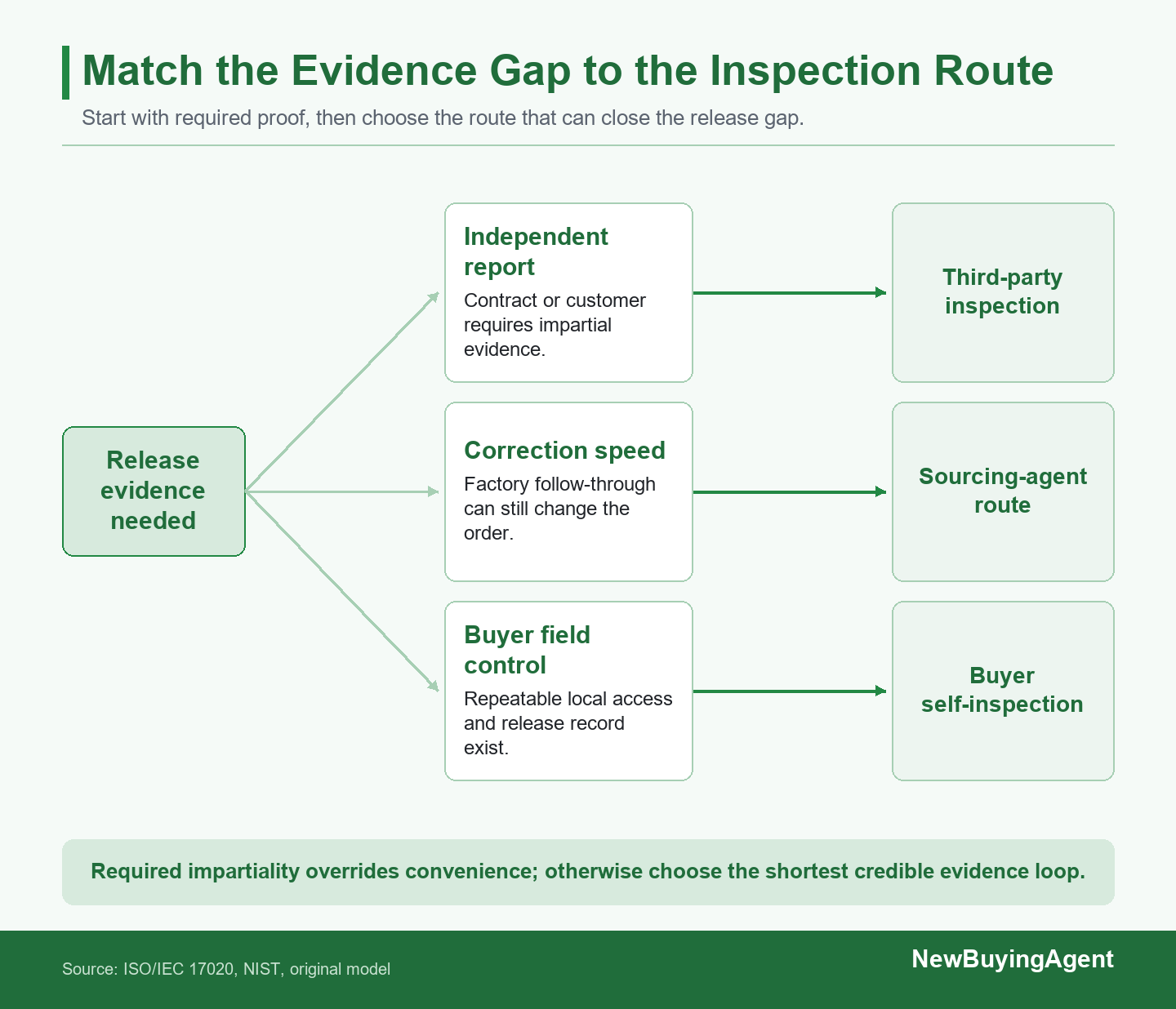
Start with the evidence that could block release, then choose the inspection route that can close that specific gap.
Side-by-Side Comparison by Evidence, Context, and Follow-Through
The practical difference is not “good inspection versus bad inspection.” The three routes allocate confidence differently: third-party inspection prioritizes impartial evidence, a sourcing-agent route prioritizes live production context and correction, and self-inspection prioritizes buyer-owned control. No column below is a promise of a result; it is a question the buyer must answer for the specific order.
| Decision dimension | Third party | Sourcing agent | Buyer self-inspection |
|---|---|---|---|
| Best fit | Independent report is required | Factory correction can still change the outcome | Buyer owns repeatable local capability |
| Primary strength | Separation from factory and buyer operations | Product context, local coordination, reinspection | Direct buyer control over method and release record |
| Main limitation | May not own correction follow-through | May not satisfy an independence requirement | Requires people, records, and authority the buyer controls |
| Evidence to specify | Report scope, lot, sample basis, findings | Approved reference, affected scope, correction proof, follow-up check | Checklist, trained representative, records, escalation path |
Based on this comparison, choose third-party inspection first when reliance on impartiality is non-negotiable. Choose a sourcing-agent route when the release decision depends on an active correction loop and no independent-report condition displaces it. Choose self-inspection only after the buyer can demonstrate that the people, method, records, and authority are already in place. The table is not a price comparison because a lower daily rate cannot repair an evidence gap.
Why a Good Inspector Can Still Produce a Weak Release Decision
Acceptance sampling means checking a random sample to decide whether to accept or reject a defined lot. It does not prove that every unit is defect-free, and it cannot make an undefined population release-ready. A buyer therefore needs the lot definition before the visit: which product revision, color or configuration, production window, cartons, and quantity does the decision cover? NIST’s acceptance-sampling guidance explains why the result is a lot decision rather than a whole-lot guarantee. Buyers with an established China supplier can also review factory-management support for existing China suppliers when local production follow-up is the missing control.
The buyer should therefore write the lot, product version, inspection timing, sample method, acceptance criteria, and consequence of a failure into the brief before the visit is booked. AQL-indexed sampling is not a number that travels alone. ISO 2859-1:2026 describes lot-by-lot attribute sampling schemes indexed by AQL, while NIST identifies lot size, inspection level, and AQL as inputs for selecting a sampling plan. ISO’s current ISO 2859-1 overview and NIST’s sampling-plan selection guidance support that instruction.
NIST's conformity-assessment glossary lists testing, inspection, and certification as activities that may all form part of conformity assessment. That is why a clean visual inspection does not automatically settle a product-specific test, certificate, label, or destination-market obligation. Put those evidence needs into the brief separately, then decide which inspection route can confirm the physical and documentary scope it is actually asked to check. NIST’s conformity-assessment definition provides the category boundary.
Illustrative Scenario: When a Sample Result Is Not Enough
The following composite example shows why a sample finding is not yet a release decision when the affected scope cannot be traced. It is an illustrative scenario, not a client result or a measured defect-rate study.
The Version-Control Gap Changes the Inspection Choice
The release decision is to hold the full 4,000-piece blue scope, not to label the entire 12,000-piece order defective and not to release the blue cartons on a generic pass.
A global home-goods buyer uses an existing China factory for a repeat drinkware accessory line and needs a release decision before a fixed shipping window.
An illustrative 12,000-piece order has three color variants, four carton-mark variants, and a ten-day shipping window.
The buyer approved a black-version sample, but packing began before every color-specific material record was reconciled.
Six of 80 checked blue units use a grip compound that differs from the approved black-version record.
The packing list identifies carton counts but cannot show which blue cartons contain the affected production run.
The finding is not only a sample-count problem. The buyer cannot identify the affected release population or prove that a factory correction reaches the relevant cartons. In this illustration, a sourcing-agent route is chosen because it can connect the approved sample, factory discussion, carton mapping, correction, and reinspection. An independent report would still take priority if the buyer’s contract required independent evidence.
Hold the 4,000-piece blue variant until the factory identifies affected cartons, restores the approved material, and provides a reinspection record tied to the revised packing list.
Freeze the blue cartons, reconcile material and carton records, replace the nonconforming grips, update the packing map, and reinspect the corrected blue scope.
Release only after approved-sample comparison, corrected material evidence, carton identifiers, and the reinspection result all describe the same 4,000-piece scope.
This is an illustrative composite scenario, not a universal release rule, destination-specific product-testing advice, or a substitute for product labeling requirements.
Set the Inspection Method Before the Factory Is Ready to Ship
Write the release decision into the inspection brief before the goods are ready. The brief should state the product and approved reference; the defined lot and packing readiness; the check items and sample method; defect and packaging criteria; required documents or test evidence; the corrective-action owner; and the person authorized to accept, hold, or release the goods. NIST’s plan-selection guidance is a reminder that lot size, inspection level, and the relevant plan rules are connected decisions, not a checklist of independent labels. NIST’s sampling-plan selection guidance is a useful reference for the sampling part of that brief.
- State whether independent evidence is mandatory.
- Map the release population before sampling begins.
- Name the correction owner and reinspection trigger.
- Choose the route that can produce the required evidence in time.
For a new China product request or an existing-factory order that needs those decisions built into one buyer brief, readers can send a complete inspection brief to NewBuyingAgent. The useful starting point is the purchasing requirement and release question, not a generic request for “a QC visit.”
Frequently Asked Questions
The same limits apply to every short answer below: an inspection route must match the release evidence needed, a sample is not a whole-lot guarantee, and product or destination requirements can add separate evidence duties.
Can a Sourcing Agent Replace Third-Party Inspection?
A sourcing agent’s inspection can replace a separate third-party visit only when no customer, contract, regulator, or dispute requirement calls for independent evidence. It can be the stronger operating choice when a buyer needs local factory communication, correction ownership, carton segregation, and a follow-up check before release. If an external party must rely on an impartial report, choose the independent route first and define its report scope.
Should Repeat Orders Rely Only on Factory Self-Inspection?
Repeat orders should rely only on buyer-owned self-inspection when the specification, records, local capability, and escalation path are proven across comparable lots. A factory’s own QC system can supply useful evidence, but it does not give the buyer independent field control. The more a release decision depends on version identity, packing traceability, or a rapid corrective loop, the less prudent it is to rely on an informal self-report.
Does AQL Prove Every Unit Is Defect-Free?
No, AQL-based sampling supports a lot-acceptance decision; it does not prove that every shipped unit is defect-free. A buyer still needs a defined lot, random or otherwise specified selection method, agreed criteria, and a disposition rule. Use sampling to make a bounded release decision, then add product testing, document checks, or full inspection where the product risk and agreement actually require them.
When Should Buyers Schedule Pre-Shipment Inspection?
Buyers should schedule pre-shipment inspection only when the defined lot is sufficiently complete to check the agreed product, packing, quantity, and release evidence. Book early enough to preserve time for isolation, rework, and reinspection, but do not inspect a moving target whose production or carton scope cannot yet be identified. The correct date follows the release decision and shipping deadline, not a calendar habit.
NewBuyingAgent
Related Resources

ابدأ اليوم
دعنا نحول أهداف التوريد الخاصة بك إلى واقعWeChat:+86 15157124615
WhatsApp:+86 15157124615
العنوان: مبنى 10 #39 طريق شيانغيوان، هانغتشو، الصين