

A/B test results should become a factory change request through a documented link between the tested difference, the product requirements and the approved production revision. Confirm what the experiment supports, check the economics, then specify what changes and what must remain unchanged. A page or price winner does not authorize an untested physical redesign. For a category director managing recurring China orders, protecting the winning variant means preserving its identity through sampling, purchasing, production and delivery.
Carry the Tested Difference Into a Controlled Revision
A winning experiment provides evidence within the conditions and differences actually tested. A controlled factory revision preserves that difference in an identified specification, assesses the commercial and downstream effects, and requires evidence that the revised goods meet the approved requirements. The change request connects those decisions, while a separate release identifies who has authorized which product version for the affected order or lot.
- Definition: An experiment variant is the tested experience or offer; a production revision is an identified product configuration.
- Risk: An attractive result can disappear when the factory changes a protected feature, mixes versions or adds costs the test did not consider.
- Decision: Carry the experiment record into a bounded request, obtain a feasibility response, verify the revised sample and authorize the production scope explicitly.
Establish What the Experiment Actually Proved
The experiment record determines which factory changes the result can support. It needs the hypothesis, variant identities, actual differences, assignment method, dates, market, primary metric, uncertainty and relevant guardrails, with links to the products or assets shown to customers. A listing-image, copy or price test can inform the offer, but it does not by itself establish the performance or suitability of a physical feature that customers never received or used.
The GOV.UK guide to A/B testing describes comparing versions and randomly splitting users to understand effects on behavior. Its examples concern digital-health interventions, so it provides experimental context rather than manufacturing acceptance criteria. For a commercial product test, preserve the equivalent essentials: who entered the test, how they were assigned, what each arm saw, and which outcome was measured under the planned analysis.
Record the experimental unit, such as a visitor or account, and the denominator behind each rate. Confirm that repeat visits, cross-device behavior, exclusions and order attribution follow the stated method. Check whether the test ran to its planned decision point and whether repeated checking or multiple comparisons were handled appropriately. Ask the experiment owner for the analysis and its uncertainty, not just the dashboard label saying that a version won.
The team also needs the guardrails that could reverse the buying decision: contribution, cancellations, returns, complaints, delivery performance and any relevant safety or compliance findings. A conversion result can mature before returns or product-use feedback does. Identify which outcomes remain unobserved and decide whether the next action is further learning, a bounded trial or a product-change proposal. That distinction prevents incomplete evidence from silently becoming a full purchasing commitment.
Microsoft Research's guidance on sample ratio mismatch describes a warning that observed allocation differs significantly from the configured split. Missing users, logging problems or biased filtering can change the apparent result, so the cause needs investigation before trusting the effect estimate. An unequal count is not automatically an error when the planned split was unequal; the check must compare observations with the intended allocation and account for sample size.
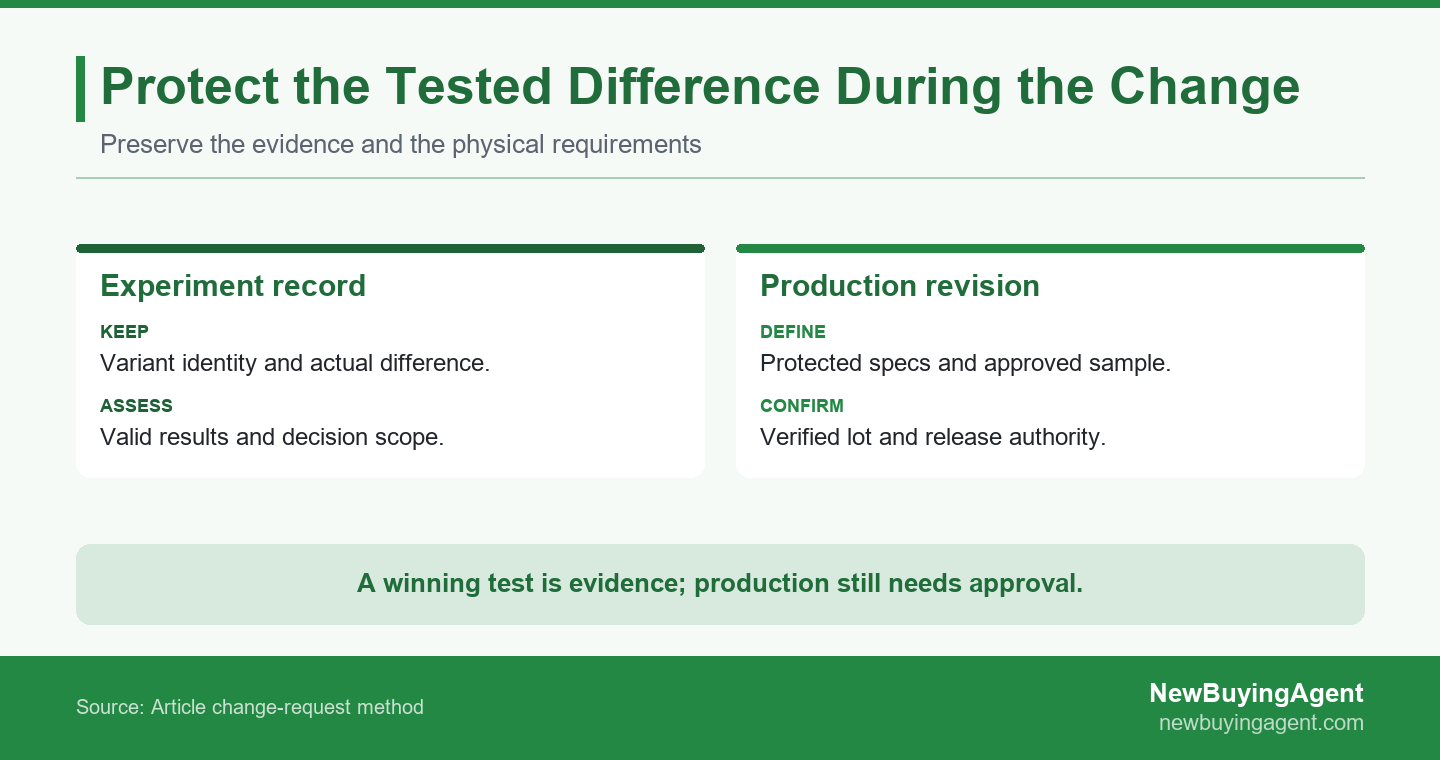
The tested difference must remain traceable from the experiment record to approved product requirements and verified production release
Map the Winning Feature to Product Requirements
The winning difference becomes usable for production when it is translated into a clear from/to requirement. The requirement identifies the attribute, its acceptable limits, the method used to check it, the approved reference and the surrounding features that must remain unchanged. A photograph or variant nickname can help explain intent, but it leaves too much unresolved to serve as the sole authority for a revised factory order. The following comparison maps four kinds of tested changes to the factory action each can support and the limit of that evidence.
| Tested | Supports | Factory action | Limit |
|---|---|---|---|
| Image/copy | Presentation choice | Keep product spec; control approved assets | No untested redesign |
| Price | Response to tested offer | Review commercial terms | No proof of quality |
| Real feature | Response to identified variant | Specify tested feature and unchanged traits | Check physical performance |
| Pack design | Response to tested pack | Control artwork and pack version | Verify protection and labels |
Based on this comparison, the change request should reach only as far as the evidence supports. If the winning image depicts a feature that was never manufactured, request a prototype and further validation before describing that feature as a proven product improvement. If customers received different real products, keep the test-to-product identity available for the later sample and production review.
Product identification needs its own decision. The GS1 GTIN Management Standard requires a new GTIN under its declared-formulation or functionality rule when the change affects legally required declared packaging information and the brand owner expects consumers or supply-chain partners to distinguish the difference; both conditions apply to that rule. Check all applicable identification rules and market requirements. An internal revision number neither determines nor replaces the GTIN decision.
When the evidence points to a different product direction, NewBuyingAgent's AI-assisted market-fit analysis and free Bestseller Market Analysis Report can inform candidate selection and design or style optimization. Request the report for the relevant products and use the resulting questions to shape the next test. That product-selection support does not establish experimental validity or prove that a proposed physical change will reproduce an earlier commercial result.
Check the Commercial Case Before Requesting Production
A conversion winner is commercially attractive only when its incremental value survives the revised product and implementation costs. The comparison needs a consistent population, outcome definition and cost basis, plus explicit treatment of setup, inventory and quality exposure. Descriptive lift is useful for screening the proposal, but it cannot replace a valid experiment analysis or establish the volume that should be ordered from the factory.
Consider a hypothetical tote-bag test in which each arm has 10000 eligible visitors and each converting visitor places one completed, fulfilled order. A records 400 orders and B records 460 orders, giving conversion rates of 4.0% and 4.6%. The difference is 0.6 percentage points, or a 15% relative lift. These are illustrative descriptive results, not a claim of statistical significance, stable demand or a client outcome.
NIST's discussion of practical and statistical significance explains that statistical detectability depends on sample size and does not by itself establish practical importance. The buyer should therefore ask both whether the estimated effect is supported by the experiment and whether its plausible range changes the product decision. A nominal winner with uncertain economics may justify a limited learning step rather than an immediate change to every open purchase order.
Assume net variable contribution per fulfilled order is USD 10 for A and USD 9 for B, after all relevant variable costs and return allowances, with an additional USD 500 one-time setup cost for B. A contributes USD 4000 and B contributes USD 4140 before setup, an incremental USD 140. After setup, the incremental result is negative USD 360. The higher conversion rate has not covered the initial setup within this illustrative comparison.
| Measure | Variant A | Variant B |
|---|---|---|
| Eligible visitors | 10000 | 10000 |
| Fulfilled orders | 400 | 460 |
| Conversion | 4.0% | 4.6% |
| Net variable contribution/order | USD 10 | USD 9 |
| Contribution before setup | USD 4000 | USD 4140 |
| Additional setup | None assumed | USD 500 |
The assumptions make the decision conditional. Setup may support later orders, but later traffic and persistence of the lift still need a defensible forecast. Include MOQ-driven stock, changed packing or transport costs, lead time and old-material exposure where they apply. Keep costs already included in net contribution out of the additional-cost line so the same expense is not counted twice.
Suppose the two real tested tote variants differ only in an internal slip pocket, and customers received the corresponding version. The request should preserve the pocket's approved size, location, material and construction, together with unchanged bag features. This is evidence about the tested offer under its conditions. A factory proposal to alter the pocket or substitute its material creates a deviation to assess; it is not automatically equivalent to the version that performed better.
Write a Factory Change Request With Clear Boundaries
A useful factory change request identifies the current agreed product version, the requested differences and the authority needed to approve them. It separates the commercial reason from the measurable production requirements, then asks the supplier to report feasibility, cost, timing and affected stock. Its status remains a proposal until the designated owners accept the revised scope and the evidence required for release.
A baseline is the agreed product version against which a change is assessed. NASA's configuration-management guidance describes documented baselines and the evaluation, approval, implementation and tracking of changes. Its aerospace procedures are specific to that setting; the transferable lesson for a consumer-product buyer is to identify the approved starting point and control what replaces it. A factory does not need NASA boards or flight procedures to use that discipline.
The following fields form a copyable request. Attach the controlled documents rather than relying on a chat thread to carry the specification. Give the supplier a response date and ask it to flag any proposed alternative explicitly, including a price or timing improvement that changes a protected requirement.
| Field | Enter in the request | Evidence or response |
|---|---|---|
| ID and status | Change ID: ___; requester: ___; status: proposal | Named buyer decision owner |
| Evidence | Experiment ID: ___; accepted conclusion: ___; scope: ___ | Analysis, variant assets and product identities |
| From / to | Current revision: ___; proposed revision: ___; changed attributes: ___ | Marked drawing, material list and specification |
| Protected traits | Unchanged features: ___; approved references: ___ | Measurement method and acceptable limits |
| Factory impact | Cost: ___; MOQ: ___; tooling/material: ___; lead time: ___ | Supplier feasibility and deviation response |
| Verification | Checks: ___; sample identity: ___; acceptance owner: ___ | Agreed methods, conditions and results |
| Version switch | First PO/lot: ___; old stock/material disposition: ___ | Segregation, labels and affected document list |
| Approval | Sample approval: ___; production release: ___; effective version: ___ | Written authority and release conditions |
For the tote example, the marked specification would identify the pocket and its position relative to agreed reference points. It would also retain the approved fabric, bag dimensions, handle construction and other unchanged requirements. Define tolerances and test conditions through the product team and supplier review; a marketing result does not supply those engineering values. Record any unresolved point as open rather than allowing the factory to choose an undocumented interpretation.
The supplier response should identify who can make the revision, which process or material changes are involved, and what must be approved before work begins. Procurement can then accept the commercial terms, the product owner can approve the specification, and the quality owner can agree the checks. A request marked urgent still needs an explicit answer on whether existing orders continue unchanged, pause or move to the revised scope.
Verify the Revision and Control the First Release
The revised product is ready for release when identified evidence shows that it meets the approved requirements and the authorized version switch is clear. Sample approval, production authorization and shipment release can have different owners and conditions, so one acceptance should not silently stand for all of them. Old stock, work in progress, dedicated materials and customer-facing information must follow the same version decision.
NASA's product-verification guidance connects conformity evidence to specified requirements, acceptance criteria and the version of the product checked. The applicable lesson is to keep those links in the buyer's own verification record. It is not a claim that a consumer product needs NASA certification. A passing result on an unidentified sample cannot establish which later production revision was accepted.
Check the revised sample against the agreed drawing, material list, construction details and approved reference. Include functional, workmanship, packing and market-specific checks affected by the change. A successful dimensional check does not establish pocket strength, durability or suitability for every use. If verification reveals a deviation, record its effect, agree the correction or authorized disposition, and obtain the necessary evidence before releasing the affected requirement.
Define the first affected purchase order or lot and confirm when the old instruction stops applying. Update the relevant production, inspection, packing and labeling documents, remove obsolete working copies, and distinguish old and new goods in stock and fulfillment records. Decide whether old material will be used, reworked, held or discarded, with approval and cost ownership recorded. Do not mix configurations under a vague instruction to use the latest sample.
For a buyer keeping an established China supplier, NewBuyingAgent's factory management in China provides a relevant execution path. Its local supplier communication, production progress and quality management, staged inspections and logistics coordination can support an agreed revision scope. Product and QC capability helps connect the approved requirements to factory follow-up; the actual engineering approvals and verification responsibilities still need to be assigned for the product and order.
To discuss local execution, share the factory change scope with the product specification, quantity, destination, timing, current supplier situation and approved variant references. Identify the from/to requirements, open deviations and intended first release. After launch, review commercial outcomes and quality feedback by product version so the team can tell whether the factory preserved the approved change and whether the business result persists.
Frequently Asked Questions
Can an inconclusive test justify a factory trial?
An inconclusive test can justify a bounded learning trial when the unresolved question, budget and approval scope are explicit. Define what the trial should establish, which product version will be made and what evidence would support the next decision. Do not label it a proven winner or authorize wider production by implication. Factory feasibility and product requirements still need review even when the immediate goal is learning.
Can the factory improve the winning variant while implementing it?
A supplier can propose an improvement, but it should be assessed as a deviation before it replaces the tested requirement. Ask what changes, why, and how the alternative affects appearance, function, cost, timing and applicable requirements. Compare it with the approved reference and obtain the necessary evidence and approvals. If the change alters the feature associated with the result, further commercial or user validation may also be needed.
Should the change request be translated for the factory?
A shared working-language version can help execution when it preserves the same controlled requirements and approval status. Keep document IDs, units, reference points and revision labels consistent, and resolve conflicting wording before approval. Use marked drawings and sample references alongside text where helpful. Identify which version governs if translations differ, and ask the factory to confirm its understanding of the protected attributes and release conditions.
What happens if the new production version underperforms?
A defined review and rollback plan should use version-specific commercial, quality and inventory evidence. Identify who decides, which orders and goods are affected, and whether reverting requires renewed product, market or supplier checks. Keep old and new stock traceable; a weaker marketing result does not automatically make the earlier configuration safe or eligible for sale. Document the accepted disposition instead of switching versions informally.
NewBuyingAgent
موارد ذات صلة



ابدأ اليوم
دعنا نحول أهداف التوريد الخاصة بك إلى واقعWeChat:+86 15157124615
WhatsApp:+86 15157124615
العنوان: مبنى 10 #39 طريق شيانغيوان، هانغتشو، الصين
