

Introduction
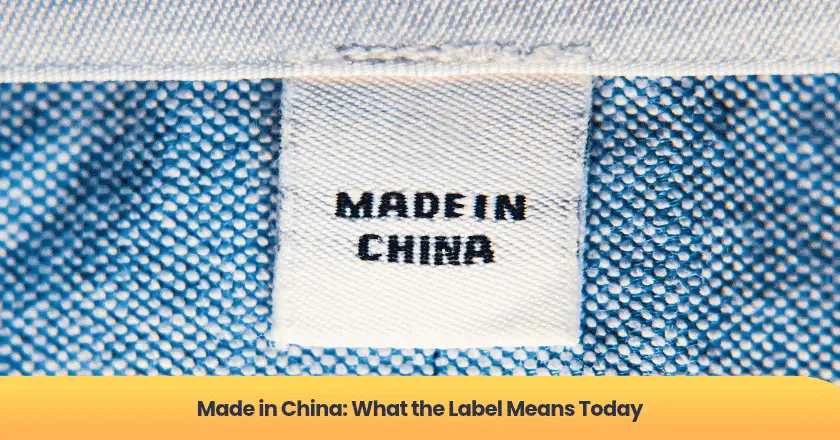
A buyer approves the packaging artwork, the factory prints a full production run, and the shipment reaches a US port with "Made in PRC" on every unit. Nothing is wrong with the goods. The label is. Re-marking under customs supervision costs time and storage fees, all because of three letters nobody questioned.
"Made in China" is printed on so many products that most people no longer see it. For an importer, it is still a legal statement with rules about what qualifies, how it must appear and what else on the package can contradict it. It says far less about quality than shoppers assume and far more about compliance than many buyers realise.
Key Takeaways
· Country of origin is a legal finding based on where goods were made or last substantially transformed, not where they were shipped from.
· US-bound goods must show the English name of the country, and US customs has repeatedly rejected "PRC" on its own.
· Wording such as "Designed in California" can trigger a requirement to place the origin mark close by and at a comparable size.
· The label describes geography rather than quality, so the factory and its checks still decide what you receive.
· Origin marking belongs in the purchase order and the pre-shipment inspection, because fixing it at the port is the expensive option.
Origin Is a Legal Finding, Not a Shipping Address
The phrase reads like a simple fact. Customs authorities treat it as a conclusion that has to be supported.
What "country of origin" actually means
Under US customs regulations, the country of origin is the country of manufacture, production or growth of an imported article. When work happens in more than one country, a later country only becomes the origin if the work there amounts to a substantial transformation (processing that turns materials into a new article with a different name, character or use). Repacking, relabelling and sorting typically do not meet that bar.
This is why a carton shipped from a third country can still contain Chinese-origin goods. The port of loading, the exporter's address and the invoice do not decide origin. The manufacturing history does.
When components come from several countries
A Bluetooth speaker might use a chip from one country, a battery from another, and a housing moulded and assembled in Guangdong. Where assembly there genuinely creates the finished article, origin typically follows that country, but borderline assembly cases are decided on their facts.
Where the answer is not obvious, an importer can request a binding ruling from CBP (U.S. Customs and Border Protection, the federal agency that clears goods entering the US) before the goods ship.
Expert Tip: Ask the factory for a simple bill of materials showing where each major component is made, even when the product looks entirely Chinese. It turns origin from an assumption into a record, and it is the first document a customs broker will want if the origin is ever questioned. Buyers who ask early rarely have to reconstruct the answer under pressure.
How the Mark Must Appear on US-Bound Goods
US rules care about where the mark sits and how it is written, not only whether it exists.
The four physical requirements
Section 304 of the Tariff Act and 19 CFR Part 134 (the US customs regulations on country-of-origin marking) require most imported articles to be marked so that the ultimate purchaser (generally the last person in the US who receives the article in the form in which it was imported) can find and read the origin. When reviewing a sample, check four things.
· The marking must be legible, so a buyer can read it without effort.
· The marking must be indelible, so it survives normal handling and does not rub off in transit.
· The marking must be as permanent as the nature of the article allows, which usually means moulded, engraved, sewn in or printed rather than a loose sticker.
· The marking must be conspicuous, placed where a buyer would reasonably expect to look.
Some articles are excepted and can be marked on their container instead, but the exceptions are specific and should be confirmed rather than assumed. Goods that are not properly marked at import can be re-marked, exported or destroyed under customs supervision. If none of that happens, US law imposes an additional 10 percent marking duty on the article.
Why "Made in PRC" fails at US customs
PRC is the official abbreviation for the People's Republic of China, and many Chinese factories print it by default. US regulations accept abbreviations only when they unmistakably indicate the country. CBP has repeatedly found that "PRC" alone does not meet that standard, while "China" and "P.R. China" do. A 2015 ruling, N262161, answered exactly this question for a supplier whose US customer wanted to switch from "Made in China" to "Made in PRC". The answer was no. The same reasoning runs through the wider labelling and origin rules for Chinese imports.
The "Designed in California" trap
Section 134.46 of the same regulations adds a rule many brands miss. If a US place name, the words "USA" or "American", or the name of another country appears on the article or its container and could mislead the buyer, the real origin must appear in close proximity. It must be at least comparable in size and preceded by "Made in", "Product of" or similar words. A front panel reading "Designed in California" with a tiny "Made in China" on the base is a layout that needs rethinking.
Common Mistake to Avoid: Letting the factory's standard carton artwork stand in for your own. Many suppliers reuse templates printed with "Made in PRC", a Chinese-language origin line or no origin at all. Approve the origin wording, its placement and its size as a separate line on the artwork proof, the same way you approve the logo.
Outside the US: EU Origin and Seller Labelling in 2026
Origin rules are set market by market.
The EU's "last substantial processing" test
For non-preferential purposes (the default origin used for the general tariff and trade measures, rather than for free trade agreements), the EU's Union Customs Code assigns origin to the country where goods underwent their last, substantial, economically justified processing or working. That processing must produce a new product or represent an important stage of manufacture. EU rules list minimal operations that never confer origin, including repacking, putting goods up in sets and affixing marks or labels.
The EU approach starts at the customs declaration rather than the label. Non-preferential origin is a mandatory element of every declaration for release into free circulation, so the importer has to state it whatever the packaging says.
Manufacturer details now sit beside the origin
In 2026, sellers into the EU are working under the General Product Safety Regulation (GPSR, Regulation (EU) 2023/988), which has applied since 13 December 2024. It requires manufacturers to show their name or registered trade mark and a postal and electronic address on the product, or on the packaging where that is not possible. Online offers must show the manufacturer's details too, plus a responsible person in the EU where the manufacturer is based outside it. A bare "Made in China" line with no traceable manufacturer behind it no longer satisfies many EU sales channels.
Expert Tip: Build one origin and identity panel for each destination market rather than one universal label. A US version needs the English country name where buyers look, and an EU version also needs the manufacturer's identity and contact details. Getting the factory to print market-specific versions costs very little at the artwork stage. Splitting a single print run later usually means stickers, rework and a second inspection.
What the Label Says About Quality Today
Many consumers still read "Made in China" as a quality signal. Experienced buyers read it as a location.
One label, very different factories
The same three words cover a large contract manufacturer producing for global brands and a small workshop running on second-hand equipment. The label tells you where the product took shape. It tells you nothing about process control, the materials specified or how strictly the order was checked.
What actually predicts quality
Here's the thing. Quality comes from the specification, the factory's capability and the checks between them. A written product specification, an approved golden sample (the signed-off reference unit that production is measured against) and in-line QC (quality control carried out during production rather than only at the end) decide far more than the country printed on the base.
A pre-shipment inspection (a check of finished, packed goods before the balance payment and loading) closes the loop. When a Chinese-made order disappoints, the cause can usually be traced to a gap in one of those steps rather than to the country itself.
Common Mistake to Avoid: Using the origin label as a stand-in for supplier vetting. Some buyers accept weak samples because "that is what Chinese products are like", while others assume a factory is reliable because a famous brand's goods carry the same label. Both assumptions skip the work that protects you: a factory audit, a written specification and an inspection standard agreed before production starts.
Writing Origin Marking Into the Order
Most marking problems are created at the artwork stage and discovered at the port. Moving the check earlier is cheap.
What to put in the purchase order
Treat origin marking as a product specification, written into the order.
· The exact wording for each destination market, such as "Made in China" for US-bound goods should be stated rather than left to the factory.
· The location and method of marking on the article itself should be specified, with a minimum text size agreed on the artwork.
· The wording and placement on retail packaging and export cartons should be listed separately.
· The person who approves the final proof should be named, and any later change to origin wording should require written sign-off.
Checking it before the goods leave
Add marking to the pre-shipment inspection checklist. The inspector should confirm wording, placement and permanence on a sample of units, including a simple rub test on printed marks. If the product carries a US place name or a "Designed in" line, the inspector should also confirm the origin mark sits close by at a comparable size.
Worth knowing: an inspection report with clear photos of the marking is useful evidence if a shipment is questioned later.
Expert Tip: Ask the factory to send a close-up photo of the origin mark on the first units off the production line, not just on the approved sample. Samples are often hand-finished. A wrong mould insert or a print plate reused from an older order shows up immediately in that first photo, while there is still time to correct the run.
Getting the Label Right at the Factory: How NewBuyingAgent Helps
A correct origin mark is a small detail that depends on how closely a factory follows your instructions. NewBuyingAgent is your perfect partner for global sourcing from China, backed by 30 years of expertise in trade, manufacturing and quality control.
Buyers who deal with factories directly often face communication barriers, blocked by language, region, time zone and cultural gaps, and factories do not always offer full cooperation. NewBuyingAgent handles all factory communication, and its local reputation gets you full factory cooperation. Through its sourcing services, you can use 50,000+ cooperated partner factories with no language, region or time zone barriers, compared with the less than 5% of China's factories within reach of most direct buyers.
Quality uncertainty is the other pain point a label cannot solve. 20,000+ product development and QC experts ensure your products match market needs and stay high-quality. Even with its margin included, NewBuyingAgent cuts costs by 5%-10% compared with direct sourcing, and it can supply products from China across all categories at better price, quality and service. See how it manages your supply chain.
Frequently Asked Questions
Does "Made in China" mean a product is low quality?
No. The label identifies the country where the product was made or last substantially transformed, not a quality grade. Factories in China range from basic workshops to plants producing for well-known global brands. Quality is set by your specification, the factory you choose and the inspections you run.
Is "Made in PRC" the same as "Made in China"?
Both refer to the People's Republic of China. For goods entering the US, CBP has repeatedly ruled that "PRC" alone is not an acceptable origin marking, while "China" and "P.R. China" are. Use "Made in China" on US-bound goods unless your customs broker advises otherwise for a specific product.
Does shipping goods through another country change their origin?
Not on its own. Origin follows where the goods were made or substantially transformed, not where they were loaded or transhipped. Repacking, relabelling or other simple operations in a third country typically do not change origin under US or EU rules.
Can I drop "Made in China" if I add my own brand label in the US?
Generally no, if the article reaches the ultimate purchaser in the form in which it was imported. Adding a brand label is not a substantial transformation, so the original marking requirement remains. If your brand label adds a US address or the word "USA", the origin mark must also sit close by at a comparable size.
Conclusion
The words on the base of a product are a legal statement about where it was made, and they are only as reliable as the process behind them. Confirm origin from the manufacturing history, write the exact wording into the order for each market, and check the mark on production units before the balance is paid. Quality is a separate question, answered by the factory and its checks. If coordinating those details across suppliers is taking more time than it should, a conversation with NewBuyingAgent about making China sourcing simpler and more profitable is a sensible next step.
Sources
1. 19 CFR Part 134 – Country of Origin Marking (incl. §134.1 definitions, §134.2 additional duties, §134.35, §134.45 approved markings, §134.46 proximity rule) – eCFR — https://www.ecfr.gov/current/title-19/chapter-I/part-134
2. CBP Ruling NY N262161 – The country of origin marking of products from China – CBP CROSS — https://rulings.cbp.gov/ruling/N262161
3. Guidance on Non-Preferential Rules of Origin (Union Customs Code Art. 60 and UCC-DA Art. 34) – European Commission — https://taxation-customs.ec.europa.eu/system/files/2022-03/Guidance%20on%20non-preferential%20rules%20of%20origin.pdf
4. Regulation (EU) 2023/988 – General Product Safety Regulation – EUR-Lex — https://eur-lex.europa.eu/eli/reg/2023/988/oj
5. New Buying Agent in China | NewBuyingAgent — https://www.newbuyingagent.com/
NewBuyingAgent
Похожие материалы

Начните сегодня
Давайте превратим ваши цели по закупкам в реальностьWeChat:+86 15157124615
WhatsApp:+86 15157124615
Адрес: Здание 10 #39 Xiangyuan Road, Ханчжоу, Китай
